
____ are defined as costs which are incurred regardless of the alternative action chosen
in a decision-making problem.
a. Opportunity costs
b. Marginal costs
c. Relevant costs
d. Sunk costs
e. None of the above
The form of economics most relevant to managerial decision-making within the firm is:
a. macroeconomics
b. welfare economics
c. free-enterprise economics
d. microeconomics
e. none of the above
When borrowers who do not intend to repay are able to hide their bad credit histories, a
lender’s well-intentioned borrowers should
a. complain to regulatory authorities
b. withdraw their loan applications
c. offer more collateral in exchange for lower interest charges
d. divulge still more information on their loan applications
e. hope for a pooling equilibrium

Vertical integration may be motivated by all of the following except:
a. Upstream market power
b. Economies of ever wider spans of managerial control
c. Technological interdependencies
d. Reduced search and bargaining cost
e. The hold-up problem.
Mac trucks and their dealers would likely have an organizational form of
a. fixed profit sharing franchise contracts
b. spot market recontracting
c. alliances
d. vertical integration
The level of an economic activity should be increased to the point where the ____ is
zero.
a. marginal cost
b. average cost
c. net marginal cost
d. net marginal benefit
e. none of the above

The standard deviation of the error terms in an estimated regression equation is known
as:
a. coefficient of determination
b. correlation coefficient
c. Durbin-Watson statistic
d. standard error of the estimate
e. none of the above
Simplified trend models are generally appropriate for predicting the turning points in an
economic time series.
a. true
b. false
A ____ total cost function implies that marginal costs ____ as output is increased.
a. linear; increase linearly
b. quadratic; are constant
c. cubic; increase linearly
d. linear; are constant

e. none of the above
The Coase Theorem works best in places that transaction costs for contracts among
people is low. Often in the world of torts and externalities both parties can claim that
they have rights to impose on others. One case is that of a railroad that is noisy and
scares the cattle and the rancher whose cattle sometimes wander in front of moving
trains causing damage to them and the train. What does the Coase say would happen?
a. The train should have property right to be safe from wandering cattle, and the rancher
should be liable for train damage of rampaging cattle.
b. The rancher should have the property right to be safe from noisy trains, and the
railroad should be liable for weight loss of cattle from train whistles and rumbling
noise.
c. If transaction costs are low, the efficient activity will occur, either the rancher or
railroad installing fences to protect from rampaging cattle and/or sound insulation with
trees, or if it is cheaper, fewer train trips per day. The cheapest or most efficient solution
will happen, regardless of who is assigned the original property right.
The chain store paradox of an incumbent who accommodates a finite stream of
potential entrants threatening to enter sequentially numerous markets illustrates
a. backwards induction
b. the unraveling problem
c. subgame perfect equilibrium
d. best reply responses
e. all of the above

The estimated slope coefficient (b) of the regression equation (Ln Y = a + b Ln X)
measures the ____ change in Y for a one ____ change in X.
a. percentage, unit
b. percentage, percent
c. unit, unit
d. unit, percent
e. none of the above
The law of diminishing marginal returns:
a. states that each and every increase in the amount of the variable factor employed in
the production process will yield diminishing marginal returns
b. is a mathematical theorem that can be logically proved or disproved
c. is the rate at which one input may be substituted for another input in the production
process
d. none of the above
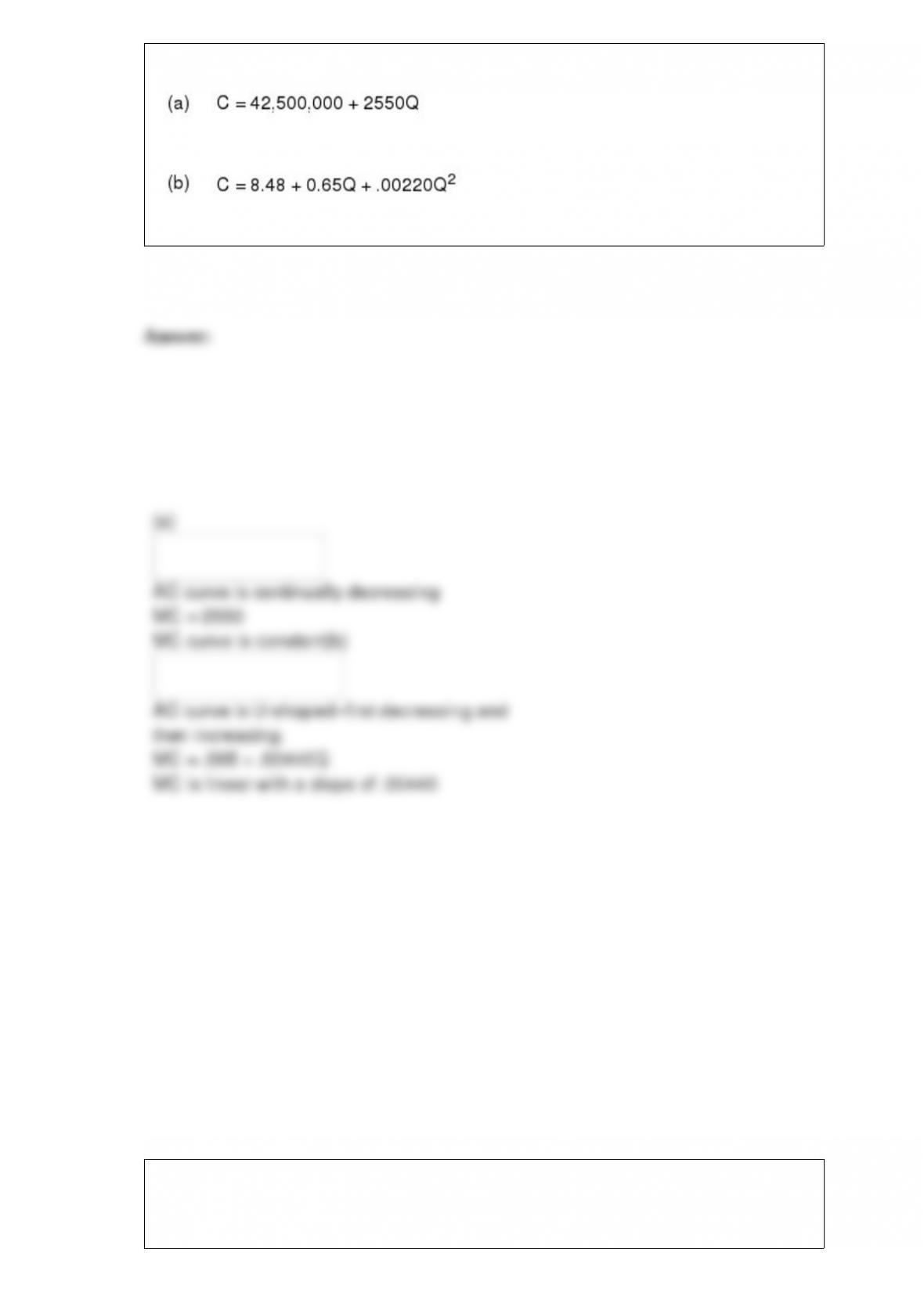
For each of the following cost-output relationships, describe the shape (U-shape,
decreasing, increasing, constant) of the average total cost and marginal cost functions
(C = total cost, Q = output):
Identify the reasons why the quantity demanded of a product increases as the price of
that product decreases.
a. as the price declines, the real income of the consumer increases

b. as the price of product A declines, it makes it more attractive than product B
c. as the price declines, the consumer will always demand more on each successive
price reduction
d. a and b
e. a and c
Receiving $100 at the end of the next three years is worth more to me than receiving
$260 right now, when my required interest rate is 10%.
a. True
b. False
The isoquants for inputs that are perfect complements for one another consist of a series
of:
a. right angles
b. parallel lines
c. concentric circles
d. right triangles
e. none of the above
The presence of association between two variables does not necessarily imply causation
for the following reason(s):
a. the association between two variables may result simply from pure chance
b. the association between two variables may be the result of the influence of a third
common factor
c. both variables may be the cause and the effect at the same time
d. a and b
e. a, b, and c