1)
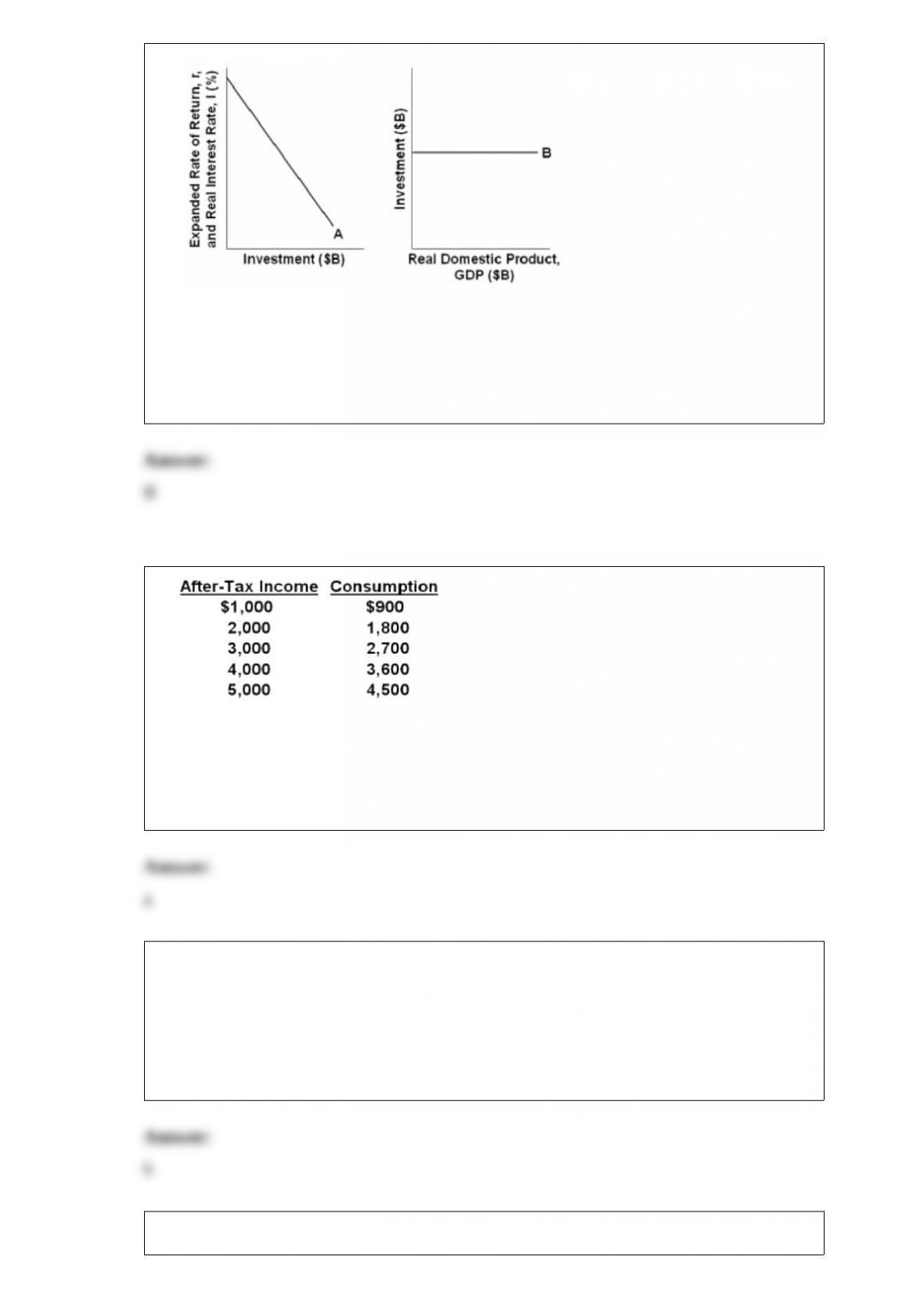
Refer to the above diagrams. Curve A:
A.is an investment schedule and curve B is a consumption of fixed capital schedule.
B.is an investment demand curve and curve B is an investment schedule.
C.and B are totally unrelated.
D. shifts to the left when curve B shifts upward.
2)
the above data suggest that:
a.a policy of tax reduction will increase consumption.
b.a policy of tax increases will increase consumption.
c.tax changes will have no impact on consumption.
d.after-tax income should be lowered to increase consumption.
3) moving upward on a downward-sloping straight-line demand curve, we find that
price elasticity:
a.is constant.
b.increases continuously.
c.decreases continuously.
d.may either increase or decrease.
4) In a labor market characterized by bilateral monopoly the wage rate will:
A.be logically indeterminate.
B.be established at the level desired by the union.
C.be established at the level desired by the employer.
D.always be established at the competitive level.
5) daily newspapers are relatively inexpensive because:
a.total variable costs and total fixed costs are low.
b.the overhead costs are spread over a large number of buyers.
c.capital has replaced virtually all labor used to produce a newspaper.
d.government subsidizes their production in most major cities.
6)
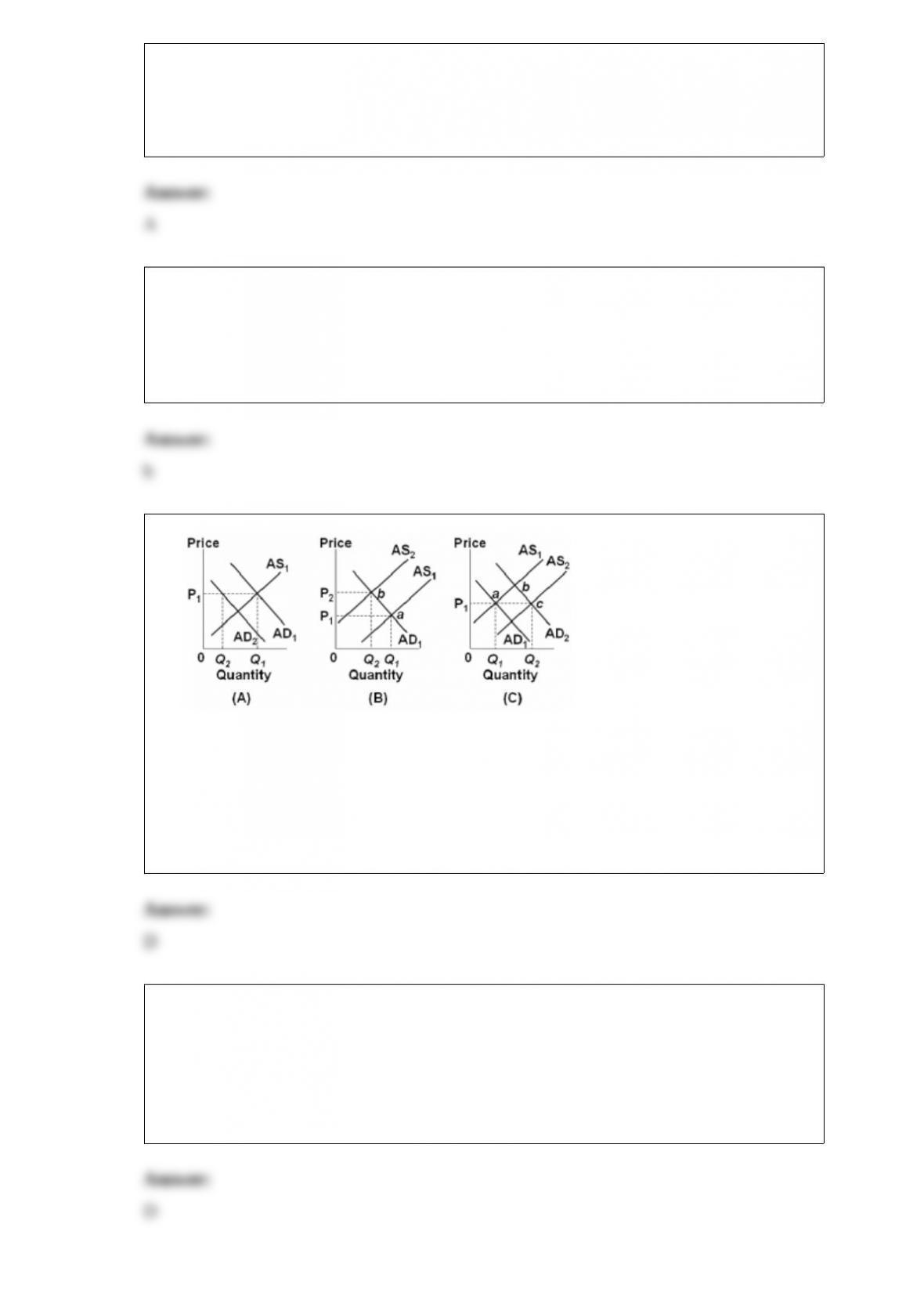
Refer to the above diagrams, in which AD1 and AS1 are the “before” curves and AD2
and AS2 are the “after” curves. A recession is depicted by:
A.panel (A) only.
B.panel (B) only.
C.panel (C) only.
D.panels (A) and (B).
7) A particular woman is denied on-the-job training because women on average are
more likely to drop out of the workforce than men. This illustrates:
A.occupational segregation.
B.the crowding model.
C.the taste-for-discrimination model.
D.statistical discrimination.

8) the following is cost information for the creamy crisp donut company:
entrepreneur’s potential earnings as a salaried worker = $50,000
annual lease on building = $22,000
annual revenue from operations = $380,000
payments to workers = $120,000
utilities (electricity, water, disposal) costs = $8,000
value of entrepreneur’s talent in the next best entrepreneurial activity = $80,000
entrepreneur’s forgone interest on personal funds used to finance the business = $6,000
refer to the above data. creamy crisp’s economic profit is:
a.$150,000.
b.$80,000.
c.$230,000.
d.$94,000.
9) the general agreement on tariffs and trade (gatt) is based on the principle of:
a.establishing a single international currency.
b.tariff reductions through multilateral negotiations.
c.converting tariffs to import quotas.
d.establishing common environmental and labor standards for all member nations.
10) refer to the above data sets. the equation for data set 5 is:
a.v = .5y.
b.u = -.5v.
c.u = v.
d.v = 2u.
11)
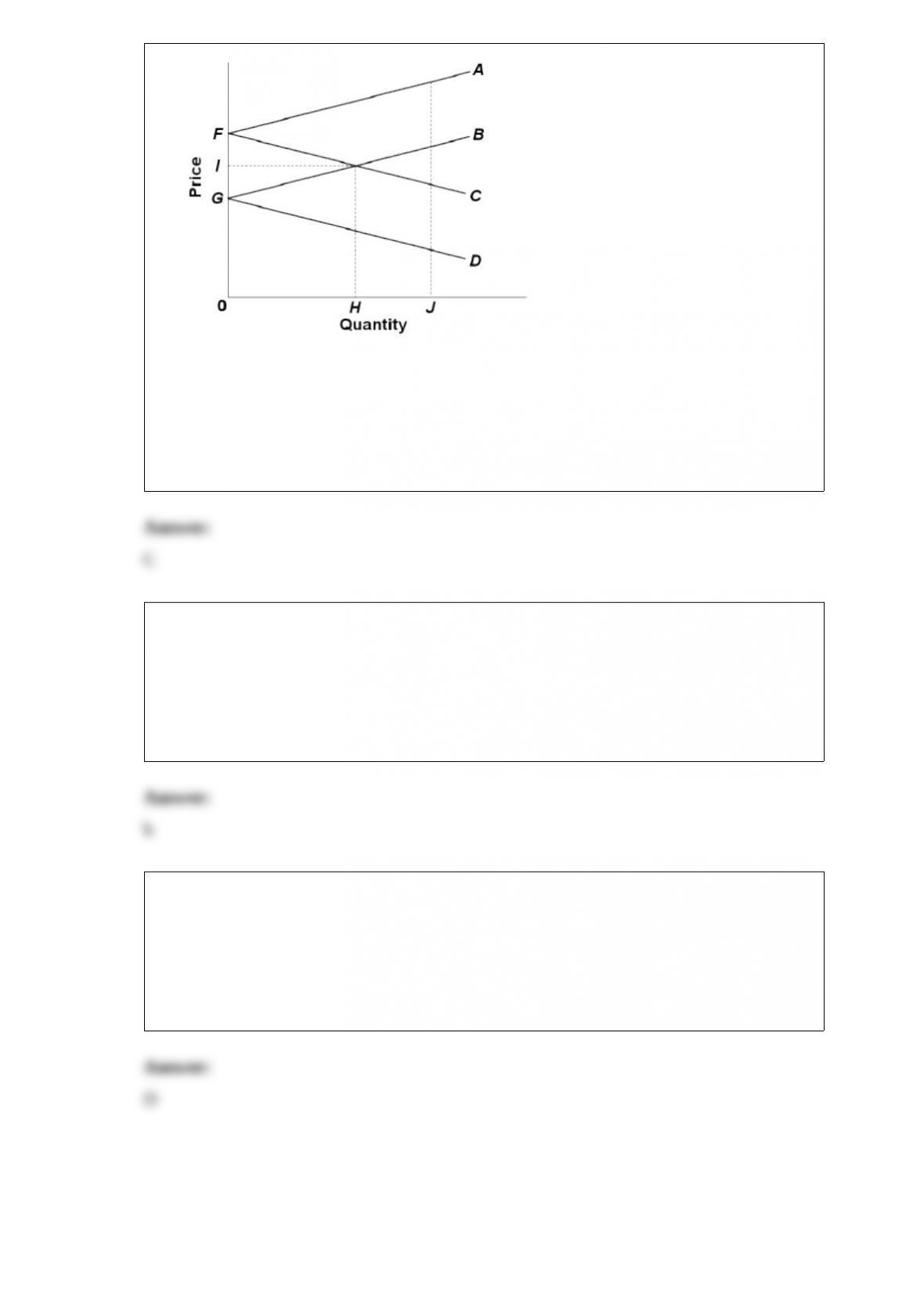
Refer to the above diagram pertaining to two nations and a specific product. Lines FC
and GD are:
A.domestic supply curves for two countries.
B.domestic demand curves for two countries.
C.import demand curves for two countries.
D.export supply curves for two countries.
12) if in some year gross investment was $120 billion and net investment was $65
billion, then in that year the country’s capital stock:
a.may have either increased or decreased.
b.increased by $65 billion.
c.increased by $55 billion.
d.decreased by $55 billion.
13) The labor supply curve facing a purely competitive employer is __________
whereas the labor supply curve facing a monopsonist is ___________.
A.upward sloping; horizontal
B.downward sloping; vertical
C.vertical; upward sloping
D.horizontal; upward sloping
14)
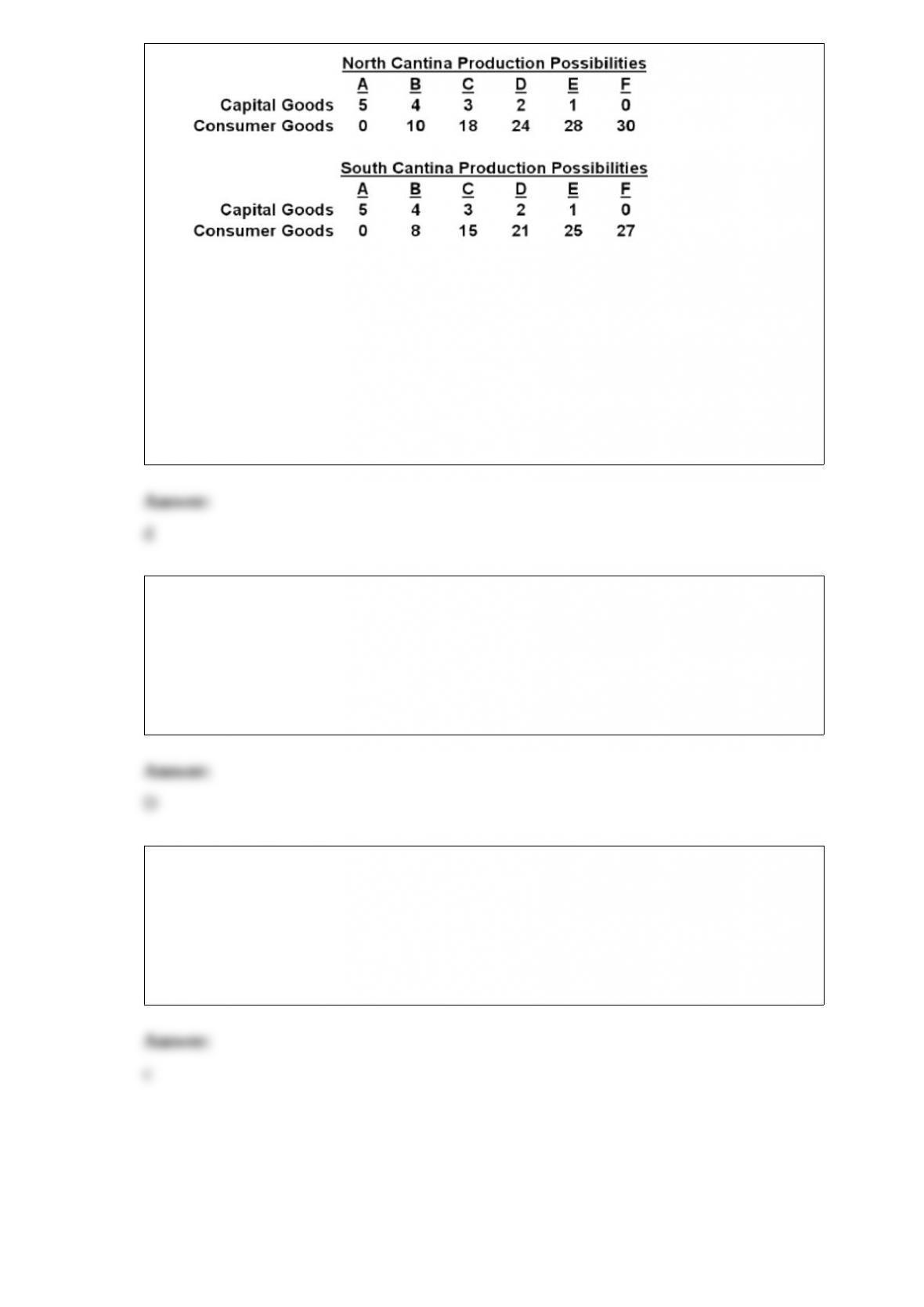
refer to the above tables. suppose that resources in north cantina and south cantina are
identical in quantity and quality. we can conclude that:
a.south cantina has better technology than north cantina in producing both capital and
consumer goods.
b.north cantina has better technology than south cantina in producing both capital and
consumer goods.
c.north cantina is growing more rapidly than south cantina.
d.north cantina has better technology than south cantina in producing consumer goods,
but not capital goods.
15) Firm ABC designs and implements a lower-cost method of producing its product.
This is an example of:
A.product innovation.
B.the inverted U-theory.
C.economies of scale.
D.process innovation.
16) if a consumer chooses a combination of goods that lies inside of her budget line, the
consumer:
a.is maximizing utility.
b.is spending in excess of her current income.
c.could obtain more goods with her money income.
d.has upsloping indifference curves.
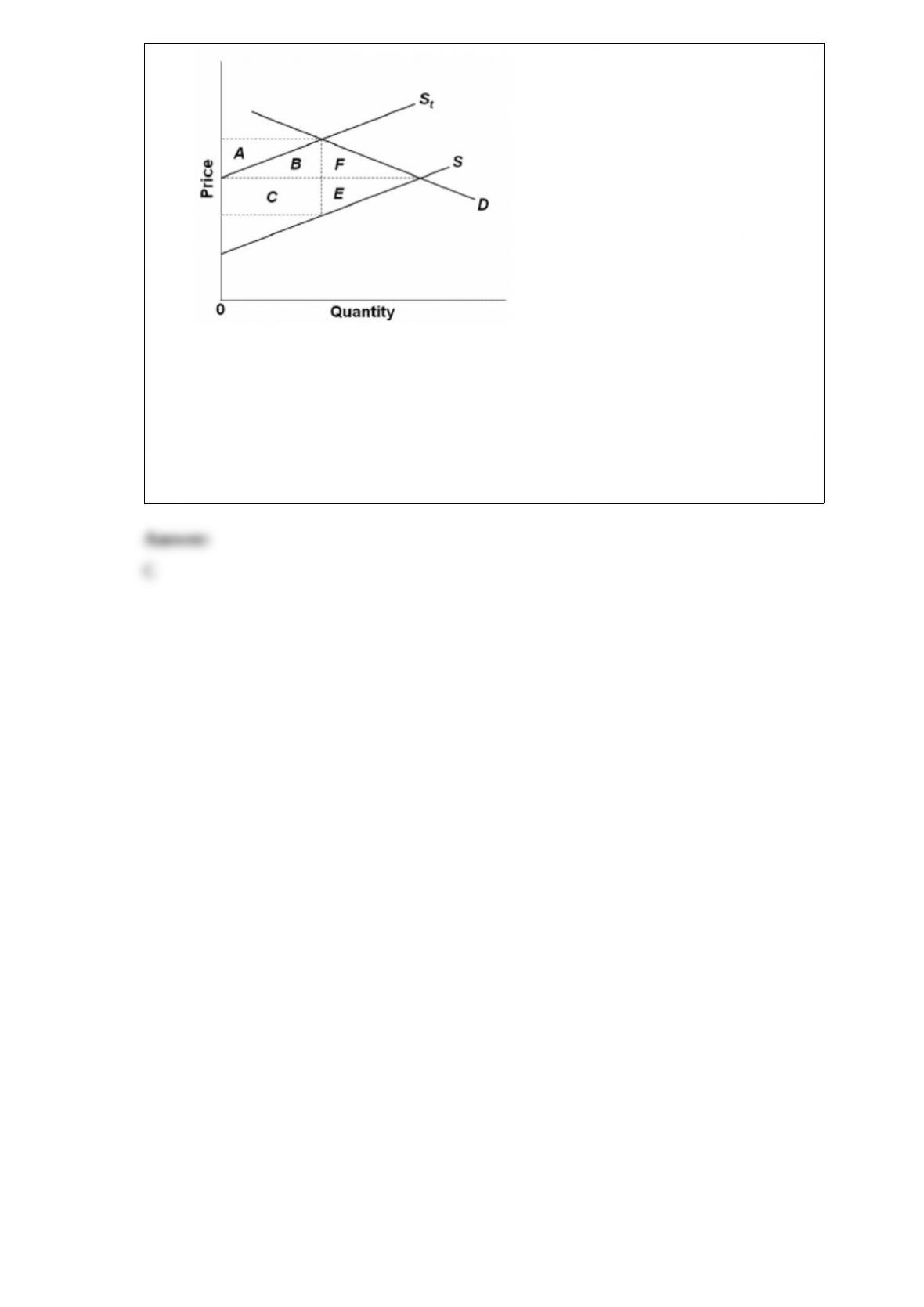
17)
Refer to the above diagram in which S is the before-tax supply curve and St is the
supply curve after an excise tax is imposed. The total tax payment to government is
shown by area(s):
A.A only.
B.A + B + C + E + F.
C.A + B + C.
D.E + F.