
1) A monopsonistic employer’s marginal resource (labor) cost curve:
A.is always more elastic than the labor supply curve.
B.coincides with the labor supply curve.
C.lies below the labor supply curve because the higher wage paid to an additional
worker must also be paid to all other employed workers.
D.lies above the labor supply curve because the higher wage paid to an additional
worker must also be paid to all other employed workers.
2) the demand for commodity x is represented by the equation p = 10 – 0.2q and supply
by the equation p = 2 + 0.2q.
refer to the above information. the equilibrium quantity is:
a.10
b.20
c.15
d.30
3) (consider this) an exception to the advice “go to college, stay in college, and earn a
degree” occurs when:
a.tuition expenses are high and rising.
b.the opportunity cost of attending college is extraordinarily high.
c.the price of textbooks is high and rising.
d.the economy is growing rapidly and jobs are plentiful.
4) to maximize utility a consumer should allocate money income so that the:
a.elasticity of demand on all products purchased is the same.
b.marginal utility obtained from the last dollar spent on each product is the same.
c.total utility derived from each product consumed is the same.
d.marginal utility of the last unit of each product consumed is the same.
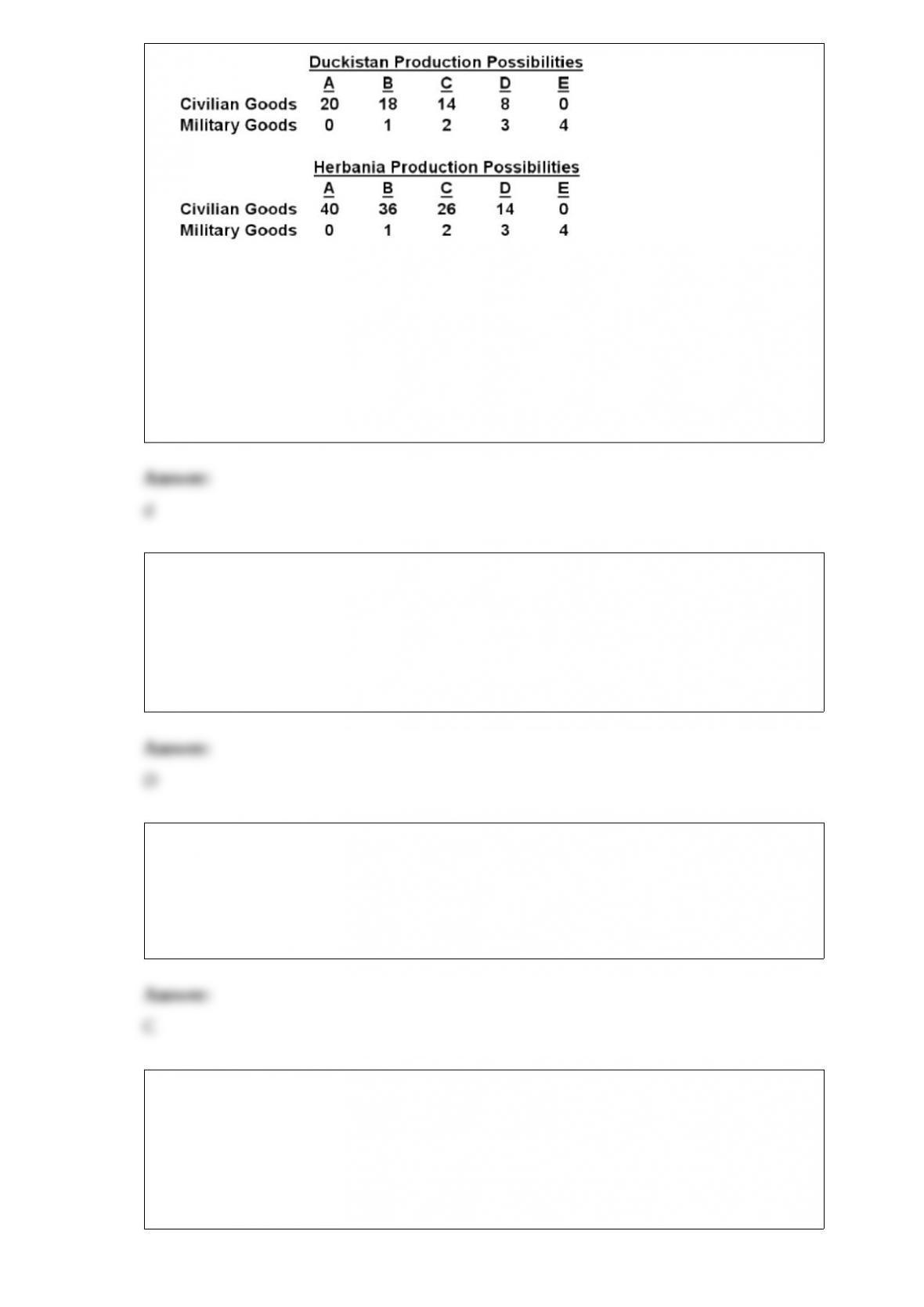
5)
refer to the above tables. suppose that the amount and quality of resources are the same
in both countries. we can conclude that:
a.duckistan is technologically better than herbania at producing military goods.
b.herbania is technologically better than herbania at producing both military goods and
civilian goods.
c.the total opportunity cost of producing 4 units of military goods is the same in both
countries.
d.herbania is technologically superior to duckistan in producing civilian goods.
6) Which of the following would cause the present optimal extraction level of a
non-renewable resource to fall?
A.A reduction in extraction costs.
B.A reduction in user costs.
C.A reduction in total costs.
D.A reduction in the price of the resource.
7) Income:
A.is a stock concept.
B.consists of accumulated assets.
C.is a flow concept.
D.consists of wages only.
8) In terms of aggregate supply, a period in which nominal wages and other resource
prices are unresponsive to price-level changes is called the:
A.long run.
B.short run.
C.immediate market period.
D.very long run.
9) (consider this) the main point of the consider this box about hypothetical countries
slogo, sumgo, and speedo is that over several decades differing:
a.inflation rates create large differences in real gdp per capita.
b.economic growth rates create large differences in real gdp per capita.
c.ratios of defense spending to gdp create large differences in real gdp per capita.
d.unemployment rates create large differences in real gdp per capita.
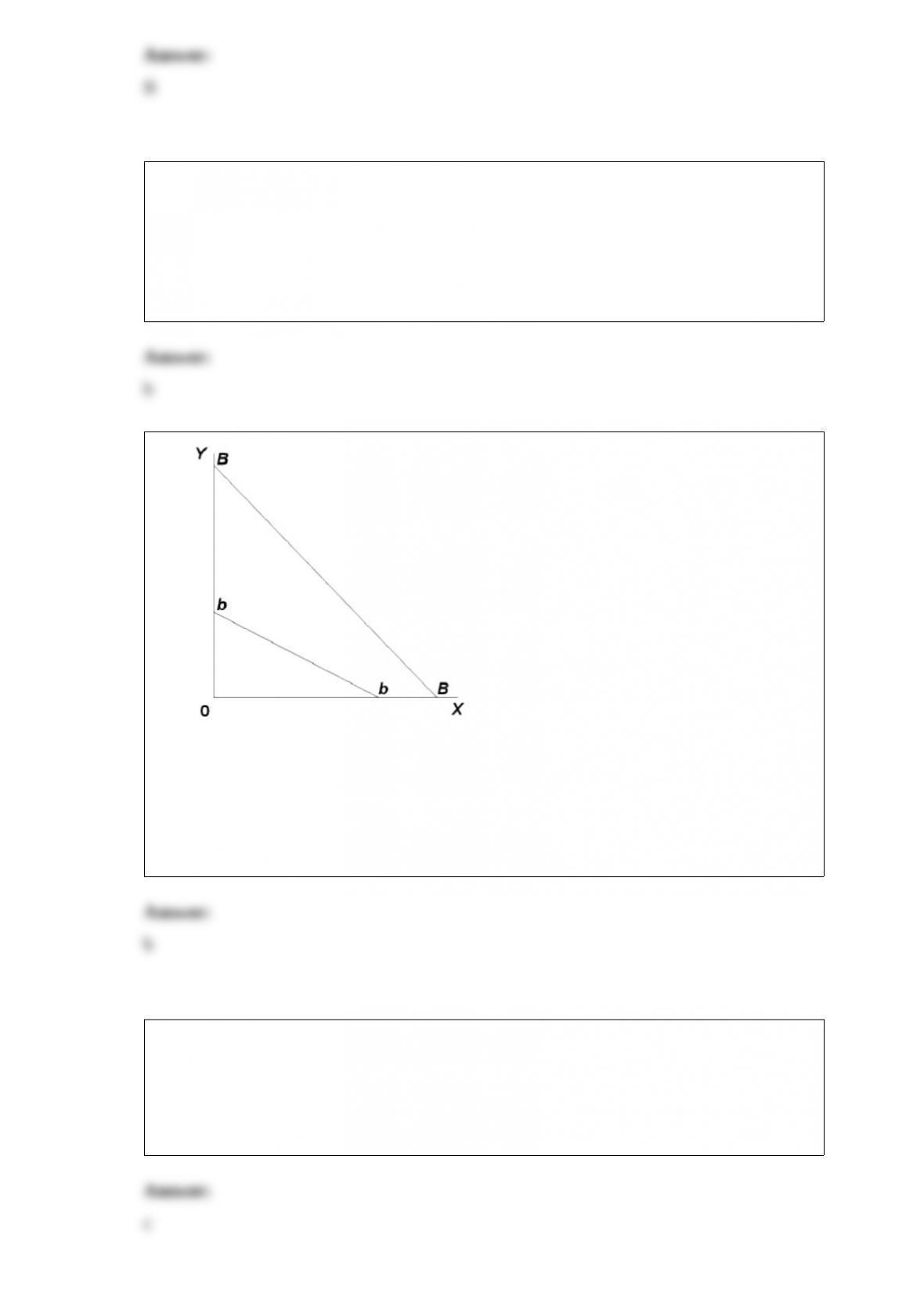
10)
the movement of the budget line from bb to bb in the above figure suggests that income
has:
a.increased and the price of x has decreased.
b.fallen and the price of y has increased.
c.fallen and the price of x has decreased.
d.decreased but there have been no price changes.
11) the spending by americans while traveling in europe best illustrates a:
a.trade flow.
b.labor flow.
c.financial flow.
d.technology flow.

12) When current government expenditures exceed current tax revenues and the
economy is achieving full employment:
A.the standardized budget has neither a deficit nor a surplus.
B.the standardized budget has a deficit.
C.fiscal policy is contractionary.
D.nominal GDP and real GDP are equal.