
If European economies experience a strong economic recovery, U.S. net exports will
a. increase and AD will shift outward.
b. increase and AD will shift inward.
c. decrease and AD will shift inward.
d. decrease and AD will shift outward.
The price elasticity of new automobile purchases is about 1.2. This implies that an
increase of $1,000 on a $10,000 automobile will
a. reduce the number of autos sold by approximately 1.2 percent.
b. increase the consumer expenditures on autos by approximately 1.2 percent.
c. reduce the number of autos sold by approximately 12 percent.
d. increase consumer expenditures on autos by approximately 12 percent.
Firms in a perfectly competitive market produce at minimum average cost in the short
run and the long run.
a. True
b. False

Which of the following is not generally considered a failing of market economies?
a. Market economies can have severe swings from boom to bust.
b. Market economies tend to underprovide public goods.
c. Market economies tend to promote equity at the expense of efficiency.
d. Market economies can misallocate resources when property rights are ill defined.
The United States has chosen to balance the competing claims of efficiency versus
equality by emphasizing greater efficiency over greater equality.
a. True
b. False

Demand-side inflation is usually accompanied by increasing real GDP, while
supply-side inflation is usually accompanied by falling real GDP.
a. True
b. False
Which of the following methods could be used to calculate GDP?
a. the sum of all spending on final goods and services
b. the sum of all factor payments plus depreciation and indirect business taxes
c. the sum of all values added at each stage of production
d. All of the above could be used.
A recent study found that it was cheaper to buy a chicken dinner from Kentucky Fried
Chicken than it was to prepare it at home. The researcher included all costs including
the imputed value of time involved to prepare the meal at home. This study illustrates
the
a. value of marginal analysis.
b. law of increasing costs.
c. difference between real costs and money costs.
d. cost disease of the service sector.
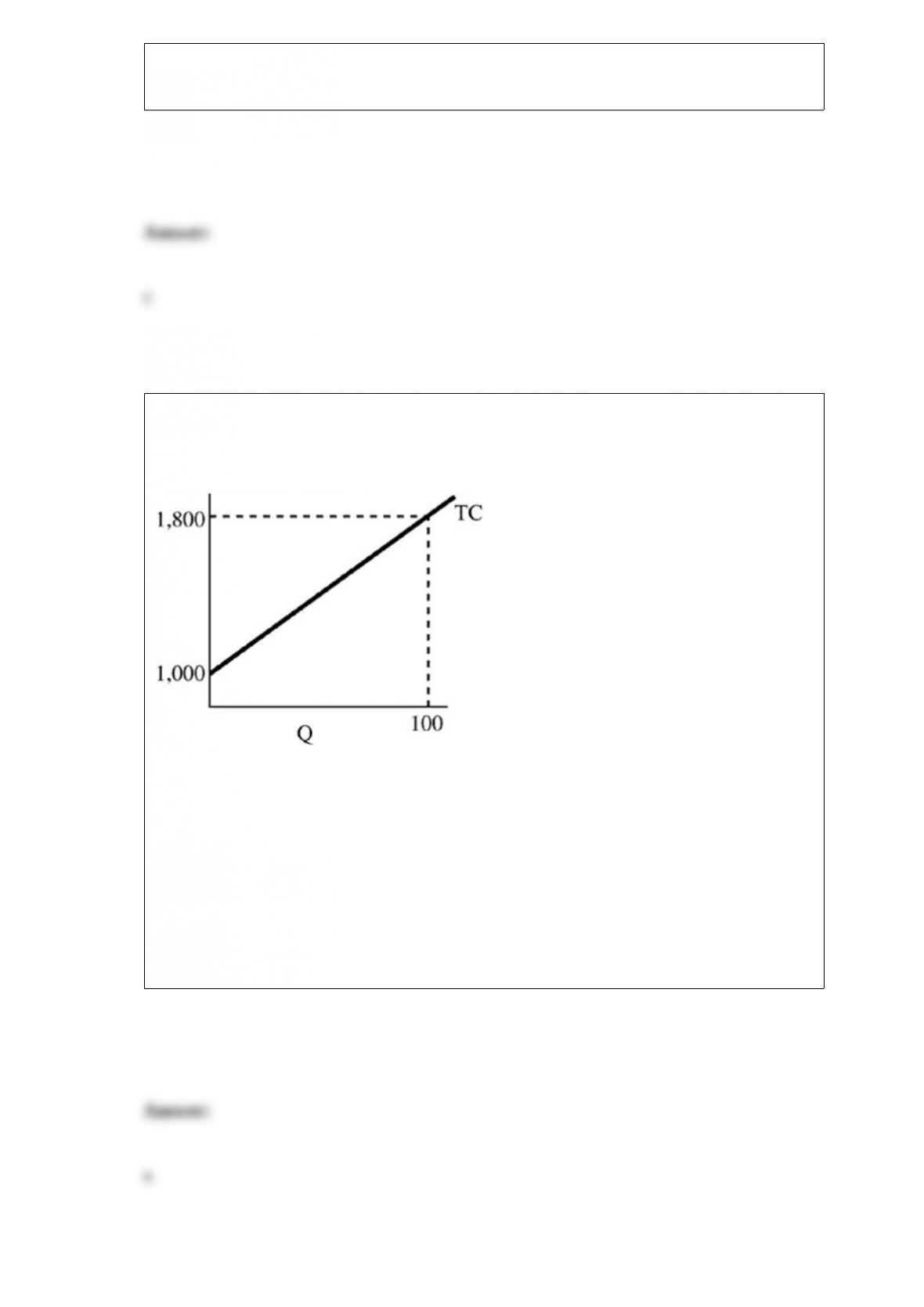
Figure 7-7
In Figure 7-7 at 100 units, AVC equals
a. 8.
b. 800.
c. 100.
d. 1,000.
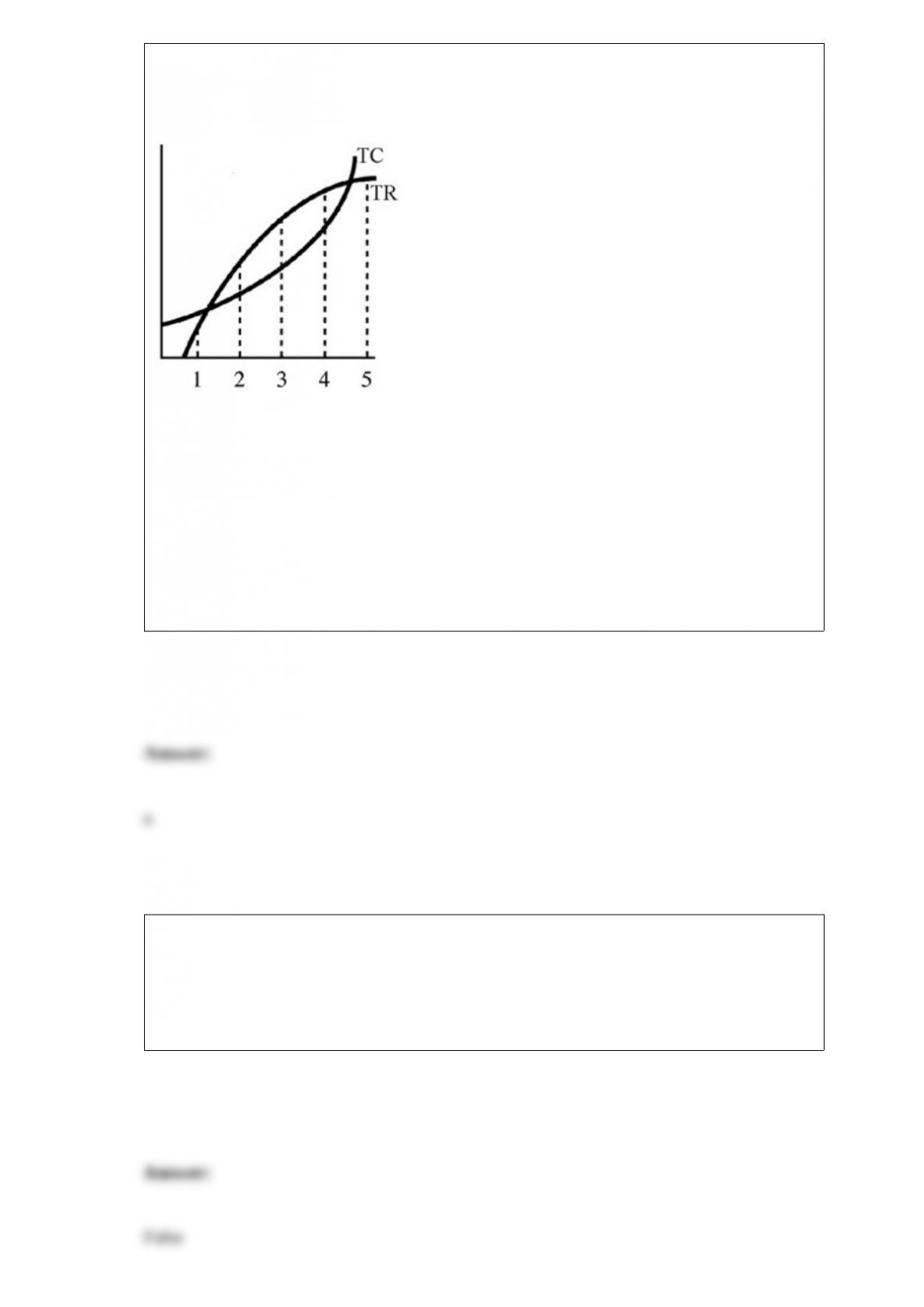
Figure 8-4
In Figure 8-4 at output level 2,
a. MR > MC.
b. the slope of the total profit curve is negative.
c. there are negative profits.
d. marginal revenue is rising compared to output.
Under the gold standard, a balance of payments surplus leads to an outflow of gold.
a. True
b. False

The Federal Reserve System was established by Congress in 1914
a. as a result of a breakthrough in economic theory.
b. against significant opposition from the banking sector.
c. because of the need for a central bank.
d. as the world’s first central bank.
In the United States each year, approximately
a. 50% of all businesses fail.
b. 25% of all businesses fail.
c. 10% of all businesses fail.
d. 5% of all businesses fail.
The period from 1983 to 1990 was characterized by
a. decreasing budget deficits and increasing trade surpluses.
b. persistently high inflation.

c. below average rates of real GDP growth.
d. consistent growth of real GDP and decreasing rates of inflation.
Open market operations affect the supply of reserves.
a. True
b. False
The relationship between the quantity of labor supplied and the wage is governed by an
income effect and a substitution effect.
a. True
b. False

Unions typically ____ deregulation because it generally makes pricing ____
competitive.
a. oppose; more
b. oppose; less
c. support; more
d. support; less
Discouraged workers are included in the
a. labor force category.
b. unemployed category.
c. not in the labor force category.
d. employed category.
Many public utilities are permitted to operate as monopolies because they enjoy
economies of large-scale production.
a. True

b. False
From 2012-2013, which of the following countries increased its expenditures by more
than 10%?
a. China
b. Germany
c. Japan
d. the U.S.
One benefit of U.S. society that encouraged entrepreneurship was the inflow of capable
immigrants.
a. True
b. False

Consumer’s surplus is a measure of how much
a. less than his income a consumer spends on goods.
b. more utility a consumer receives from his purchases than he has to pay for them.
c. a consumer’s marginal utility differs from his total utility.
d. a change in price induces a consumer to substitute other goods.
Under laissez faire, the allocation of resources among different products depends on
a. consumer preferences.
b. production costs.
c. Both a and b are correct.
d. Neither a nor b is correct.
Investment spending

a. cannot be stimulated by decreasing the interest rate.
b. is often the cause of business fluctuations in the United States.
c. is a remarkably stable function of the level of real GDP.
d. is the primary solution to recessions and inflations, according to John Maynard
Keynes.
If ten years ago the price of a movie ticket was $5 and the average hourly wage was
$10, and today the price of a movie ticket is $8 and the average hourly wage is $20,
then
a. movies are now relatively cheaper in terms of work hours.
b. movies are now relatively more expensive in terms of work hours.
c. the relative price of movies has remained constant.
d. workers now need to work longer hours to earn one movie ticket.
An essential point, among many, in the refutation of the “cheap foreign labor” argument
is that
a. foreign workers have a lower standard of living.
b. foreign workers are less productive.
c. low foreign wages mean fewer exports for the United States.
d. the United States does not benefit from cheap foreign labor so the goods should be
kept out.
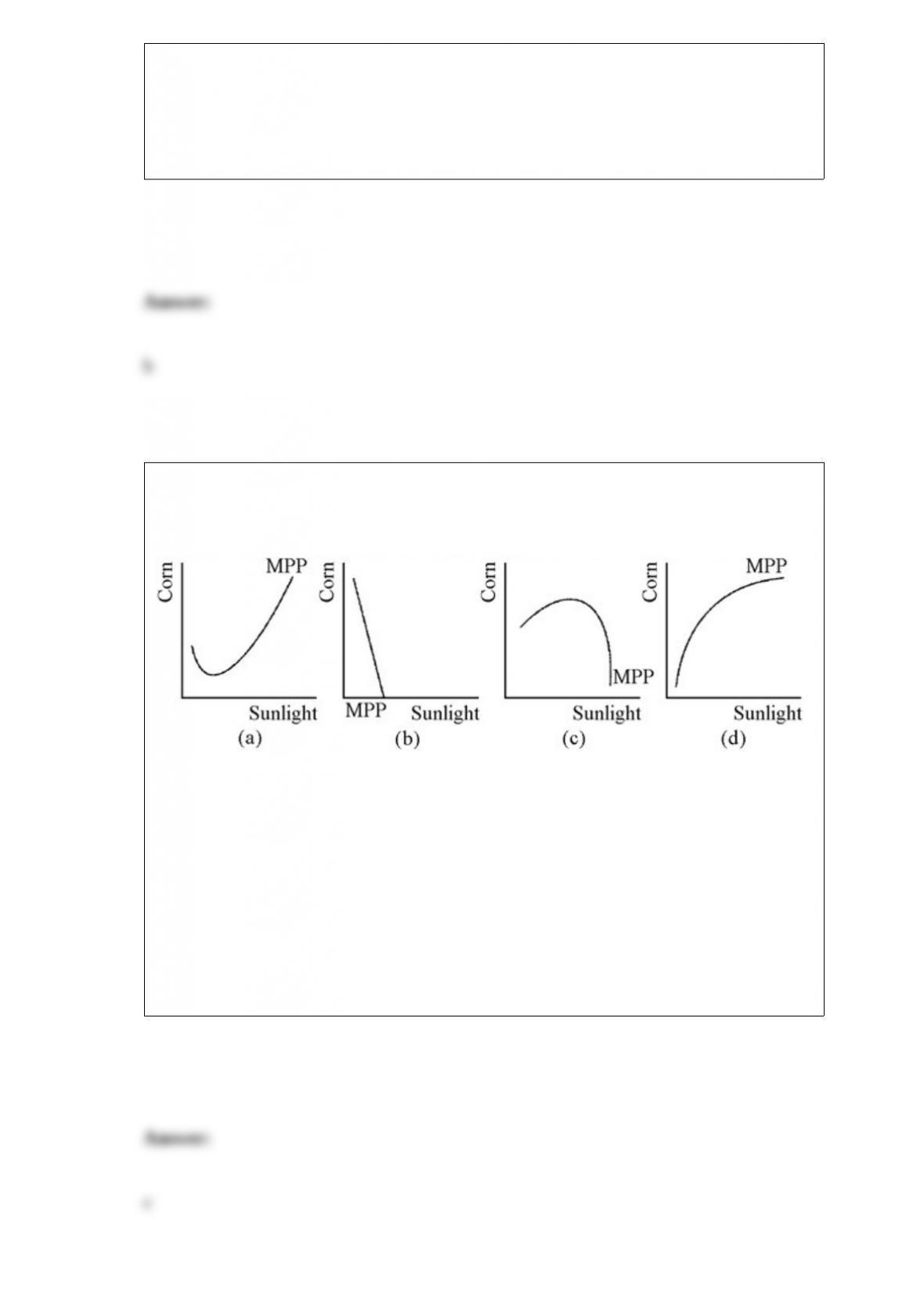
Figure 7-12
Which of the graphs in Figure 7-12 shows a marginal physical product curve that
exhibits first increasing, and then diminishing, marginal returns to sunlight?
a. (a)
b. (b)
c. (c)
d. (d)

The external costs of alcohol consumption are related to, among other things, death and
injury related to auto accidents caused by drunk drivers. These costs have been
estimated to be about 47 cents per ounce of alcohol consumed. Taxes on alcohol
amount to 23 cents per ounce. This suggests that alcohol consumption is (i) greater than
the efficient or optimal amount; (ii) should be reduced to zero to eliminate the
externality.
a. i and ii
b. i not ii
c. ii not i
d. neither i nor ii
If the income tax system were indexed, a person whose nominal income went up from
$30,000 to $33,000 in a year when the price index rose by 10 percent would pay
a. no increases in nominal income taxes.
b. no increases in real income taxes.
c. lower taxes in both real and nominal terms.
d. higher taxes in both real and nominal terms.

Centrally planned economies like China produce relatively little pollution.
a. True
b. False
Most prophecies of the imminent exhaustion of many natural resources have not come
true because
a. such resources are generally available in infinite quantities.
b. rising prices for resources have stimulated supply and encouraged innovation.
c. the demand for most natural resources has fallen as income levels have increased.
d. government price floors have prevented resource exhaustion.
In order to make an optimal choice we must use
a. percentage analysis.
b. total analysis.
c. average analysis.
d. marginal analysis.

The coordination task of any economy that answers the question of how output shall be
divided among consumers may best be described as
a. output selection.
b. production planning.
c. distribution.
d. None of the above is correct.
The best hope for continued growth of the U.S. economy probably lies in:
a. a return of manufacturing to the U.S.
b. innovation
c. patents
d. decreasing poverty