
1) a manufacturer of frozen pizzas found that total revenue decreased when price was
lowered from $5 to $4. it was also found that total revenue decreased when price was
raised from $5 to $6. thus,
a.the demand for pizza is elastic above $5 and inelastic below $5.
b.the demand for pizza is elastic both above and below $5.
c.the demand for pizza is inelastic above $5 and elastic below $5.
d.$5 is not the equilibrium price of pizza.
2) the natural rate of unemployment is the:
a.unemployment rate experienced at the depth of a depression.
b.full-employment unemployment rate.
c.unemployment rate experienced by the least-skilled workers in the economy.
d.unemployment rate experienced by the most-skilled workers in the economy.
3) if fred’s annual real income rises by 8 percent each year, his annual real income will
double in about:
a.8-9 years.
b.10-11 years.
c.5-6 years.
d.19-20 years.
4) a positive statement is one which is:
a.derived by induction.
b.derived by deduction.
c.subjective and is based on a value judgment.
d.objective and is based on facts.
5)
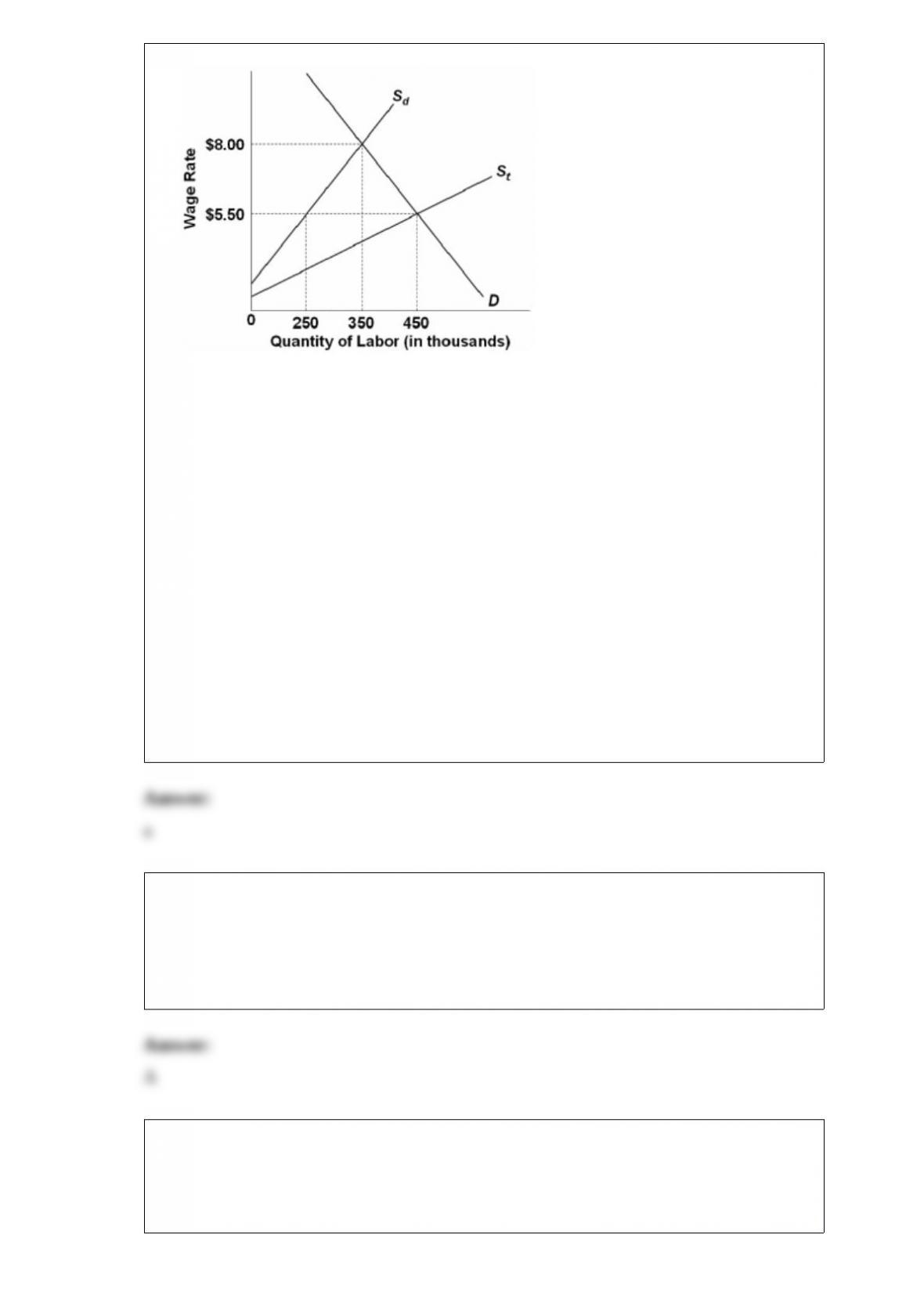
assumptions: 1) employers in this market are willing and able to ignore minimum wage
laws; 2) sd represents the supply of domestically-born (and legal immigrant) workers;
3) st represents the total supply of workers in this labor market (sd plus illegal
immigrants); and 4) unless otherwise stated, illegal immigration is not effectively
blocked by the government.
refer to the above figure. assume initially that government does not effectively block
illegal immigration. if the government then finds a way to prevent all illegal immigrants
from working in this labor market:
a.100,000 domestically-born workers will gain employment at the expense of 200,000
illegal immigrants.
b.200,000 domestically-born workers will gain employment at the expense of 200,000
illegal immigrants.
c.100,000 domestically-born workers will gain employment at the expense of 250,000
illegal immigrants.
d.100,000 domestically-born workers will gain employment at the expense of 100,000
illegal immigrants.
6) As it applies to insurance, the adverse selection problem is the tendency for:
A.those most likely to collect on insurance to buy it.
B.those who buy insurance to take less precaution in avoiding the insured risk.
C.sellers to price discriminate.
D.sellers to restrict output and charge high prices.
7) Pa and Pb are the prices that individuals A and B are willing to pay for the last unit of
a public good, rather than do without it. These people are the only two members of
society.
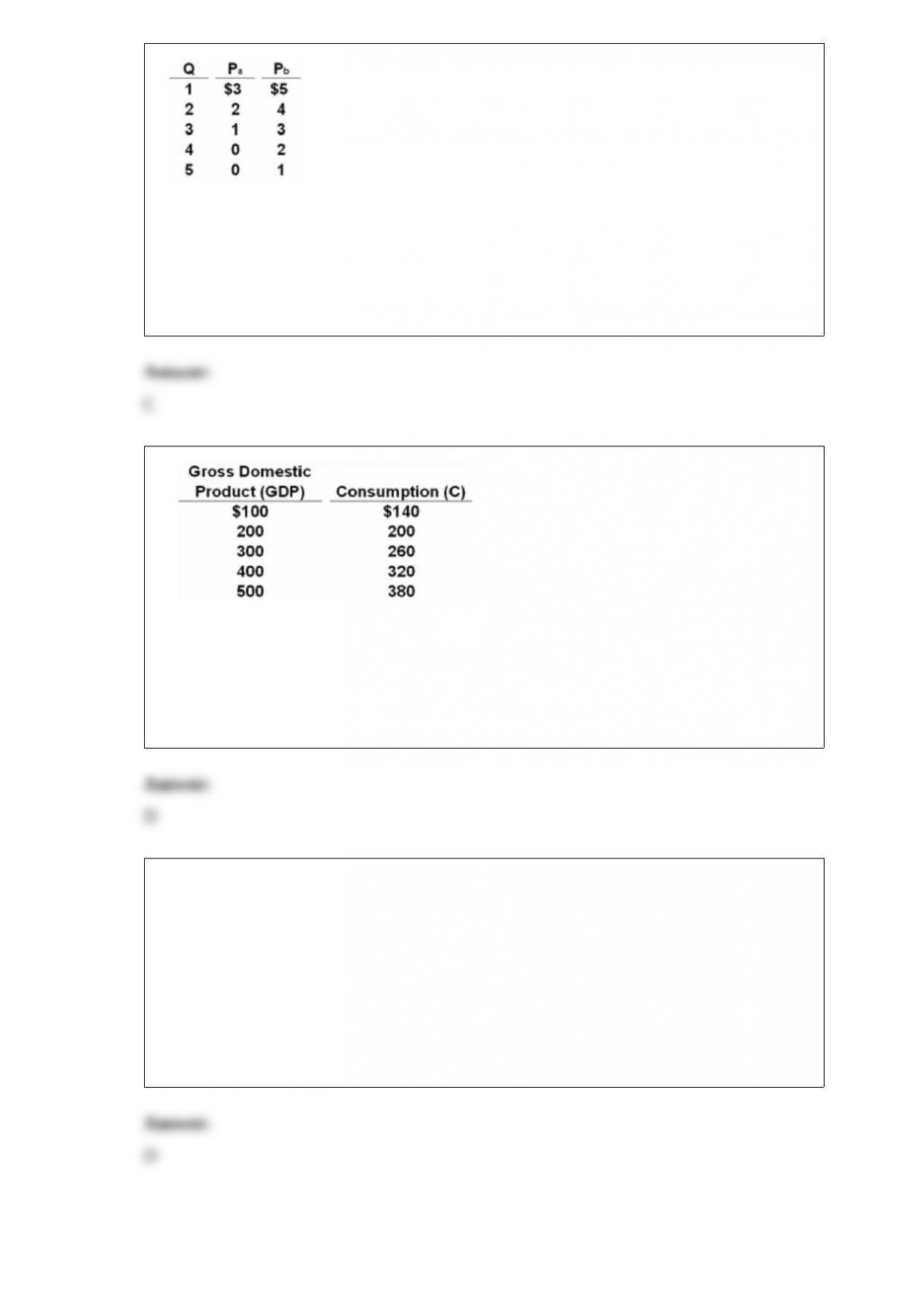
Refer to the above data. The collective willingness of this society to pay for the 2nd unit
of this public good is:
A.$2.
B.$4.
C.$6.
D.$8.
8)
Refer to the above data. A 10 percent proportional tax on income would:
A.affect neither the size of the multiplier nor the stability of the economy.
B.increase the size of the multiplier and make the economy more stable.
C.increase the size of the multiplier and make the economy less stable.
D.reduce the size of the multiplier and make the economy more stable.
9) According to economist Milton Friedman (1912-2006), the source of instability in
the economy could be thought of as a:
A.baseball manager (the Fed) that removes his starting pitcher too soon and sees a 5-run
lead evaporate in a single inning.
B.duck hunter (the Fed) who starts shooting at ducks well before they fly over.
C.a camp councilor (the Fed) who is wearing a baseball cap that has two bills and says
“I am the leader, which way did they go?”
D.backseat car passenger (the Fed) who occasionally leans over the front seat and
abruptly jerks the steering wheel to the left or to the right.
10)
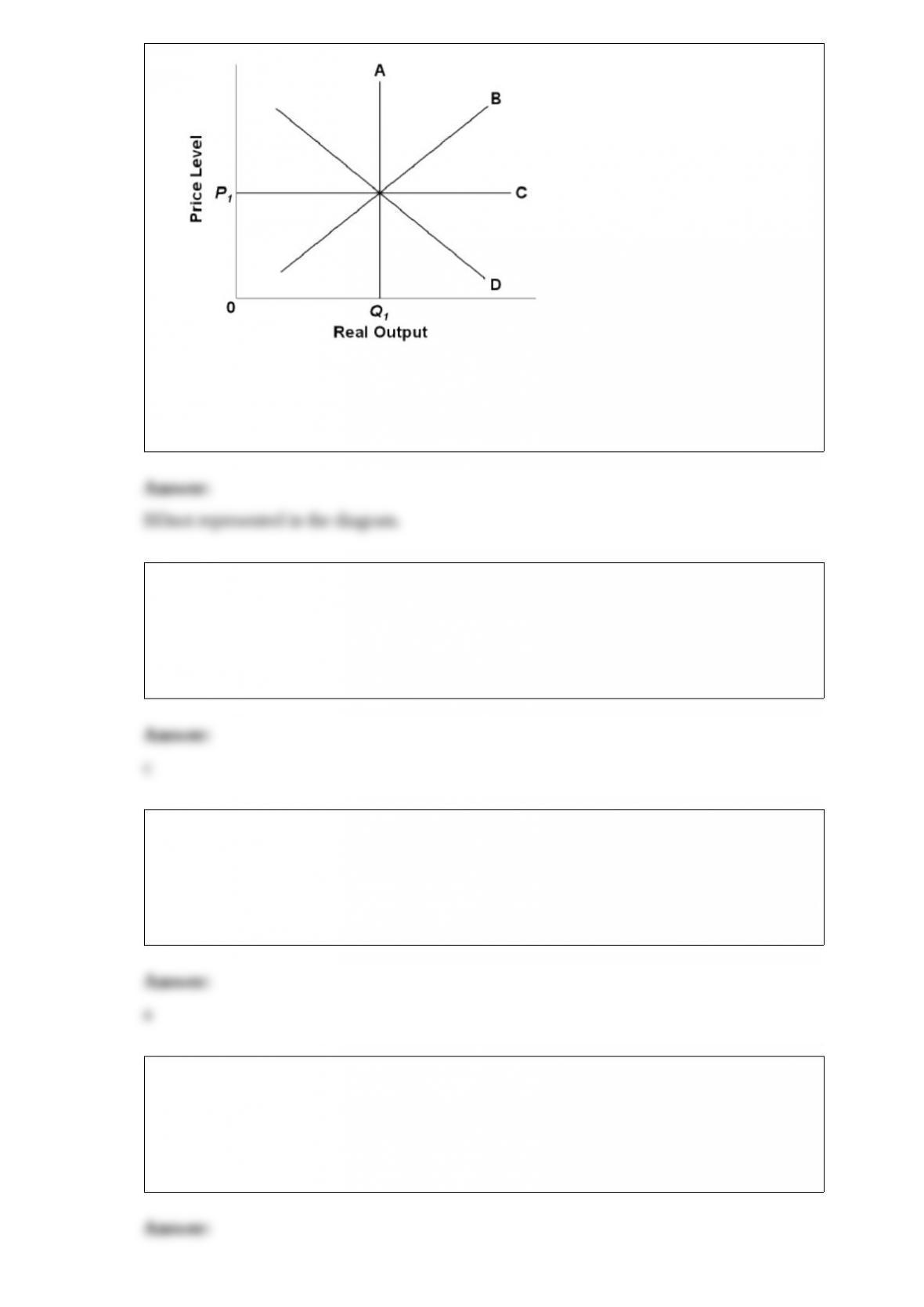
Refer to the above diagram. The short-run aggregate supply is:
A.A.
B.B.
C.D.
11) inflation initiated by increases in wages or other resource prices is labeled:
a.demand-pull inflation.
b.demand-push inflation.
c.cost-push inflation.
d.cost-pull inflation.
12) the public decision to build the interstate highway system is an example of:
a.the allocative function of government.
b.the redistributional function of government.
c.public provision of a suitable legal framework for the market system.
d.the stabilization function of government.
13) the upward slope of the supply curve reflects the:
a.principle of specialization in production.
b.law of supply.
c.fact that price and quantity supplied are inversely related.
d.law of diminishing marginal utility.
14) appreciation of the mexican peso will:
a.make mexico’s exports and imports both more expensive.
b.make mexico’s exports more expensive and its imports less expensive.
c.make mexico’s exports less expensive and its imports more expensive.
d.increase mexican exports.
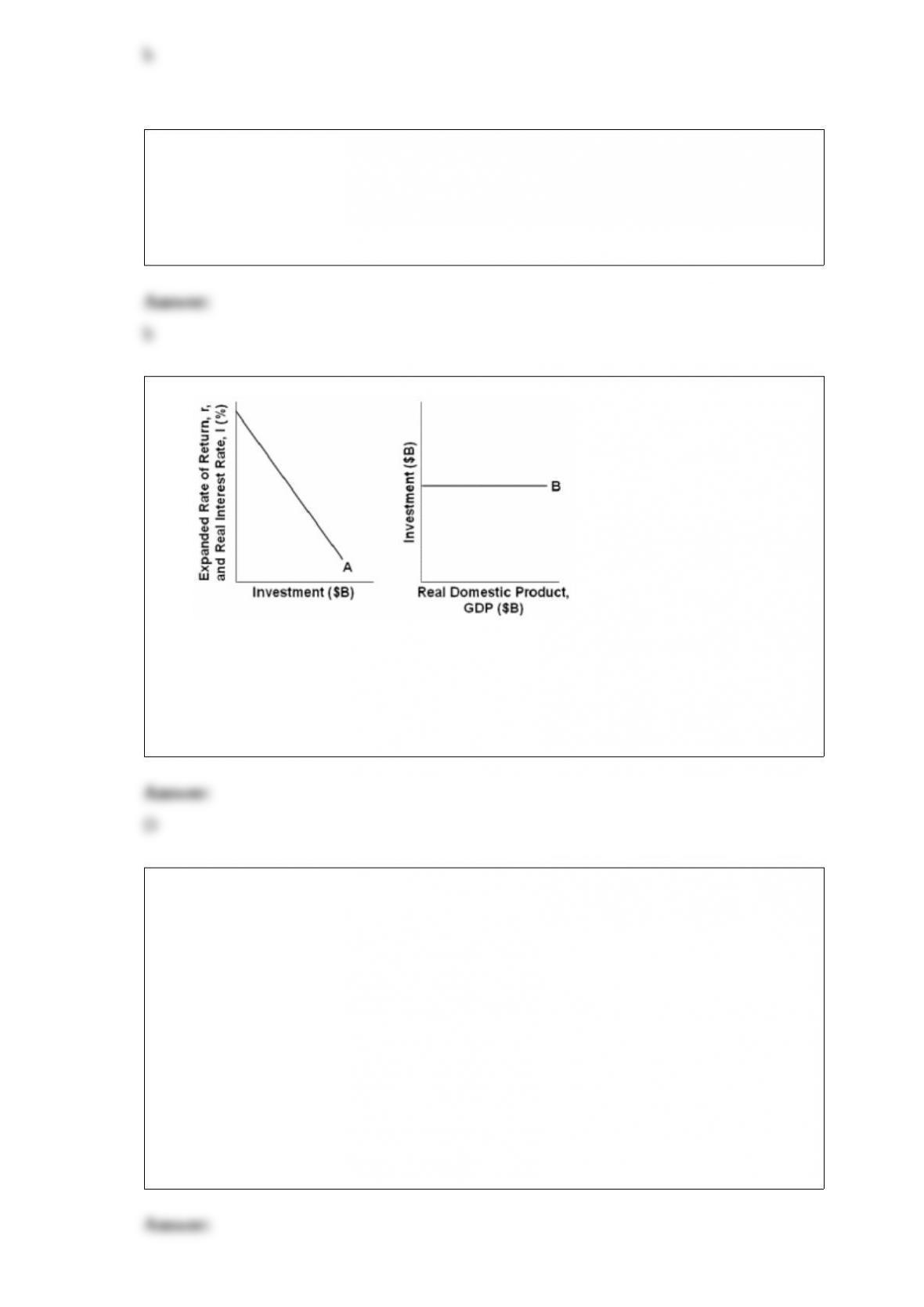
15)
Refer to the above diagrams. Other things equal, curve B will shift upward when:
A.the level of GDP increases.
B.the interest rate increases.
C.curve A shifts to the left.
D.curve A shifts to the right.
16) Consider the following situations related to a sports stadium in a city. Assume this
is the primary venue for sports games. Decide whether the city government is likely to
intervene to enforce antitrust law or not.
(a)In response to slow sales of memorabilia in its sport shop, the stadium management
decides to require patrons to buy one item of memorabilia over $5 along with their
ticket.
(b)The stadium management decides to charge different prices for students, regular
patrons and senior citizens.
(c)The stadium is purchased by a soft drink company, who will only provide their
products at games.
(d)A company is coming into the town wanting to build a new sports complex. The
stadium management decides to fund a smear campaign against the new development,
as well as threaten to pull funding from key city council members campaign funds.
17) in recent years, firms that produce the wide variety of corn-based products have
experienced rising costs. this has been due primarily to:
a.introduction of expensive capital used to process corn.
b.lower productivity in processing corn.
c.lower prices for corn.
d.higher prices for corn.
18) if the equation y = -10 + 2.5x was plotted:
a.the vertical intercept would be -10
b.the slope would be -7.5
c.it would graph as a downsloping line
d.the slope would be -10
19) The total demand for money is equal to the transactions demand plus the asset
demand for money.
(a)Assume that each dollar held for transactions purposes is spent on the average five
times per year to buy final goods and services. If the nominal GDP is $5000 billion ($5
trillion), what is the transaction demand?
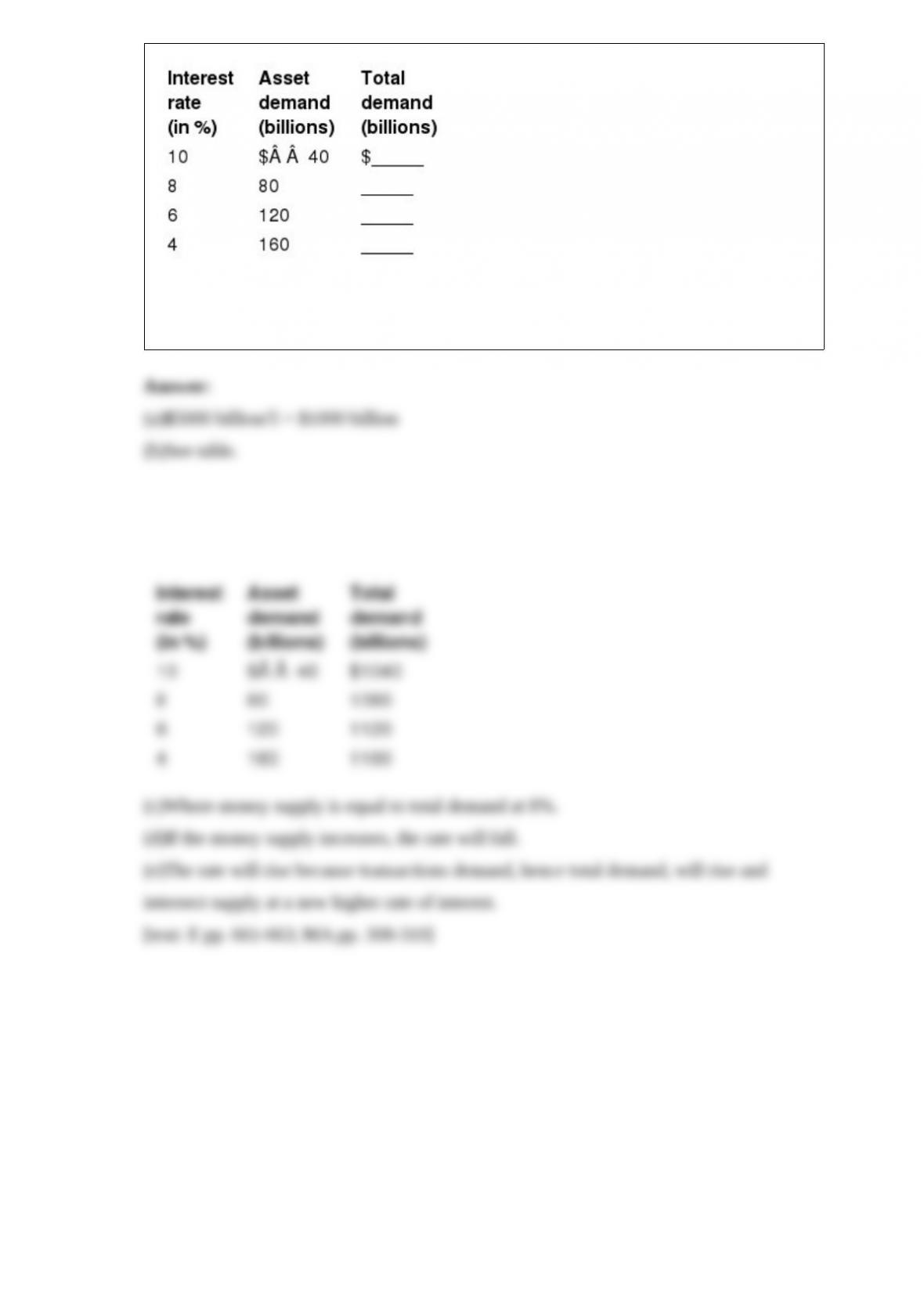
(b)The table below shows the asset demand at certain rates of interest. Using your
answer to part (a), complete the table to show the total demand for money at various
rates of interest.
(c)If the money supply is $1080 billion, what will be the equilibrium rate of interest?
(d)If the money supply rises, will the equilibrium rate of interest rise or fall?
(e)If GDP rises, will the equilibrium rate of interest rise or fall?