
A village has five residents, each of whom has an accumulated savings of $50. Each
villager can use the money to buy a government bond that pays 10% interest per year or
to buy a year-old goat, send it onto the commons to graze, and sell it after one year. The
price of the goat that the villager will get at the end of the year depends on the amount
of weight it gains while grazing on the commons, which in turn depends on the number
of goats sent onto the commons, as shown in table below. Assume that if a villager is
indifferent between buying a bond and buying a goat, the villager will buy a goat.
The villagers will buy a year-old goat if the goat can be sold for a price of at least
_____ when it is 2 years old.
A. $55
B. $75
C. $70
D. $65
When a U.S. firm engages in outsourcing, it benefits ______ and harms ______.
A. the firm; the U.S. consumers of the firm’s products
B. the U.S. consumers of the firm’s products; the firm
C. the U.S. consumers of the firm’s products; the firm’s U.S. employees
D. the U.S. consumers of the firm’s products; the firm’s foreign employees
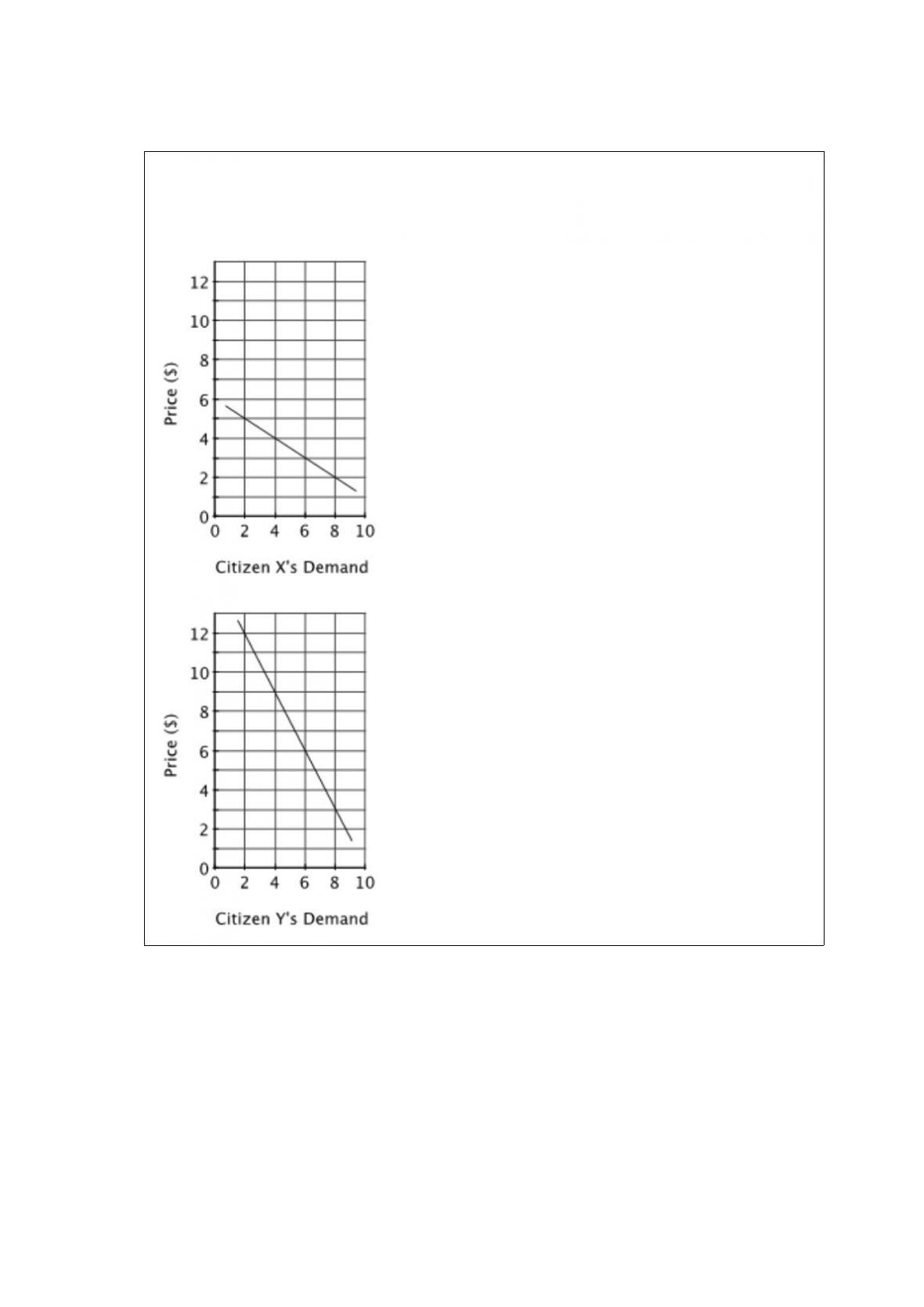
Consider a town with three residents. The residents’ demand curves for various acres of
a public park are shown below.

Suppose the city receives a grant that pays one half of the cost of each acre the city
buys. If the cost of land is $28 per acre, the optimal park size is
A. 8.
B. 2.
C. 4.
D. 6.
Refer to the figure above. Suppose all the sellers in this market started out charging a
price of $45 per unit. What is the most likely result?
A. They would all make a large profit because $45 is more than the equilibrium price.
B. They would all just break even because $45 is their reservation price.
C. They would feel pressure to lower their prices because at $45 there would be excess
supply.
D. They would be forced to lower their prices because at $45 there would be excess
demand.
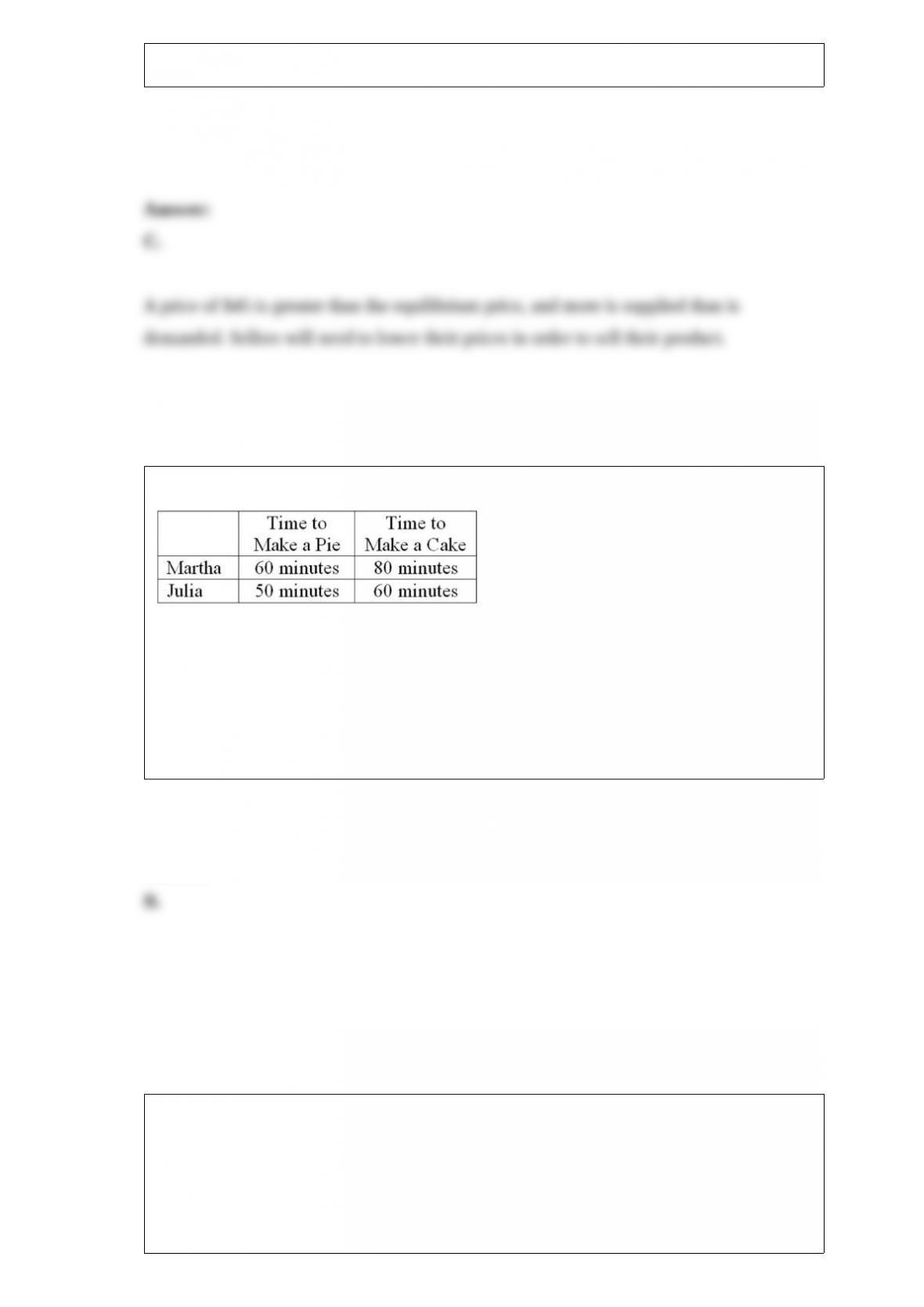
Refer to the table below. Martha’s opportunity cost of making a cake is:
A. 3/4 of a pie.
B. 4/3 of a pie.
C. 6 pies.
D. 60 pies.
The value added by any firm equals the firm’s ______ from selling the product minus
_______.
A. revenue; labor expenses
B. revenue; the cost of inputs purchased from other firms

C. profits; labor expenses
D. profits; the cost of inputs purchased from other firms
For a fixed percent reduction in pollution emissions to be economically efficient, it
would have to be the case that:
A. the marginal cost of pollution control is the same across all firms.
B. enforcement is vigorous.
C. all firms be the same size.
D. large polluters reduce emissions by more than small polluters.
On a graph of a production possibilities curve, an inefficient point is:
A. necessarily an attainable point.
B. not necessarily an attainable point.
C. necessarily an unattainable point.
D. possibly an unattainable point.

Suppose a firm uses workers and office space to produce output. The firm is locked into
a year-long lease on its office space, but it can easily vary the number of
employee-hours it uses each day. The table below describes the relationship between
the number of employee-hours the firm uses each day and the firm’s daily output. Each
unit of output sells for $2, the hourly wage rate is $14, and the rent on the office space
is $50 per day.
What is the marginal cost of production between 80 and 120 units of output each day?
A. $1.40
B. $1.75
C. $14
D. $70
Provisions in the law that automatically increase government spending or decrease
taxes when real output declines are called:
A. autonomous stabilizers.
B. automatic stabilizers.
C. the marginal propensity to consume.
D. the income-expenditure multiplier.
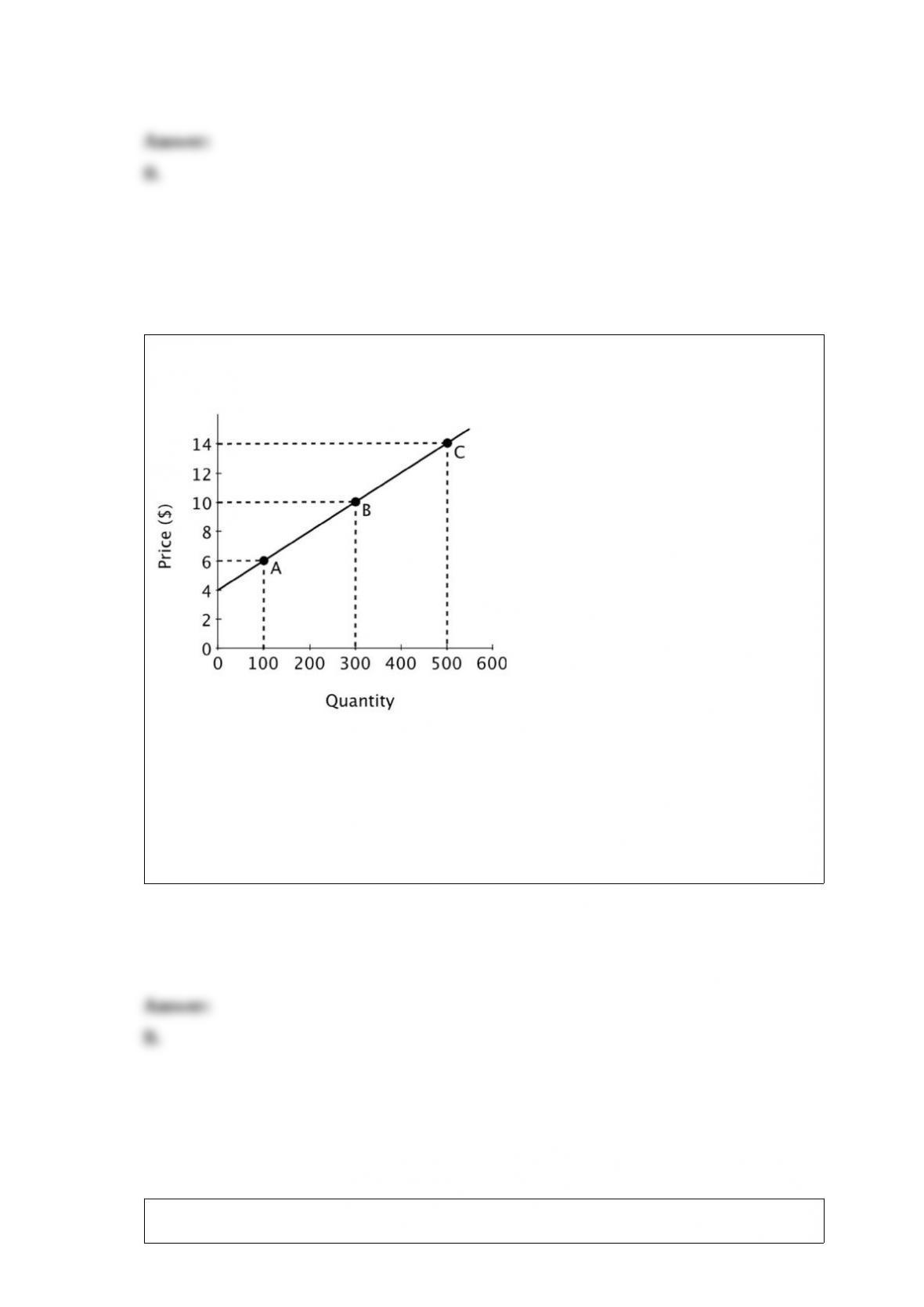
Refer to the figure below. If the price rises from $10 to $14, what will happen to the
price elasticity of supply?
A. It increases.
B. It decreases.
C. It stays the same.
D. This cannot be determined from the information provided.
A low rate of expected inflation tends to lead to a ___ rate of actual inflation and a high

rate of expected inflation tends to lead to a ____ rate of actual inflation.
A. high; high
B. high; low
C. low; low
D. low; high
After the Federal Reserve increases reserves in the banking system, banks create new
deposits through multiple rounds of lending and accepting deposits until the:
A. Federal Reserve requires them to stop.
B. deposit insurance limit is reached.
C. actual reserve/deposit ratio is greater than the desired reserve/deposit ratio.
D. actual reserve/deposit ratio is equal to the desired reserve/deposit ratio.
Suppose a small island nation imports sugar for its population at the world price of
$1,500 per ton. The domestic market for sugar is shown below.
If the government provides a subsidy of $500 per ton, then the cost of subsidy, which
must be borne by taxpayers, will be ______ per day.
A. $500
B. $2,000
C. $5,000
D.$6,000
Suppose that if the price of plane tickets increased, more people would choose to travel
by train. If this happened, you would know that:
A. plane tickets are an inferior good.
B. the cross-price elasticity between plane tickets and train tickets is positive.
C. the cross-price elasticity between plane tickets and train tickets is negative.
D. plane tickets and train tickets are complements.

A college graduate in 1972 found a job paying $7,200. The CPI was 0.418 in 1972. A
college graduate in 2005 found a job paying $30,000. The CPI was 1.68 in 2005. The
1972 graduate’s job paid ______ in nominal terms and ______ in real terms than the
2005 graduate’s job.
A. more; less
B. more; more
C. less; more
D. less, less
Holding other factors constant, a technological improvement that increases the marginal
product of capital will:
A. increase national saving.
B. decrease national saving.
C. increase investment.
D. decrease investment.

In a certain economy, the components of planned spending are given by:
C = 500 + 0.8(Y – T) – 300r
Ip = 200 – 400r
G = 200
NX = 10
T = 150
Given the information about the economy above, what would be the impact on
autonomous expenditures of a one-percentage-point increase in the real interest rate?
A. Autonomous expenditures would increase by 35 units.
B. Autonomous expenditures would decrease by 70 units.
C. Autonomous expenditures would decrease by 35 units.
D. Autonomous expenditures would decrease by 7 units.
At the beginning of the fall semester, college towns experience large increases in their
populations, causing a(n):
A. decrease in the quantity of apartments demanded.
B. increase in the supply of apartments.
C. increase in the demand for apartments.
D. decrease in the quantity of apartments supplied.

Making more frequent, but smaller cash withdrawals from banks ______ the inflation
losses from holding cash and ______ the shoe leather costs of inflation.
A. increases; increases
B. increases; reduces
C. reduces; has no impact on
D. reduces; increases
Leaving the labor force or finding a job are two ways that:
A. a person can become a discouraged worker.
B. a person can become an involuntary part-time worker.
C. an unemployment spell can begin.
D. an unemployment spell can end.
In general, when the demand curve shifts to the right and supply remains constant then:

A. quantity demanded will rise.
B. the equilibrium price will fall.
C. the equilibrium quantity will rise.
D. the market cannot reestablish an equilibrium.
Quick Buck and Pushy Sales produce and sell identical products and face zero marginal
and average cost. Below is the market demand curve for their product.
If Quick Buck and Pushy Sales decide to collude and work together as a monopolist
with each firm producing half the quantity demanded by the market at the monopoly
price, then what will be Quick Buck’s economic profit?
A. $1,000
B. $2,000
C. $3,000
D. $4,000
Imagine that you are an entrepreneur, making designer t-shirts in your garage. Your
total cost (in dollars) is given by the equation TC = 300 + 10Q, where Q represents the
number of t-shirts you make. Your fixed cost is $______, and your marginal cost is
$______.
A. 300; 10
B. 300/Q; 30
C. 300; 10Q
D. 300/Q; 10
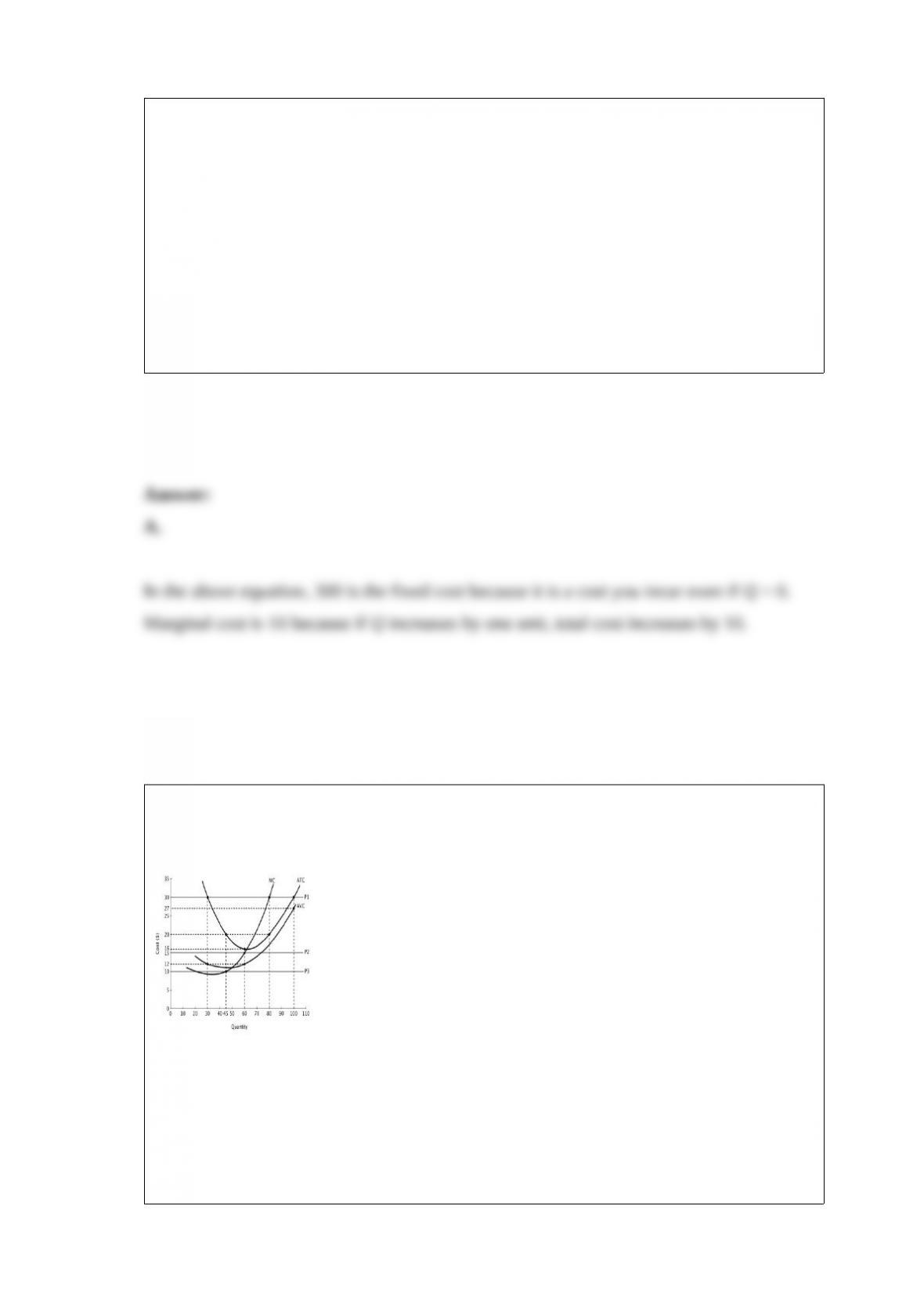
Refer to the figure below. If this firm is a price taker and the price of each unit of output
is $15, then at this firm’s profit-maximizing level of output, it will earn a ______ of
______.
A. loss; $60
B. profit; $180
C. loss; $300
D. loss; $900

Suppose last year Moe faced a 25% marginal tax rate. This year tax rates have increased
and now Moe faces a 30% marginal tax rate. Moe may choose to work more hours this
year because:
A. working hours tend to increase over a worker’s life in the United States.
B. the opportunity cost of leisure has increased.
C. the opportunity cost of leisure has fallen.
D. he must work more hours to have the same after-tax income this year.
In 2015, Pete Rich purchases a 1642 painting by Rembrandt for $20 million. He also
pays a one percent commission to the auction house that sold the painting. What is the
contribution of these transactions to GDP in the year 2015?
A. $0
B. $200,000
C. $2 million
D. $20.2 million

The system of government insurance that pays benefits to workers injured on the job is
referred to as:
A. Social Security.
B. welfare.
C. OSHA.
D. workers’ compensation.
The optimal quantity of a negative externality is zero if:
A. it imposes a high enough cost on society.
B. it is costly for people to negotiate with each other.
C. the majority of voters decide to eliminate the externality.
D. the marginal cost of reducing the externality is zero.

Refer to the figure below. The marginal utility of consuming the 2nd apple is:
A. 10
B. 15
C. 20
D. 35
Refer to the figure below.
Based on the Keynesian cross diagram, short-run equilibrium output equals:
A. 3,000.
B. 3,250.
C. 4,000.
D. 4,750.
Satellite TV is a close substitute for cable TV. In the 1990’s, small satellite TV units
were developed that made it less costly for individual consumers to subscribe to
satellite TV service. This caused the price elasticity of demand for cable TV service to:
A. become more inelastic.
B. become less elastic.
C. become more elastic.
D. shift to the left.
Which of the following is NOT an example of an activity with external benefits?
A. Eating a sandwich in the dining hall
B. Planting flowers in your front yard
C. Installing smoke alarms in your house
D. Having your car’s faulty exhaust system repaired