
1) the trade adjustment assistance act of 2002:
a.enacts temporary tariffs to enable firms hurt by foreign competition to transition to
new industries or improve their international competitiveness.
b.subsidizes firms for a maximum of 2 years as they try to establish themselves in
foreign markets.
c.provides price supports on domestically produced goods for up to 52 weeks.
d.provides financial help for up to 78 weeks for workers displaced by imports or plant
relocations abroad.
2) in economics, a physical establishment such as a factory, farm, mine, store, or
warehouse that performs one or more functions in fabricating and distributing goods is
called a(n):
a.industry.
b.plant.
c.conglomerate.
d.shop.
3) Buyers will opt out of markets in which:
A.there are significant negative externalities.
B.standardized products are being produced.
C.there is inadequate information about sellers and their products.
D.there are only foreign sellers.
4) the terms of trade:
a.show the ratio at which nations will exchange two goods.
b.show how the gains from trade can be equally shared.
c.show the value of one nation’s currency in terms of another nation’s currency.
d.compare the volume of a nation’s exports and imports.
5) Which one of the following will not directly affect the U.S. balance on current
account?
A.an increase in U.S. goods imports
B.a decrease in U.S. net investment income

C.an increase in U.S. purchases of assets abroad
D.an increase in U.S. imports of services
6) which of the following is correct as it relates to cost curves?
a.average variable cost intersects marginal cost at the latter’s minimum point.
b.marginal cost intersects average total cost at the latter’s minimum point.
c.average fixed cost intersects marginal cost at the latter’s minimum point.
d.marginal cost intersects average fixed cost at the latter’s minimum point.
7) a single-price pure monopoly is economically inefficient:
a.only because it produces beyond the point of minimum average total cost.
b.only because it produces short of the point of minimum average total cost.
c.because it produces short of minimum average cost and price is greater than marginal
cost.
d.because it produces beyond minimum average total cost and marginal cost is greater
than price.
8) The asset most commonly traded is:
A.land.
B.buildings.
C.corporate stock.
D.money.
9) According to real business cycle theory:
A.monetary factors affecting aggregate demand cause macroeconomic instability.
B.recessions result from declines in long-run aggregate supply, rather than decreases in
aggregate demand.
C.when real wages fall during recessions, “real” unemployment rates rise.
D.the net long-run costs of business fluctuations are severe.

10) Suppose that in an economy with a MPC of .5 the government wanted to shift the
aggregate demand curve rightward by $80 billion at each price level to expand real
GDP. It could:
A.reduce taxes by $160 billion.
B.increase government spending by $80 billion.
C.reduce taxes by $40 billion.
D.increase government spending by $40 billion.
11) determine, other things equal, the effects of a given change in a determinant of
demand or supply for product x upon (1) the demand (d) for, or supply (s) of, x, (2) the
equilibrium price (p) of x and (3) the equilibrium quantity (q) of x.
refer to the above. an increase in the price of a product that is a complement to x will:
a.decrease s, decrease p, and decrease q.
b.decrease d, decrease p, and decrease q.
c.increase d, increase p, and increase q.
d.increase d, increase p, and decrease q.
12) the reciprocal trade agreements act:
a.exempted american exporters from the sherman antitrust act.
b.provided technological assistance to developing countries.
c.brought about considerable reductions in american trade barriers.
d.eliminated american subsidies to agricultural exports.
13) Suppose an employer is biased against African-Americans. If his discrimination
coefficient is $2, the employer will:
A.randomly hire African-American and white workers if the actual
African-American-white wage differential is more than $2.
B.randomly hire African-American and white workers if the actual
African-American-white wage differential is less than $2.
C.hire only African-Americans if the actual African-American-white wage differential
is less than $2.
D.hire only whites if the actual African-American-white wage differential is less than
$2.
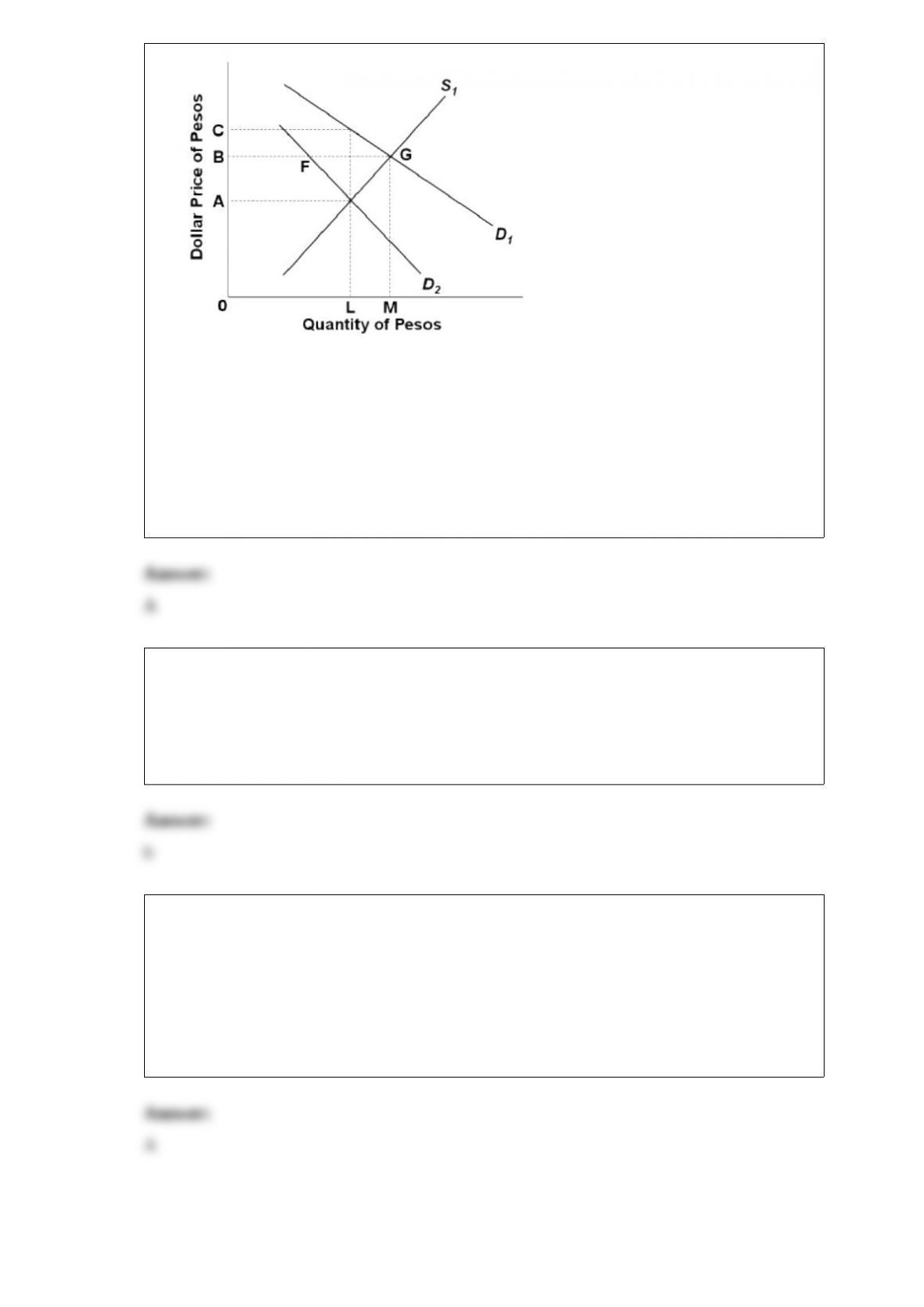
14)
Refer to the above diagram. The initial demand for and supply of pesos are shown by
D1 and S1. Suppose the United States reduces its imports of Mexican goods, shifting its
demand for pesos from D1 to D2. If the United States and Mexico were both on the
international gold standard:
A.gold would flow from Mexico to the United States.
B.the exchange rate would rise from B dollars equals 1 peso to C dollars equals 1 peso.
C.gold would flow from the United States to Mexico.
D.the exchange rate would fall from B dollars equals 1 peso to A dollars equals 1 peso.
15) in the simple circular flow model:
a.households are buyers of resources.
b.businesses are sellers of final products.
c.households are sellers of final products.
d.there are real flows of goods, services, and resources, but not money flows.
16) The XYZ Corporation can make a real (inflation-adjusted) return on an investment
of 9 percent. The nominal rate of interest is 13 percent and the rate of inflation is 7
percent. We can conclude that the:
A.investment will be profitable.
B.investment will be unprofitable.
C.real rate of interest is 4 percent.
D.real rate of interest is 2 percent.