
1) The value of the marginal product of labor can be calculated as the price of the final
good minus the marginal product of labor.
a.True
b.False
2) The market for ice cream is a
a.monopolistic market.
b.highly competitive market.
c.highly organized market.
d.Both b and c are correct.
3) People who grew up in the western part of Aquilonia have an accent distinct from
people who grew up in the eastern part of the country. People from the west also receive
lower wages than people from the east. From this information alone, we can conclude
that it is possible that
a.discrimination against people from the west exists.
b.people from the east receive compensating differentials.
c.people from the west have lower levels of human capital.
d.All of the above could be correct.
4) Figure 10-10
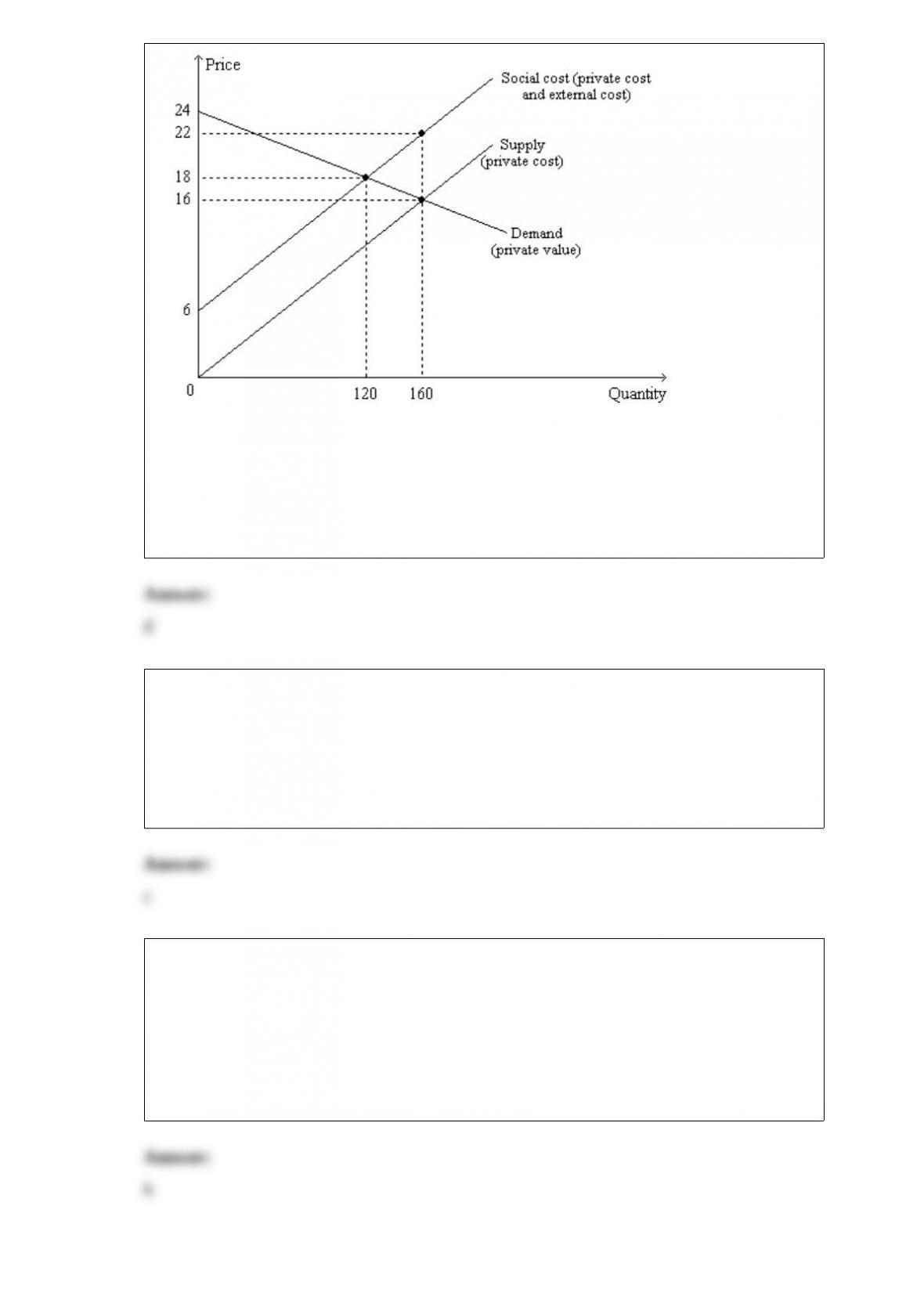
Which of the following statements is correct?
a.The private cost of producing the 160th unit of output is $16.
b.The social cost of producing the 160th unit of output is $22.
c.The external cost of producing the 160th unit of output is $6.
d.All of the above are correct.
5) When a market is characterized by an externality, the government
a.can correct the market failure only in the case of positive externalities.
b.can correct the market failure only in the case of negative externalities.
c.can correct the market failure in the case of both positive and negative externalities by
inducing market participants to internalize the externality.
d.cannot correct for externalities due to the existence of patents.
6) The Big Blue Sky jet company has long-run total costs of $20 million if it produces 5
jets and long-run total costs of $24 million if it produces 6 jets. The Big Blue Sky jet
company is experiencing
a.economies of scale.
b.constant returns to scale.
c.diseconomies of scale.
d.negative profits.

7) The amount of goods and services produced from each unit of labor input is called
a.opportunity cost.
b.productivity.
c.externality.
d.marginal benefit.
8) An increase in population can be expected to
a.increase the marginal product of land.
b.decrease the supply of land.
c.decrease the rents on land.
d.decrease the demand for land.
9) The deadweight loss that arises from a monopoly is a consequence of the fact that the
monopoly
a.quantity is lower than the socially-optimal quantity.
b.price equals marginal revenue.
c.price is the same as average revenue.
d.earns positive profits.
10) To determine the optimal level of output in a market with negative externalities, a
benevolent social planner would look for the level of output at which private cost
equals private value.
a.True
b.False
11) Kelly and David are both capable of repairing cars and cooking meals. Which of the
following scenarios is not possible?
a.Kelly has a comparative advantage in repairing cars and David has a comparative
advantage in cooking meals.
b.Kelly has an absolute advantage in repairing cars and David has an absolute
advantage in cooking meals.
c.Kelly has a comparative advantage in repairing cars and in cooking meals.
d.David has an absolute advantage in repairing cars and in cooking meals.