
A put option is a contract
a. that gives the owner the right, but not the obligation, to buy shares of a stock at a
specified price within the time limits of the contract.
b. that gives the owner the right, but not the obligation, to sell shares of a stock at a
specified price within the time limits of the contract.
c. in which the seller agrees to provide a particular good to the buyer on a specified
future date at an agreed-upon price.
d. that gives the owner the right, but not the obligation, to buy or sell shares of a stock
at a specified price within the time limits of the contract.
There is a flexible exchange rate system and only two countries in the world, the United
States and Mexico. The real interest rate in the United States rises relative to the real
interest rate in Mexico. It follows that
a. the dollar will depreciate and the peso will appreciate.
b. the peso will depreciate and the dollar will appreciate.
c. both the peso and the dollar are likely to appreciate.
d. both the peso and the dollar are likely to depreciate.
Economies of scale, constant returns to scale and diseconomies of scale account for the
shape of the __________ cost curve.
a. average variable

b. average fixed
c. long-run average total
d. short-run average total
e. marginal
If you are buying a bond that is newly issued by the corporation, you are buying it in
the primary market.
a. True
b. False
A __________ good is one that once produced and provided to one person, provides
benefits to other persons.
a. consumption
b. investment
c. private
d. public

When positive externalities are involved, the market is said to
a. fail, because it underproduces the good connected with the positive externality.
b. fail, because it overproduces the good connected with the positive externality.
c. succeed, because it produces the socially optimal quantity of the good connected with
the positive externality.
d. be “in optimum,” because the equilibrium fully adjusts for the positive externality.
Refer to Exhibit 27-3. The marginal factor cost (MFC) of the fourth unit of labor is
Exhibit 27-3
a. greater than $10 if the firm expects to hire the fourth worker.
b. the same as the MFC of the first unit.
c. less than the wage rate.
d. equal to the wage rate.
e. b and d
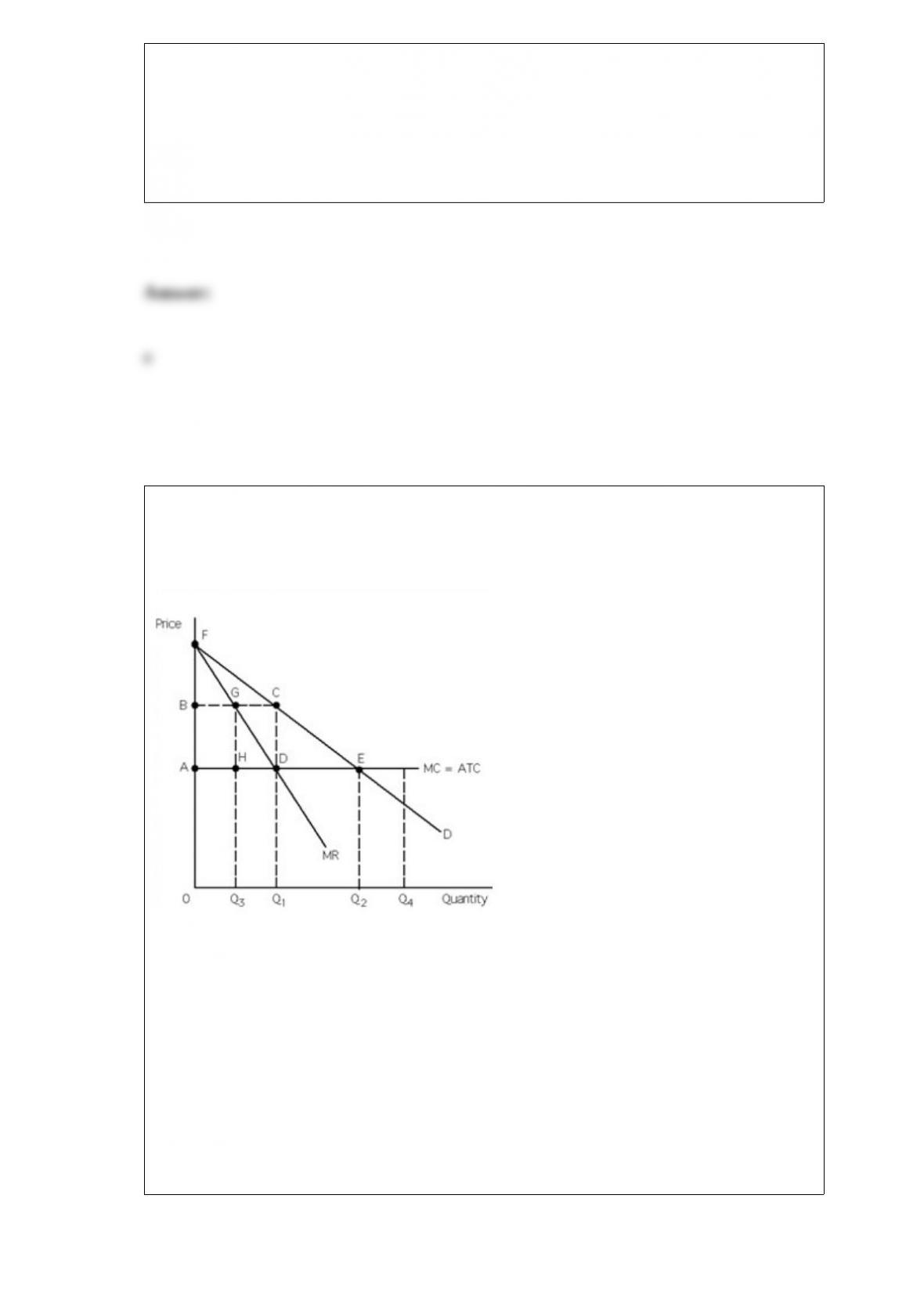
Refer to Exhibit 24-10. The profit-maximizing single-price monopolist incurs total cost
equal to what area?
Exhibit 24-10
a. 0BCQ1
b. 0ADQ1
c. 0AEQ2
d. ABCD
e. GFC

If a 5 percent reduction in the price of a commodity results in a 3 percent increase in the
quantity demanded, demand is said to be
a. perfectly elastic.
b. elastic.
c. unit elastic.
d. inelastic.
e. perfectly inelastic.
If the government grants tax credits to first-time homebuyers, the supply of houses
would increase and the price of housing would fall.
a. True
b. False
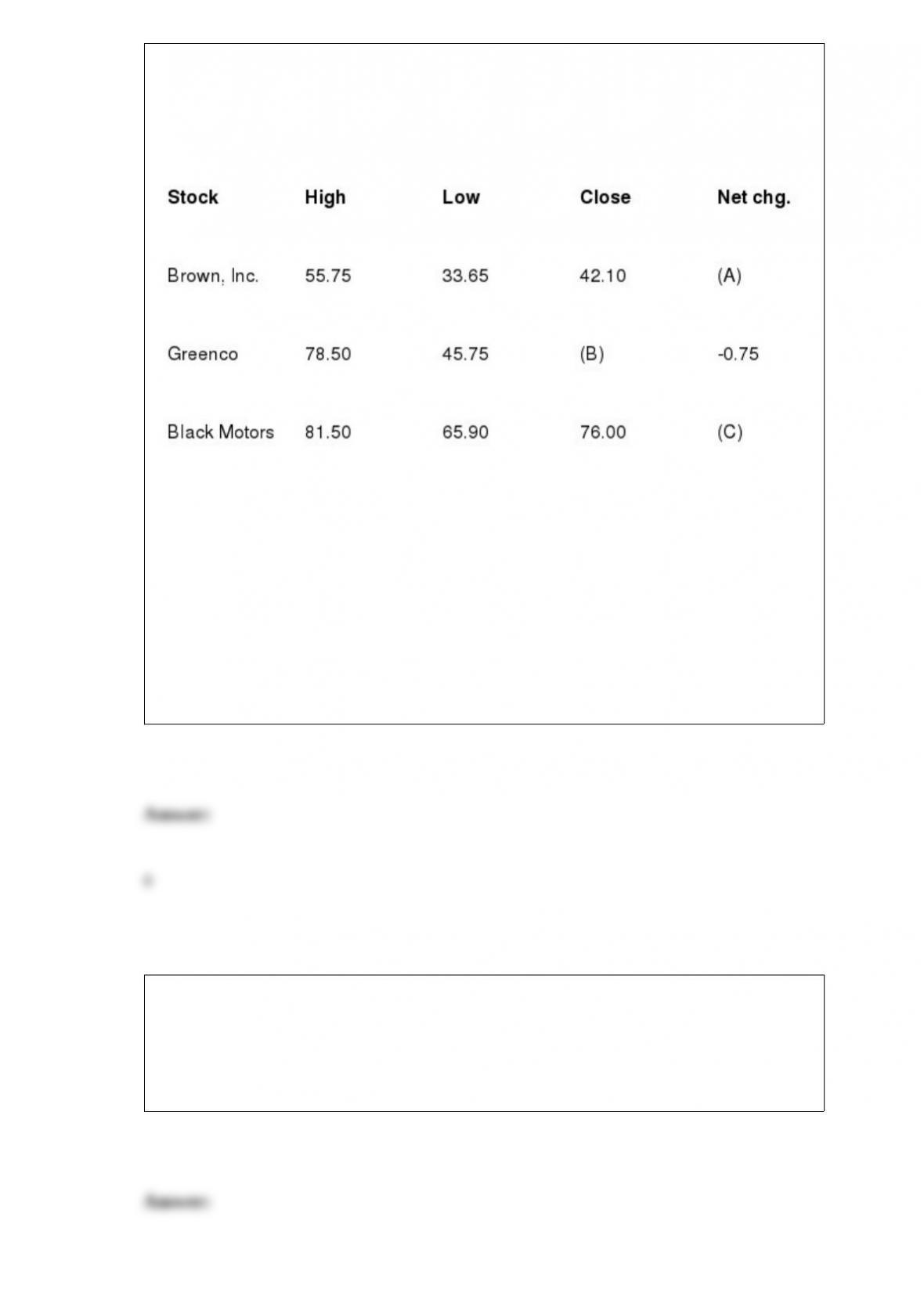
Refer to Exhibit 38-4.If the closing price of Brown, Inc.’s stock on the previous day was
$43.10, what value goes in blank (A)?
Exhibit 38-4
a. -1.00
b. +1.00
c. -0.50
d. +0.50
e. There is not enough information given to answer this question.
The interest paid on corporate bonds is not subject to federal taxes.
a. True
b. False

In all cases, normative economics deals with
a. what is.
b. what should be.
c. relatively small units in the economy.
d. the entire economy.
Which of the following statements is false?
a. To an economist, the resource land includes natural resources such as minerals,
forests, water and unimproved land.
b. To an economist, the resource capital consists of unproduced goods that can be
turned into produced goods.
c. To an economist, the resource labor consists of the physical and mental talents people
contribute to the production process.
d. To an economist, the resource entrepreneurship refers to a particular talent that some
people have for organizing the resources of land, labor, and capital to produce goods,
seek new business opportunities, and develop new ways of doing things.

Company Z is a U.S. company that has just entered the market for a given good and is
the first in this country to produce that good.The good is already being produced in
many foreign countries is exported to the United States. If company Z wants to restrict
this foreign competition, it will most likely use which of the following arguments?
a. anti-dumping
b. national-defense
c. job-creation
d. infant-industry
e. low-foreign-wages
The Sherman Act of 1890 was passed with the intent of
a. establishing the Federal Trade Commission (FTC) to deal with “unfair methods of
competition.”
b. preventing monopolization and/or conspiracy in the restraint of trade.
c. spelling out the conditions under which mergers would be considered
anti-competitive.
d. dealing with false and deceptive advertising.
e. declaring interlocking directorates illegal.

Unions are interested in increasing the productivity of their members because as their
productivity rises, the __________ their labor __________ and their wages
__________.
a. demand for; falls; rise.
b. demand for; rises; rise.
c. supply of; rises; rise.
d. supply of; falls; rise.
If marginal cost is rising, average variable cost must also be rising.
a. True
b. False
Making a manager a residual claimant is often a way of
a. forming a partnership.
b. increasing the efficiency of a nonprofit firm.
c. reducing the incentive of the manager to shirk.
d. redirecting the firm to the objective of revenue maximization.

If the absolute price of a new car is $40,000 and the relative price of a laptop computer
in terms of cars is 1/40 of a car, it follows that the absolute price of the laptop is
a. $10,000.
b. $1,000.
c. $4,000.
d. $2,000.
e. $1,500.
When a firm produces the quantity of output where price equals marginal cost, it has
achieved resource allocative efficiency.
a. True
b. False

Marginal social benefits are equal to
a. marginal private benefits + marginal internal benefits.
b. marginal private benefits – marginal internal benefits.
c. marginal private benefits + marginal external benefits.
d. marginal private benefits – marginal external benefits.