
1) If the number of buyers in a market decreases, then
a.demand will increase.
b.demand will decrease.
c.supply will increase.
d.supply will decrease.
2) If the income elasticity of demand for a good is negative, then the good must be an
inferior good.
a.True
b.False
3) Budget constraints exist for consumers because
a.their utility from consuming goods eventually reaches a maximum level.
b.even with unlimited incomes they have to pay for each good they consume.
c.they have to pay for goods, and they have limited incomes.
d.prices and incomes are inversely related.
4) A negative externality arises when a person engages in an activity that has
a.an adverse effect on a bystander who is not compensated by the person who causes
the effect.
b.an adverse effect on a bystander who is compensated by the person who causes the
effect.
c.a beneficial effect on a bystander who pays the person who causes the effect.
d.a beneficial effect on a bystander who does not pay the person who causes the effect.
5) If income increases and prices are unchanged, the consumer’s budget constraint
a.remains the same.
b.shifts outward.
c.shifts inward.
d.rotates outward along the horizontal axis.
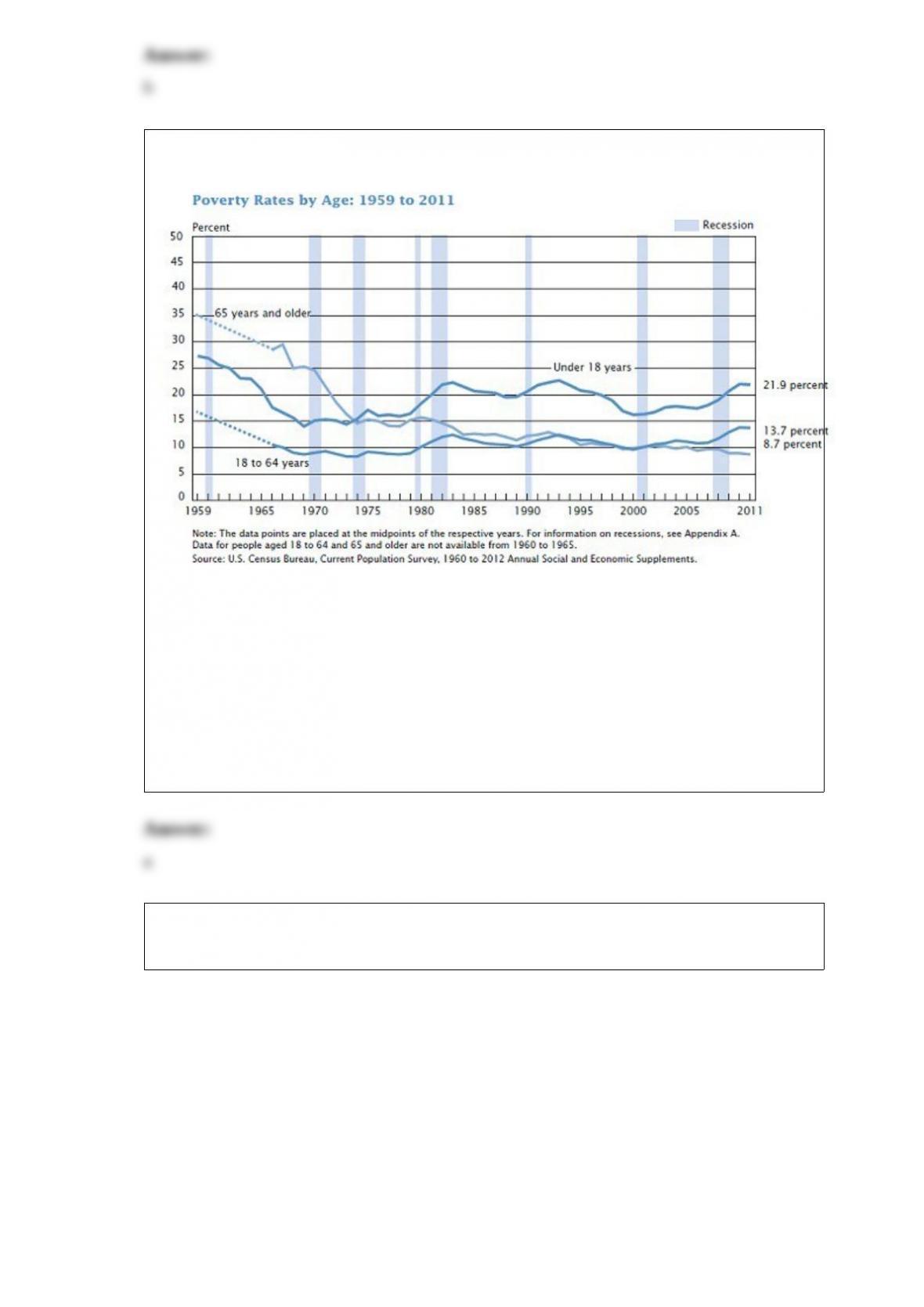
6) Figure 20-3
Refer to Figure 20-3. In 2011, the percent of children under age 18 in poverty is
a.higher than both the percentage of adults aged 18 to 64 and the percentage of elderly
aged 65 years and over in poverty.
b.higher than the percentage of adults aged 18 to 64 but is lower than the percentage of
elderly aged 65 years and over in poverty.
c.lower than both the percentage of adults aged 18 to 64 and the percentage of elderly
aged 65 years and over in poverty.
d.lower than the percentage of adults aged 18 to 64 but is higher than the percentage of
elderly aged 65 years and over in poverty.
7) Figure 9-5
The figure illustrates the market for tricycles in a country.
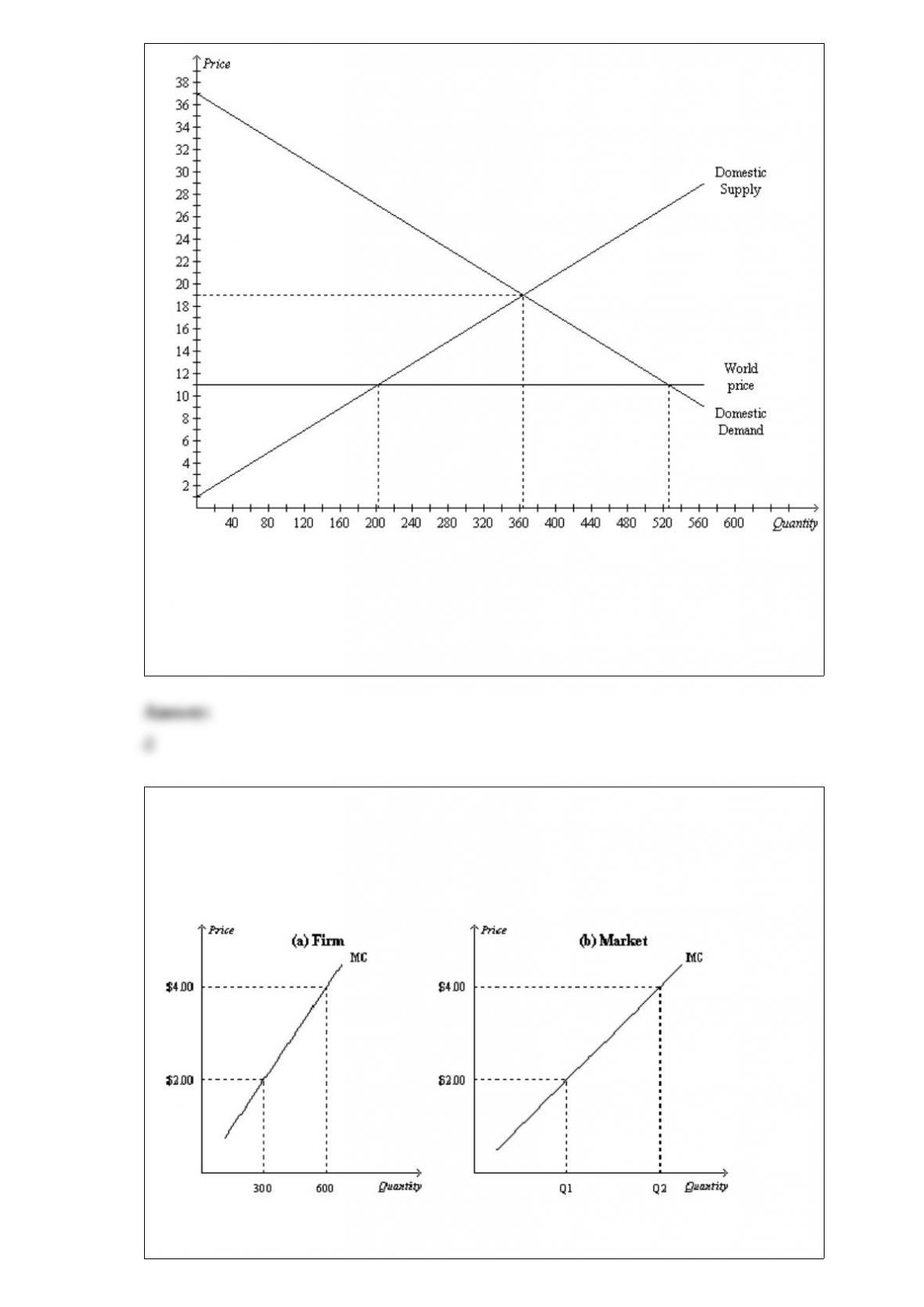
With trade, this country
a.exports 160 tricycles.
b.exports 320 tricycles.
c.imports 160 tricycles.
d.imports 320 tricycles.
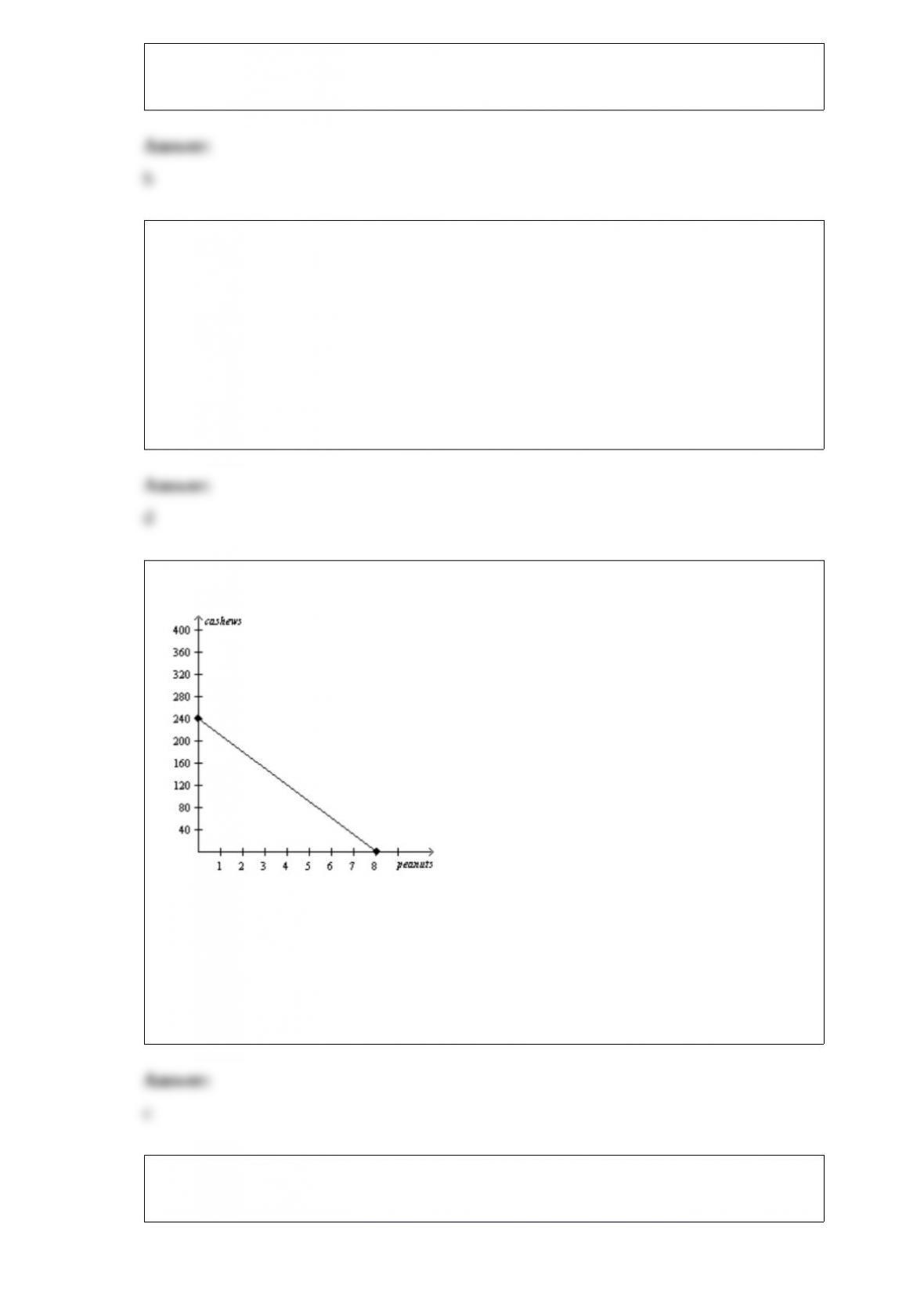
8) Figure 14-10
In the figure below, panel (a) depicts the linear marginal cost of a firm in a competitive
market, and panel (b) depicts the linear market supply curve for a market with a fixed
number of identical firms.
If there are 700 identical firms in this market, what is the value of Q1? a. 140,000
b. 210,000
c. 280,000
d. 420,000
9) An increase in the supply of labor
a.increases the equilibrium wage and increases the value of the marginal product of
labor.
b.increases the equilibrium wage and decreases the value of the marginal product of
labor.
c.decreases the equilibrium wage and increases the value of the marginal product of
labor.
d.decreases the equilibrium wage and decreases the value of the marginal product of
labor.
10) Brazil’s Production Possibilities Frontier
If the production possibilities frontier shown is for 24 hours of production, then how
long does it take Brazil to make one peanut?
a.1/10 hour
b.1/3 hour
c.3 hours
d.10 hours
11) Canada’s Production Possibilities FrontierMexico’s Production Possibilities
Frontier
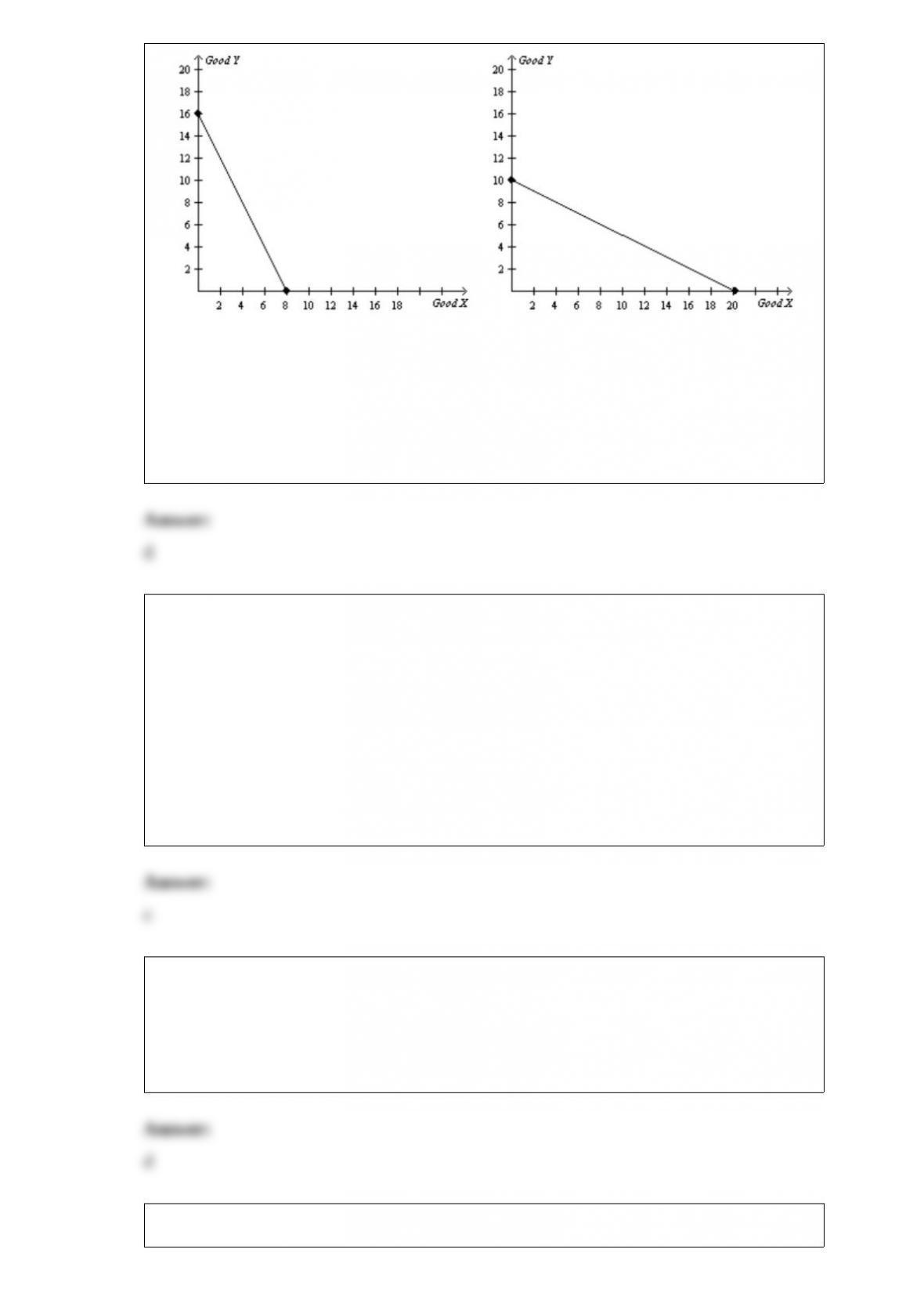
Canada would incur an opportunity cost of 6 units of Good X if it increased its
production of Good Y by
a.3 units.
b.6 units.
c.9 units.
d.12 units.
12) Consider the labor market for short-order cooks. An increase in the wages paid to
fast-food workers will cause
a.both equilibrium wages and equilibrium employment to increase in the market for
short-order cooks.
b.both equilibrium wages and equilibrium employment to decrease in the market for
short-order cooks.
c.equilibrium wages to increase and equilibrium employment to decrease in the market
for short-order cooks.
d.equilibrium wages to decrease and equilibrium employment to increase in the market
for short-order cooks.
13) Which of the following could be used to calculate the profit for a firm?
a.Profit = MR – MC
b.Profit = MR – TC
c.Profit = (P – MC) x Q
d.Profit = (P – ATC) x Q
14) Economists may disagree about the validity of alternative positive theories about

how the world works.
a.True
b.False
15) Graphically demonstrate the conditions associated with a consumer optimum.
Carefully label all curves and axes.
16) Give an example of a trade-off faced by society.
17) Give an example of government intervention that is intended to reduce an
externality.
18) If income rises in the market for a normal good, will the demand curve for the
normal good shift to the right or to the left?
19) Suppose the demand schedule in a market can be represented by the equation
QD=500-10P, where QD is the quantity demanded and is the price. Also, suppose the
supply schedule can be
represented by the equation QS=200+10P, where QS is the quantity supplied.
What is the equilibrium price in this market?

20) Compare the equilibrium output in a duopoly to the monopoly output.