Figure 5-9
Companies producing toilet paper bleach the paper to make it white. The bleach is
discharged into rivers and lakes and causes substantial environmental damage. Figure
5-9 illustrates the situation in the toilet paper market.
The efficient output is
A) Q1.
B) Q2.
C) Q3.
D) Q4.
Table 2-18
Table 2-18 shows the output per week of two people, Minnie and Mickey. They can
either devote their time to making hats or making umbrellas. What is Mickey’s
opportunity cost of making a hat?

A) 1/10 of an umbrella
B) 1/5 of an umbrella
C) 5 umbrellas
D) 10 umbrellas
Suppose Jason owns a small pastry shop. Jason wants to maximize his profit, and
thinking back to the college microeconomics class he took in college, he decides he
needs to produce a quantity of pastries which will minimize his average total cost. Will
Jason’s strategy necessarily maximize profits for his pastry shop?
A) Yes; Since jason’s pastry shop is in a perfectly competitive market, the only way to
maximize profit is to produce the quantity where average total cost is minimized.
B) Not necessarily; This strategy will only maximize Jason’s profit in the long run, but
not in the short run.
C) No; In order to maximize profit, Jason would never want to produce the quantity
where average total cost is minimized.
D) Not necessarily; Depending on demand, Jason may maximize profit by producing a
quantity other than that where average total cost is at a minimum.
Figure 9-3
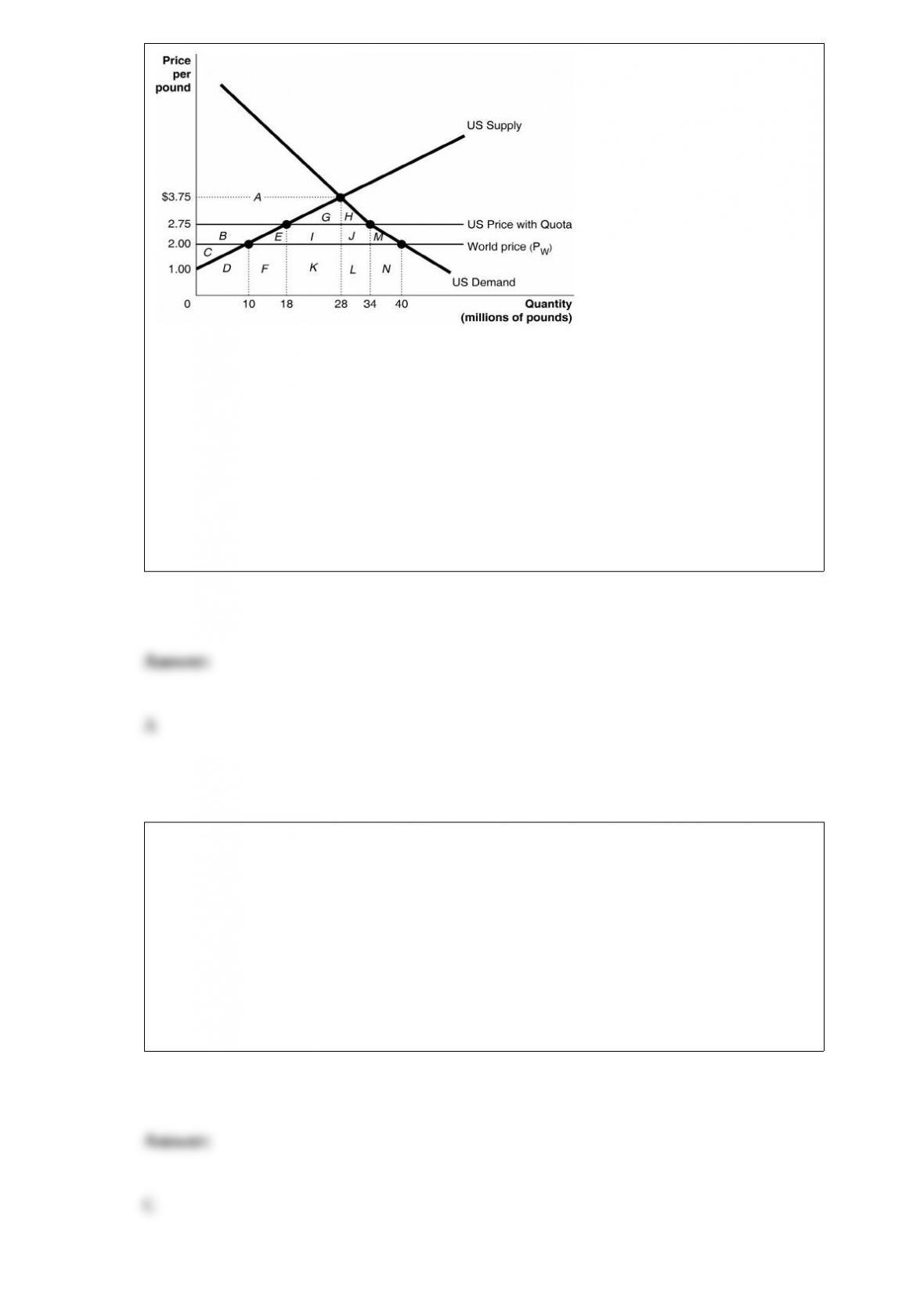
Since 1953 the United States
has imposed a quota to limit the imports of peanuts. Figure 9-3 illustrates the impact of
the quota. What is the area of consumer surplus after the imposition of the quota?
A) A + G + H
B) G + H + E + I+ J + M
C) G + H
D) A
Which of the following is an example of an implicit cost a firm might incur?
A) the out-of-pocket expense to hire resources
B) taxes owed to the state and Federal governments
C) the rental value of the office space the company owns and uses for itself
D) the revenue a firm generates in using its resources

The demand curve for a Giffen good is
A) non-linear but downward-sloping.
B) vertical.
C) upward-sloping.
D) non-existent.
Examples of comparative advantage show how trade between two countries can make
each better off. Compared to their pre-trade positions, trade makes both countries better
off because in each country
A) total employment is greater.
B) total consumption of goods is greater.
C) wages are higher.
D) total welfare is greater.
Firms such as Caribou Coffee and Diedrich Coffee operate hundreds of coffeehouses
nationwide while firms such as Dunn Brothers Coffee operate only in four states. How
would you characterize these stores?
A) Caribou Coffee and Diedrich Coffee are oligopolists while Dunn Brothers is a

monopolistic competitor.
B) Caribou Coffee and Diedrich Coffee are duopolists while Dunn Brothers is a
monopolistic competitor.
C) Caribou Coffee and Diedrich Coffee are duopolists while Dunn Brothers is an
oligopolist
D) They are all monopolistic competitors.
If workers leave a country to seek out better opportunities in another country, then this
will
A) shift the short-run aggregate supply curve of the original country to the left.
B) shift the short-run aggregate supply curve of the original country to the right.
C) move the original economy up along a stationary short-run aggregate supply curve.
D) move the original economy down along a stationary short-run aggregate supply
curve.
If net exports are equal to net foreign investment, which of the following is not true?
A) The balance of payments is zero.
B) The current account balance is equal to the negative of the financial account balance.
C) Net capital inflows are equal to imports minus exports.

D) The balance on the financial account is zero.
In the United States, the largest source of funds for public schools is
A) the federal income tax.
B) the property tax.
C) the consumption tax.
D) sales taxes.
Suppose Jason owns a small pastry shop. Jason wants to maximize his profit, and
thinking back to the college microeconomics class he took in college, he decides he
needs to produce a quantity of pastries which will minimize his average total cost. Will
Jason’s strategy necessarily maximize profits for his pastry shop?
A) Yes; since Jason’s pastry shop is in a perfectly competitive market, the only way to
maximize profit is to produce the quantity where average total cost is minimized.
B) Not necessarily; this strategy will only maximize Jason’s profit in the long run, but
not in the short run.
C) No; in order to maximize profit, Jason would never want to produce the quantity
where average total cost is minimized.
D) Not necessarily; depending on demand, Jason may maximize profit by producing a
quantity other than that where average total cost is at a minimum.
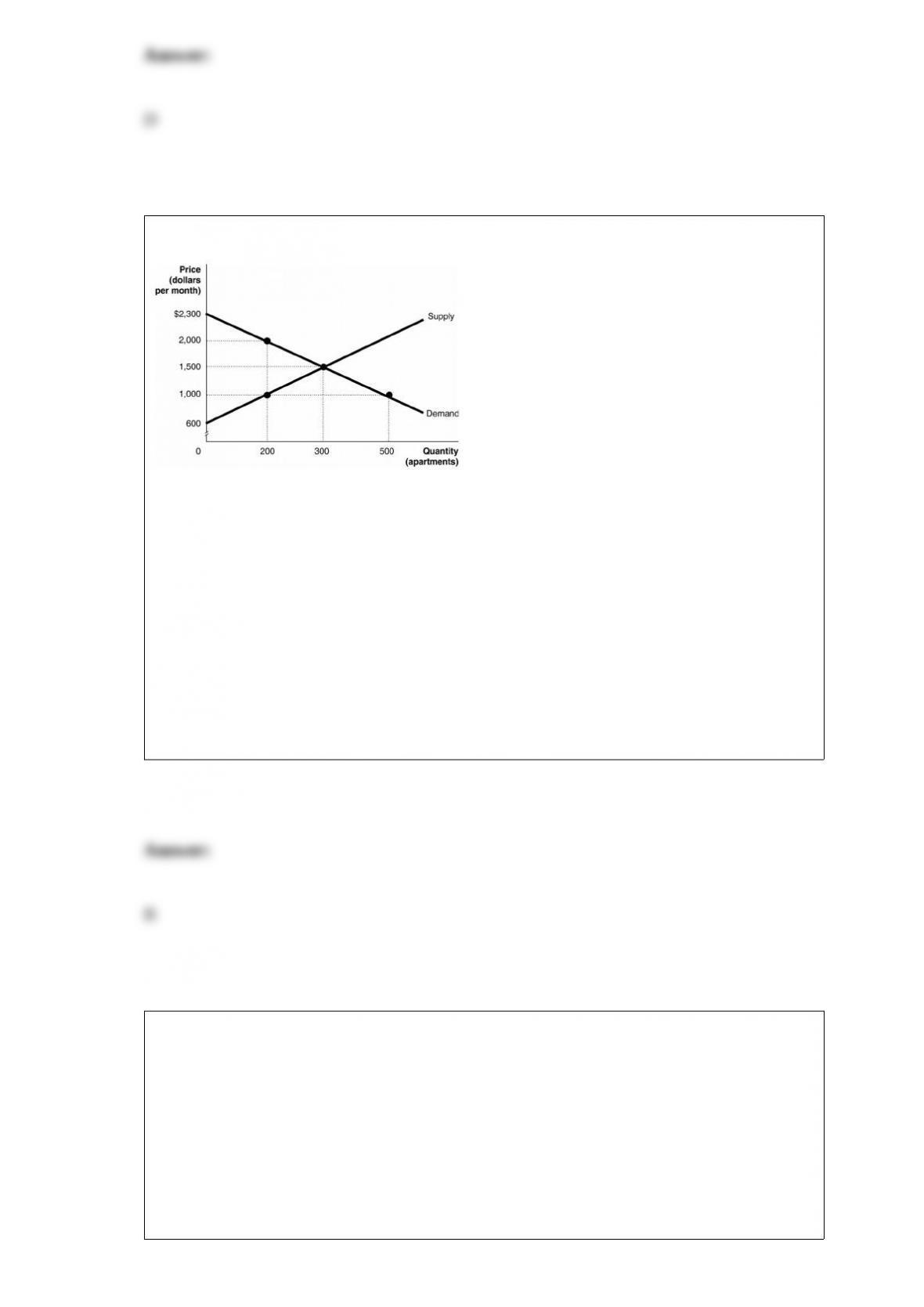
Figure 4-5
Figure 4-5 shows the market for apartments in
Springfield. Recently, the government imposed a rent ceiling of $1,000 per month.
What is the value of the portion of producer surplus transferred to consumers as a result
of the rent ceiling?
A) $40,000
B) $100,000
C) $125,000
D) $140,000
Most movie theatres charge different prices to different groups of customers for movie
admission but not on movie popcorn. Which of the following is a reason for this?
A) because the markup on movie popcorn is very high and movie theatres do not want
to forego this source of revenue
B) because the demand for popcorn is very high relative to the demand for movie
admissions
C) because it is easier to limit resale in movie admissions but not in popcorn
D) because the cost of operating a concession stand in a movie theatre is very high
compared to the cost of showing a movie
According to the World Bank, GDP per capita ________ in the least corrupt countries
than in the most corrupt countries.
A) is more than 50 percent less
B) is roughly the same
C) is twice as high
D) is more than 10 times higher
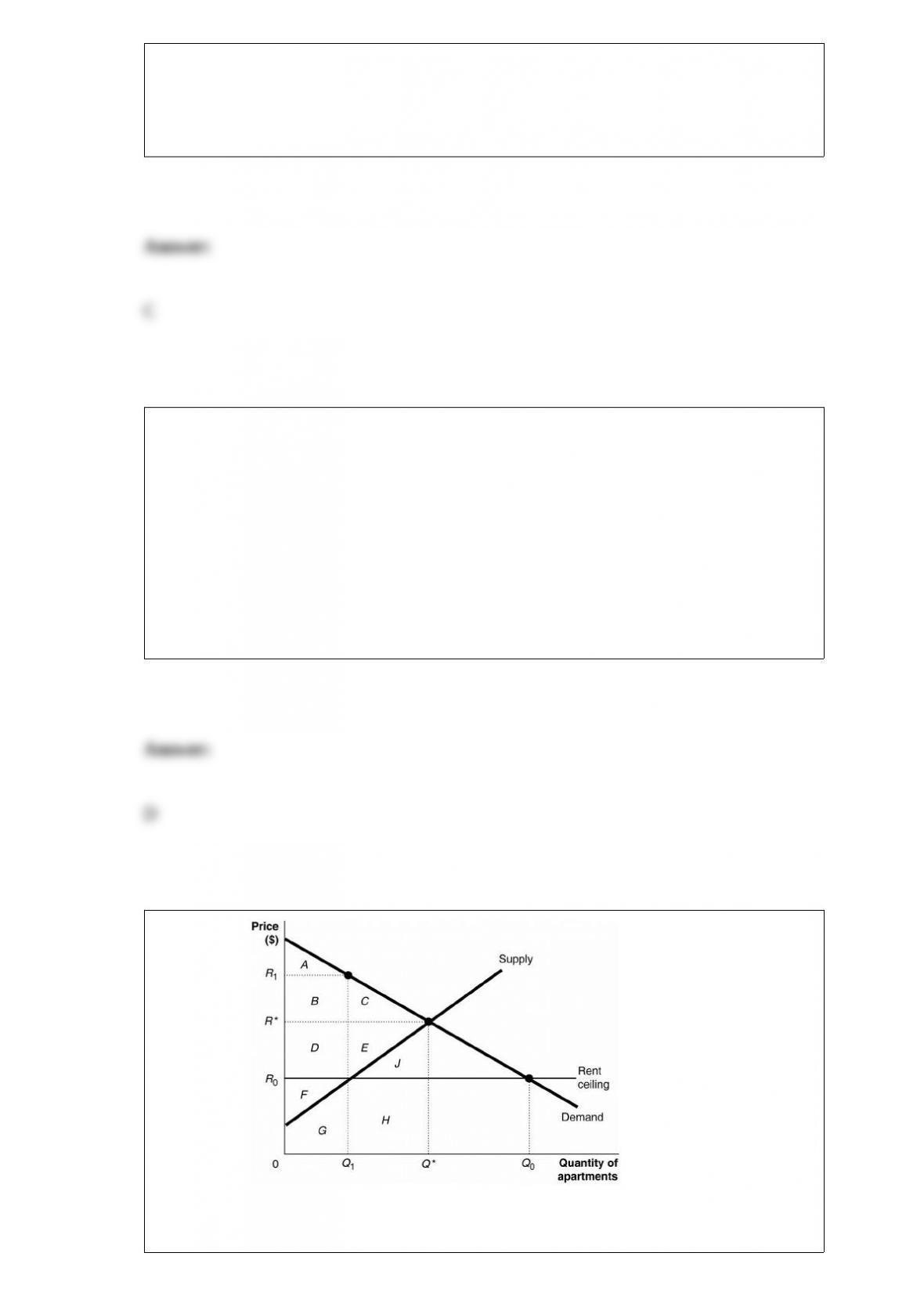
Figure 4-10 Figure 4-10 shows the
market for apartments in Bay City. Recently, the government imposed a rent ceiling at
R0. Suppose that instead of a price ceiling, the government imposed a price floor of R1.
What is the area representing the portion of consumer surplus transferred to producers
as a result of the price floor?
A) A
B) B
C) B + C
D) A + B
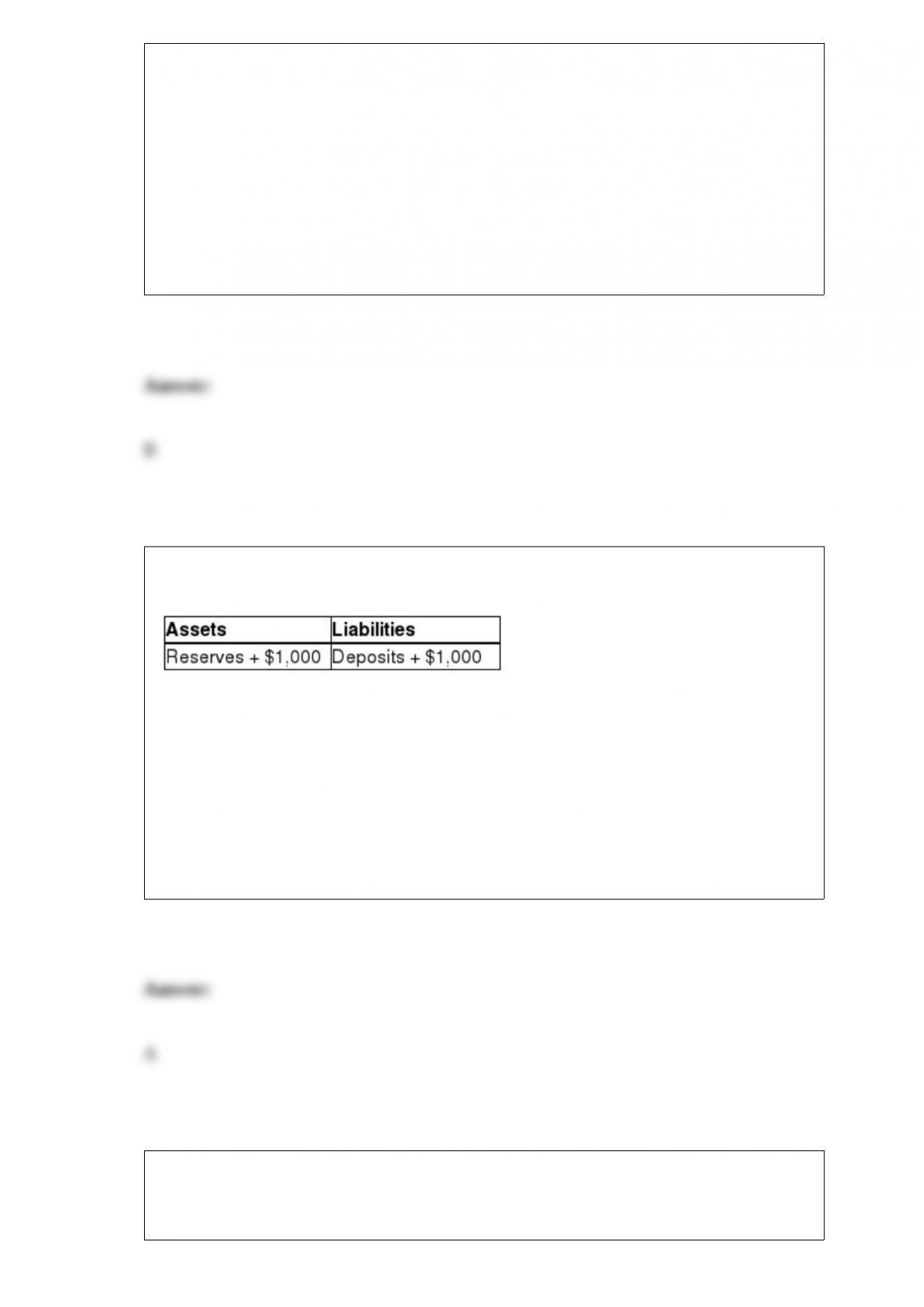
Suppose a transaction changes the balance sheet of Wells Fargo bank as indicated in the
following T-account.
At this point, what percentage of the new deposits does Wells Fargo hold in reserves?
A) 100 percent
B) 10 percent
C) 5 percent
D) 1 percent
In the United States, consumers usually pay less than the true cost of medical treatment
because of ________.

A) adverse selection
B) rising insurance premiums
C) third-party payers
D) rising insurance deductibles
Recessions cause the unemployment rate to ________ and the inflation rate to
________.
A) rise; rise
B) rise; fall
C) fall; rise
D) fall; fall