
If an economist says “the higher the price of oranges, the fewer oranges individuals will
buy, ceteris paribus,” this means that
a. individuals don’t like high-priced oranges.
b. as the price of oranges rises, individuals’ preferences change and they no longer like
oranges as much as they once did.
c. as the price of oranges rises, individuals’ preferences do not change, nor does
anything else, but individuals buy fewer oranges in response to the higher price of
oranges.
d. the higher the price of oranges, the fewer oranges individuals will buy, assuming that
people have economic motives.
The Federal Trade Commission Act of 1914
a. made conspiracy in the restraint of trade illegal.
b. made price discrimination, exclusive dealing, tying contracts, and the acquisition of
competing companies’ stock illegal when they ‘substantially lessen competition or tend
to create a monopoly.”
c. declared “unfair methods of competition in commerce” illegal.
d. attempted to decrease the failure rate of small businesses by protecting them from the
competition of large and growing chain stores.
e. banned anticompetitive mergers that occurred as a result of one company acquiring
the physical assets of another company.
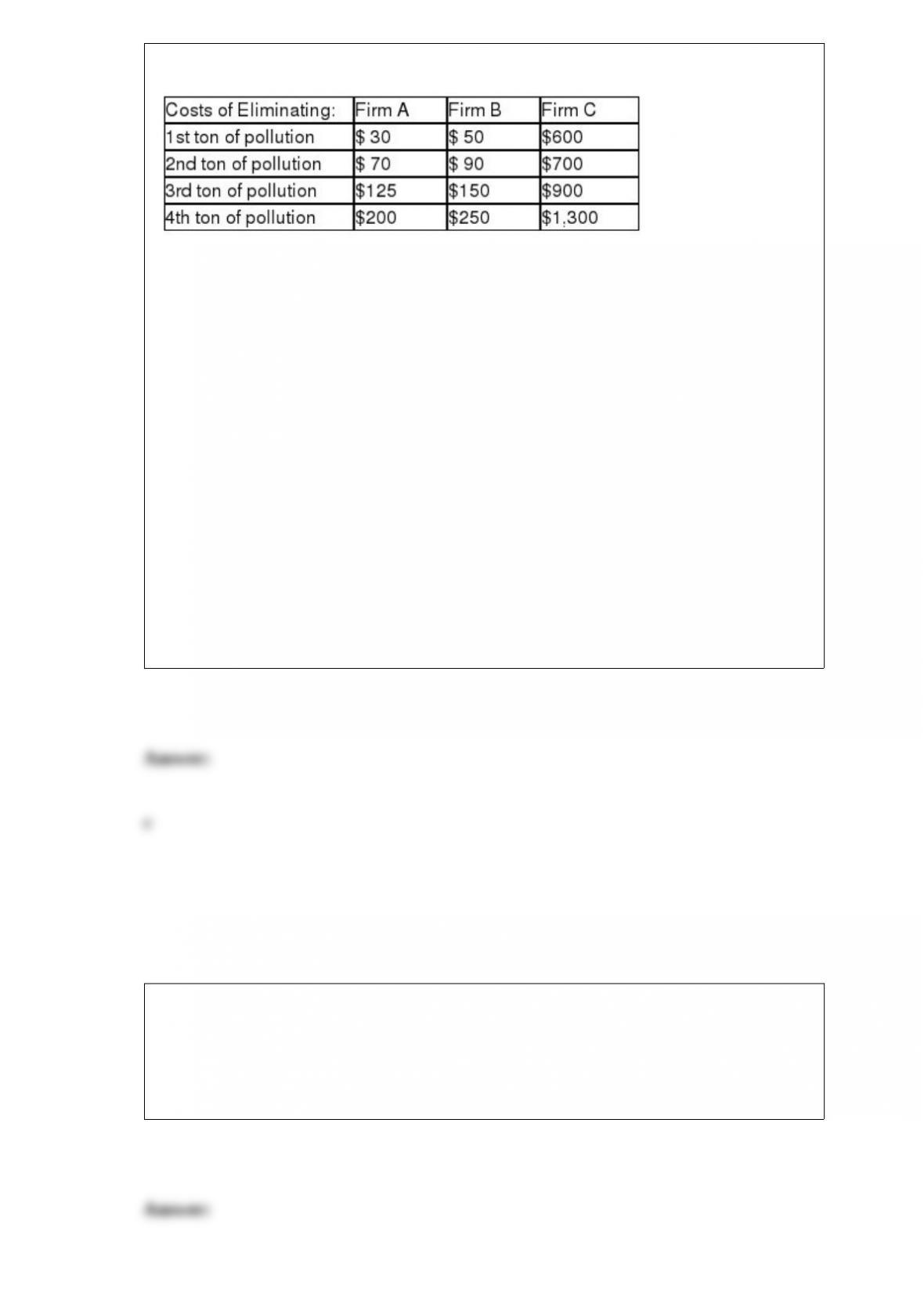
Exhibit 31-3
Suppose that Firms A, B, and C are the only polluters in the state and that each emits 4
tons of pollution into the atmosphere. To cut the level of pollution in half the
government issues two transferable pollution permits to each firm (a cap and trade
policy).What is the total cost savings to society of decreasing pollution to half its
present level if firm C buys one pollution permit from firm A and one pollution permit
from firm B compared to if there were a government mandate for each firm to cut
pollution by one-half?
a. $515
b. $1,300
c. $1,380
d. $965
e. $1,025
As a result of a quota, both consumers’ surplus and producers€ surplus fall.
a. True
b. False

An economy can produce the following combinations of goods: 50X and 0Y, 40X and
10Y, 30X and 20Y, 20X and 30Y, 10X and 40Y, and 0X and 50Y. The production
possibilities frontier (PPF) for the economy is
a. concave downward because the opportunity cost of producing the 10th unit of Y is
greater than the opportunity cost of producing the first unit of Y.
b. a straight (downward-sloping) line because the opportunity cost of producing the two
goods is constant.
c. concave downward because the opportunity cost of producing the 40th unit of Y is
less than the opportunity cost of producing the 10th unit of Y.
d. a straight (downward-sloping) line because the opportunity cost of producing the
10th unit of X is greater than the opportunity cost of producing the 40th unit of X.
e. a straight (downward-sloping) line because the opportunity cost of producing the
30th unit of Y is greater than the opportunity cost of producing the 30th unit of X.
Asymmetric information can exist before, but not after, a transaction.
a. True
b. False

A “decrease in demand” means that
a. the demand curve has shifted to the left.
b. price has declined and consumers want to purchase more of the good.
c. the demand curve has shifted to the right.
d. the price of the good can be expected to decline, assuming supply stays constant.
Suppose candidate A is conservative and candidate B is liberal and both are currently
positioned away from the “middle ground” toward their respective ends of the political
spectrum. We would expect that as the campaign draws closer to election day,
a. candidate A will move to the right (more conservative) and candidate B will move to
the left (more liberal).
b. both candidates A and B will move to the other’s position in an attempt to capture the
other’s supporters.
c. candidate A will move closer to the middle, and candidate B will stay where he or she
is because he or she realizes that Americans are basically liberal.
d. candidate B will move closer to the middle, and candidate A will stay where he or she
is because he or she realizes that Americans are basically conservative.
e. both candidates will move toward the middle.
Smith and Jones are different when it comes to taking risk. Smith will assume much
more risk than Jones. It follows that
a. Smith will earn more income than Jones.
b. Jones will earn more income than Smith.
c. Smith has a higher probability than Jones of earning a higher income.
d. Smith has a higher probability than Jones of earning a lower income.
e. c and d
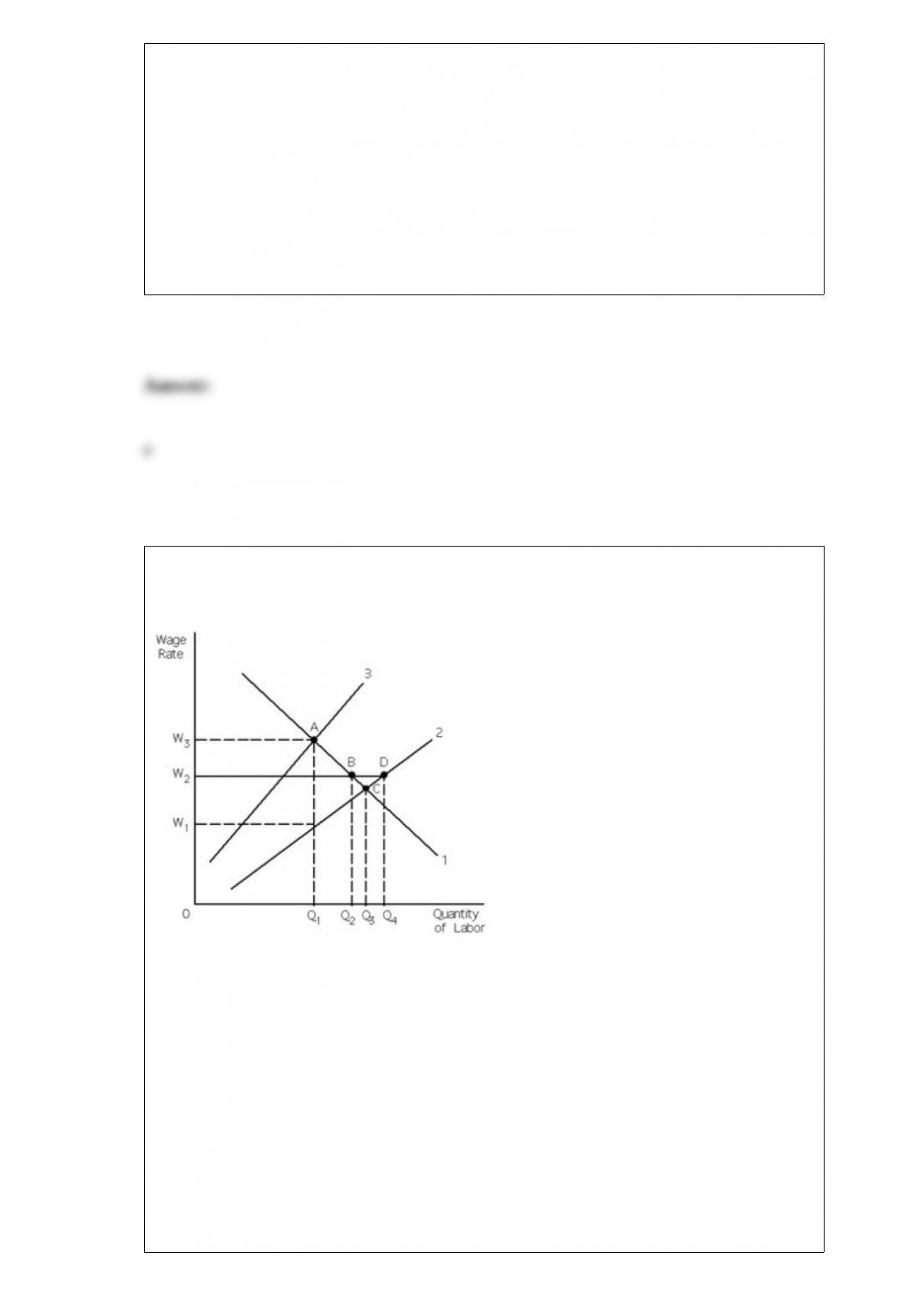
Exhibit 28-11
The firm in the exhibit is a monopsony. We have deliberately not identified the three
curves in the exhibit. They are simply curves 1, 2, and 3. If (union) collective
bargaining with the monopsony guarantees the wage rate that workers will be paid is
W2, then how many more workers will the monopsony hire than it would hire if it could
pay its chosen (or preferred) wage?
a. Q4 – Q1 more workers
b. Q3 – Q2 more workers
c. Q2 – Q1 more workers

d. Q3 – Q1 more workers
e. Q4 – Q3 more workers
A rise in variable input prices will affect
a. fixed costs.
b. variable costs.
c. marginal costs.
d. a, b, and c
e. b and c
Why do societies need rationing devices?
a. Because people have too many needs and not enough wants.
b. Because price exists.
c. Because scarcity exists.
d. Because people have opportunity costs.
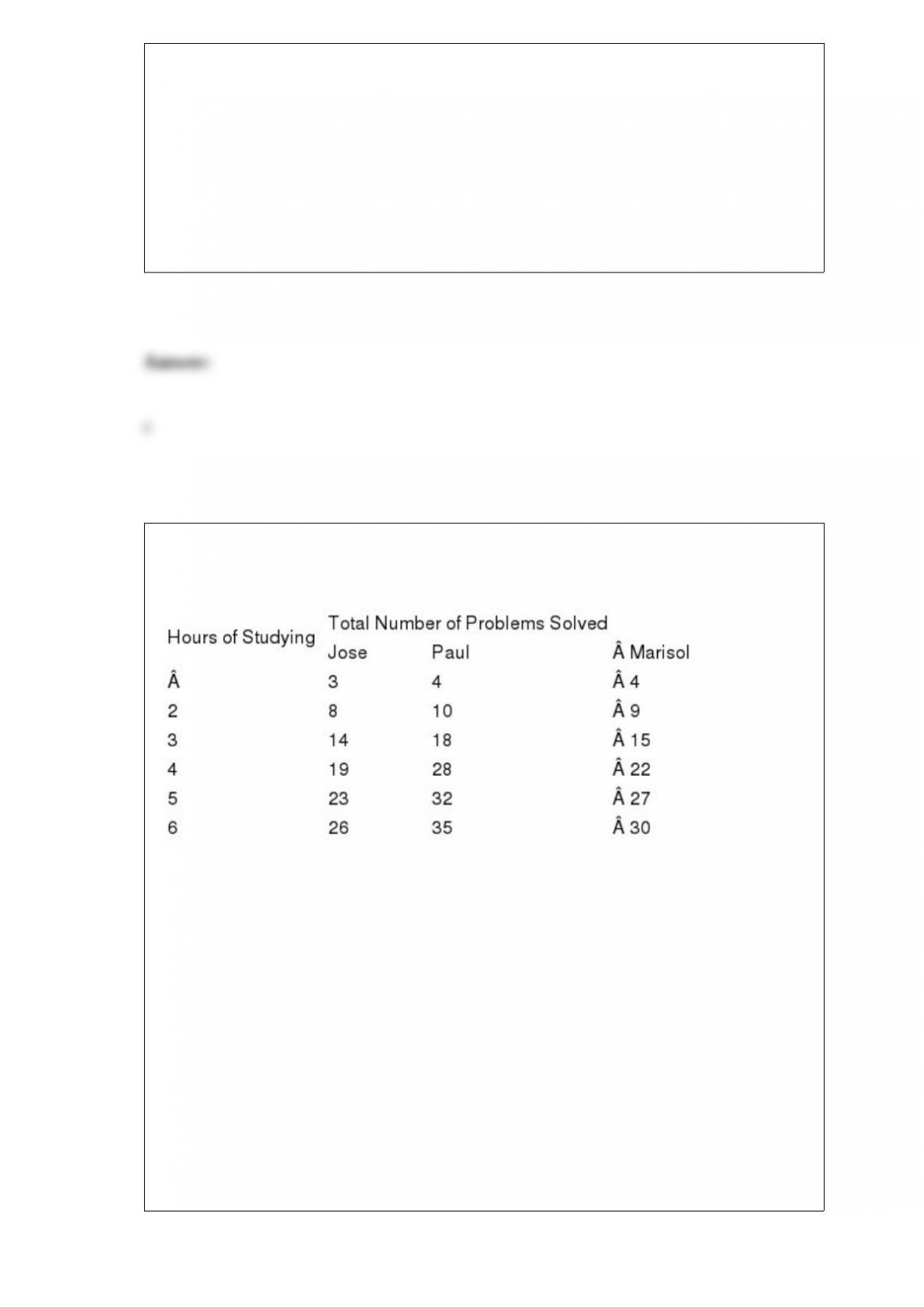
Exhibit 22-10
Professor Jones, who is encouraging the three students to work together in order to be
“more productive,” is implicitly assuming that by working together they will be able to
a. solve more problems in the same amount of time than they would by studying
separately.
b. solve the same number of problems in less time than they would by studying
separately.
c. decrease their marginal products through joint efforts.
d. all of the above
e. a and b
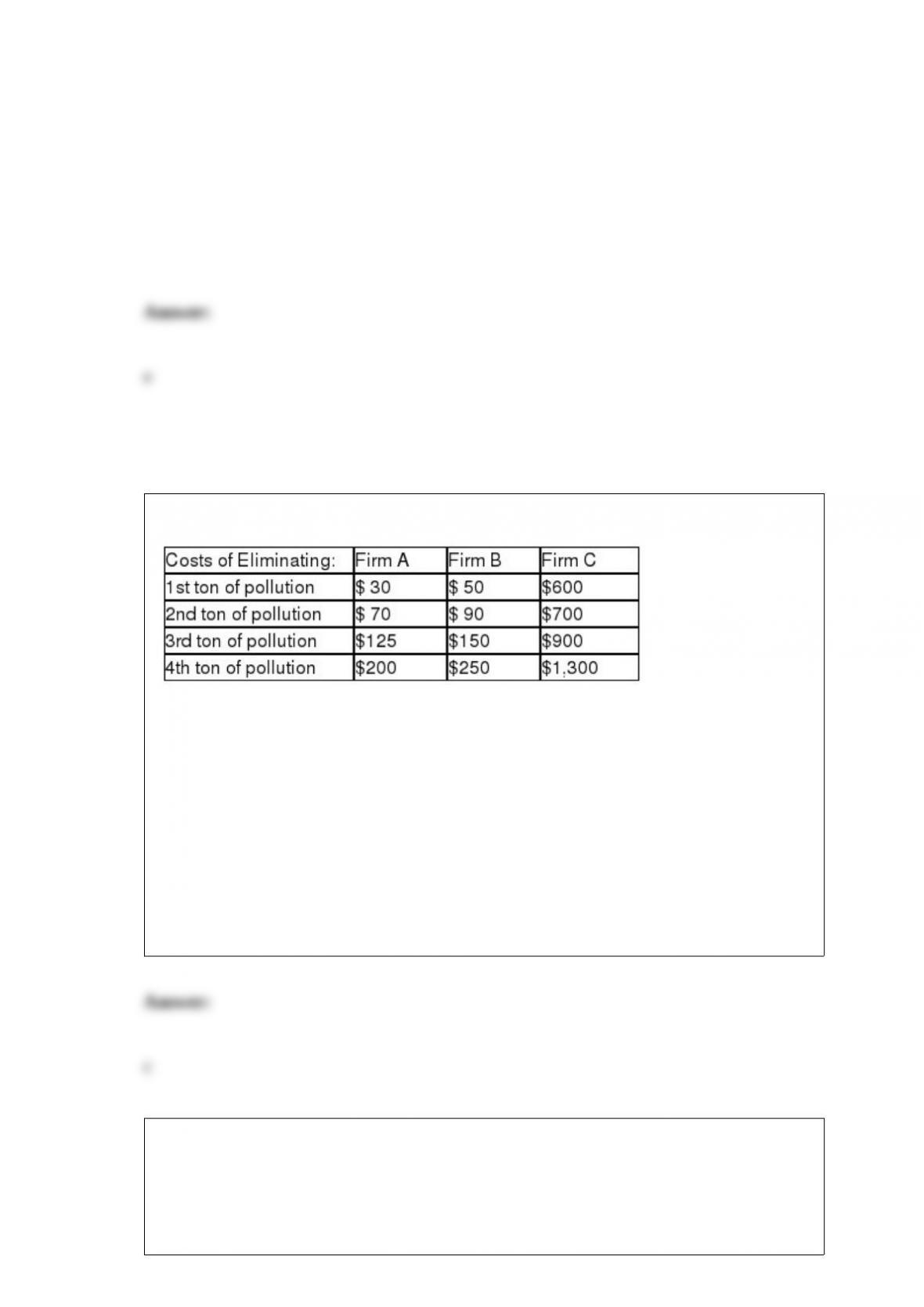
Exhibit 31-3
The government issues two pollution permits to each firm. Firm C will pay up to
__________ to buy a permit from Firm A or B.
a. $2,200
b. $1,000
c. $600
d. $500
When a prospective employer asks a graduating college senior for evidence of his grade
point average (GPA), the employer is
a. discriminating against the graduating senior.

b. screening the graduating senior.
c. probably just trying to intimidate the graduating senior.
d. b and c
Public choice theorists assert that persons who change jobs from, say, a government
position to a business position, sometimes alter their work behavior and attitudes
because
a. they want to fit in and be liked by their fellow workers.
b. they are acting rationally by weighing the costs and benefits of certain behavior in
different work settings.
c. they feel that if they change jobs, they should also change their behavior.
d. their new boss tells them it is in their best interest.
Which of the following is the best example of a monopoly?
a. a local public utility
b. a fast-food restaurant
c. a department store
d. a wheat farmer
A right granted to a firm by government that permits the firm to provide a particular
good or service and excludes others from doing the same is called
a. a natural monopoly.
b. a comparative advantage.
c. an economy of scale.
d. a public franchise.
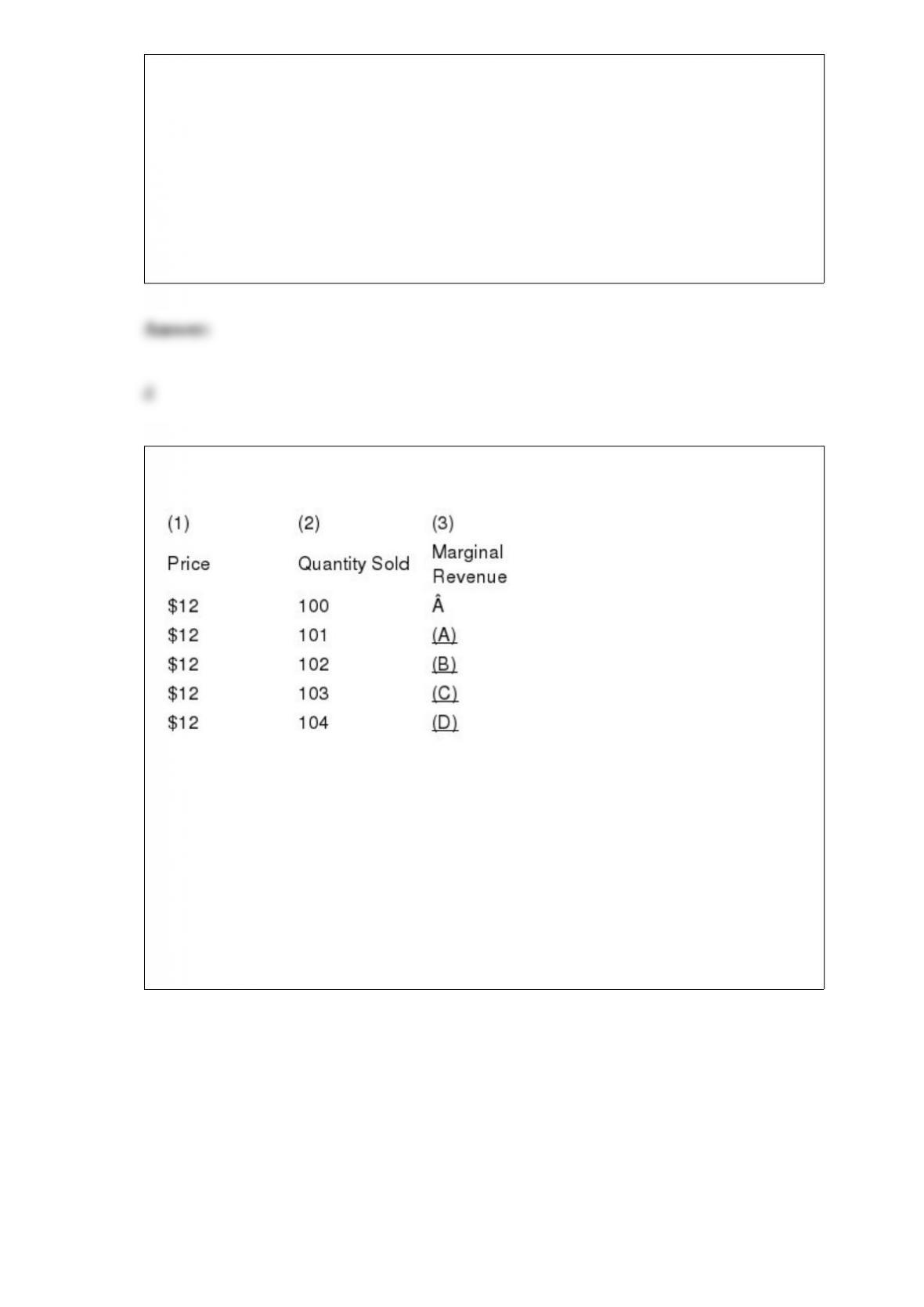
Exhibit 23-1
The dollar amounts that go in blanks (C) and (D) are, respectively,
a. $1 and $12.
b. $12 and $12.
c. $8.58 and $8.67.
d. $4 and $3.