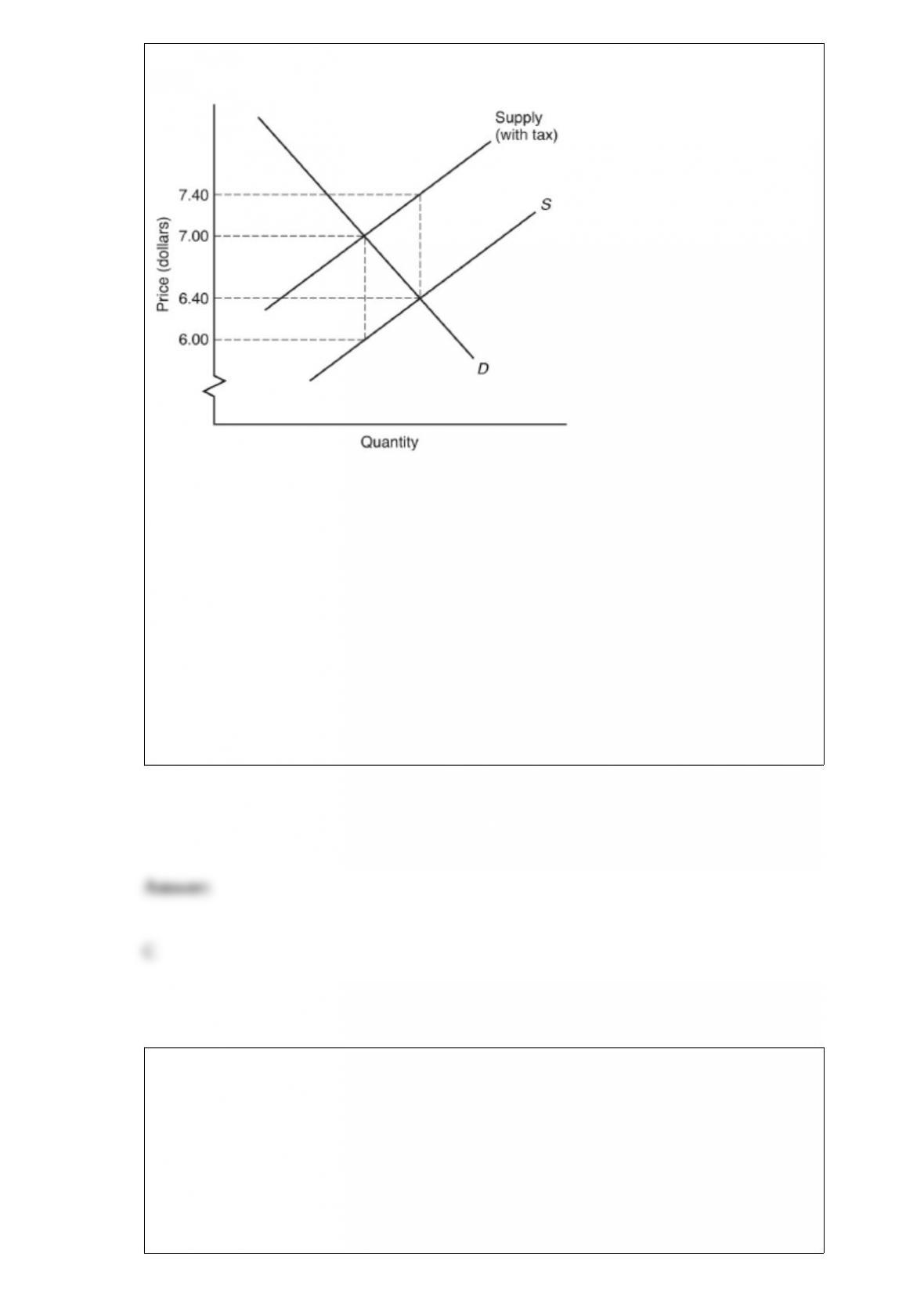
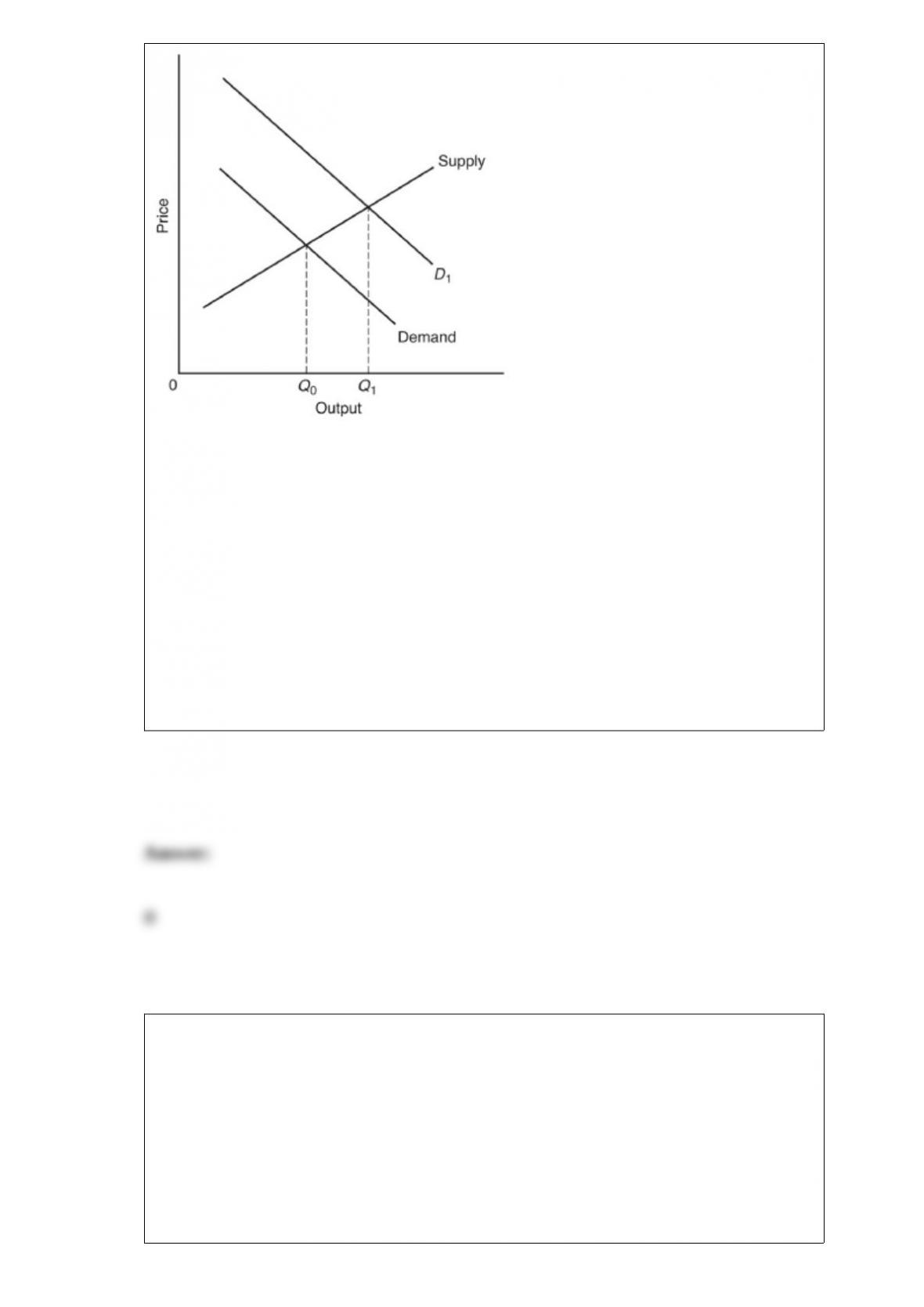
The following questions are based on the following diagram:
Suppose a sales tax on the commodity is imposed where S and D are the market supply
and demand curves before the tax was levied. The equilibrium price with the tax is
a. $6.
b. $6.40.
c. $7.
d. $7.40.
e. somewhere between $6.40 and $7.
In 2011, a family of four would be above the poverty line with an annual income of at
least
a. $5,250.
b. $8,000.
c. $10,000.

d. $15,000.
e. $22,350.
One explanation for why wages adjust slowly and with a substantial lag to changes in
aggregate demand is
a. the presence of formal multiyear labor contracts in unionized industries.
b. the widespread practice of profit-sharing plans as part of most employee
compensation packages.
c. that such changes have little or no impact on rates of unemployment because the
short-run aggregate supply curve is vertical.
d. that labor markets clear readily without changes in wage rates.
e. a belief by most workers that real wages are unaffected by changes in the price level.
The national debt differs from consumer debt in that
a. no interest is paid on the national debt.
b. the national debt is of no economic consequence.
c. most of the national debt is held by foreigners.

d. the national debt influences the amount of aggregate spending.
e. the national debt need never be paid off if it is held internally.
The poor performance of the U.S. economy relative to other industrialized countries
during the 1970s, 1980s, and early 1990s was called
a. disflation.
b. reflation.
c. a competitiveness problem.
d. unflation.
e. proflation.
If the required ratio of reserves to deposits is , then for every $1 in excess reserves, the
banking system can potentially increase the money supply by
a. .
b. 1 + .
c. 1/.

d. 1/(1 ” r).
e. (1 ” r)/r.
The portion of a sales tax increase paid by the consumers of a good is smaller the
a. steeper the demand curve.
b. greater the upward shift of the supply curve.
c. less sensitive the quantity supplied is to changes in price.
d. smaller the downward shift of the supply curve.
e. less sensitive the quantity demanded is to changes in price.
In a given year in the production function of a typical college or university, a tenured
faculty member would be an example of a(n) ________ input.
a. fixed d. average
b. variable e. marginal
c. expendable
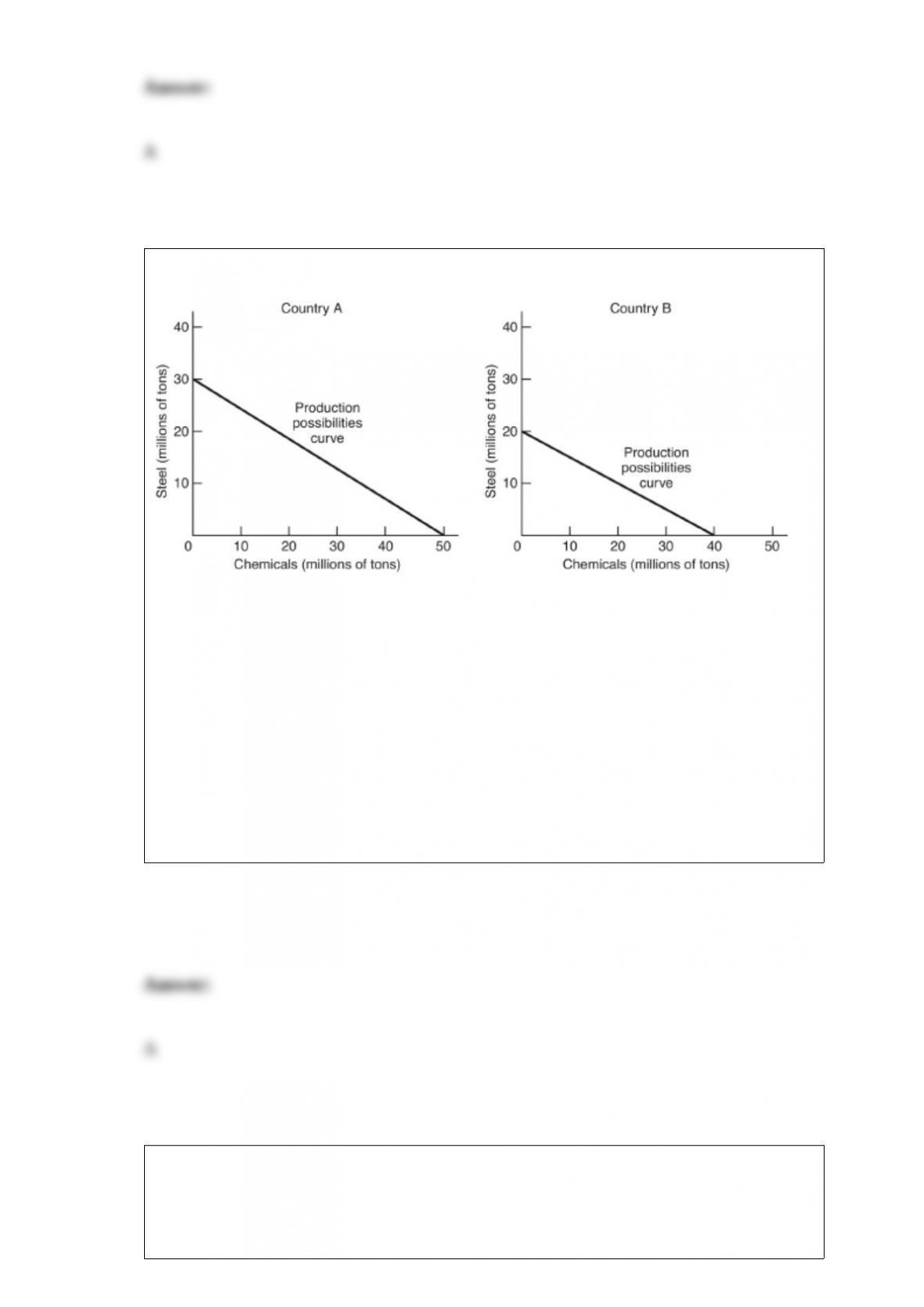
The following questions are based on the following diagrams:
For trade to benefit a nation, its consumption possibilities curve must
a. lie above and to the right of its production possibilities curve.
b. equal its production possibilities curve.
c. lie below and to the left of its production possibilities curve.
d. slope upward and intersect the production possibilities curve below its midpoint.
e. be either vertical or horizontal.
According to economist Richard Gill, certain individuals such as rock stars and talented
athletes earn high incomes because
a. of a failure of the laws of supply and demand.

b. supply exceeds demand for these types of jobs.
c. there are few such individuals relative to the demand for their services.
d. they are less productive than average workers.
e. they are more visible to consumers than the people who work in manufacturing,
agriculture, and service industries.
The United States’ national debt
a. has been steadily declining since World War II.
b. represents a smaller share of national output than in 1945.
c. is currently larger than its GDP.
d. is primarily an externally held debt.
e. totals less than $1 trillion, two-thirds of which is held by government agencies.
On June 1, 2004, the following foreign exchange rates were quoted. For 1 U.S. dollar
you would receive 8.28 Chinese renminbi, 110.64 Japanese yen, 11.48 Mexican pesos,
29.04 Russian roubles, or 0.544 British pounds. A unit of which country’s currency
would give you the fewest U.S. dollars?
a. China
b. Japan
c. Mexico
d. Russia
e. Great Britain
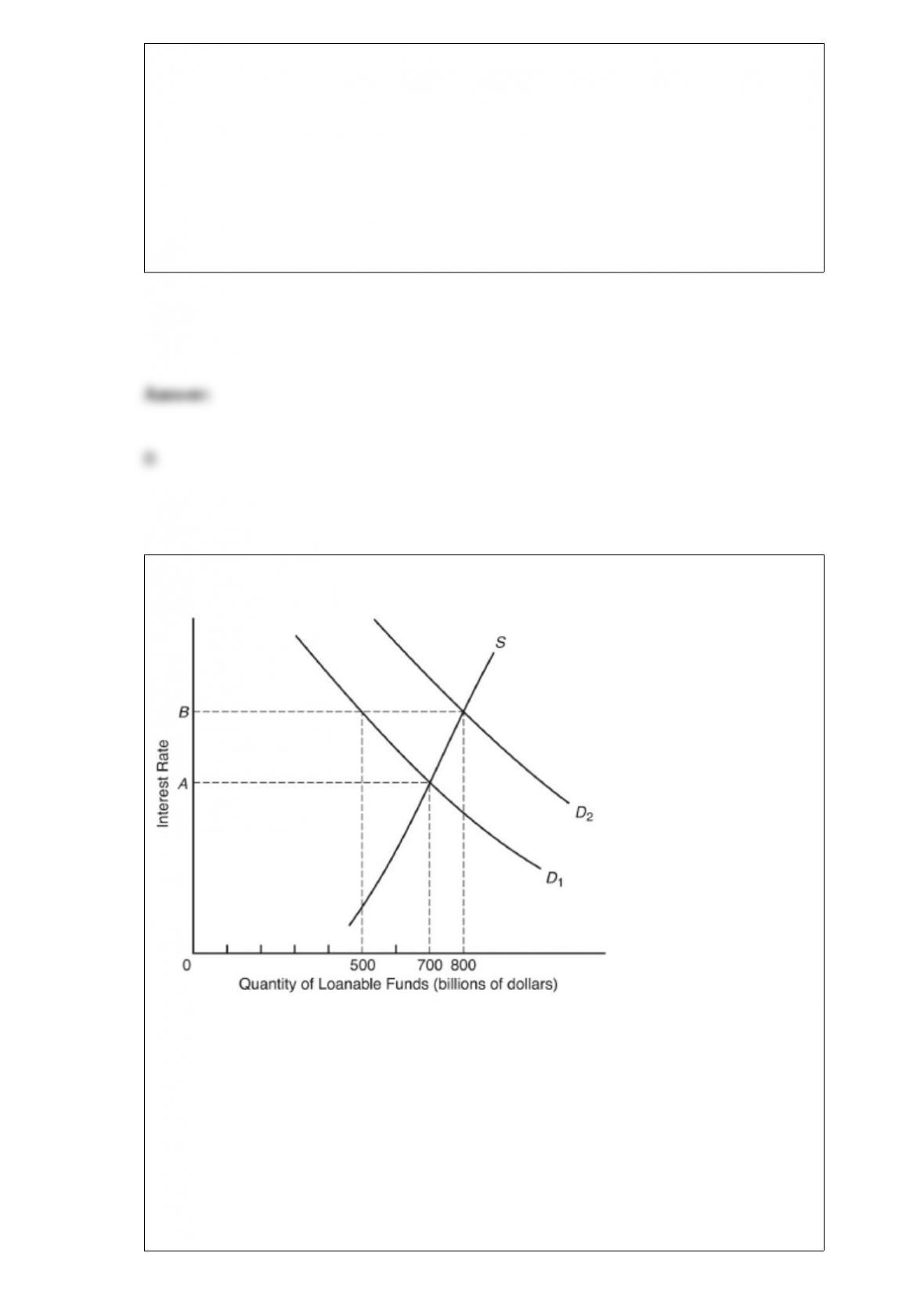
The following questions are based on the following diagram:
If S is the supply curve of loanable funds, D1 is the demand curve for loanable funds
before government borrowing, and D2 is the demand curve for loanable funds after
government borrowing, the size of the government deficit must be ________ billion.
a. $800
b. $700
c. $500

d. $300
e. $100
This table shows the hypothetical effect of a redeployment of resources within the
United States and the Arab countries for the production of oil and wheat.
Which of the following can be inferred from the table?
a. It costs the United States 5 billion barrels of oil for every 1 billion bushels of wheat.
b. The Arab countries have an absolute advantage in both oil and wheat.
c. It cost the Arabs 1 barrel of oil for every 0.10 bushel of wheat.
d. The United States has a comparative advantage in both oil and wheat.
e. It costs the United States 1 barrel of oil for every 1.25 bushels of wheat.

Which of the following would be explicitly counted when computing the gross
domestic product by the expenditures approach?
a. the purchase of a used car by a college student
b. the salary of the CEO of Gillette Corporation
c. the purchase of fuel injectors by Ford
d. Social Security payments to retired persons
e. the purchase of a microwave oven by newlyweds
The money wage adjusted for the price level is called
a. salary.
b. compensation.
c. value added.
d. the value of the marginal product.
e. the real wage.

A manufacturing firm that decides to add enough people to its workforce to operate
around the clock is
a. making a short-run operating decision.
b. holding the proportion of labor to capital constant.
c. decreasing the average product of its fixed inputs.
d. making operating decisions along its planning horizon.
e. using its facilities inefficiently.
Occupational wage rates tied to a point scale that weighs different jobs in terms of
criteria such as accountability, knowledge and skills, mental demand, and working
conditions reflects the doctrine of
a. comparative advantage.
b. comparable worth.
c. crowding out.
d. consumer surplus.
e. conscious parallelism.
Assume that the economy is in equilibrium with the pure rate of interest at 7 percent per
year and an investment of funds in a particular project would return 11 percent per year.
Frank Knight would argue that most of the 4 percent differential is
a. a reward for innovation in this area.
b. a premium for the risk inherent in this project.
c. the result of monopoly profits due to contrived scarcity in this area.
d. an indication that society should allocate more resources to this area.
e. the result of exploitation of labor in this area.
The following questions are based on the following information:
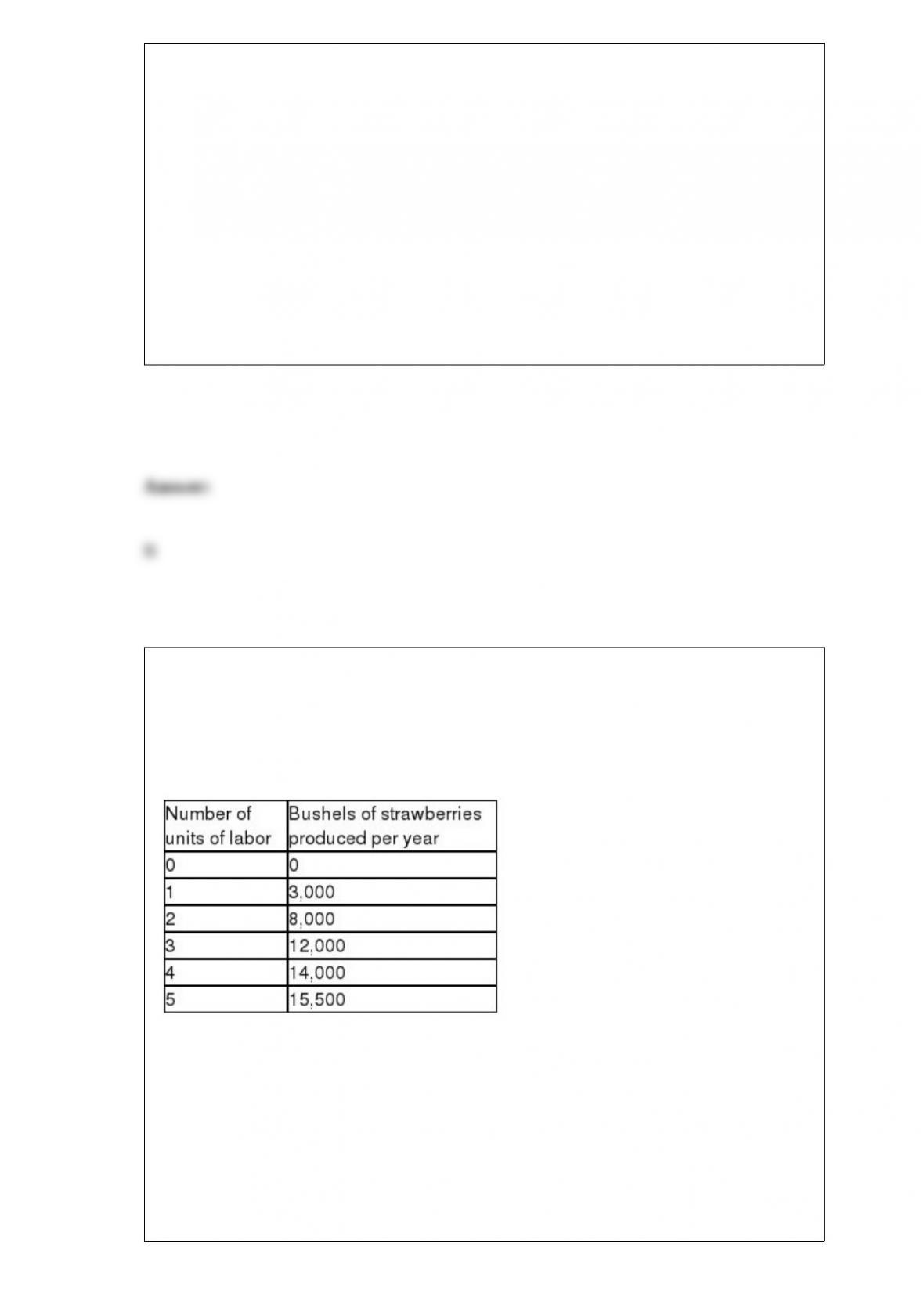
A firm uses inputs of labor, fertilizer, and land to produce strawberries (which are sold
to wholesalers and processors). The quantity of land used is fixed at eight acres per
season and the production function implies the relationships in the following table:
The average product of the fourth unit of labor is ________ bushels.
a. 1,000
b. 2,000
c. 3,100

d. 3,500
e. 4,000
An element of economic welfare that is NOT effectively captured in measurements of
real per capita GDP is
a. population growth.
b. output.
c. income.
d. inflation.
e. leisure.
A firm produces heavy machinery and can sell 10 units per month at a price of $50,000.
To increase sales to 11 units per month, the firm must cut its price to $46,000. The
marginal revenue for selling one extra unit per month is
a. $363.
b. $4,000.
c. $4,182.

d. $6,000.
e. $46,000.
The greatest source of revenue for most state governments is the ________ tax.
a. personal income
b. corporate income
c. estate and gift.
d. general sales
e. property
The terms of trade reflect the
a. equation of exchange.
b. gross-net export ratio.
c. balance of trade divided by the transactions demand for money.
d. difference between the trade surplus and consumer surplus.
e. international supply and demand curves for the traded goods.

An increase in interest rates will cause
a. present values to rise.
b. a dollar received today to be worth less than a dollar received a year from today.
c. no changes in the capitalized worth of an asset.
d. firms to undertake more projects whose rates of return are below the interest rate.
e. bond prices to fall.
Shown in this diagram are demand and supply conditions for a competitive industry.
If the socially optimal level of output for an industry is greater than the equilibrium
output for that industry, there are
a. external diseconomies.
b. external economies.
c. both external economies and diseconomies simultaneously.
d. external internalities of substance.
e. both external internalities and internal externalities.
The view that the only tax governments should impose is a tax on rent is most closely
associated with
a. Adam Smith.
b. J. M. Keynes.
c. Henry George.

d. Joseph Schumpeter.
e. Frank Knight.
If the demand for digital cameras is price elastic
a. they will have a high price.
b. they are probably in demand.
c. an increase in price will not measurably reduce sales.
d. a decrease in price increases the total amount spent on them.
e. the elasticity coefficient equals 1.
The supreme governing body of the national union is the
a. AFL-CIO.
b. local government.
c. executive council.
d. National Labor Relations Board.
e. convention.

The basic distinction between M1 and M2 is that
a. M2 excludes all checkable deposits.
b. M1 is the money supply broadly defined to include large certificates of deposit.
c. M2 is the money supply expressed in current dollars, whereas M1 is expressed in
constant dollars.
d. M1 includes credit card balances on bank-issued credit cards.
e. M2 equals M1 plus savings, small time deposits, money market mutual fund
balances, and money market deposit accounts.
Under perfect competition, the supply curve of labor or other inputs to an individual
firm is
a. horizontal.
b. backward bending.
c. downward sloping.
d. vertical.
e. identical with the market supply curve of the input.

Which of the following has been a major factor in keeping U.S. farm incomes low?
a. depletion of resources resulting from the war effort
b. rapid advances in technology pushing the supply curve to the right
c. growth in per capita income pushing the demand curve to the right
d. shift from an agricultural to a service-oriented society
e. large imports of agricultural products from abroad
If disposable income rises by $100 billion and personal consumption expenditure rises
by $60 billion, what is the marginal propensity to consume?
a. 0.60
b. 0.40
c. 1.60
d. 1.66
e. 2.50

According to the classical view of the equation of exchange, which of the following two
factors are constant?
a. price level and output
b. price level and velocity
c. money supply and velocity
d. velocity and output
e. money supply and price level