
1) developing countries with more than one major trading partner often peg their
currencies to a group or basket of those trading partner currencies.
a.true
b.false
2) the high point of u.s. protection culminated with the passage of the:
a.smoot-hawley act of 1930
b.general agreements on tariffs and trade in 1947
c.trade reduction act of 1962
d.adjustment assistance act of 1970
3) customs union theory reasons that the formation of a customs union will decrease
members’ real welfare when the:
a.trade diversion effect exceeds the trade creation effect
b.trade production effect exceeds the trade consumption effect
c.trade consumption effect exceeds the trade production effect
d.trade creation effect exceeds the trade diversion effect
4) the main focus of the uruguay round of multilateral trade negotiations was on tariff
barriers rather than nontariff trade barriers.
a.true
b.false
5) all of the following are potential advantages of an international joint venture except:
a.sharing research and development costs among corporations
b.forestalling protectionism against imports
c.establishing work rules promoting higher labor productivity
d.operating at diseconomy-of-scale output levels

6) exhibit 4.1
assume that the united states imports automobiles from south korea at a price of
$20,000 per vehicle and that these vehicles are subject to an import tariff of 20 percent.
also assume that u.s. components are used in the vehicles assembled by south korea and
that these components have a value of $10,000.
refer to exhibit 4.1. under the offshore assembly provision of u.s. tariff policy, the price
of an imported vehicle to the u.s. consumer after the tariff has been levied is:
a.$22,000
b.$23,000
c.$24,000
d.$25,000
7) suppose an importer of steel is required to pay a tariff of $20 per ton plus 5 percent
of the value of steel. this is an example of a (an):
a.specific tariff
b.ad valorem tariff
c.compound tariff
d.tariff quota
8) which of the following is not considered a “borrowed” reserve?
a.special drawing rights
b.oil facility
c.imf drawings
d.reciprocal currency arrangement
9) most foreign exchange transactions are conducted between commercial banks and
household customers.
a.true
b.false
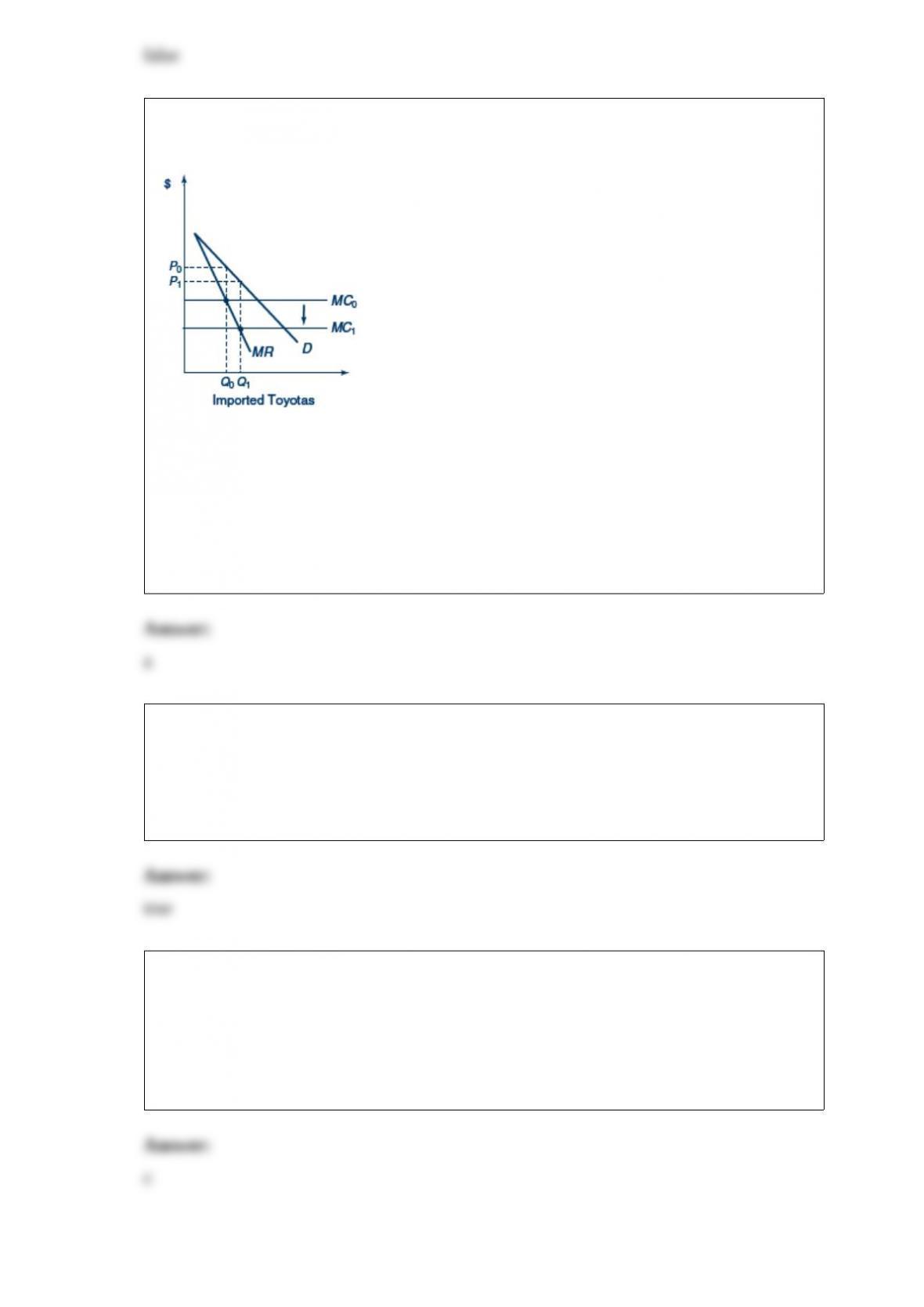
10) figure 14.1us market for imported toyotas
in figure 14.1, d represents the us demand curve for toyotas and mc0 represents the
marginal cost of producing toyotas.a shift in the marginal cost curve from mc0 to mc1
represents
a.an appreciation of the dollar relative to the yen
b.an appreciation of the yen relative to the dollar
c.a depreciation of the dollar relative to the yen
d.neither an appreciation nor a depreciation of the dollar relative to the yen
11) when western european democracies removed trade barriers and began to form the
european community, one of their hopes was that their economic and financial ties
would bind them together so that it would not be in their interest to go to war again.
a.true
b.false
12) if wheat costs $4 per bushel in the united states and 2 pounds per bushel in great
britain, then in the presence of purchasing-power parity the exchange rate should be:
a.$.50 per pound
b.$1.00 per pound
c.$2.00 per pound
d.$8.00 per pound

13) producing goods for export produces:
a.jobs
b.income
c.tariffs
d.a and b
14) export embargoes induce greater losses in consumer surplus for the target country:
a.the lesser its initial dependence on foreign produced goods
b.the more elastic the target country’s demand schedule
c.the greater the available output from alternative suppliers
d.the more inelastic the target country’s supply schedule
15) proponents of ____ maintain that government should enact policies that encourage
the development of emerging, ‘sunrise” industries.
a.product life cycle policy
b.static comparative advantage policy
c.intra-industry trade policy
d.industrial policy
16) proponents of the smoot-hawley act of 1930 viewed it as a means of combating
domestic unemployment.
a.true
b.false
17) for developing countries such as mexico and brazil, severe economic problems in
the 1980s were caused by:
a.a fall in the world demand for products produced by developing countries

b.high prices of basic raw materials and other commodities
c.low real interest rates in the united states
d.high levels of income and imports for the united states
18) the elasticity approach to currency depreciation emphasizes the relative price effects
of depreciation and suggests that depreciation best improves a country’s trade balance
when the elasticities of demand for the country’s imports and exports are high.
a.true
b.false
19) because seasons in the southern hemisphere are opposite those in the northern
hemisphere, one would expect intra-industry trade to occur in agricultural products.
a.true
b.false
20) among the economic problems facing developing countries have been low
dependence on primary-product exports, unstable export markets, and worsening terms
of trade.
a.true
b.false