The total income of capital and labor must equal the value of total:
A. production.
B. profits.
C. revenue.
D. investment.
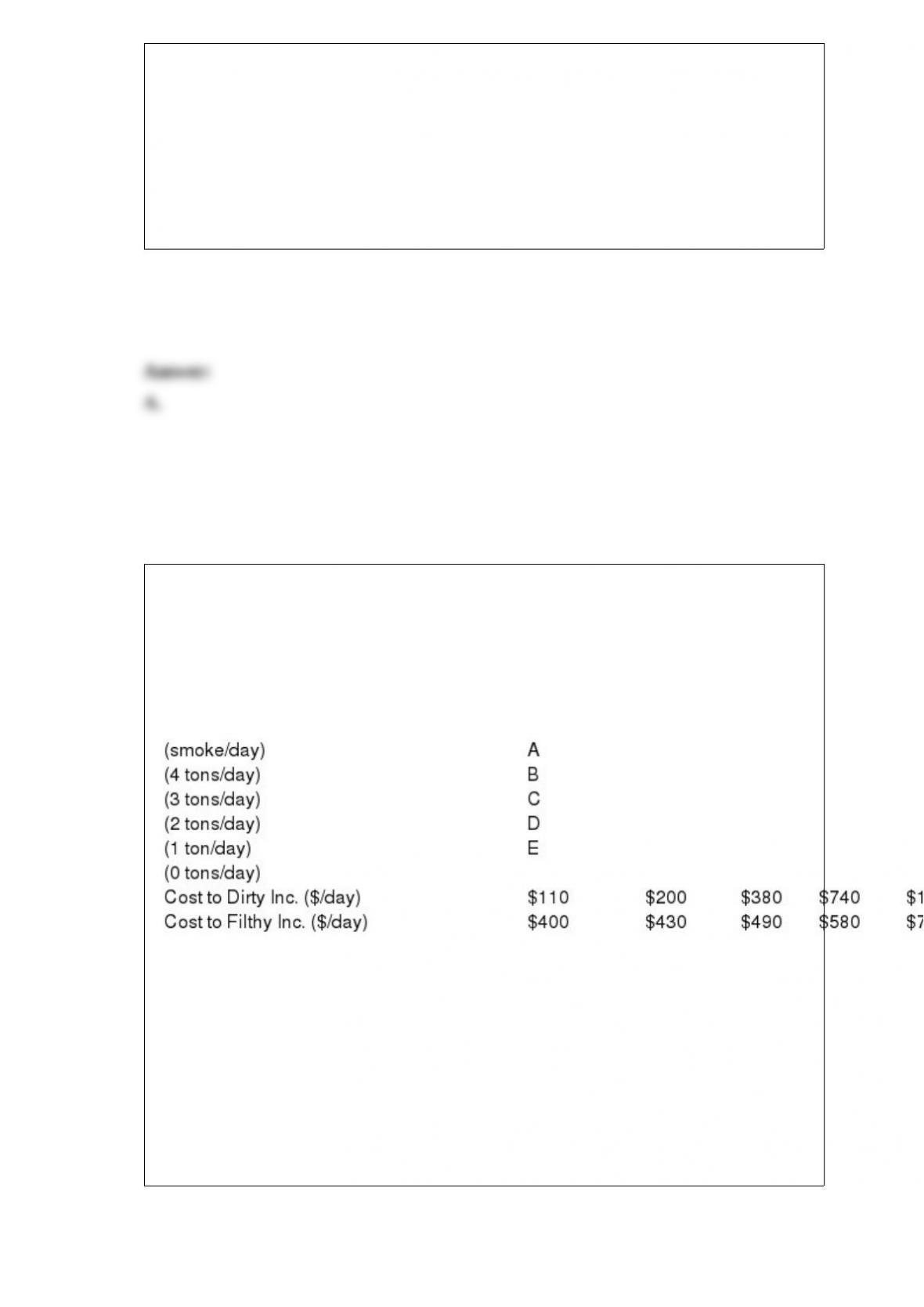
Two companies, Dirty Inc. and Filthy Inc., each of which has access to 5 different
production processes, each of which has a different cost and produces a different
amount of pollution. The daily costs of the processes and the number of tons of smoke
emitted are shown in the table below.
process
If the City Council imposes a tax of $91 per day on each ton of smoke emitted, then
what will be the total cost to society of the resulting reduction in pollution?
A. $90
B. $180
C. $270
D. $360

A decrease in demand for a firm’s output results in a(n):
A. increase in labor supply.
B. decrease in labor demand.
C. decrease in labor supply.
D. increase in labor demand.
Refer to the figure below. If Mallory and Rick are the only two consumers in this
market, then the market demand for soda will be 90 cans per week when the price of a
can of soda is:
A. $1.50
B. $1.25
C. $0.75
D. $0.50
According to economists, the satisfaction people get from their consumption activities
is called:
A. demand.
B. utility.
C. a need.
Suppose Mo is considering whether to see Zombie Revenge III at her local movie
theater. Tickets cost $12 each, but Mo isn’t sure how much she’s going to like the
movie. There’s a 40 percent chance she’ll get $20 worth of enjoyment from seeing the
movie, and there’s a 60 percent chance she’ll only get $10 worth of enjoyment from
seeing the movie. Mo’s expected value of seeing the movie is:
A. $20.
B. $14.
C. $4.
D. $2.
If the demand for a good is highly elastic, that good is likely to have:
A. many close complements.
B. few close complements.
C. many close substitutes.
D. few close substitutes.
In an open-market purchase the Federal Reserve ______ government bonds from the
public and the supply of bank reserves ______.
A. buys; increases
B. buys; decreases
C. sells; decreases
D. sells; increases

Refer to the figure below. Suppose a law is passed requiring restaurants to charge no
more than $25 per meal. This law would:
A. decrease producer surplus.
B. increase producer surplus.
C. have no effect on producer surplus.
D. have an ambiguous effect on producer surplus.
Which of the following policies would be expected to increase private saving?
A. Replacing the income tax with a consumption tax
B. Increasing the tax rate on capital gains
C. Providing more generous Social Security retirement benefits
D. Reducing the size of down payments needed to buy a house
Refer to the figure below. Based on the diagram, if potential output equals 5,000 and the
real interest rate is 1%, then there is ______ gap and the Fed must ______ the real
interest rate so that output will equal potential output.

A. a recessionary; raise
B. a recessionary; reduce
C. an expansionary; reduce
D. an expansionary; raise
If Gerry saves $500 per month, then Gerry’s ______ will increase by _____.
A. wealth; $500 only if he has no debt
B. income; $500 only if he buys additional assets
C. wealth; $500
D. wealth; $500 only if he buys additional assets
It is spring, and several graduates of State U are seeking employment. State U graduates
have evenly distributed GPAs, from 2.0 to 4.0, with an average GPA of 3.0. The largest
employer in town, Acme Dynamite, is interviewing candidates, hoping to hire a few
hard workers. While Acme does not require students to submit a transcript with their
applications, the hiring officer believes that high GPAs signal a willingness to work
hard. Suppose that all State U students have the same academic ability when they enter
college and do not learn anything in college that will be useful to them while working at
Acme. Students only differ only in their willingness to work hard and study for their
classes. In this case:
A. Acme will not care about a student’s GPAs because all students enter college with the
same academic ability.
B. Acme will not care about a student’s GPAs because the students at State U don’t learn
anything useful in their classes.
C. there is no benefit to studying hard in college.
D. Acme will use a student’s GPA as a signal of the student’s willingness to work hard.
A seller’s reservation price is generally equal to:
A. the buyer’s reservation price.
B. the seller’s average cost.
C. the seller’s marginal cost.
D. the market price.
Which of following is NOT true of an equilibrium price?
A. Consumers who are willing to pay the equilibrium price can acquire the good.
B. It measures the value of the last unit sold to consumers.
C. It is always a fair and just price.
D. Firms who are willing to accept the equilibrium price can sell what they produce.
Those whofavor programs aimed at reducing inequality argue that these programs:
A. provide a financial incentive to work harder.
B. provide a financial incentive to invest in human capital.
C. help reduce poverty.
D. discourage firms from discriminating in their hiring.
P-TV and QRS-TV are trying to decide whether to air a sit-com or a reality show in a
given time slot. Viewers like both sit-coms and reality shows, but sitcoms are more
expensive to produce than reality shows since real actors need to be hired. QRS-TV
makes its decision first, and then P-TV observes that choice before making its decision.
Both stations know all of the information in the decision tree below.
Suppose QRS-TV enters into an agreement with P-TV that gives QRS-TV the exclusive
right to air a reality show during this time slot. QRS-TV would be willing to pay P-TV
_______ in order to persuade P-TV to enter into this agreement.
A. no more than $10 million
B. nothing
C. more than $10 million
D. no more than $5 million
Someone who is not strongly committed to achieving and maintaining low inflation is
called a(n):
A. anchored central banker.
B. inflation dove.
C. inflationary central banker.
D. inflation hawk.

When recessions are the result of slowing growth in potential output, the government’s
best policy is to:
A. increase aggregate demand.
B. decrease aggregate supply.
C. promote saving and investment.
D. reduce government spending.
The most efficient distribution of pollution abatement is such that the:
A. extent of pollution abatement is the same across all geographic regions.
B. extent of pollution abatement is the same across all polluters.
C. largest reductions in pollution are made by the largest polluters.
D. marginal cost of abatement is the same across all polluters.
The two negative demand shocks that caused the Great Recession were:
A. declining housing prices and the 2008 financial panic.
B. declining housing prices and declining stock prices.
C. increasing oil prices and the 2008 financial panic.
D. increasing oil prices and declining stock prices.
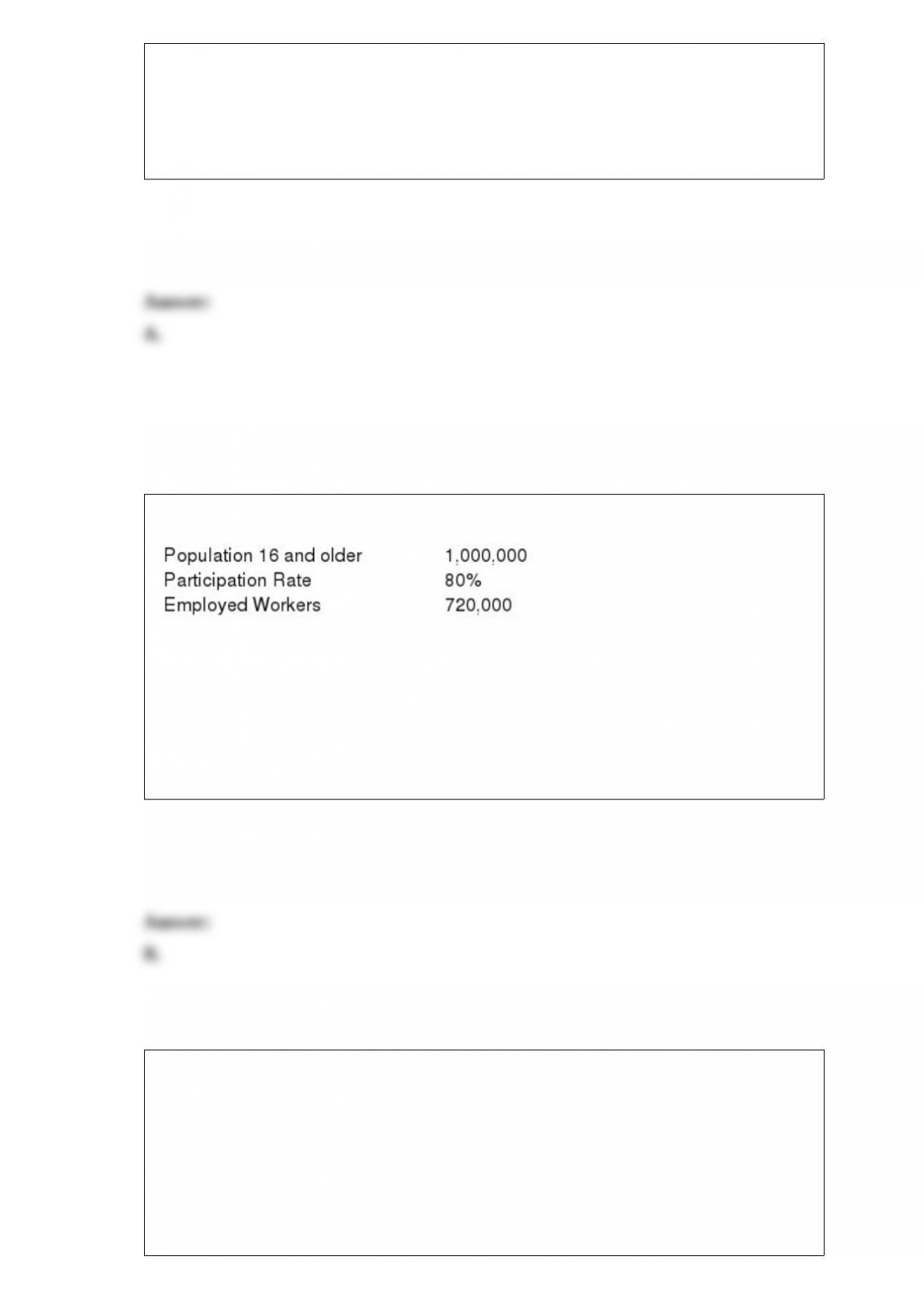
Based on the information in the table, how many people are out of the labor force?
A. 144,000
B. 200,000
C. 280,000
D. 576,000
If there is 3 percent frictional unemployment, 4 percent structural unemployment, and
-2 percent cyclical unemployment, then the natural rate of unemployment equals:
A. 1%.
B. 2%.
C. 5%.
D. 7%.
Which of the following is NOT a characteristic of a market in equilibrium?
A. Excess supply is zero.
B. All consumers are able to purchase an amount equal to their quantity demanded.
C. Excess demand is zero.
D. The equilibrium price is stable, i.e., there is no pressure for it to change.
A fixed factor of production:
A. is fixed in the long run but variable in the short run.
B. is fixed only in the short run.
C. is fixed in both the short run and the long run.
D. is common in large firms but rare in small firms.
An increase in the aggregate demand for goods and services will result in an increase in
the amount of output firms are willing to produce, and this increase in output is
accompanied by:
A. a decrease in the inflation rate.
B. an increase in the inflation rate.
C. a decrease in nominal GDP
D. an increase in potential GDP.
An outcome is socially optimal if it:
A. follows from a market equilibrium.
B. follows from collective action.
C. leaves no money on the table.
D. maximizes total economic surplus.
Suppose the production of cotton causes substantial environmental damage because the
pesticides used by cotton farmers often make their way into nearby rivers and streams,
and are very harmful to fish and other wildlife. Economists would consider the
environmental damage that results from the production of cotton to be a(n):
A. relevant cost of production.
B. relevant cost of production only if cotton farmers are charged a fine for the damage
done.
C. relevant cost of production only if the environmental damage negatively affects other
firms.
D. implicit cost of production that cotton farmers will take into account when
determining their profit-maximizing level of output.
Curly and Moe are considering living alone or being roommates and splitting the rent
for the next twelve months. If they live alone, they each rent a one bedroom, one bath
apartment for $500 per month, while if they are roommates, they can split a two
bedroom, one bath apartment for $800 per month. The one difficulty they have is that
Moe snores very loudly. Curly estimates the cost of poor sleep due to Moe’s snoring at
$150 per month. Moe could obtain a snore-eliminating device for $50 per month. The
least costly solution to the externality present in this situation is for:
A. Curly to endure Moe’s snoring.
B. both to live alone.
C. Moe to eliminate his snoring.
D. Moe to pay Curly for his discomfort.
The figure below shows the supply and demand curves for jeans in Smallville.
The equilibrium price will NOT lead to the largest possible total economic surplus if:
A. jeans are purchased by consumers with reservation prices greater than $40.
B. the market for jeans is perfectly competitive.
C. the production of jeans generates air pollution.
D. there are diminishing returns in the production of jeans.
In general, when the price of a fixed factor of production increases:
A. the profit-maximizing price falls.
B. marginal cost is unchanged.
C. marginal cost increases.
D. the profit-maximizing level of output increases.