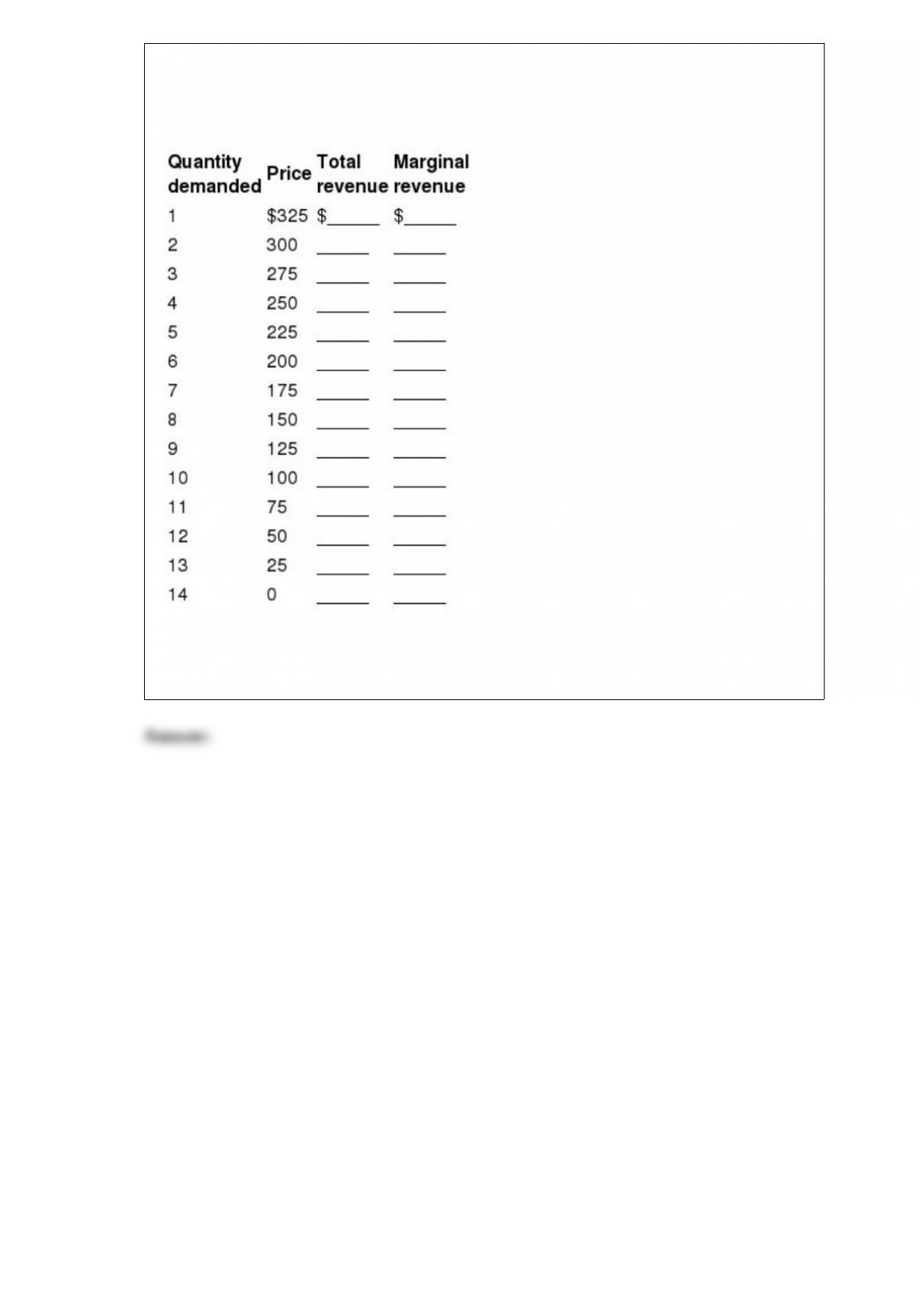
1) The demand schedule for the product produced by a monopolist is given in the table
below. Complete the table by computing total revenue and marginal revenue.
(a)What do the data in the table indicate about the relationship between total revenue
and marginal revenue? Explain.
(b)What do the data in the table indicate about the elasticity of demand?
2) we would expect an industry to expand if firms in that industry are:
a.earning normal profits.
b.earning economic profits.
c.incurring economic losses.
d.earning accounting profits.
3) other things equal, increased emphasis on providing the best possible medical care
for all, regardless of income, will:
a.increase the demand for health care.
b.increase the supply of health care.
c.have no effect.
d.decrease the demand for health care.
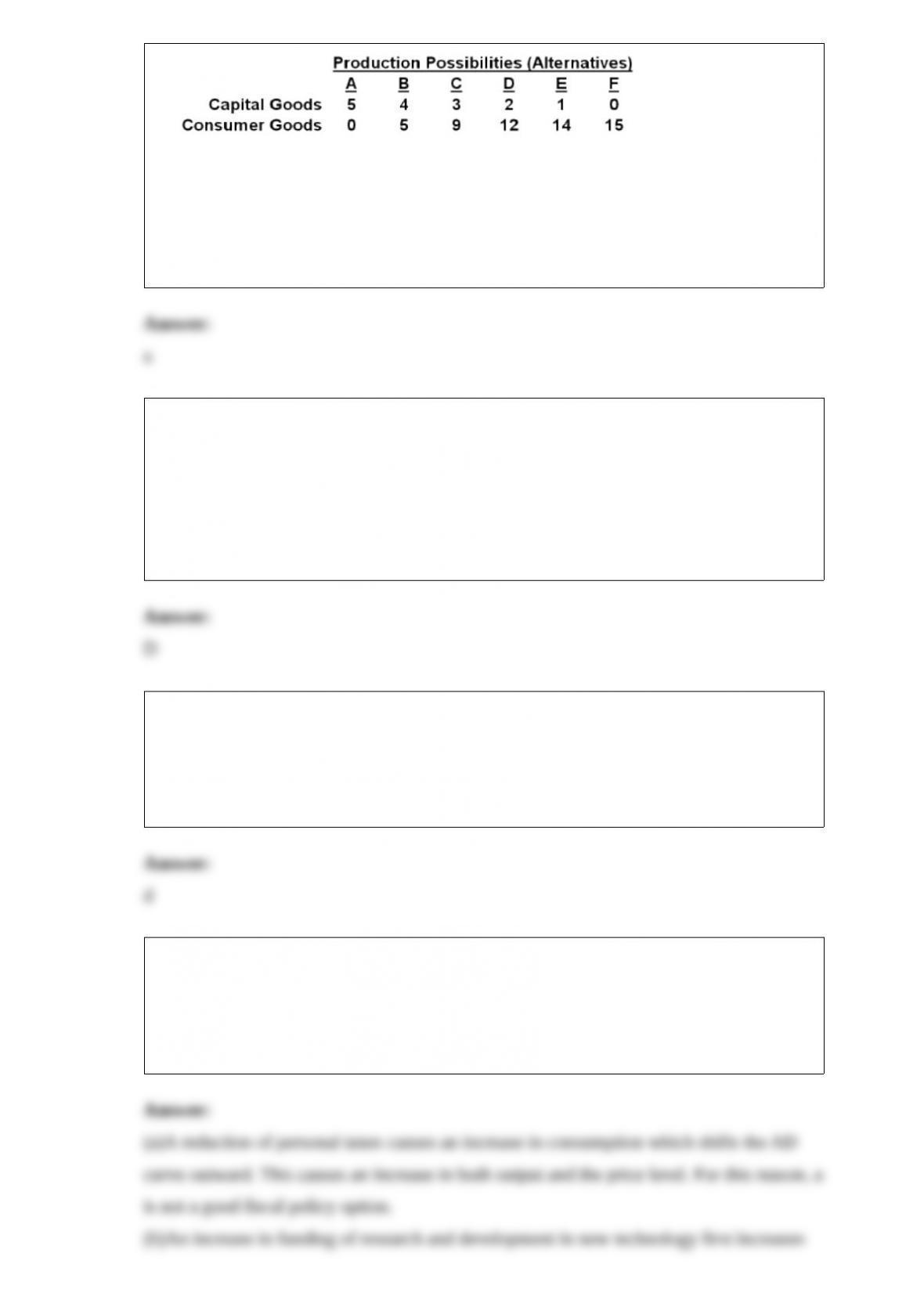
4)
refer to the above table. for this economy to produce a total output of 3 units of capital
goods and 13 units of consumer goods it must:
a.achieve economic growth.
b.use its resources more efficiently than the data in the table now indicate.
c.allocate its available resources most efficiently among alternative uses.
d.achieve the full employment of available resources.
5) The labor demand curve of a purely competitive seller:
A.slopes downward because the firm must lower price to sell more output.
B.slopes downward because labor productivity increases as successive workers are
hired.
C.is perfectly elastic because the firm is hiring an insignificant portion of the total labor
supply.
D.slopes downward because the marginal product of successive workers declines.
6) pollution:
a.should be corrected by the subsidization of offending firms.
b.is not an economic problem because it is external to the market system.
c.is an example of private production costs.
d.is an example of an external cost.
7) How would the following developments affect aggregate demand or aggregate
supply?
(a)A reduction personal income taxes.
(b)More funding for research and development in new technologies.
(c)An increase in business subsidies.
8) (consider this) rising wages for women in the united states have:
a.increased the proportion of women working part time compared to working full time.
b.increased labor costs and thus shifted the nation’s production possibilities curve
inward.
c.increased average family size in the united states.
d.increased the percentage of married women in the workforce.
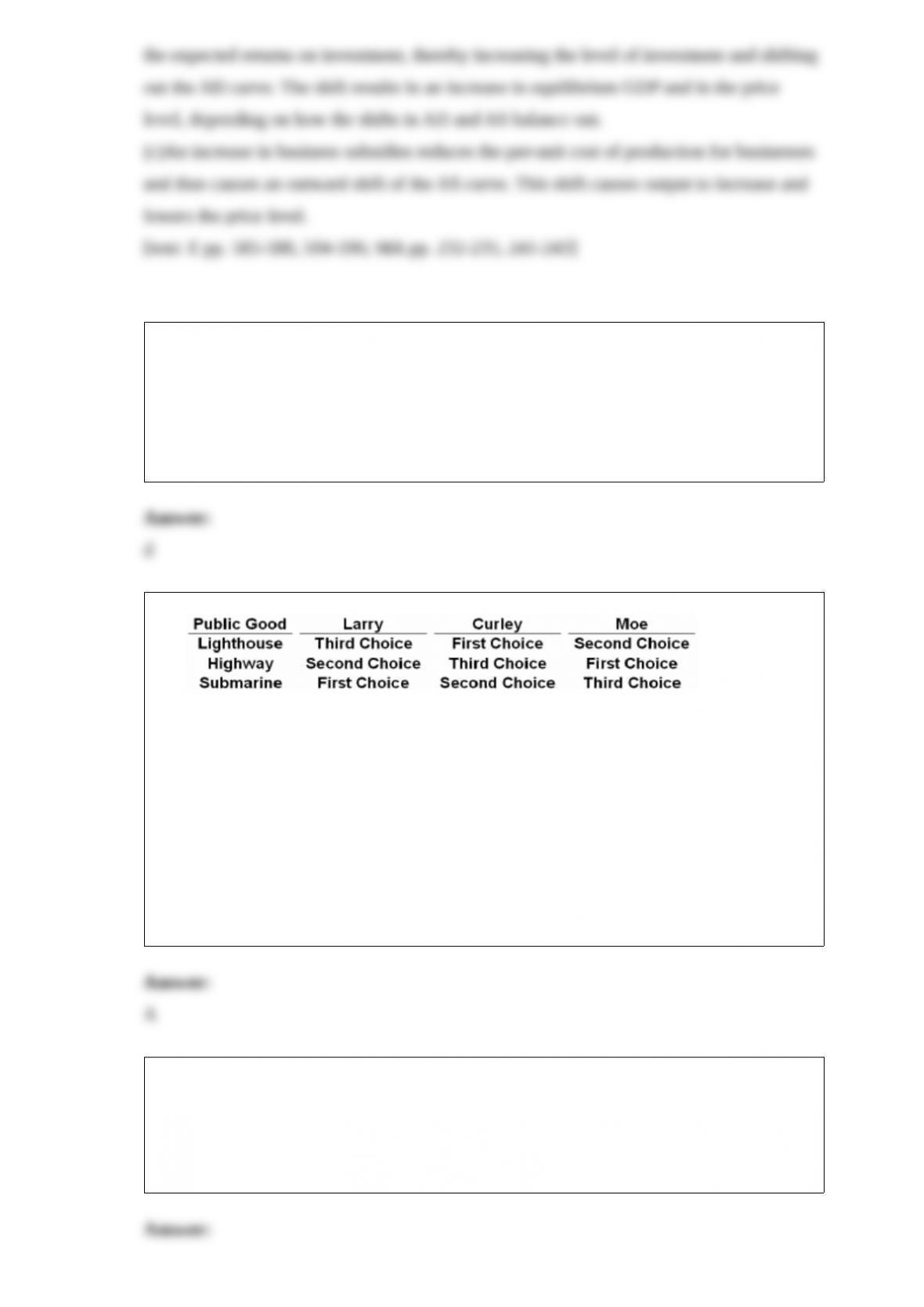
9)
Refer to the above table. The inconsistency illustrated by the table is that, while a
majority of voters prefer the:
A.highway to the lighthouse and the submarine to the highway, they also prefer the
lighthouse to the submarine.
B.lighthouse to the highway and the lighthouse to the submarine, they also prefer the
submarine to the highway.
C.highway to the lighthouse and the submarine to the lighthouse, they also prefer the
submarine to the highway.
D.lighthouse to the submarine and the highway to the submarine, they also prefer the
highway to the lighthouse.
10) the term “other things equal” means that:
a.the associated statement is normative.
b.many variables affect the variable under consideration.
c.a number of relevant variables are assumed to be constant.
d.when variable x increases so does related variable y.