1) Kodak introduced to the marketplace a digital camera which uses no film, but which
takes photos that can be shown on personal computers. This is an example of:
A.economies of scale.
B.product innovation.
C.process innovation.
D.venture capital.
2) If the Federal Reserve System buys government securities from commercial banks
and the public:
A.commercial bank reserves will decline.
B.commercial bank reserves will be unaffected.
C.it will be easier to obtain loans at commercial banks.
D.the money supply will contract.
3) Assume the supply curve for product X is perfectly elastic and that government
imposes a $2 per unit excise tax. We can conclude that the resulting:
A.increase in output will be greater the less elastic the demand curve.
B.decrease in output will be greater the less elastic the demand curve.
C.decrease in output will be greater the more elastic the demand curve.
D.increase in output will be greater the more elastic the demand curve.
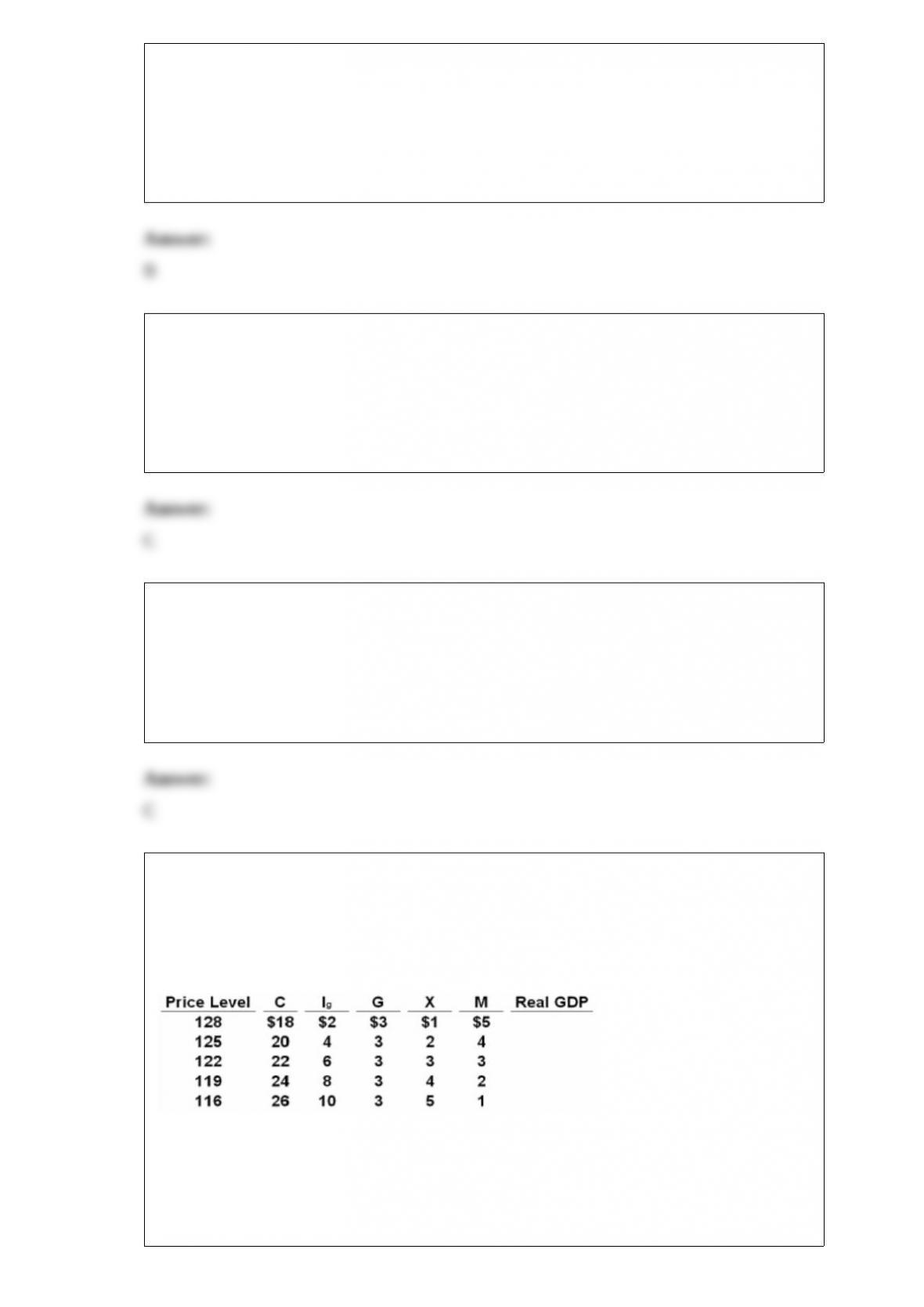
4) Answer the next question(s) on the basis of the following table for a particular
country in which C is consumption expenditures, Ig is gross investment expenditures, G
is government expenditures, X is exports, and M is imports. All figures are in billions of
dollars. Each question is independent of the other questions.
Refer to the above table. If equilibrium real GDP is $31 billion, the equilibrium price
level will be:
A.128.
B.125.
C.122.

D.119.
5) increasing marginal cost of production explains:
a.the law of demand.
b.the income effect.
c.why the supply curve is upsloping.
d.why the demand curve is downsloping.
6) Planned investment plus unintended increases in inventories equals:
A.actual investment.
B.consumption of fixed capital.
C.consumption minus saving.
D.unintended saving.
7) The economic benefits from forests come from:
A.wood.
B.erosion prevention.
C.oxygen production.
D.all of these.
8) New classical economists:
A.stress the importance of federal budget deficits in stimulating aggregate demand.
B.hold that, left alone, the economy gravitates to its full employment level of output.
C.emphasize tax cuts as means of increasing aggregate supply.
D.advocate active use of monetary policy to stabilize the economy.
9) The general sales tax is regressive because:
A.the incidence of the tax is on sellers rather than buyers.
B.tax rates are constant and incomes are variable.
C.lower income families save a smaller percentage of their incomes than do higher
income families.
D.tax rates decrease as consumer spending increases.
10) Other things equal, serious recession in the economies of U.S. trading partners will:
A.have no perceptible impact on the U.S. economy.
B.cause inflation in the U.S. economy.
C.depress real output and employment in the U.S. economy.
D.stimulate real output and employment in the U.S. economy.
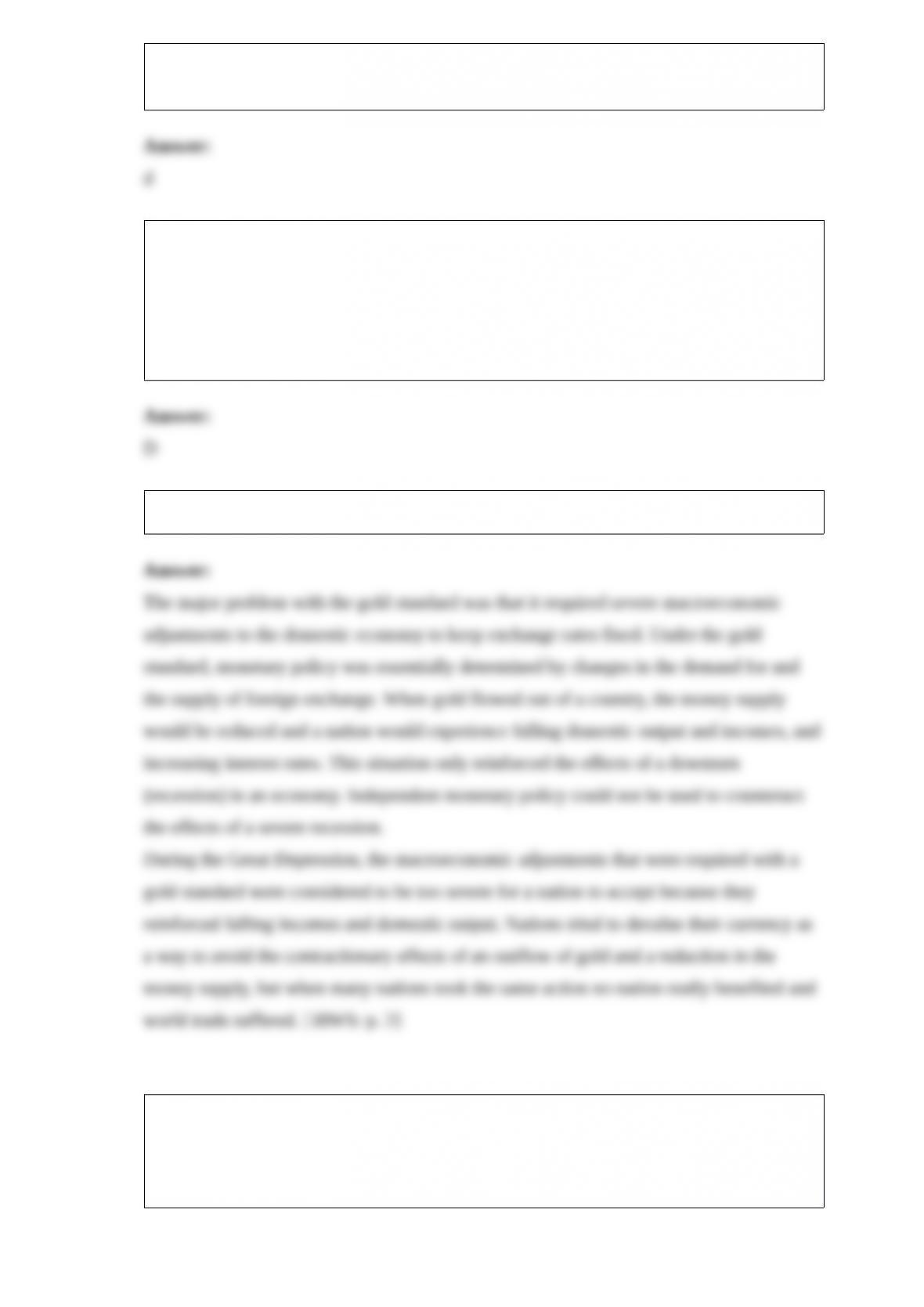
11) The following data for the hypothetical nations of Alpha and Beta. Qs is domestic
quantity supplied and Qd is domestic quantity demanded.
Refer to the above data. At a world price of $5:
A.Alpha will want to import 50 units of steel.
B.Beta will want to import 60 units of steel.
C.Alpha will want to export 50 units of steel.
D.neither country will want to export steel.
12) the price of product x is reduced from $100 to $90 and, as a result, the quantity
demanded increases from 50 to 60 units. therefore demand for x in this price range:
a.has declined.
b.is of unit elasticity.
c.is inelastic.
d.is elastic.
13) The following are hypothetical exchange rates: $1 = 140 yen; 1 Swiss franc = $.10.
We can conclude that:
A.1 yen = 280 Swiss francs.
B.1 yen = 14 Swiss francs.
C.1 Swiss franc = 28 yen.
D.1 Swiss franc = 14 yen.
14) What was the major problem with an international gold standard?
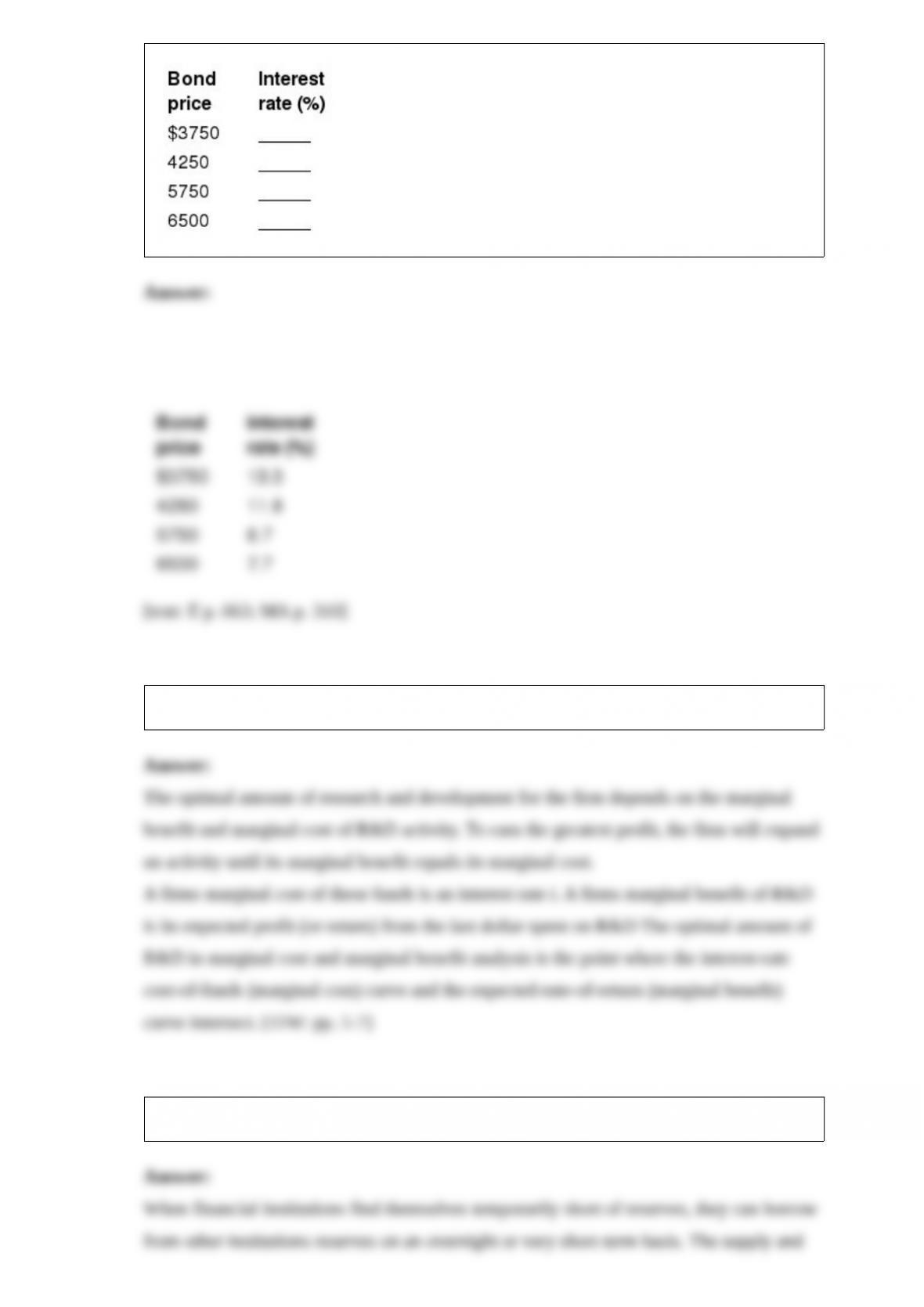
15) Suppose that a bond having no expiration date has a face value of $5000 and pays a
fixed amount of interest of $500 annually. Compute and enter in the spaces provided the
effective interest rate (to one decimal place) that a bond buyer could receive at the new
bond price.
16) Explain how the firm decides on the optimal amount of research and development.
17) What is meant by the Federal funds market and what is the Federal funds rate?
18) Define remittances.
19) What is X-inefficiency? Why is it likely to occur in monopoly?
20) What may be the complementary relationship, in terms of employment, between
illegal fruit pickers and domestic-born truck drivers?
21) How do theories of mainstream macroeconomics and monetarism differ in relation
to monetary policy?
22) What are the economic effects of imposition of a new occupational license or
examination on a labor market?