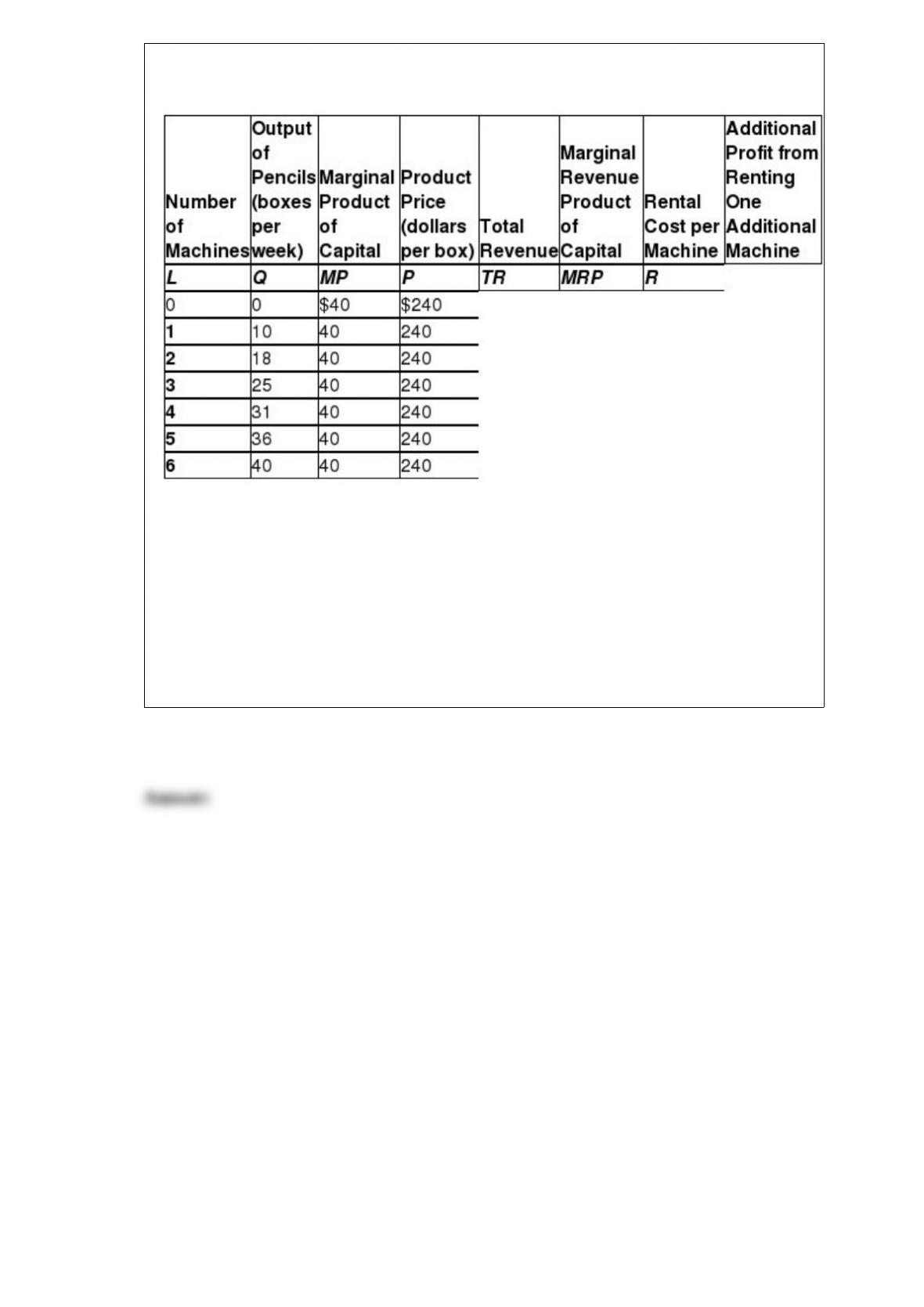
Table 17-7
Dante owns a pencil factory and faces the situation shown in the table and the cost of
renting a machine is $240 per week.
a. Fill in the blanks in the table and determine the profit-maximizing number of
machines for Dante to rent. Explain why renting this number of machines is profit
maximizing.
b. Draw Dante’s demand curve for capital.
Leisure is
A) an inferior good.
B) a complementary good to labor.
C) wasteful to society.
D) a normal good.
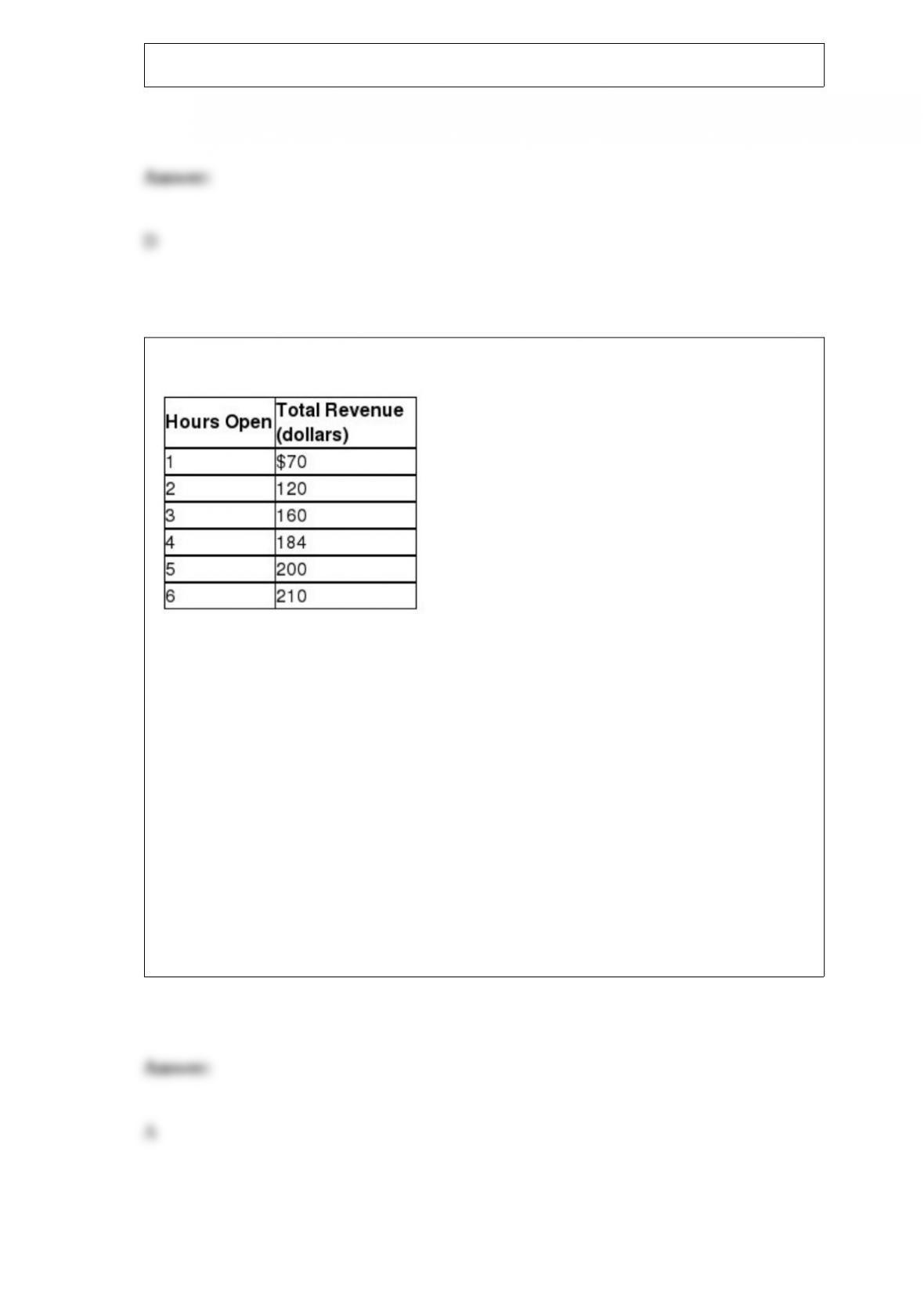
Table 1-3
Santiago runs a comic book store in the town of East Arbor. He is debating whether he
should extend his hours of operation. Santiago figures that his sales revenue will
depend on the number of hours the store is open as shown in the table above. He would
have to hire a worker for those hours at a wage rate of $18 per hour.
What is Santiago’s marginal cost if he decides to stay open for two hours instead of one
hour?
A) $18
B) $36
C) $38
D) $102
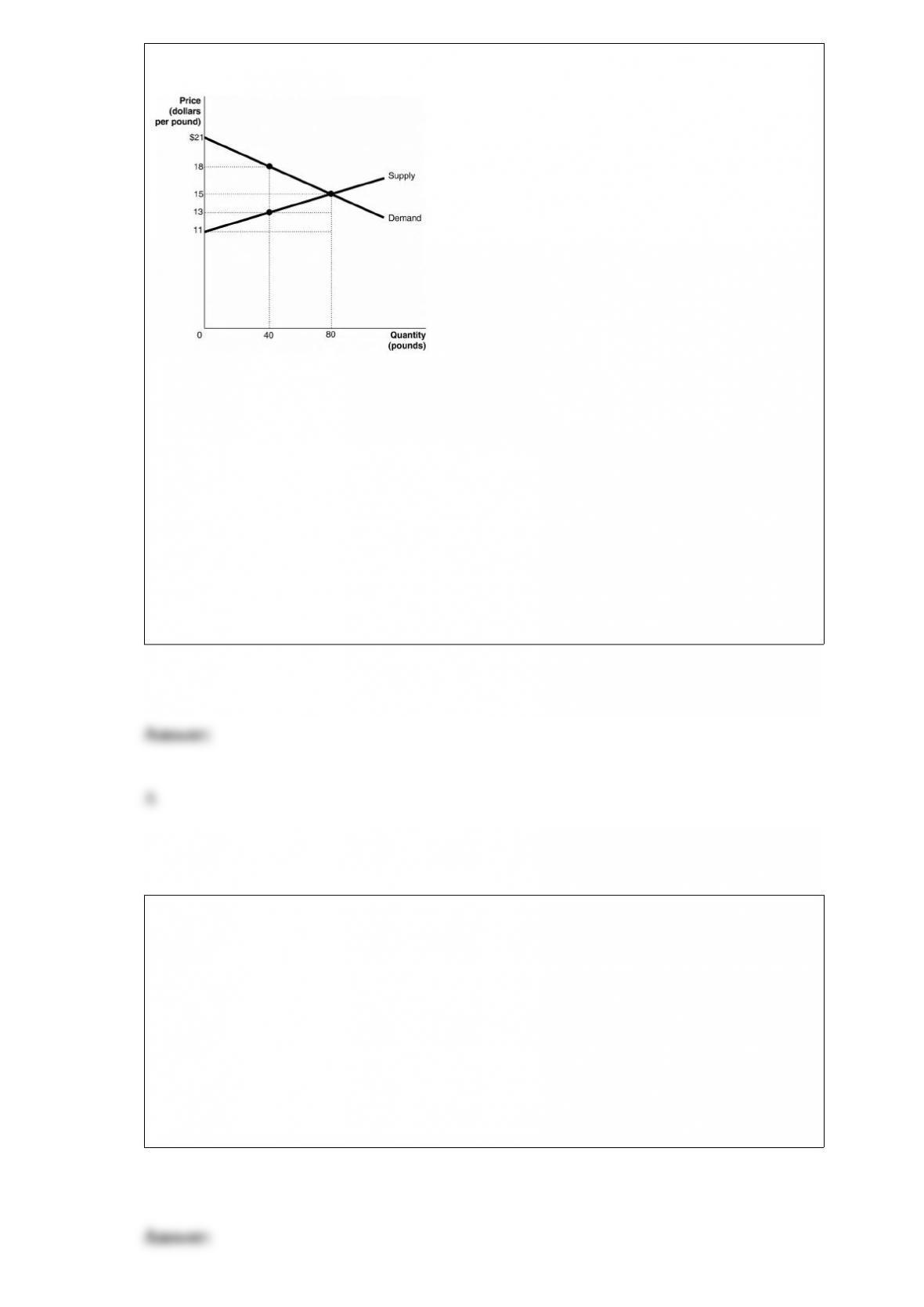
Figure 4-3
Figure 4-3 shows the market for tiger shrimp. The
market is initially in equilibrium at a price of $15 and a quantity of 80. Now suppose
producers decide to cut output to 40in order to raise the price to $18.
What is the value of the deadweight loss at the equilibrium price of $15?
A) $0
B) $40
C) $60
D) $100
Which of the following indicates that the U.S. economy has become more stable since
1950?
A) longer recessions
B) shorter expansions
C) less severe fluctuations in real GDP
D) All of the above indicate that the U.S. economy has become more stable since 1950.

A positive externality results when
A) economists are sure that a good or service provides benefits to consumers.
B) someone pays for a good or service even though she is not directly affected by the
production or consumption of it.
C) when people who live in one country benefit from the production of a good or
service that occurs in another country.
D) people who are not directly involved in producing or paying for a good or service
benefit from it.
In which of the following situations would the Fed conduct contractionary monetary
policy?
A) The Fed believes that aggregate demand was growing too slowly to keep up with
potential GDP.
B) The Fed fears that unemployment is climbing above the natural rate.
C) The Fed is concerned that aggregate demand would continue to exceed the growth in
potential GDP.
D) The Fed is worried that deflation will become a problem.

Consumption expenditures do not include household purchases of
A) medical care.
B) education.
C) new houses.
D) durable goods.
Compared to a situation in which there is no change in the value of the dollar relative to
the peso, in which of the following situations would you be worse off?
A) you borrow 10,000 pesos, you earn income in dollars, the dollar appreciates against
the peso, you must pay back the loan in pesos
B) you borrow $10,000, you earn income in pesos, the dollar depreciates against the
peso, you must pay back the loan in dollars
C) you borrow $10,000, you earn income in pesos, the dollar appreciates against the
peso, you must pay back the loan in dollars
D) you borrow 10,000 pesos, you earn income in pesos, the dollar depreciates against
the peso, you must pay back the loan in pesos
If a country has a ________ exchange rate, its central bank must buy and sell its
holdings of currencies to maintain a given exchange rate.
A) floating

B) flexible
C) fixed
D) all of the above
If you expect the economy is going to boom and average income in the economy will
rise in the foreseeable future, the type of firm that would be able to increase its sales if
your expectations are met is
A) one that sells an inferior good.
B) one that sells a necessity good.
C) one that sells a luxury good.
D) one that sells a price inelastic good.
Suppose a negative externality exists in a market. If transactions costs are low and
parties are willing to bargain then, according to the Coase theorem
A) an efficient solution can be reached only if property rights are assigned to the
victims of the pollution.
B) an efficient solution can be reached only if property rights are assigned to the
polluters.
C) an efficient solution can be reached regardless of the initial assignment of property
rights.

D) government intervention is critical to reach an efficient solution.
To compete in the automobile market, Tesla must make many strategic decisions such
as whether to introduce a new car model, how to sell and service its cars, and where to
advertise. At Tesla’s Fremont, California plant, managers must decide on the monthly
production quantities of their S and X models. In making this decision, the managers
A) face no trade-off because the Fremont plant only produces these two models of the
many Tesla models produced worldwide.
B) face a trade-off, because producing more of one model means producing less of the
others.
C) will choose to only produce the quantity of S and X models where marginal cost
equals zero.
D) will always decide on production quantities in which revenues are maximized.
Private saving is defined as
A) Y + TR – C – T.
B) T + G + TR.
C) T – G + TR.
D) Y + TR + C – T.

Economies of scale can lead to an oligopolistic market structure because
A) if larger firms have lower costs, new small entrants will not be able to produce at the
low costs achieved by the big established firms.
B) if economies of scale are insignificant, only a few firms are able to produce at the
low costs achieved by the big established firms.
C) a few firms can force rivals to produce at low levels of output.
D) a few firms can use high profits to keep out new entrants.
________ is maximized in a competitive market when marginal benefit equals marginal
cost.
A) Deadweight loss
B) Marginal profit
C) Economic surplus
D) Selling price

In general, the costs tariffs and quotas impose on consumers are
A) large in total but relatively small per person.
B) small in total but relatively large per person.
C) large in total and large per person.
D) small in total and small per person.
Some economists argue that the productivity slowdown of the mid-1970s to the
mid-1990s was due to changes in oil prices that
A) increased production costs, causing firms to reorganize production to conserve
energy, which reduced output per worker.
B) decreased production costs, causing firms to reorganize production to conserve
energy, which reduced output per worker.
C) increased production costs, causing firms to reorganize production to conserve
energy, which increased output per worker.
D) decreased production costs, causing firms to increase production, which reduced
output per worker.