
The supply curve of a uniquely talented actor or superstar athlete will be perfectly
inelastic.
The only type of business that faces unlimited liability is a sole proprietorship.
An equilibrium in which each player chooses its best strategy given the strategies
chosen by the other players is called a Nash equilibrium.
Stagflation occurs when short-run aggregate supply decreases.

If a monopolist’s marginal revenue is $15 per unit and its marginal cost is $25, then to
maximize profit the firm should decrease output.
Stagflation occurs when aggregate supply and aggregate demand both increase.
Disposable personal income is equal to personal income minus personal tax payments.
The marginal product of labor curve is the demand curve for labor.

A monopoly is defined as a firm that has the largest market share in an industry.
The payment received by suppliers of entrepreneurial skills is called rent.
Policies based on normative economic ideas tend to increase economic efficiency and
improve equity.
For developed countries like the United States, GDP will always exceed GNP.

Although the United States is the second largest exporting country, international trade is
less important to the U.S. than it is to most other countries.
The substitution effect of a change in the price of cauliflower is the portion of the
change in the quantity of cauliflower demanded that can be attributed to the change in
the price of a substitute vegetable such as asparagus.
The long run refers to a time period
A) during which a firm is able to purchase all of its inputs, including its plant and
equipment.
B) long enough for a firm to vary all of its inputs, to adopt new technology and change
the size of its physical plant.
C) long enough for a firm to pay all of its creditors in full.
D) long enough for a firm to change the use of its variable inputs.

Which of the following would cause the equilibrium price of white bread to decrease
and the equilibrium quantity of white bread to increase?
A) a decrease in the price of flour
B) an increase in the price of flour
C) an increase in the price of rye bread, a substitute for white bread
D) an increase in the price of butter, a complement for white bread
The primary purpose of patents and copyrights is to
A) provide owners with large profit forever.
B) protect firms from being taken advantage of by competing firms.
C) protect domestic firms from foreign competition.
D) encourage the expenditure of funds on research and development to create new
products.
Figure 14-1
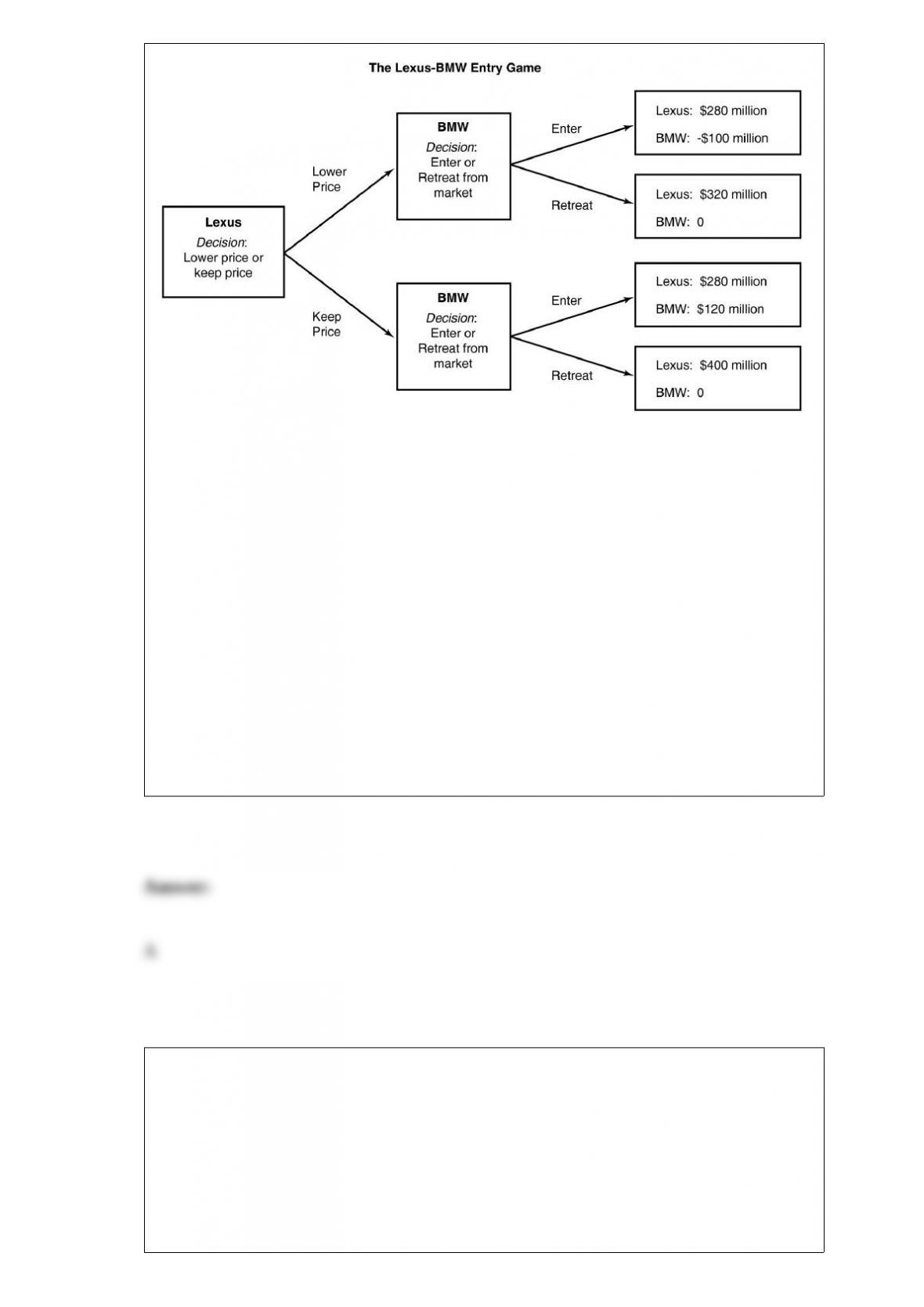
Assume that Lexus (L) is the first automobile company to produce a luxury class hybrid
automobile and is the only such company for the past four years. BMW is now
considering producing its own luxury hybrid automobile and Lexus must decide
whether or not to lower the price of its luxury hybrid to counter BMW’s entry into the
luxury hybrid niche.
If Lexus lowers its price, will this deter BMW from entering the market?
A) Yes, because BMW stands to lose $100 million if it competes with Lexus.
B) Yes, because BMW will make a smaller profit than Lexus if it chooses to compete.
C) No, because BMW will still make a profit of $120 if it competes with Lexus.
D) No, because BMW will be able to break Lexus’ first mover advantage.
Which of the following is not one of the ways that the German government ended the
hyperinflation of the 1920s?
A) negotiating a new agreement with the Allies (the United States, Great Britain,
France, and Italy) that reduced its reparations payments
B) reducing government expenditures and raising taxes to balance its budget
C) raising the required reserve ratio to reduce bank loans
D) replacing the existing mark with a new mark
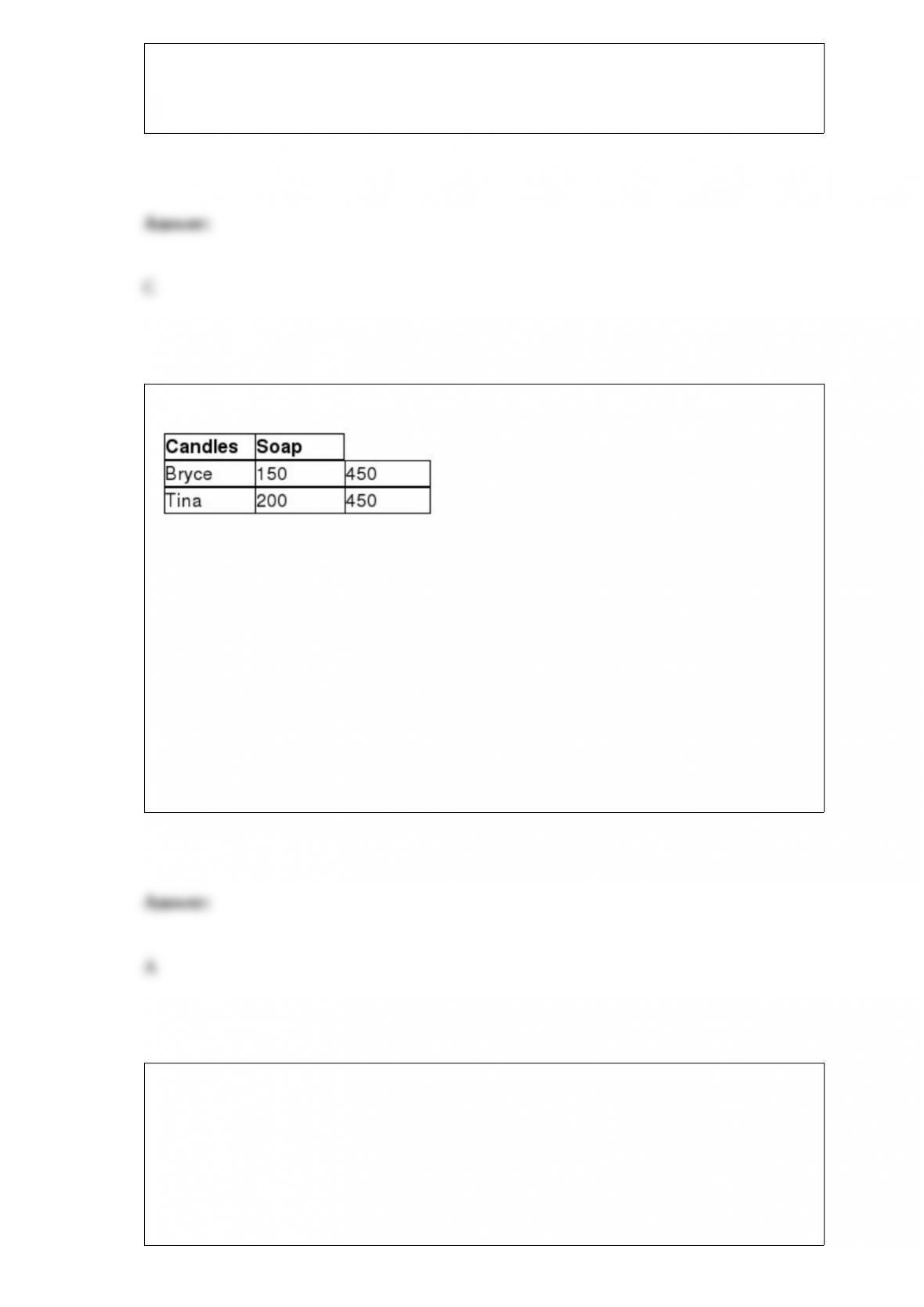
Table 9-3
Bryce and Tina are artisans who produce homemade candles and soap. Table 9-3 lists
the number of candles and bars of soap Bryce and Tina can each produce in one month.
Select the statement that accurately interprets the data in the table.
A) Bryce has a greater opportunity cost than Tina for making candles.
B) Bryce’s opportunity cost for making candles is less than Tina’s.
C) Tina has a greater opportunity cost than Bryce for making candles.
D) Bryce’s opportunity cost for making candles and making soap are both greater than
Tina’s.
Suppose an industry is made up of 25 firms, all with equal market share. The four-firm
concentration ratio of this industry is
A) 16%.
B) 20%.
C) 25%.
D) It cannot be determined from the information given.
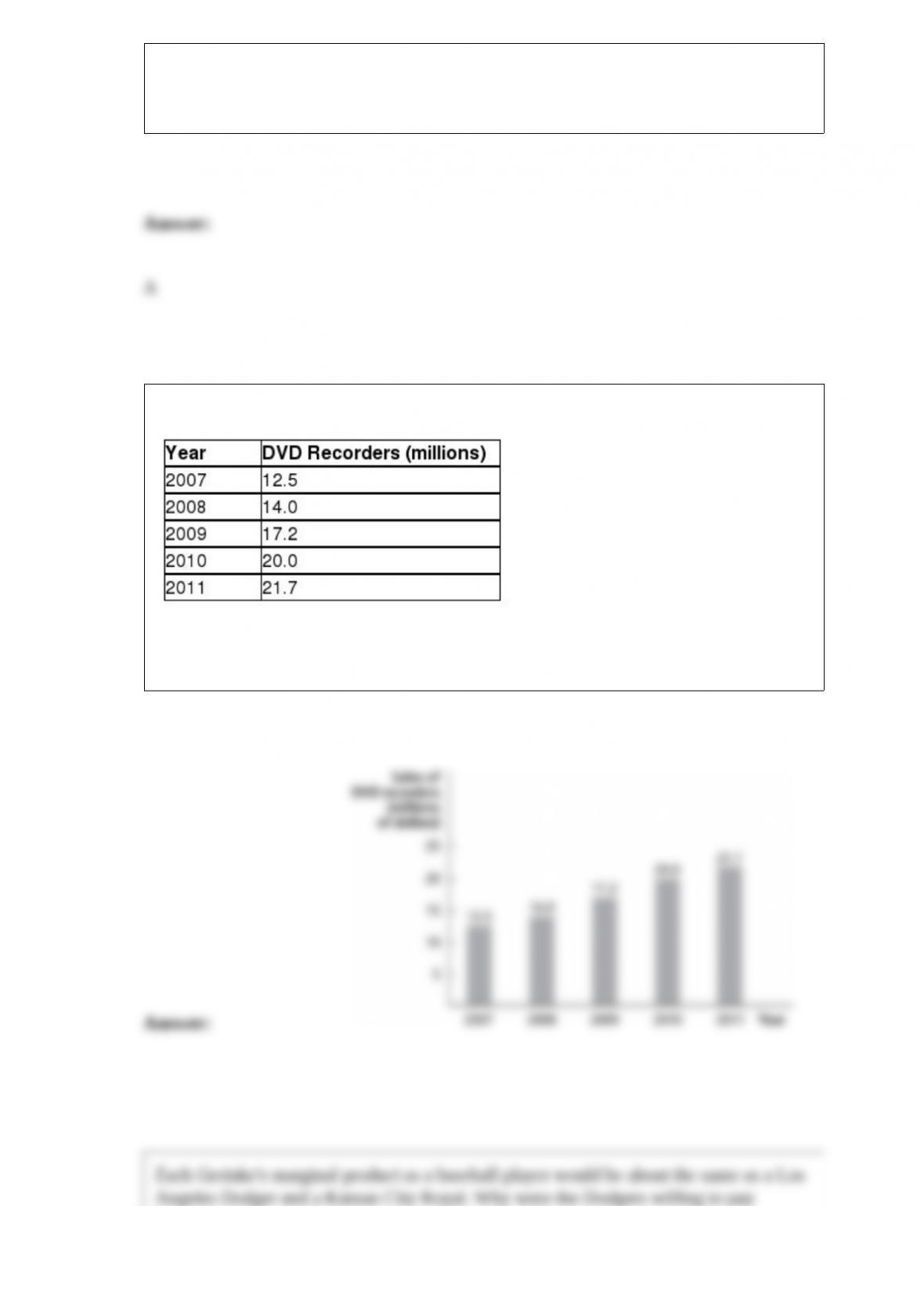
Table 1-4
The table above shows the sales of DVD recorders in North America. Present the
information using a bar graph.

Zach Greinke’s marginal product as a baseball player would be about the same as a Los
Angeles Dodger and a Kansas City Royal. Why were the Dodgers willing to pay
Greinke a higher salary than he was paid as a Royal?
A) The Dodgers play needed a superstar to attract fans to their games. The Royals had
no need to attract fans to their games.
B) The Dodgers play more home games than the Royals. As a result, the Dodgers earn
more revenue from ticket sales that they can use to pay player salaries.
C) Greinke’s marginal revenue product is higher as a Dodger than it was as a Royal.
D) The owner of the Dodgers was under more pressure from the fans and the Los
Angeles media to pay Greinke a higher salary than the Royals were willing to pay.
An article on how prices in South Bend, Indiana rise during Notre Dame home football
games noted: “For the Sept. 16 game against the University of Michigan, the South
Bend Marriott is charging $649 a night for a double room…. The Marriott’s regular
weekend price is $149 a night.”
Source: Ilan Brat, “Notre Dame Football Introduces Its Fans To Inflationary
Spiral,” Wall Street Journal, September 7, 2006, p. A1. Which of the following
statements is true?
A) The Marriott is practicing first-degree price discrimination by charging what the
market will bear.
B) This is evidence of third-degree price discrimination because hotel accommodation
on a particular day is not a product that can be resold later.
C) There is no evidence of price discrimination; the Marriott is responding to increased
demand for hotel rooms in the face of constant supply.
D) The Marriott has adopted this pricing strategy to capitalize on arbitrage profits.
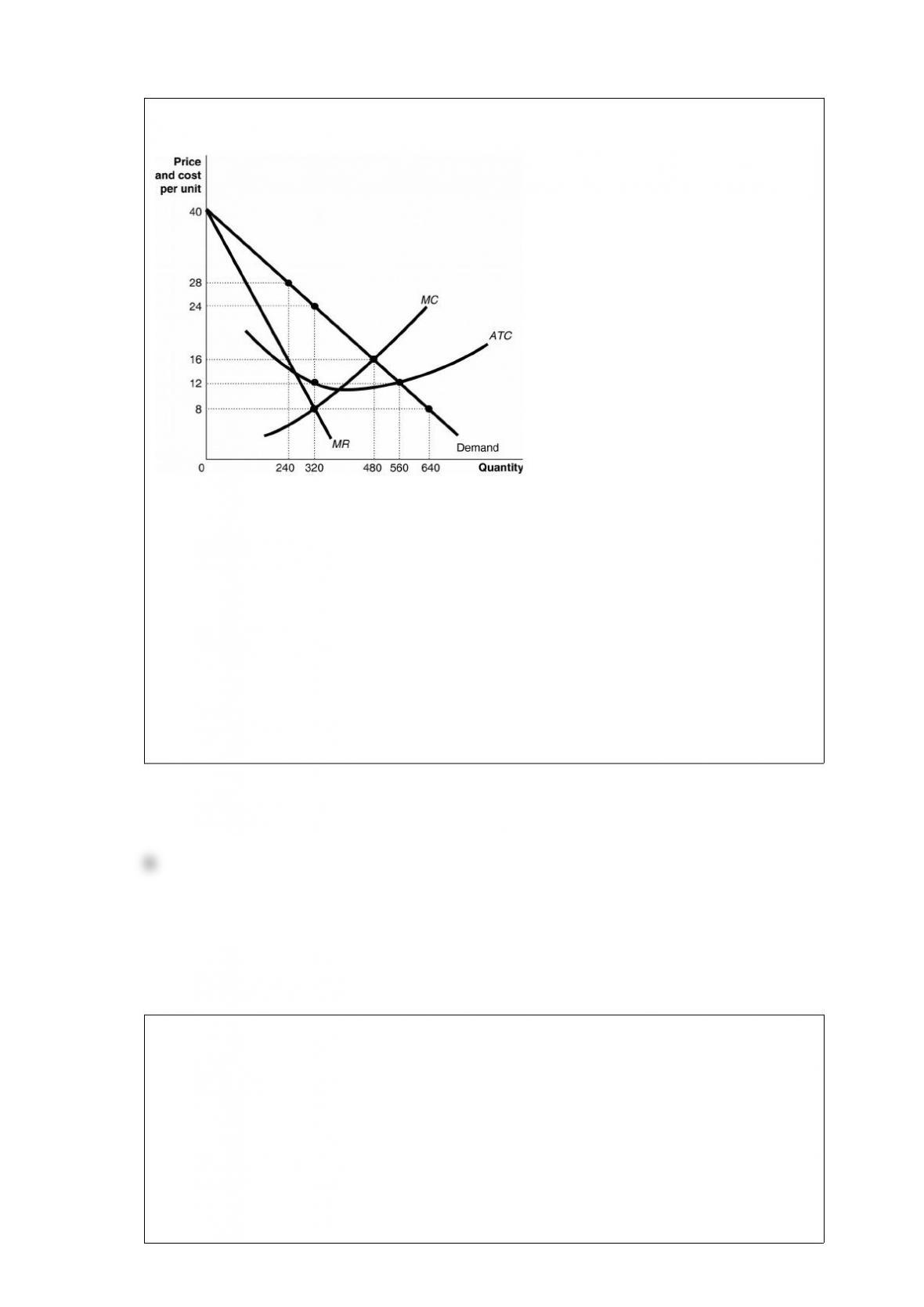
Figure 16-5
Suppose the firm represented in the diagram decides to use a two-part pricing strategy
such that it charges a fixed fee and a per-unit price equal to the monopoly price. What is
the per-unit price?
A) $28
B) $24
C) $12
D) $8
Max Shreck, an accountant, quit his $80,000-a-year job and bought an existing tattoo
parlor from its previous owner, Sylvia Sidney. The lease has five years remaining and
requires a monthly payment of $4,000. The lease
A) is a fixed cost of operating the tattoo parlor.
B) is a variable cost of operating the tattoo parlor.
C) is an implicit cost of operating the tattoo parlor.
D) is part of the marginal cost of operating the tattoo parlor.
Briefly describe the types of health care systems in Canada, Japan, and the United
Kingdom.
How can a sole proprietorship raise funds needed for firm expansion?
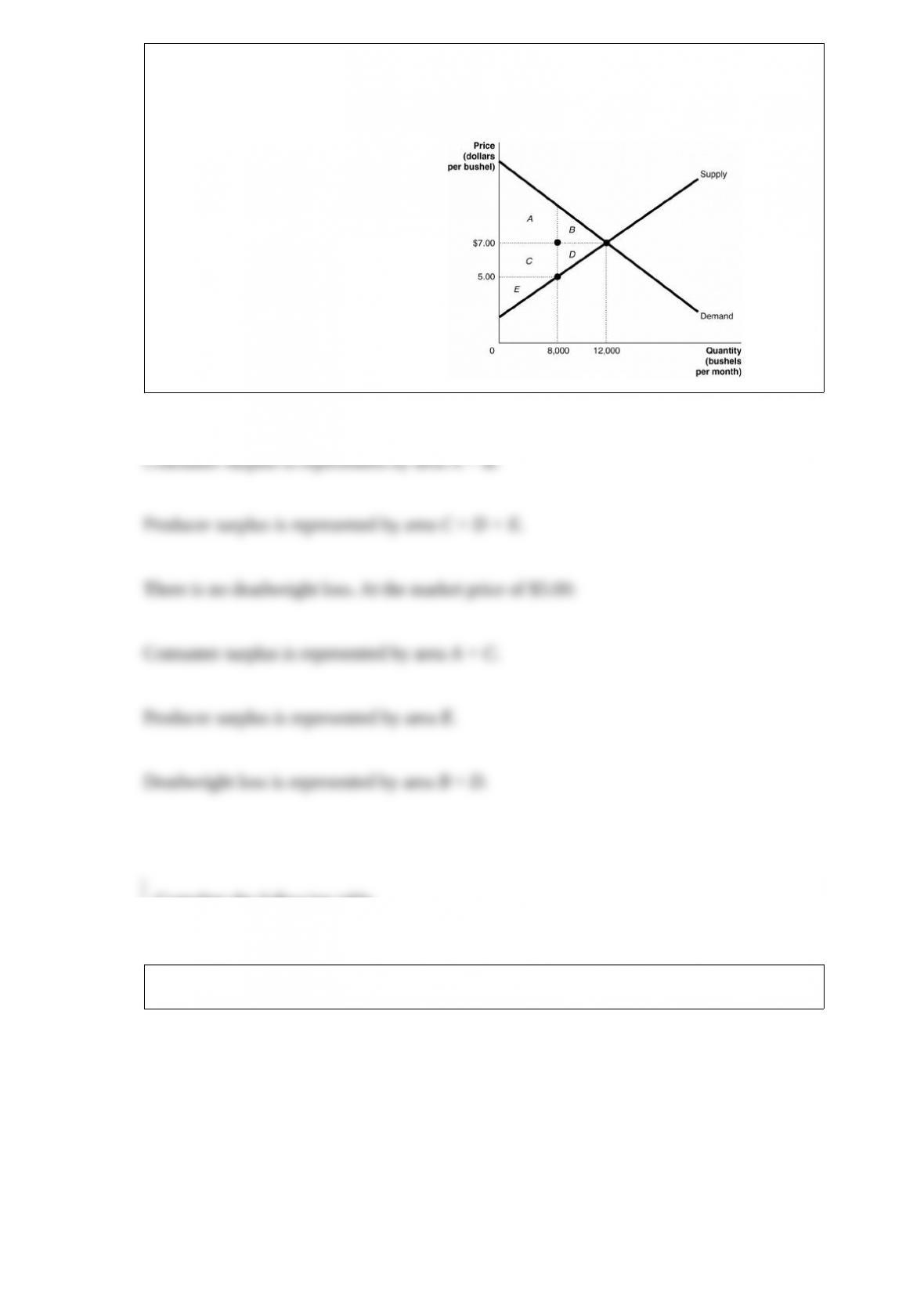
The graph below represents the market for lychee nuts. The equilibrium price is $7.00
per bushel, but the market price is $5.00 per bushel. Identify the areas representing
consumer surplus, producer surplus, and deadweight loss at the equilibrium price of
$7.00 and at the market price of $5.00.
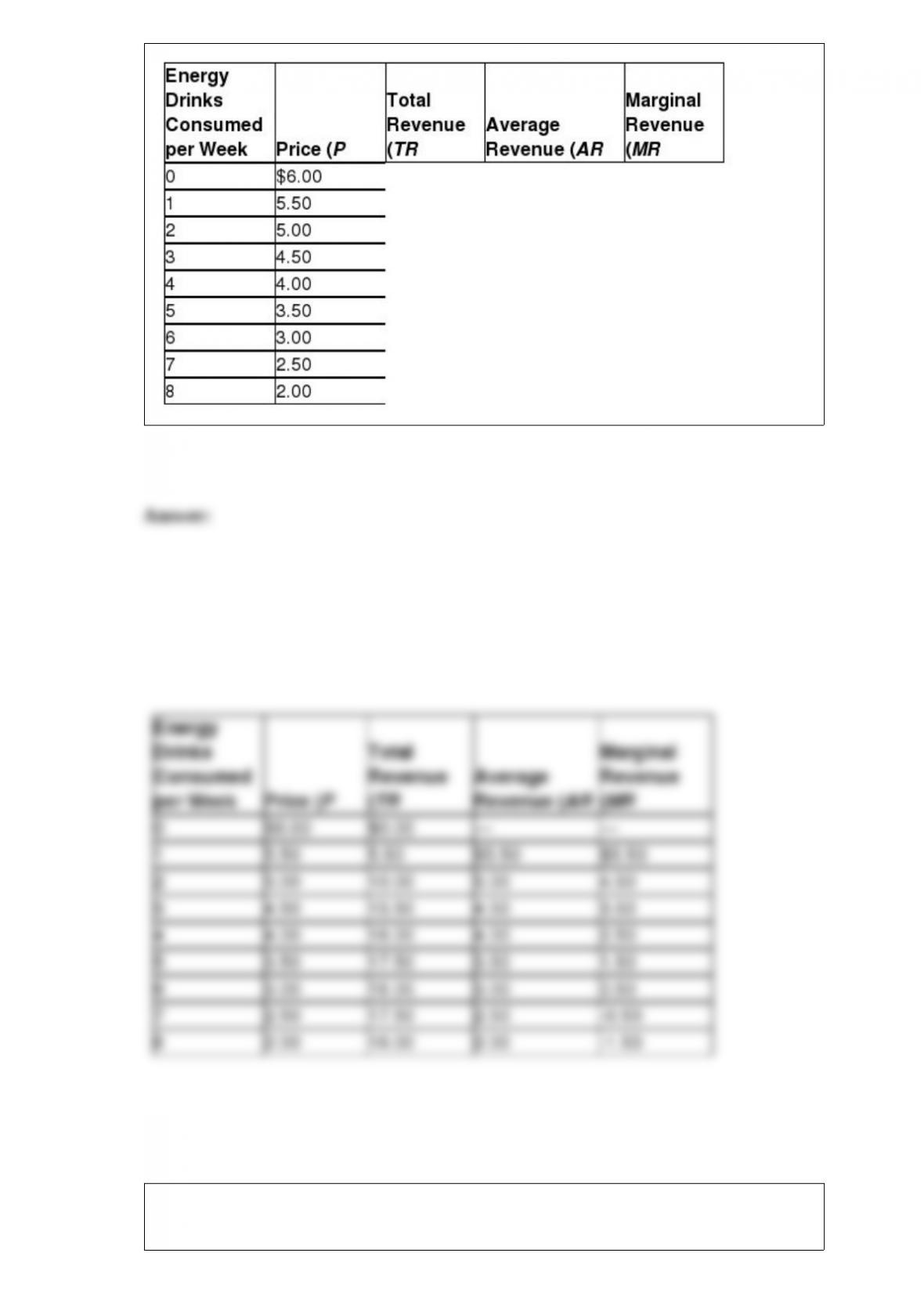
Complete the following table.
List three reasons why demand for a product will often increase if the product is
endorsed by a celebrity.
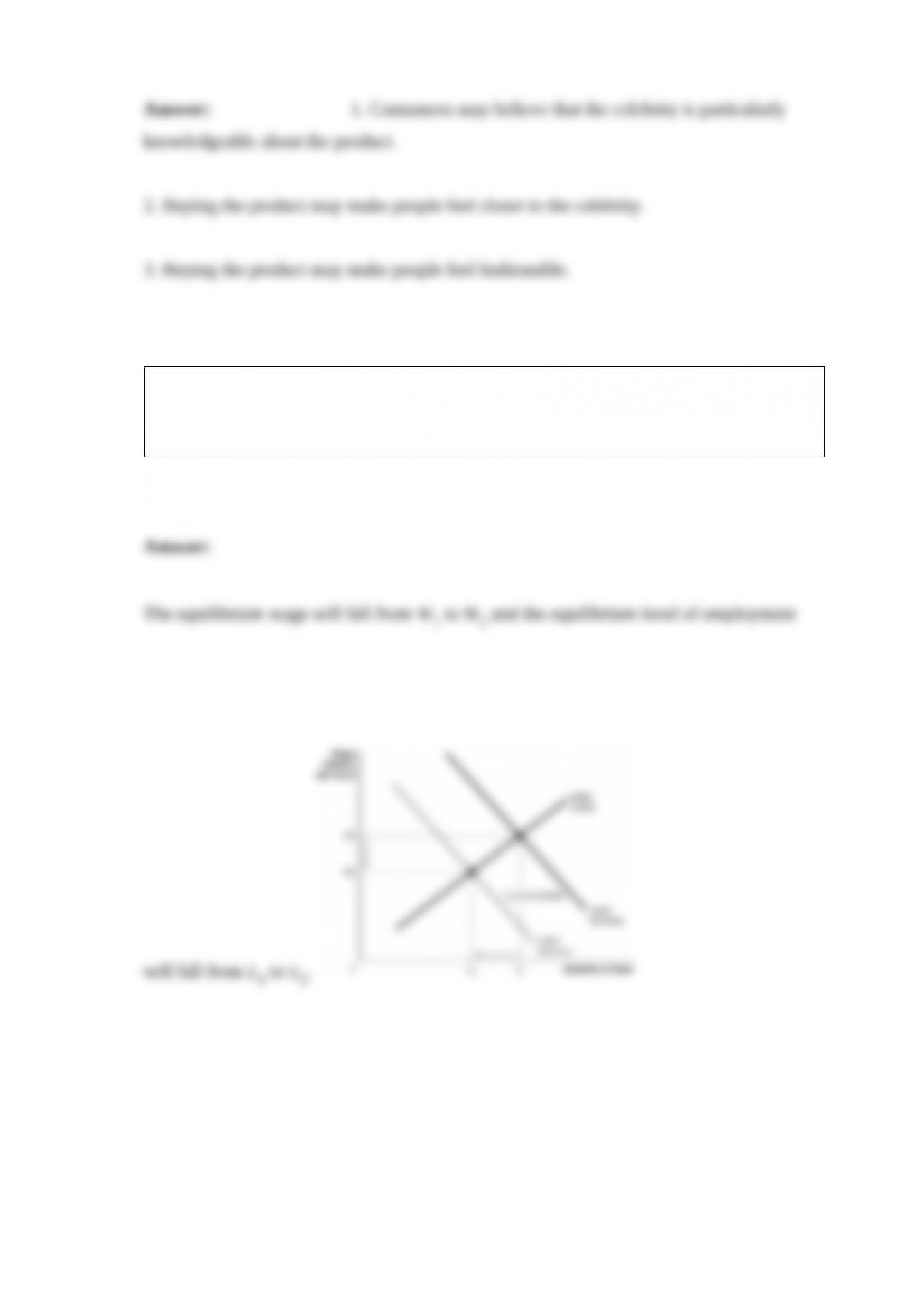
If the labor demand curve shifts to the left and the labor supply curve remains
unchanged, what will happen to the equilibrium wage and the equilibrium level of
employment? Illustrate your answer with a graph.