Monetary policy refers to the actions the
A) President and Congress take to manage the money supply and interest rates to
pursue their economic objectives.
B) Federal Reserve takes to manage the money supply and interest rates to pursue its
macroeconomic policy objectives.
C) President and Congress take to manage government spending and taxes to pursue
their economic objectives.
D) Federal Reserve takes to manage government spending and taxes to pursue its
economic objectives.
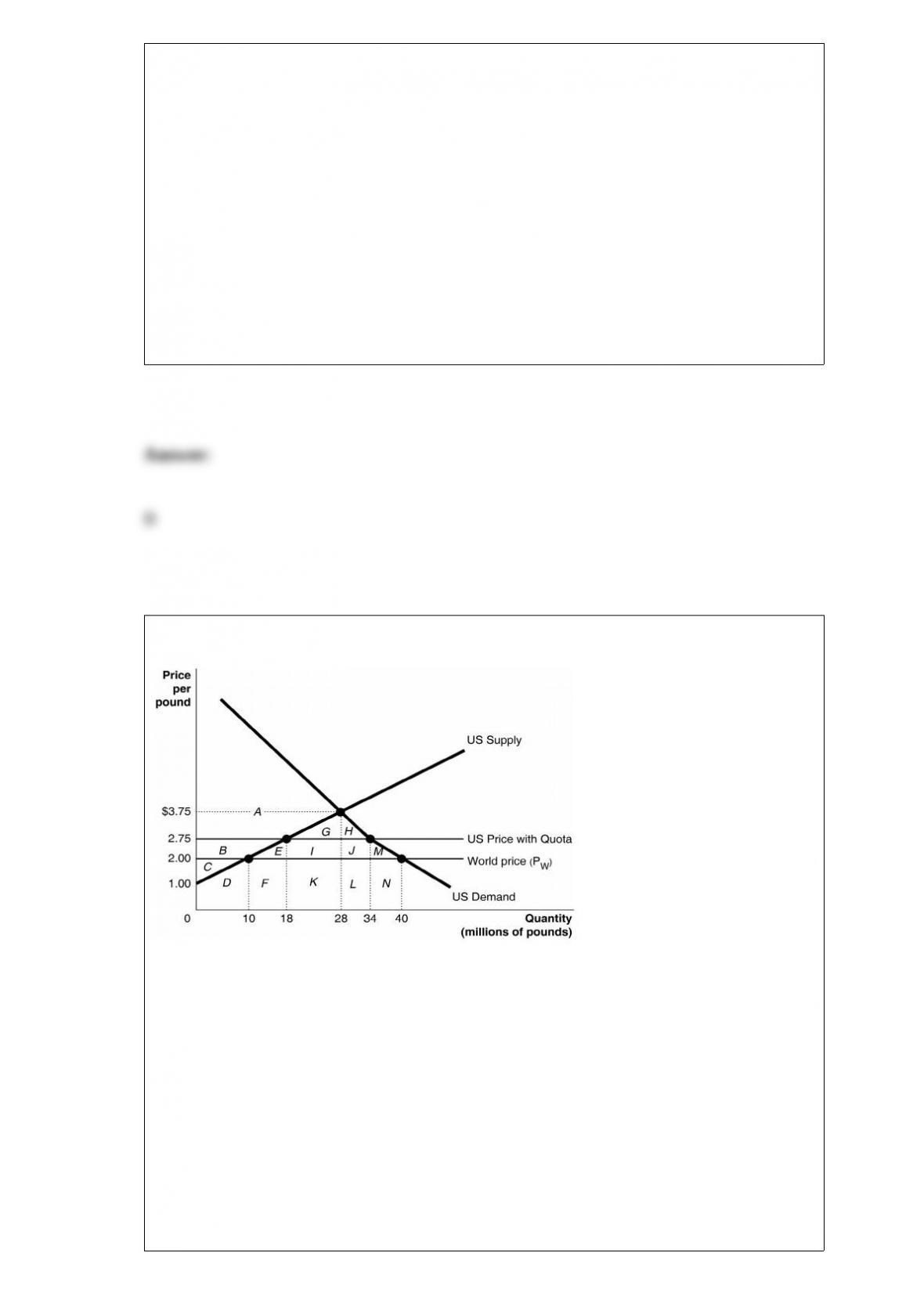
Figure 7-3
Since 1953 the United States has imposed a quota to limit the imports of peanuts.
Figure 7-3 illustrates the impact of the quota.
Refer to Figure 7-3. With a quota in place, what is the quantity consumed in the
domestic market and what portion of this is supplied by imports?
A) Domestic consumption equals 28 million pounds of which 18 million pounds are
imports.
B) Domestic consumption equals 40 million pounds of which 22 million pounds are
imports.
C) Domestic consumption equals 34 million pounds of which 16 million pounds are

imports.
D) Domestic consumption equals 34 million pounds of which 18 million pounds are
imports.
Article Summary
Although growing at only half the average rate following the seven previous recessions,
consumer spending has increased 9 percent since the end of the 2007-2009 recession,
and consumer confidence has been on the rise as household finances, the job market,
and the housing market continue to improve. The Federal Reserve projects a 3% – 3.5%
growth rate for the economy in 2014, up from the recent average of 2%. Debt payments
have fallen to an average of 15.69% of after-tax income for households, the lowest level
in 30 years, and lower debt payments leave households with more to spend on
consumer goods.
Source: Neil Shah, “Pocketbooks Begin to Open As Household Wealth Grows,” Wall
Street Journal, June 25, 2013.
Refer to the Article Summary. The increase in consumer spending discussed in the
article summary was due in part to lower debt payments which have resulted in an
increase in disposable income. The increase in consumption resulting from the increase
in disposable income caused a(n) ________ the aggregate expenditure curve.
A) movement up along
B) movement down along
C) downward shift of
D) upward shift of
What is the most common type of business?
A) corporation
B) partnership
C) sole proprietorship
D) They are equally represented because of Federal laws.
Stagflation usually results from
A) a supply shock.
B) a decrease in aggregate demand.
C) an increase in aggregate supply.
D) an increase in aggregate demand.
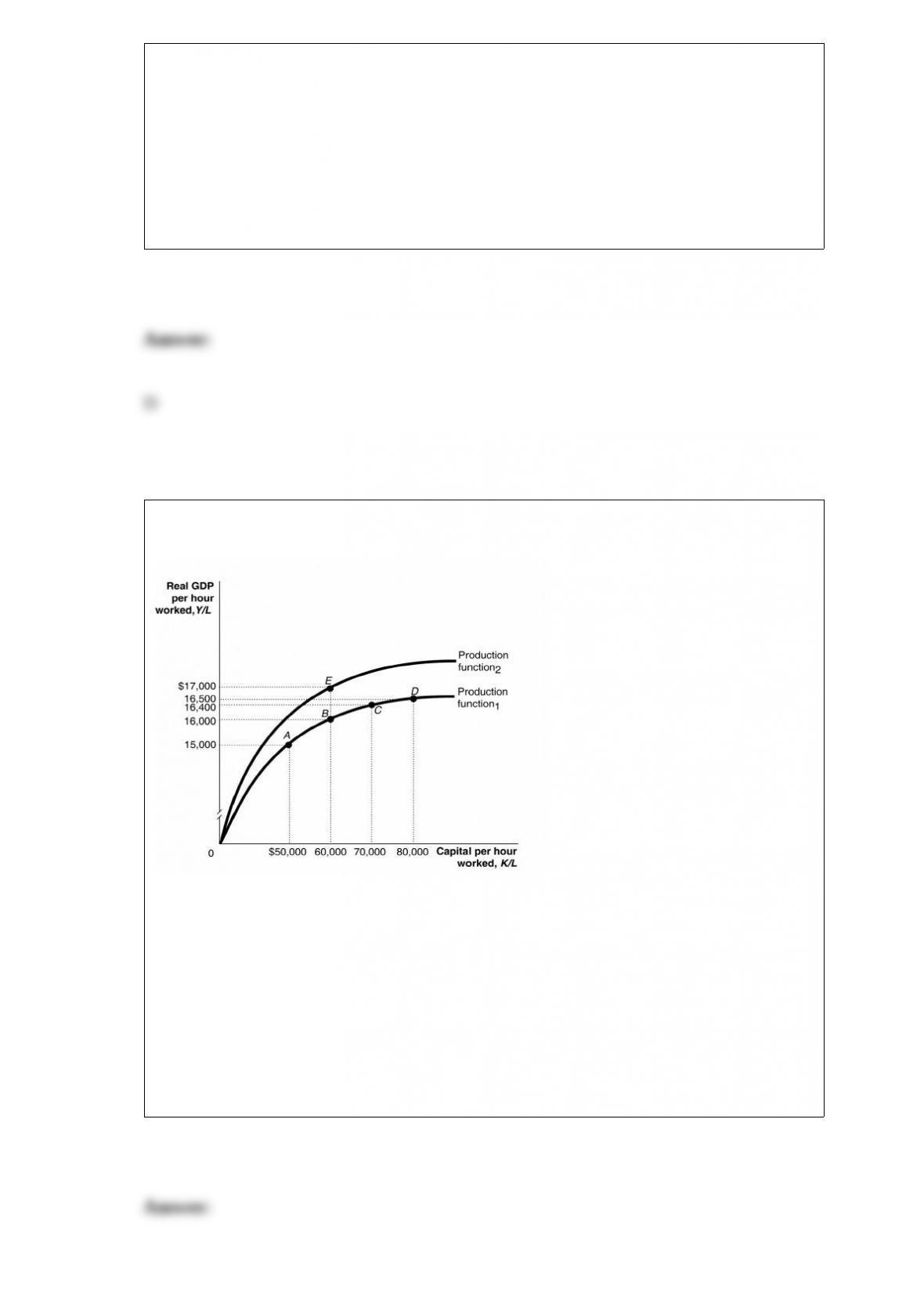
Table 9-17
Refer to Table 9-17. Looking at the table above, real average hourly earnings between
2010 and 2011 changed by
A) 1.2%.
B) 4.5%.
C) 9.9%.
D) 14.5%.
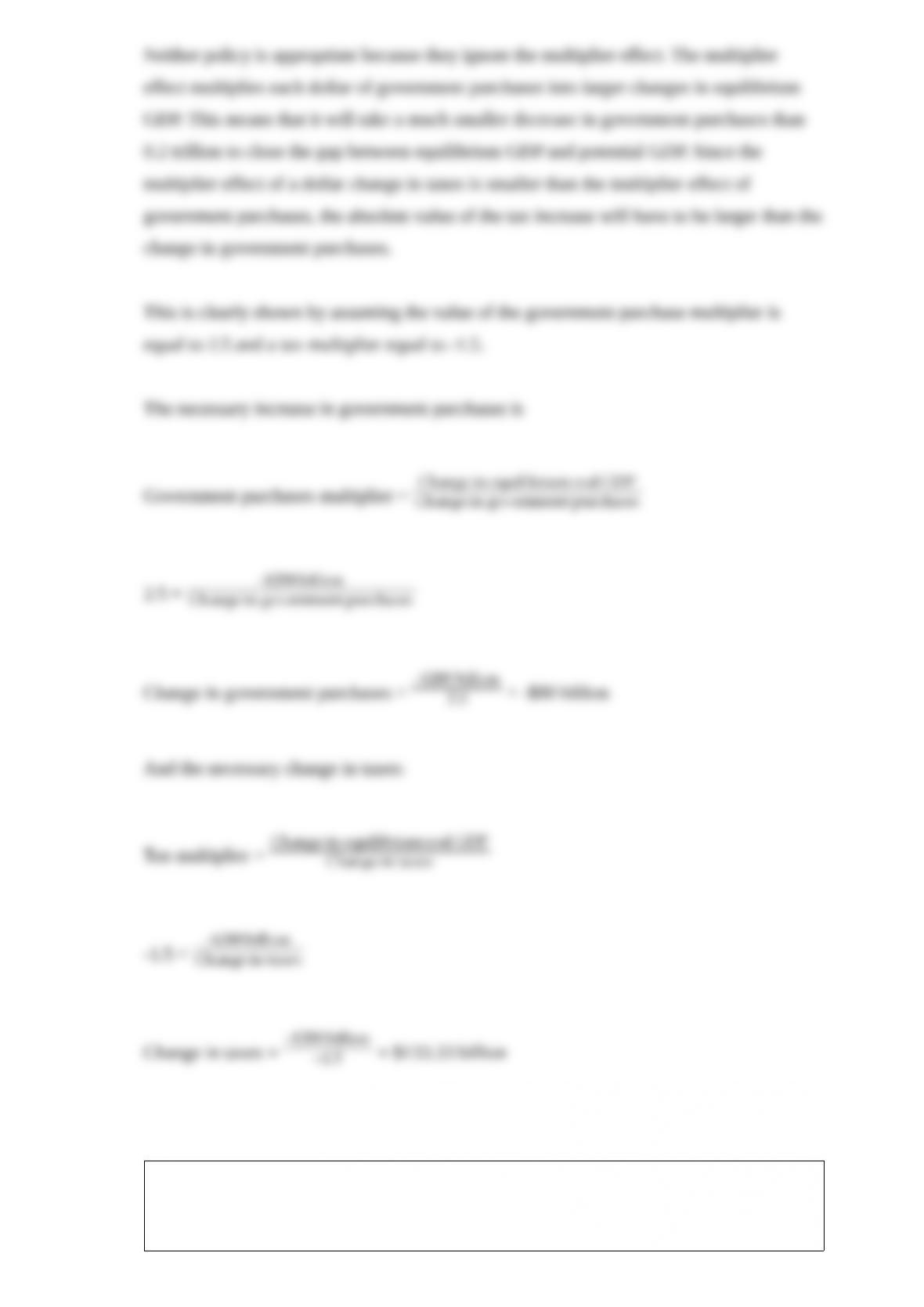
Figure 11-3
Refer to Figure 11-3. Which of the following would cause an economy to move from a
point like A in the figure above to a point like B?
A) an improvement in technology
B) a decrease in capital per hour worked
C) an increase in capital per hour worked
D) a technological regression

________ involves undertaking an activity until its marginal benefits equal marginal
costs.
A) Scarcity reduction
B) Central planning
C) Marginal analysis
D) Market intervention
________ is defined as a market outcome in which the marginal benefit to consumers of
the last unit produced is equal to the marginal cost of production, and in which the sum
of consumer surplus and producer surplus is at a maximum.
A) Economic efficiency
B) Consumer efficiency
C) Producer efficiency
D) Deadweight efficiency
The ________ curves are both vertical.

A) aggregate demand and short-run Phillips
B) long-run aggregate supply and short-run Phillips
C) long-run aggregate supply and long-run Phillips
D) short-run aggregate supply and short-run Phillips
If your nominal wage rises more slowly than the price level, we can say your real wage
has ________ and the purchasing power of a dollar has ________.
A) fallen; fallen
B) fallen; risen
C) risen; risen
D) risen; fallen
Which of the follow is a result of imposing a rent ceiling?
A) Some consumer surplus is converted to producer surplus.
B) There is an increase in the quantity of apartments supplied.
C) There is an increase in the quantity of apartments demanded.
D) The marginal benefit of the last apartment rented is less than the marginal cost of
supplying it.

Suppose your grandfather earned a salary of $12,000 in 1964. If the CPI is 31 in 1964
and 219 in 2013, then the value of your grandfather’s salary in 2013 dollars is
approximately
A) $84,775.
B) $63,830.
C) $37,200.
D) $26,280.
Article Summary
A growing number of U.S. citizens are going to other countries for elective surgery
procedures. Improved quality and significant cost savings abroad have attracted an
increasing number of what are being referred to as American medical tourists,
especially those who either do not have insurance or whose insurance does not cover
the desired procedure. As few as five years ago, Americans tended to travel to countries
such as Thailand or Mexico for the procedures, but many are now choosing to go to
Europe, where governments and hospitals are now publicizing these services. Many of
the procedures being done overseas are joint replacement, and partly in response to the
number of patients going abroad for these procedures, programs are being developed to
reduce the cost of these surgeries in the United States.
Source: Elizabeth Rosenthal, “The Growing Popularity of Having Surgery Overseas,”
New York Times, August 6, 2013.
Refer to the Article Summary. If European governments and hospitals continue to
publicize their existing services to American medical tourists and more Americans
consider joint-replacement surgery to improve their quality of life, what will happen in

the market for joint-replacement surgery as a result of these two factors?
A) Demand will increase, but these two factors will not shift the supply curve.
B) Supply will increase, but these two factors will not shift the demand curve.
C) Demand and supply will both increase.
D) Demand will increase and supply will decrease.
Suppose that domestic investment in Canada is 10.7% of GDP, and Canadian national
savings is 13% of GDP. What is Canada’s foreign investment as a percentage of GDP?
A) 1.15%
B) 2.3%
C) 15.3%
D) 23.7%
Suppose that the current equilibrium GDP is $14.5 trillion and that potential GDP is
$14.3 trillion. Will decreasing government purchases by $200 billion, or raising taxes
by $200 billion, restore the economy to potential GDP? Explain.
Use the dynamic model of aggregate demand and supply to illustrate a situation where
aggregate demand and short-run aggregate supply are both increasing from year 1 to
year 2, resulting in a higher price level and higher level of real GDP at macroeconomic
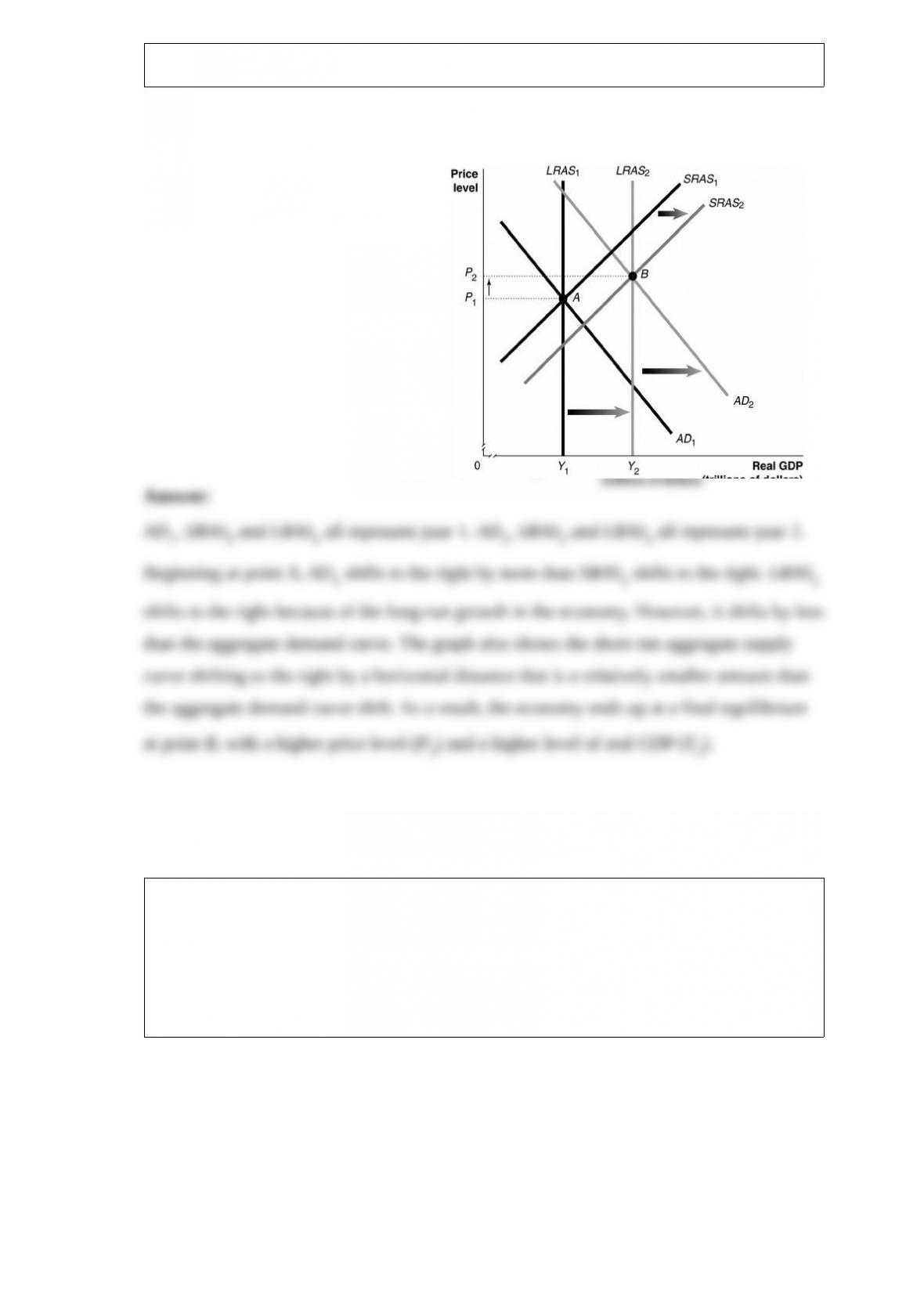
equilibrium in year 2.
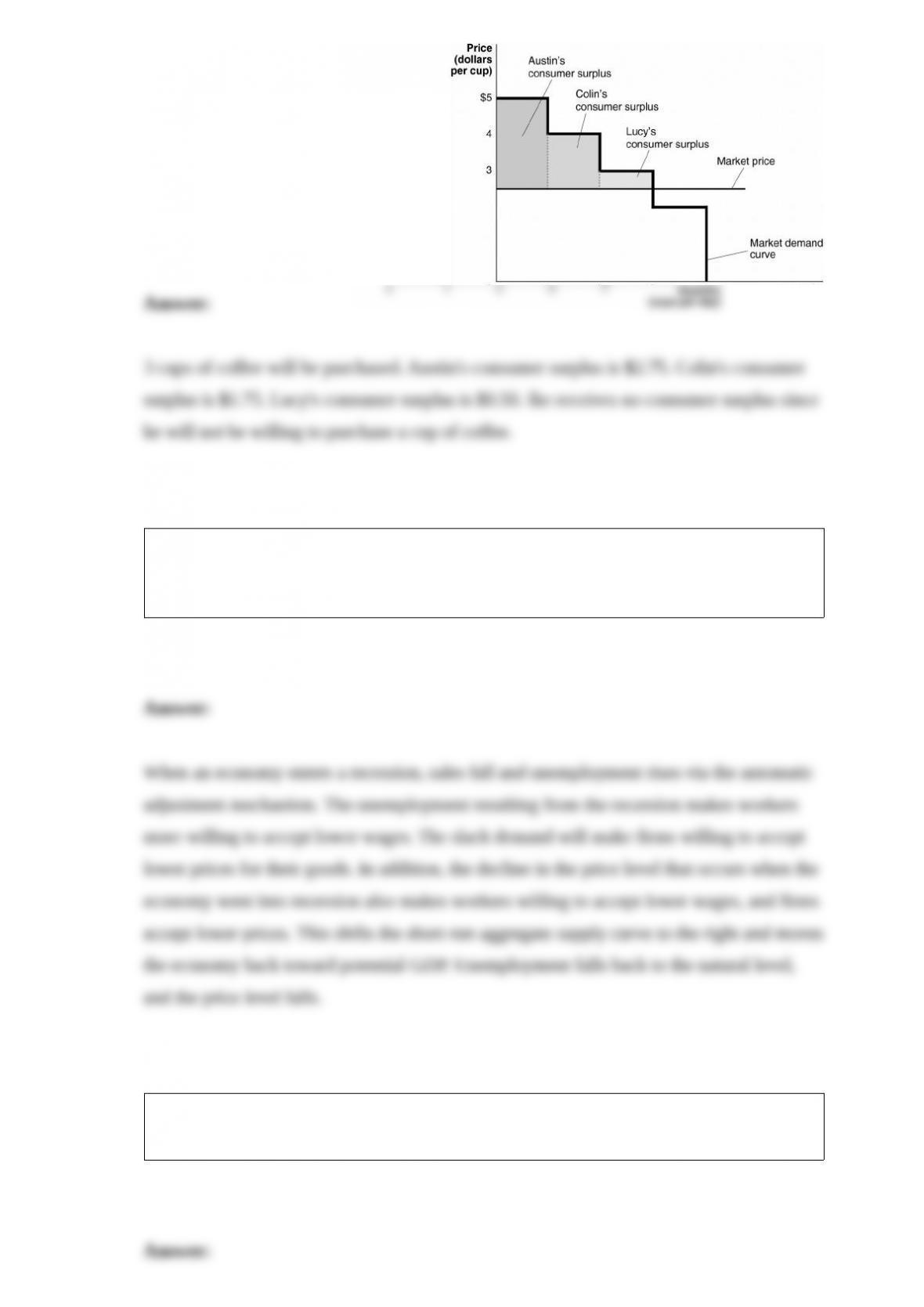
The market price for coffee is $2.25 per cup. Austin is willing to pay $5.00 per cup,
Colin is willing to pay $4.00 per cup, Lucy is willing to pay $3.00 per cup, and Ike is
willing to pay $2.00 per cup. Construct a graph showing the consumer surplus for each
cup of coffee purchased. How many cups of coffee will be purchased? What is the
value of the consumer surplus each of the four consumers receives from their coffee
purchases?
Explain how the economy moves back to full employment from recession. Be sure to
detail what happens to short-run aggregate supply, unemployment, equilibrium GDP
and the price level.
What is destabilizing speculation? What role did it play in the collapse of the Bretton
Woods system?
Although gold is highly valued by most people, it is difficult to use as a medium of
exchange. Explain.
List three different price indices and explain how they differ in terms of the market
basket on which they are based.
How does the principal-agent problem extend to managers and employees?
Can the Federal Reserve achieve both low inflation and low levels of unemployment?
Explain.
Suppose you withdraw $1,000 from your savings account and put it in your checking

account. Briefly explain how this will affect M1 and M2.