1) The movement of individuals and households from one income quintile to another
over time is called:
A.income averaging.
B.wealth turnover.
C.income mobility.
D.the ratchet effect.
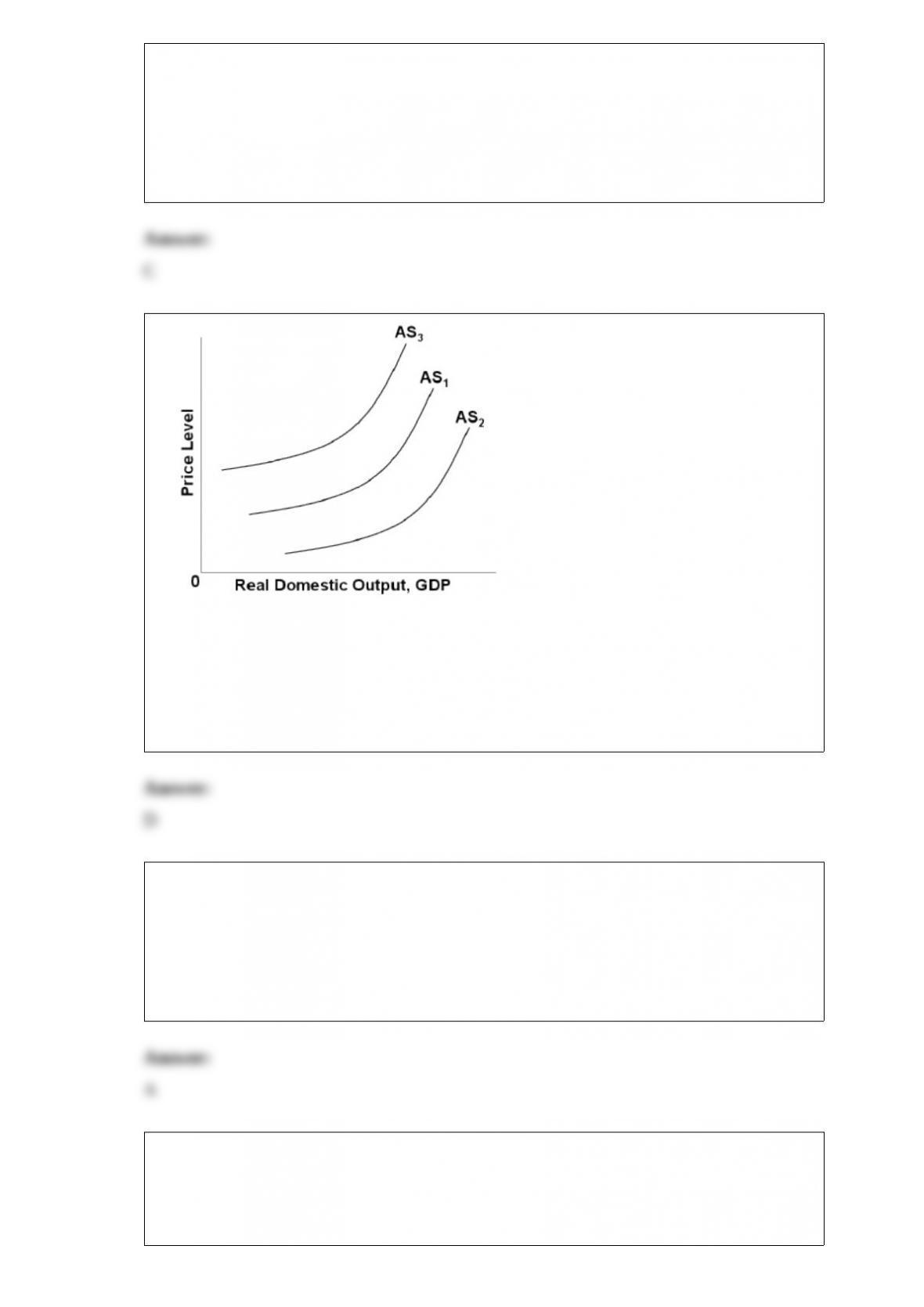
2)
In the above diagram, the most favorable shift of the aggregate supply curve for the
economy would be from:
A.AS1 to AS2.
B.AS1 to AS3.
C.AS2 to AS3.
D.AS3 to AS2.
3) If the prices paid by farmers increase and the prices received by farmers decrease,
then the parity ratio:
A.will necessarily decrease.
B.will necessarily increase.
C.may either increase or decrease.
D.will be unaffected.
4) a purely competitive firm should produce in the short run if its total revenue is
sufficient to cover its:
a.total variable costs.
b.total costs.

c.total fixed costs.
d.marginal costs.
5) the coordination problem in the centrally planned economies refers to the idea that:
a.planners had to direct required inputs to each enterprise.
b.the price level and the level of employment were inversely related.
c.the immediate effect of more investment was less consumption.
d.exports had to be equal to imports for a central plan to work.
6) if x is a normal good, a rise in money income will shift the:
a.supply curve for x to the left.
b.supply curve for x to the right.
c.demand curve for x to the left.
d.demand curve for x to the right.
7) A firm decides to make a $10 million expenditure on research and development that
will create a new product. This product is expected to increase the firms revenues by a
total of $12 million in the next year. The firm also estimates that the production cost of
the new product will be $11 million.
(a)What is the expected rate of return on this research and development expenditure?
(b)If the firm has to take out a loan to finance the project, what is the highest interest
rate they will pay and still do the project? Explain.
8) Assume the equation for the total demand for money is L = 0.4Y + 80 – 4 i, where L
is the amount of money demanded, Y is gross domestic product, and i is the interest
rate. If gross domestic product is $200 and the interest rate is 10 (percent), what amount
of money will society want to hold?

A.$200
B.$120
C.$320
D.$160
9) The Food for Peace program is designed to:
A.achieve 100 percent price parity for all farm products.
B.discover new uses for farm products through research and development.
C.take agricultural land out of the production of feed grains.
D.facilitate the distribution of U.S. farm products in the developing countries.
10) suppose that gdp was $200 billion in year 1 and that all other components of
expenditures remained the same in year 2 except that business inventories increased by
$10 billion. gdp in year 2 is:
a.$180 billion.
b.$190 billion.
c.$200 billion.
d.$210 billion.
11) Upon learning that his auto transmission is about to fail, Ray Roma sells his car to
an unsuspecting buyer. This circumstance illustrates:
A.asymmetric information.
B.the Coase theorem.
C.the moral hazard problem.
D.the principal-agent problem.
12) which of the following is correct?
a.when total product is rising, both average product and marginal product must also be
rising.
b.when marginal product is falling, total product must be falling.
c.when marginal product is falling, average product must also be falling.
d.marginal product rises faster than average product and also falls faster than average
product.

13) command systems are also known as:
a.market systems.
b.pure capitalism.
c.laissez-faire capitalism.
d.communism.
14) A private closed economy includes:
A.households, businesses, and government, but not international trade.
B.households, businesses, and international trade, but not government.
C.households and businesses, but not government or international trade.
D.households only.
15) if the existence of health insurance increases one’s incentive to use the health care
system more intensively, this is an illustration of:
a.the adverse selection problem.
b.the moral hazard problem.
c.the benefits-received principle.
d.the coase theorem.
16) A balance-of-payments deficit occurs:
A.when a nation must make an inpayment of official reserves to its capital and financial
account.
B.whenever a nation has a goods and services deficit.
C.whenever a nation has a goods and services surplus.
D.when a nation must make an outpayment of official reserves from its capital and
financial account.
17) It is sometimes difficult to transfer the advanced technologies of the industrialized
nations to the DVCs because:

A.the technologies of the IACs are frequently based on relatively expensive labor and
relatively cheap capital.
B.the resource endowments of the IACs and the DVCs are highly similar.
C.international patent laws prohibit such transfers.
D.the technologies of the IACs are frequently based on relatively cheap labor and
relatively expensive capital.
18) If the nominal GDP is $477 billion and the velocity of money is 4.5, then the money
supply is:
A.$122 billion.
B.$98 billion.
C.$106 billion.
D.$477 billion.
19) If MPC = .5, a simultaneous increase in both taxes and government spending of $20
will:
A.decrease GDP by $20.
B.decrease GDP by $40.
C.increase GDP by $20.
D.increase GDP by $40.