
A monopsony restricts the quantity of a factor demanded to force down the price of the
factor and increase profits.
Answer:
The natural rate of unemployment consists of frictional unemployment plus cyclical
unemployment.
Answer:
The rising cost of malpractice insurance is one of the leading causes of the increase in
health care spending as a percentage of GDP in the United States.
Answer:
In a free market there are virtually no restrictions, or at best few restrictions on how
factors of production can be employed.
Answer:

The process a firm uses to turn inputs into outputs of goods and services is called
technology.
Answer:
When potential GDP increases, short-run aggregate supply also increases, but long-run
aggregate supply does not change.
Answer:
It is not possible to have a comparative advantage in producing a good or service
without having an absolute advantage.
Answer:
The government purchases multiplier will be larger if the marginal income tax rate
decreases.
Answer:

An increase in the quantity of a product supplied is caused by an increase in the price of
the product.
Answer:
According to the U.S. Bureau of Labor Statistics, between 2000 and 2005, real wages in
concrete work fell by 16.5%, despite a soaring demand for workers. This implies that
the supply of workers in this field increased faster than the demand for workers.
Answer:
Which of the following statements is true?
A) The supply of oil is very elastic over short time periods but becomes perfectly
inelastic over time. A given shift in supply results in a greater increase in the price of oil
when the supply of oil is perfectly inelastic.
B) The supply of oil is very inelastic over short time periods but becomes more elastic
over time. A given shift in supply results in a smaller increase in the price of oil when
the supply is more elastic.
C) The supply of oil is perfectly inelastic; therefore, as the demand for oil increases
over time the price of oil increases significantly.
D) Over short periods of time increases in the demand for oil are greater than increases
in the supply of oil. Over the long run increases in the demand and the supply of oil are
about equal. As a result, the price of oil increases greatly in the short run but is stable in
the long run.
Answer:
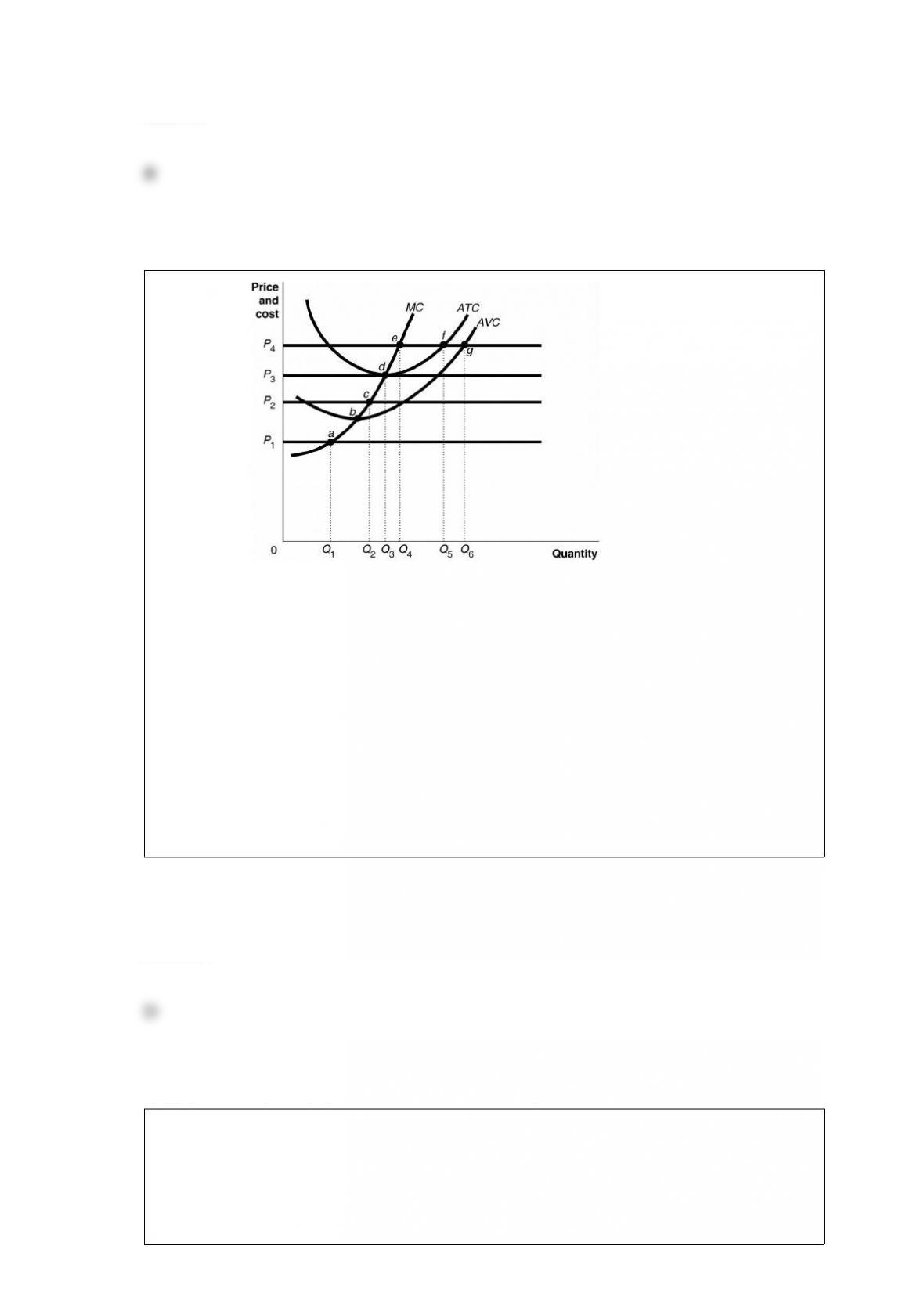
Figure 12-9 Figure 12-9 shows cost and
demand curves facing a profit-maximizing, perfectly competitive firm.
At price P1, the firm would produce
A) Q1 units
B) Q3 units.
C) Q5 units.
D) zero units.
Answer:
What is behavioral economics?
A) the study of how people make wealth-maximizing decisions
B) the study of how people behave in the face of scarcity
C) the study of situations in which people act in ways that are not economically rational
D) the study of how people make decisions at the margin
Answer:
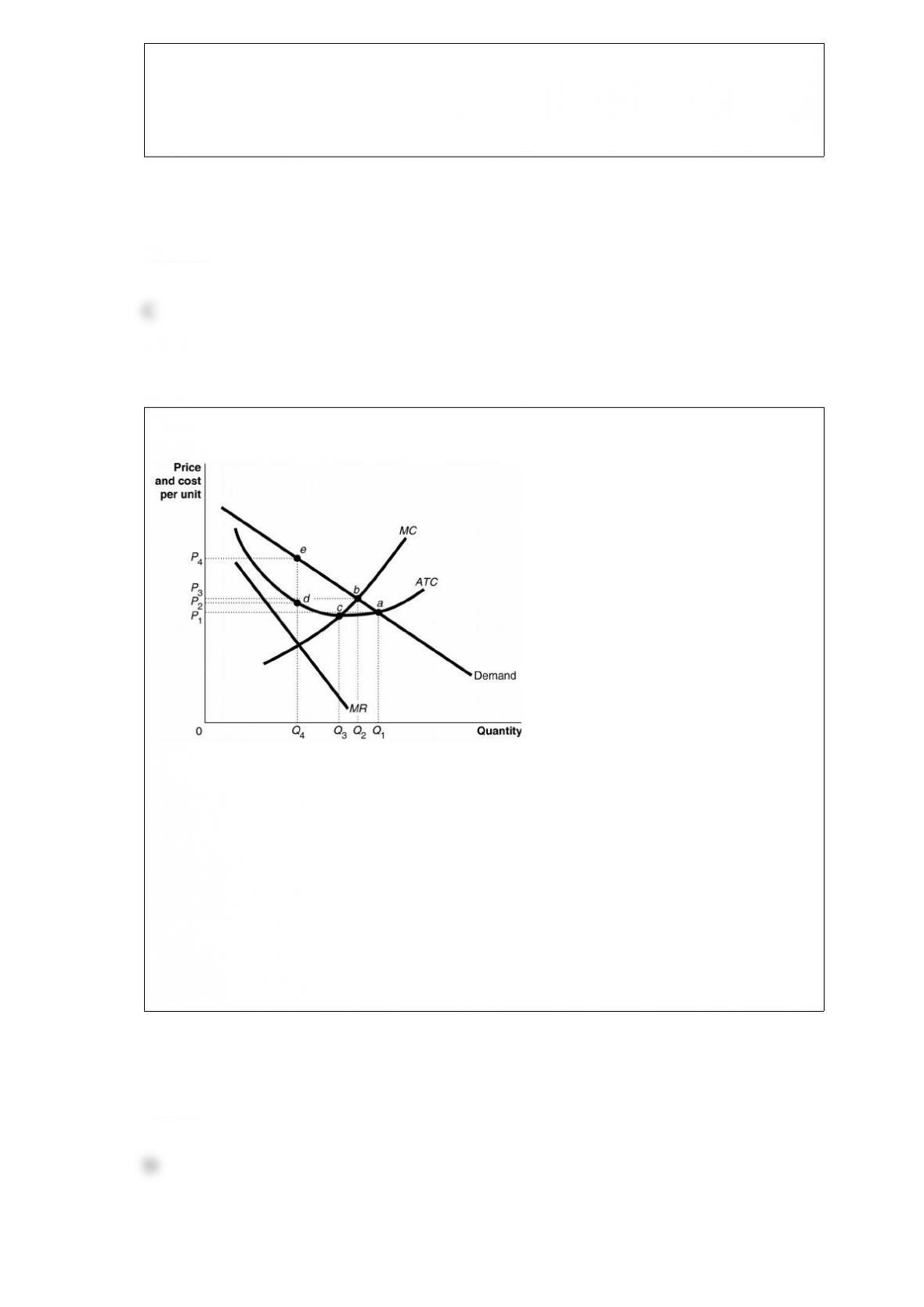
Figure 13-13
What is the profit maximizing output level?
A) Q1 units
B) Q2 units
C) Q3 units
D) Q4 units
Answer:

Economists estimate that ________ of U.S. currency is outside the United States and
held primarily by ________.
A) over half; households and firms in countries where there is little confidence in the
local currency
B) over half; foreign banks and foreign governments
C) less than one quarter; households and firms in countries where there is little
confidence in the local currency
D) less than one quarter; foreign banks and foreign governments
Answer:
Which of the following statements correctly describes the distinction between
technology and technological change?
A) Technology refers to the processes used by a firm to transform inputs into output of
goods and services while technological change is a change in a firm’s ability to produce
a given level of output with a given quantity of inputs.
B) Technology refers to the ability of a firm to increase its maximum output from a
given quantity of inputs and technological change is the process by which the firm
achieves this productivity gain.
C) Technology is product-centered; its refers to developing new products with limited
resources while technological change is process-centered in that it focuses on
developing new production techniques.
D) Technology involves research and development while technological change involves
the use of more efficient machinery.
Answer:

Suppose the reserve ratio is RR. Then,
A) required reserves = RR actual reserves.
B) required reserves = RR excess reserves.
C) required reserves = RR deposits.
D) required reserves = RR loans.
Answer:
According to the law of one price,
A) if transaction costs are zero, identical goods should sell for the same price
everywhere.
B) if transactions costs are zero, firms must sell a product at a price equal to its
marginal cost.
C) if transactions costs are zero, all firms must earn the same profit margin.
D) there must be no differences in the cost of producing identical goods by different
producers.
Answer:
If real GDP per capita in Ireland is estimated to be $7,400 in 2014, what will real GDP
per capita be in 2019 if real GDP per capita grows at an annual rate of 2.8%?
A) $7,607
B) $8,496

C) $9,472
D) $20,720
Answer:
Assume that you observe the long-run average cost curve of ACME Bookstores, a
national chain. Starting from the point on the curve where output is zero and moving to
the right which of the following lists the behavior of long-run average costs in the
correct sequence (that is, which will be observed first, second, etc.)?
A) minimum efficient scale; economies of scale; constant returns to scale; diseconomies
of scale
B) economies of scale; constant returns to scale; diseconomies of scale; minimum
efficient scale
C) constant returns to scale; economies of scale; minimum efficient scale; diseconomies
of scale
D) economies of scale; minimum efficient scale; constant returns to scale; diseconomies
of scale
Answer:
Who was the economist who first analyzed the advantages of specialization and the
division of labor?
A) David Ricardo
B) Arthur C. Pigou
C) Ronald Coase
D) Adam Smith
Answer:
Define a corporation.
Answer:
Every society faces trade-offs. Explain the concept of trade-offs.
Answer:
As the level of output increases, what happens to the value of average fixed cost, and
what happens to the difference between the value of average total cost and average
variable cost?
Answer:
What gives rise to a natural monopoly? How do consumers benefit from a natural
monopoly?
Answer:
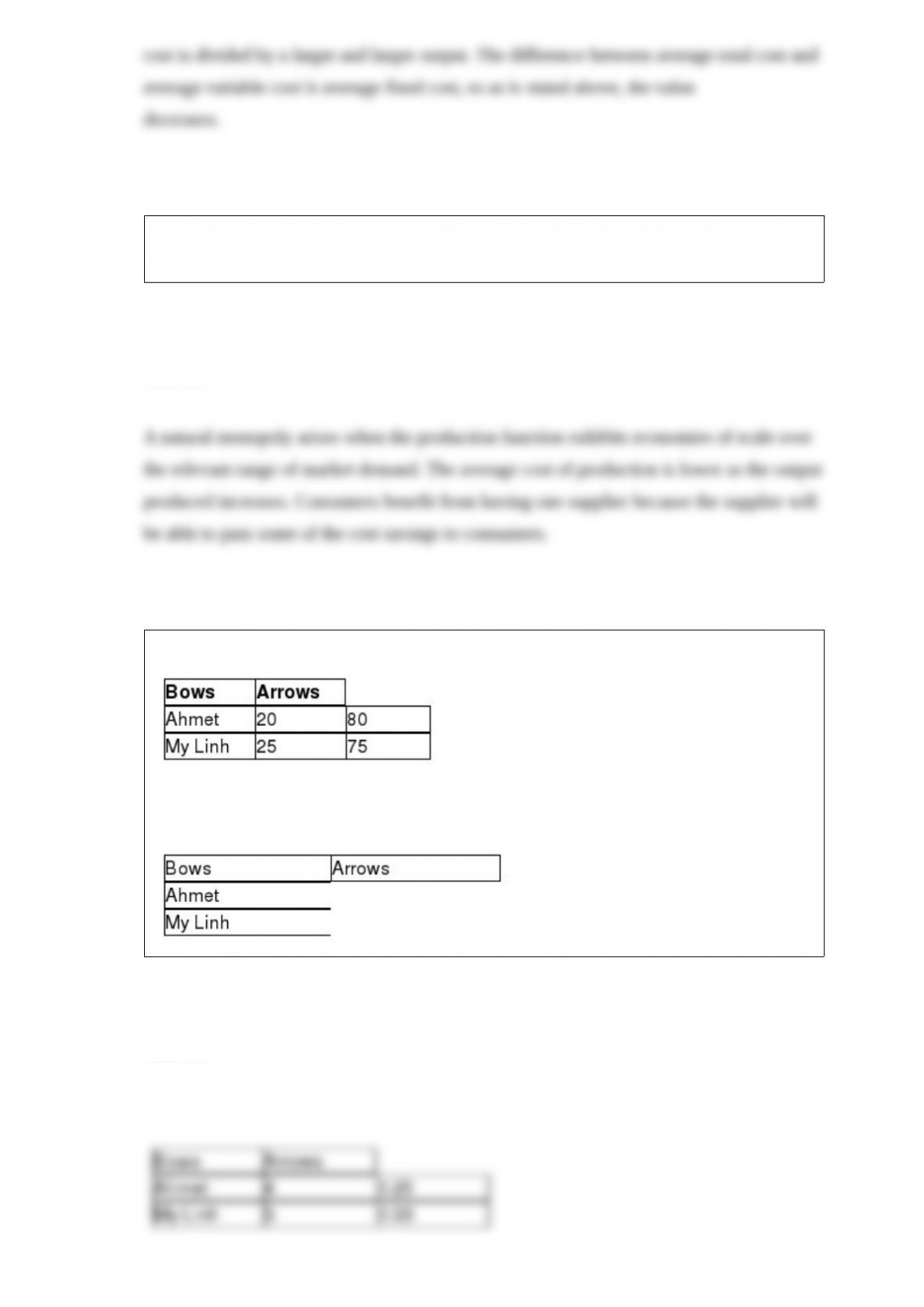
Table 9-5
Table 9-5 shows the output per week for bows and arrows by Ahmet and My Linh. Fill
in the following table with the opportunity costs of producing bows and arrows for
Ahmet and My Linh.
Answer:

How were exchange rates determined under the gold standard? How did the Bretton
Woods system differ from the gold standard?
Answer:
What is the difference between goods and services?
Answer:
What is a marginal cost?
Answer:

Assuming a fixed amount of taxes and a closed economy, calculate the value of the
government purchases multiplier, the tax multiplier, and the balanced budget multiplier
if the marginal propensity to consume equals 0.75.
Answer:
If your income is $40,000 and you pay taxes of $4,650, what is your average tax rate?
Show your work.
Answer: