
The substitution effect explains why there is an inverse relationship between the price
of a product and the quantity of the product demanded.
For a perfectly competitive firm, at the profit-maximizing output average revenue
equals marginal cost.
Horizontal equity is achieved when taxes are collected from those who benefit from the
government expenditure of the tax revenue.
Economic efficiency is a market outcome in which the marginal benefit of consumers is
equal to the marginal cost of production and the sum of consumer surplus and producer
surplus is maximized.

Changes in the health of the average person are an important indicator of changes in the
standard of living.
Expansionary fiscal policy is used to increase aggregate demand in an attempt to fight
rising inflation.
Suppose real GDP is $13 trillion and potential real GDP is $13.5 trillion. If Congress
and the president increase government purchases by $500 billion, then the economy
will be brought to equilibrium at potential real GDP.
If consumers paid the full price of medical services instead of using health insurance
and third-party payers to cover part of the cost, the quantity of medical services
provided would decrease.

A study conducted by Robert Shiller, a Yale Economist, found that a large majority of
the public thinks that increases in inflation will not quickly lead to an increase in wages.
A shortage occurs when the market price is lower than the equilibrium price.
A perfectly competitive market is in long-run equilibrium. At present there are 100
identical firms each producing 5,000 units of output. The prevailing market price is $20.
Assume that each firm faces increasing marginal cost. Now suppose there is a sudden
increase in demand for the industry’s product which causes the price of the good to rise
to $24. Which of the following describes the effect of this increase in demand on a
typical firm in the industry?
A) In the short run, the typical firm increases its output and makes an above normal
profit.
B) In the short run, the typical firm’s output remains the same, but because of the higher
price, its profit increases.
C) In the short run, the typical firm increases its output but its total cost also rises,
resulting in no change in profit.
D) In the short run, the typical firm increases its output but its total cost also rises.
Hence, the effect on the firm’s profit cannot be determined without more information.
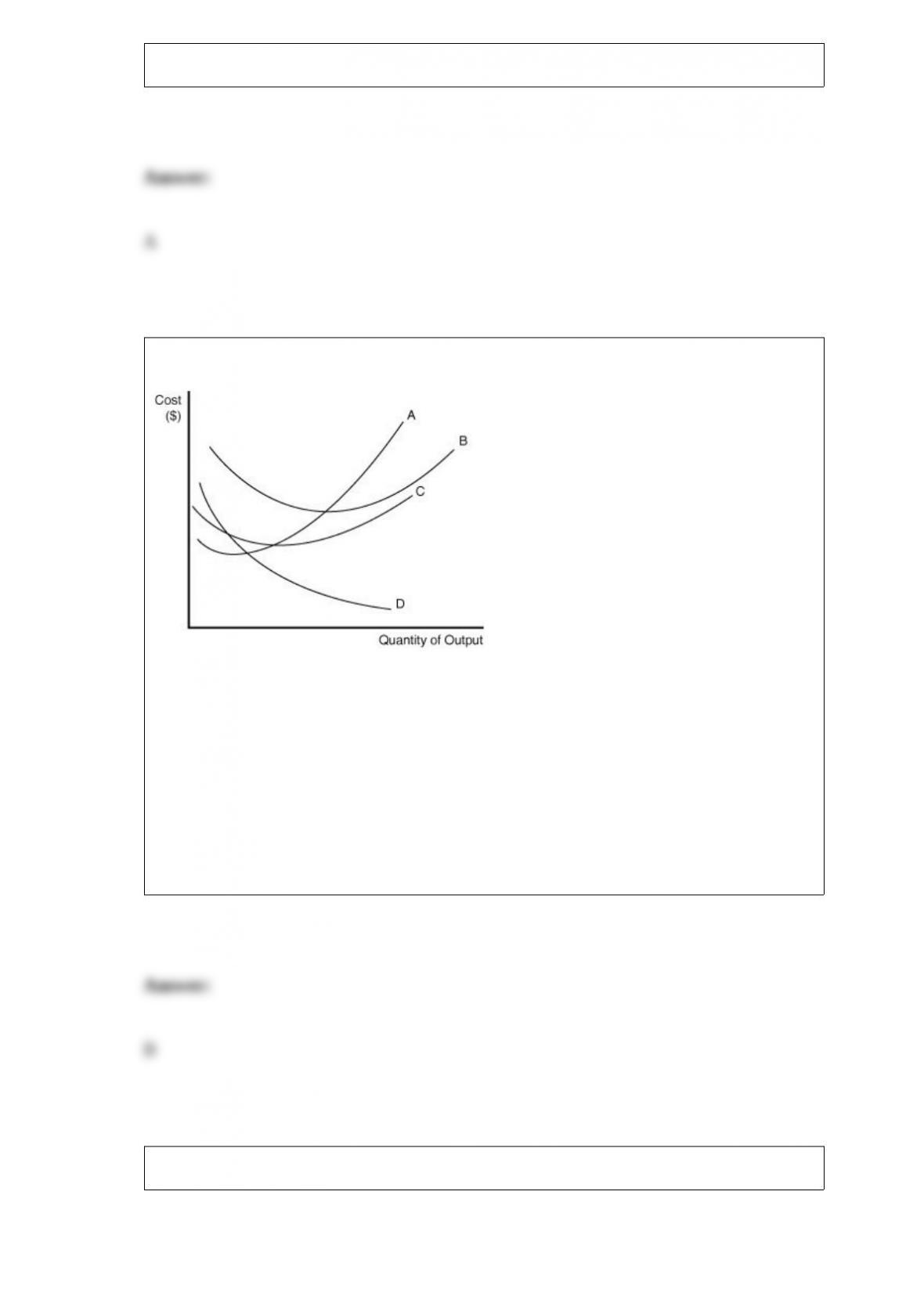
Figure 11-6
Figure 11-6 contains information about the
short run cost structure of a firm. In the figure above which letter represents the average
total cost curve?
A) A
B) B
C) C
D) D
Table 4-4
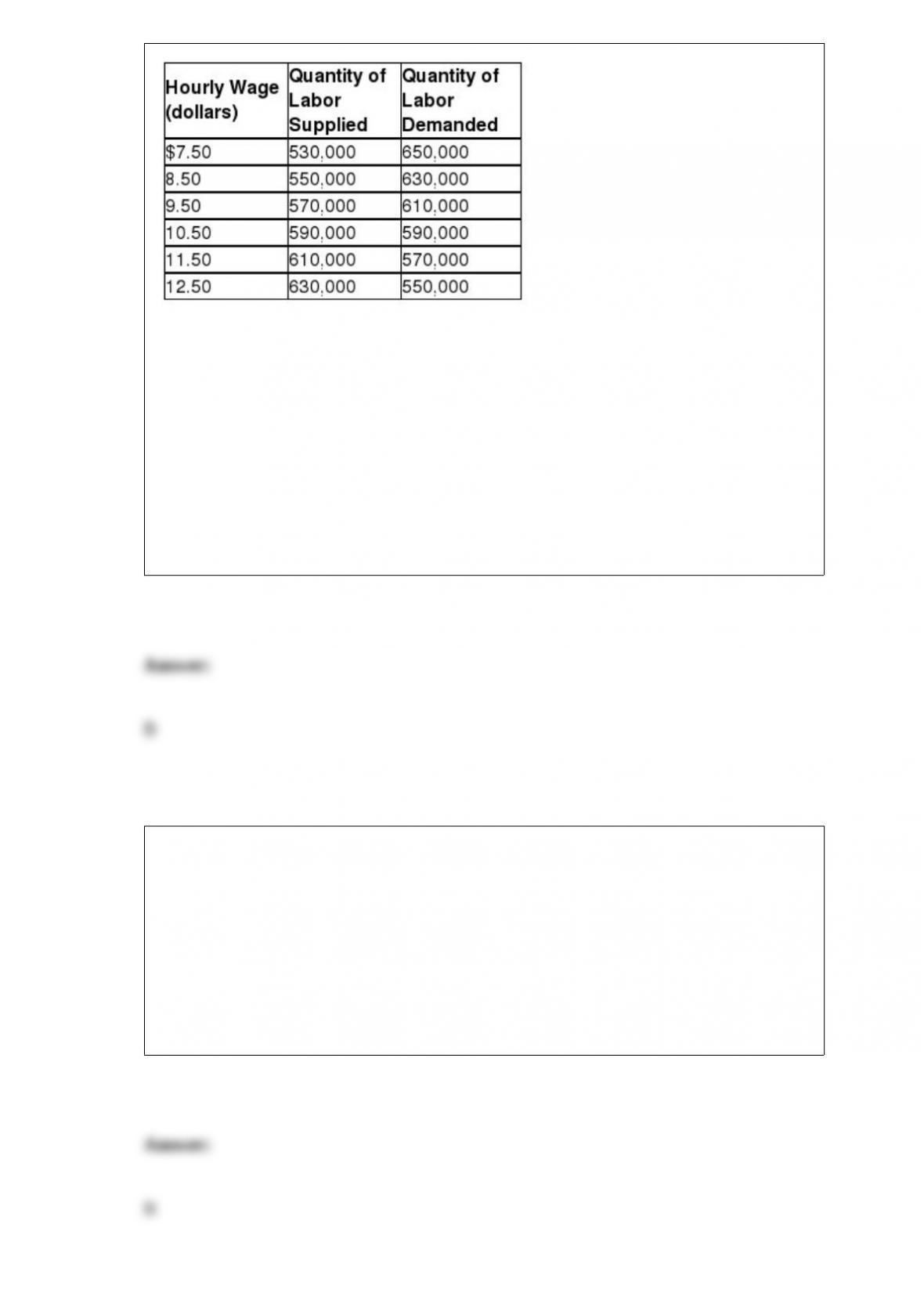
Table 4-4 shows the demand and supply schedules for labor market in the city of Pixley.
If a minimum wage of $12.50 an hour is mandated, what is the quantity of labor
demanded?
A) 80,000
B) 550,000
C) 630,000
D) 1,180,000
Allocative efficiency is achieved when firms produce goods and services
A) at the lowest possible cost.
B) that consumers value most.
C) at the lowest opportunity cost.
D) at a marginal cost of zero.

A firm’s primary interest when it hires an additional worker is
A) the cost of hiring the additional worker.
B) how the average output of the firm will be affected by this new worker.
C) the extra revenue the firm realizes from hiring that worker.
D) whether or not the new worker gets along with the firm’s existing workers.
Because a monopoly’s demand curve is the same as the market demand curve for its
product,
A) the monopoly’s marginal revenue equals its price.
B) the monopoly is a price taker.
C) the monopoly must lower its price to sell more of its product.
D) the monopoly’s average total cost always falls as it increases its output.
Which of the following represents the true economic cost of production when firms
produce goods that cause negative externalities?
A) the private cost of production
B) the social cost of production

C) the external cost of production
D) the explicit cost of production
Sally quit her job as an auto mechanic earning $50,000 per year to start her own
business. To save money she operates her business out of a small building she owns
which, until she started her own business, she had rented out for $10,000 per year. She
also invested her $20,000 savings (which earned a market interest rate of 5% per year)
in her business. You are given the following information about the first year of her
operations. Total revenue $120,000
Cost of labor 40,000
Cost of materials 15,000
Equipment rental 5,000 a. Calculate her economic costs.
b. Calculate her accounting costs.
c. Calculate her implicit costs.
d. Sally tells you that she would really like to move to a location closer to town but she
decided against it because “right now I don’t pay any rent and it will cost me $10,000 a
year to rent near town.” Do you agree with her reasoning?
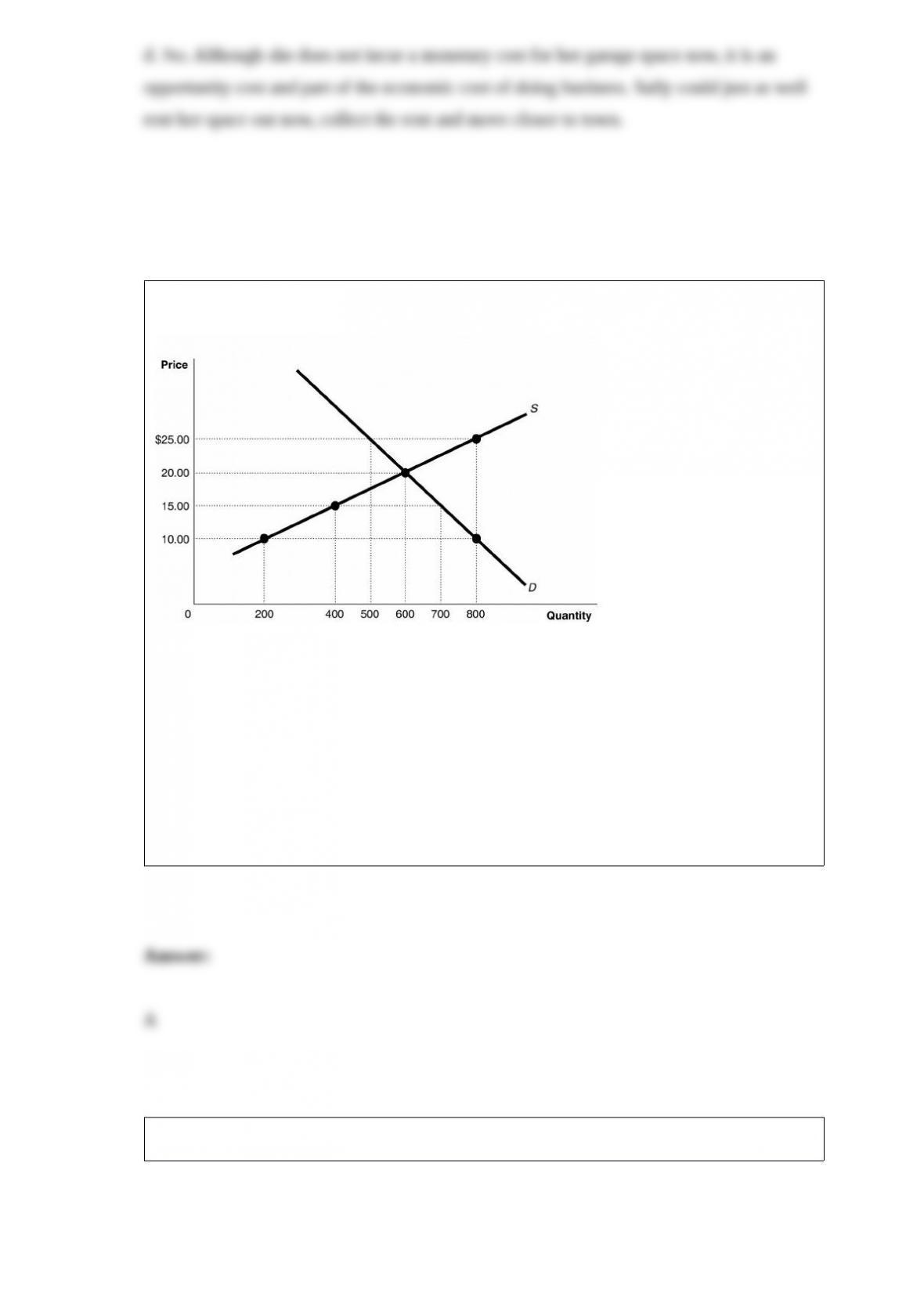
Figure 3-4
If the price is $25,
A) there would be a surplus of 300 units.
B) there would be a shortage of 300 units.
C) there would be a surplus of 200 units.
D) there would be a shortage of 200 units.
Figure 18-2

Figure 18-2 shows a demand curve
and two sets of supply curves, one set more elastic than the other. If the government
imposes an excise tax of $1.00 on every unit sold, the producer’s burden of the tax
A) is greater under the more elastic supply curve S0.
B) is greater under the less elastic supply curve S0.
C) is greater under the less elastic supply curve S1.
D) is the same under either supply curve because there is a single demand curve that
captures buyers’ market behavior.
China began pegging its currency, the yuan, to the dollar in 1994. Because the yuan was
________ at the pegged exchange rate, the level of Chinese exports remained ________
than they would have been if the exchange rate were allowed to float freely.
A) undervalued; higher
B) undervalued; lower
C) overvalued; higher
D) overvalued; lower
Is it possible for technological change to be negative? If so, give an example.
What is an externality? Explain how someone receiving a meningitis vaccination is an
example of an externality in the market for health care.
How could the existence of an unemployment insurance system or other transfer
programs have reduced the severity of the Great Depression?

When is demand perfectly elastic? When is demand perfectly inelastic? What are the
values of the price elasticity of demand when demand is perfectly elastic or perfectly
inelastic? What do perfectly elastic and perfectly inelastic demand curves look like?
What is the Difference between retained earnings and dividends?
Using an aggregate demand graph, illustrate the impact of an increase in the growth rate
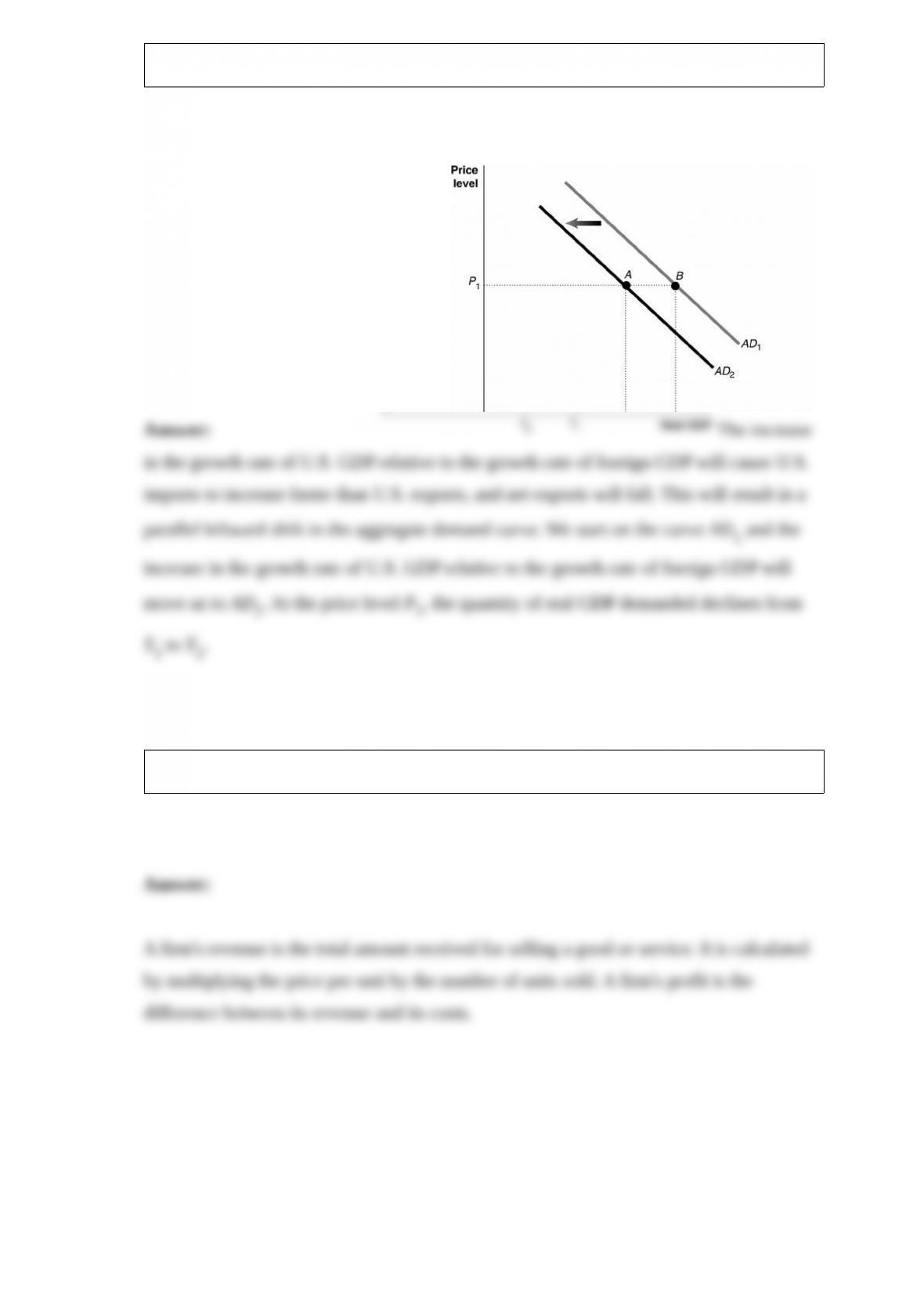
of U.S. GDP relative to the growth rate of foreign GDP.
Explain the difference between a firm’s revenue and its profit.