
Why are laws aimed at regulating monopolies called “antitrust” laws?
A) The rise of large firms (e.g., Standard Oil) in the late 1800s in the United States
caused consumers to lose trust in private business.
B) “Trust” was a word in Old English that meant monopoly in the Middle Ages.
Therefore, “antitrust” is a term that means “against monopoly.”
C) In the late 1800s, firms in several industries formed trusts; the firms were
independent but gave voting control to a board of trustees. Antitrust laws were passed to
regulate these trusts.
D) In the late 1800s, firms in several industries formed trusts; they were called “trusts”
because when corporate officials were questioned about their business they would clam
that business was good for the country and that they should trusted.
Which of the following contributes to the efficiency of markets?
A) Governments play an active role in the day-to-day operations of markets.
B) Markets are able to bring about an equitable distribution of goods and services.
C) Markets promote equal standards of living.
D) Markets promote competition and voluntary exchange.
In a typical year, ________ new firms open in the United States.
A) more than 600,000

B) more than 1 million
C) less than 200,000
D) approximately 125,000
When a foreign investor buys a bond issued in the United States,
A) the balance on the capital account increases.
B) the balance on the current account increases.
C) the balance on the financial account increases.
D) the balance of trade increases.
Table 2-6
Table 2-6 shows the output per week of two jewelers, Serena and Haley. They can either
devote their time to making bracelets or making necklaces.
Which of the following statements istrue?
A) Haley has an absolute advantage in making both products.
B) Serena has an absolute advantage in making both products.
C) Haley has an absolute advantage in making bracelets and Serena in making
necklaces.
D) Haley has an absolute advantage in making necklaces and Serena in making
bracelets.
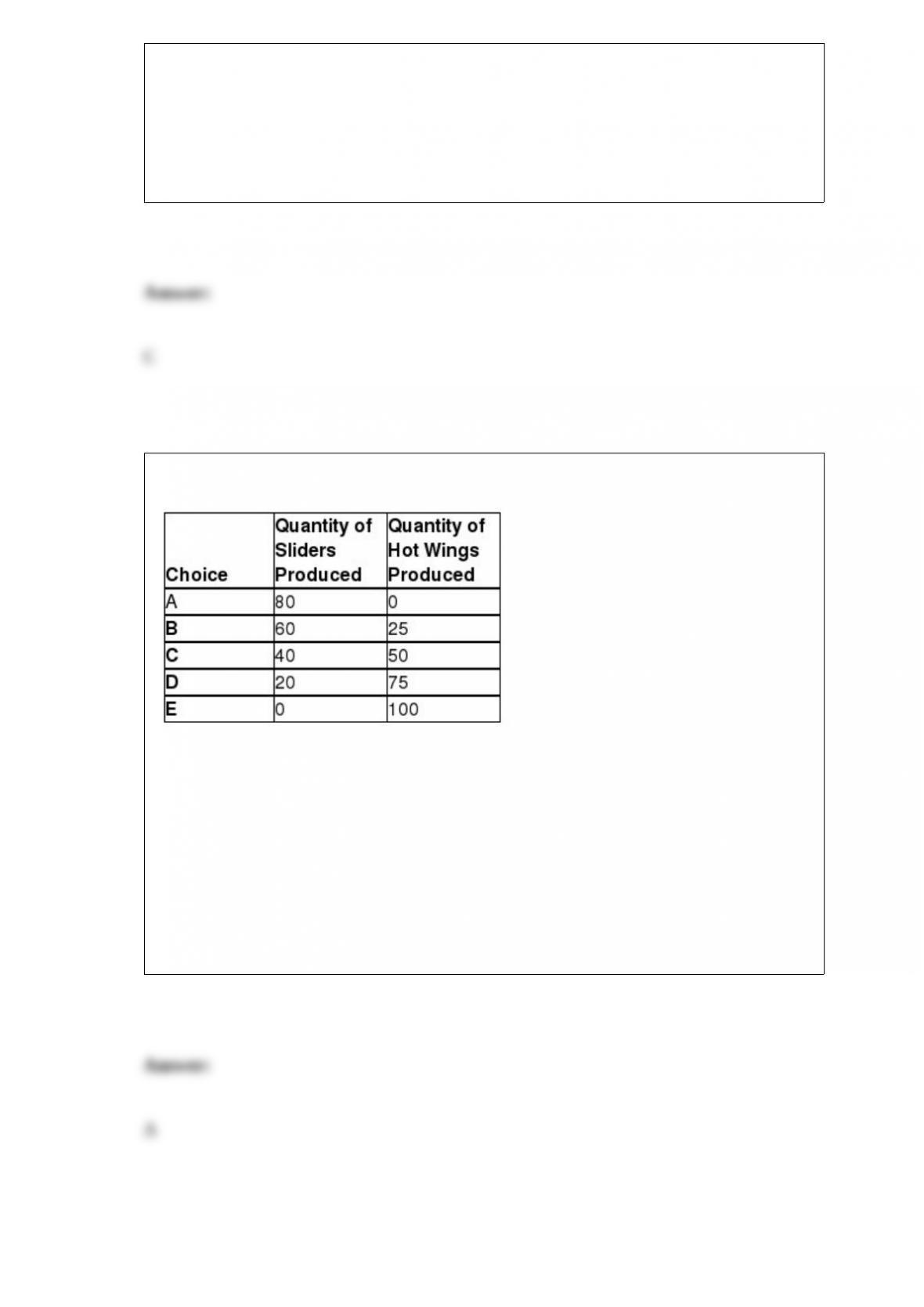
Table 2-4 Production Choices for Dina’s Diner
Assume Dina’s Diner only produces sliders and hot wings. A combination of 60 sliders
and 25 hot wings would appear
A) along Dina’s production possibilities frontier.
B) inside Dina’s production possibilities frontier.
C) outside Dina’s production possibilities frontier.
D) at the vertical intercept of Dina’s production possibilities frontier.

Grace Makutsi finally bought a pair of blue shoes that she had been coveting for a long
time. In less than a week she discovered that the shoes were uncomfortable. Grace went
back to wearing her old pair and stashed away the new pair. When asked by her boss,
Mme. Ramotswe why does she not simply give away the new pair, she said: “But I paid
so much for them.” Grace’s behavior
A) is rational: she should not discard a valuable item.
B) ignores the fact that the purchase price is now a sunk cost and has no bearing on
whether she should give them away or not.
C) supports the endowment effect which states that ownership of an item makes it more
valuable.
D) is rational because the more you pay for an item the more valuable it is.
According to the quantity theory of money, if the money supply grows at 6%, real GDP
grows at 2%, and the velocity of money is constant, then the inflation rate will be
A) 8%.
B) 6%.
C) 4%.
D) 2%.
When a proposed merger between two companies is reviewed by the government, the
relevant market is defined by

A) whether or not there are close substitutes for the products of the two firms.
B) how elastic the demand is for each firm’s product.
C) counting the number of firms that produce the same product.
D) how much advertising is done in the industry.
Rational ignorance
A) explains why consumers ignore sunk costs when they vote.
B) explains the Arrow impossibility theorem.
C) refers to attempts by special interests to use government action to make themselves
better off at the expense of others.
D) helps to explain why rent seeking by special interest groups occurs.
Assume that both the demand curve and the supply curve for DVD players shift to the
left but the supply curve shifts more than the demand curve. As a result
A) both the equilibrium price and quantity of DVD players will decrease.
B) the equilibrium price of DVD players will decrease; the equilibrium quantity may
increase or decrease.
C) the equilibrium price of DVD players may increase or decrease; the equilibrium
quantity will increase.

D) the equilibrium price of DVD players will increase; the equilibrium quantity will
decrease.
A cut in tax rates effects equilibrium real GDP through two channels: ________
disposable income and consumer spending, and ________ the size of the multiplier
effect.
A) decreasing; increasing
B) decreasing; decreasing
C) increasing; increasing
D) increasing; decreasing
Concerned that its dependence on sales of microprocessors to computer firms would
make it vulnerable to sharp sales declines during the recession of 2007-2009, Intel
began to develop memory chips that could be used in portable consumer electronic
devices such as tablets and smartphones. One reason that Intel chose to branch out from
producing microprocessors for computers is that
A) sales of computers have been declining over the past decade.
B) technology with respect to microprocessor production was no longer advancing at a
rate where Intel’s new products were still wanted by computer manufacturers.
C) Intel had lost a majority of its market share in microprocessor production to foreign
competition.
D) computers are durable goods and spending on computers follows the business cycle.