
Ari is currently consuming 10 hot dogs and 8 hamburgers per week. The last hot dog
she consumed yielded 20 utils while the last hamburger she ate gave her 25 utils. If hot
dogs cost $2 and hamburgers cost $2.50, is Ari consuming the correct quantities of
these two goods to be in consumer equilibrium?
a. No, she should consume more hamburgers and fewer hot dogs.
b. No, she should consume more hot dogs and fewer hamburgers.
c. Yes, so there is no need to change her eating habits.
d. There is not enough information to answer the question.
For every gift that A gives to B from the first to the tenth gift, A receives a net benefit of
$10.The additional cost to A of giving an additional gift is constant at $5.It follows that
A’s marginal benefit curve for giving gifts to B is ___________________(assuming that
we place “marginal benefits” on the vertical axis and “number of gifts” on the
horizontal axis).
a. downward-sloping over units 1 -10.
b. upward-sloping over units 1-10.
c. horizontal over units 1-10.
d. vertical over units 1-10.
e. There is not enough information provided to answer the question.

A mandatory seatbelt law ends up raising the number of traffic fatalities if it lowers
fatalities per accident from 0.10 to 0.07 while raising the number of accidents per
period from 35,000 to any more than
a. 35,000.
b. 38,500.
c. 37,450.
d. 50,000.
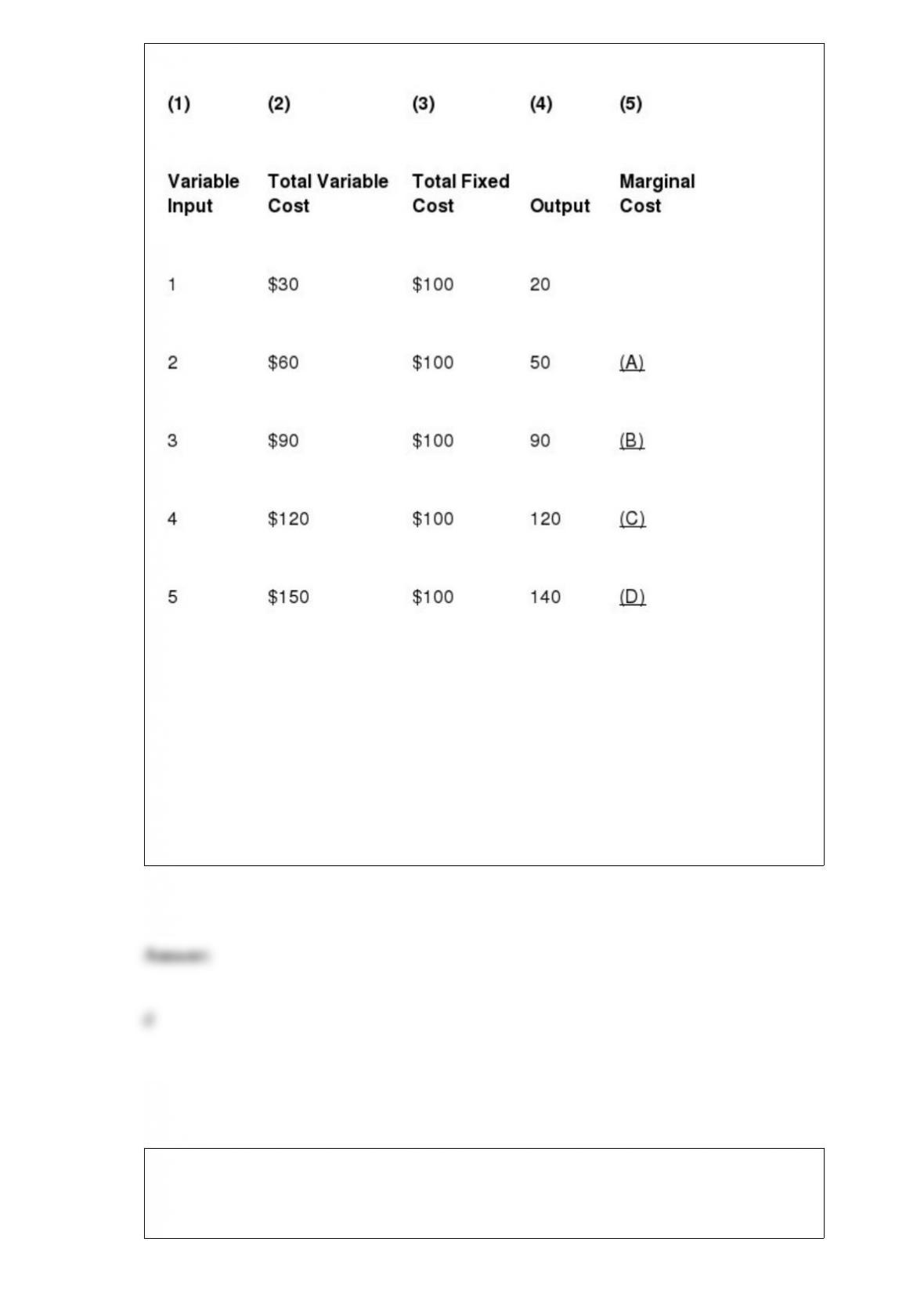
Refer to Exhibit 22-2. What is the average total cost of producing 90 units of output?
Exhibit 22-2
a. $4.75
b. $1.17
c. $1.07
d. $2.11
e. There is not enough information provided to answer the question.
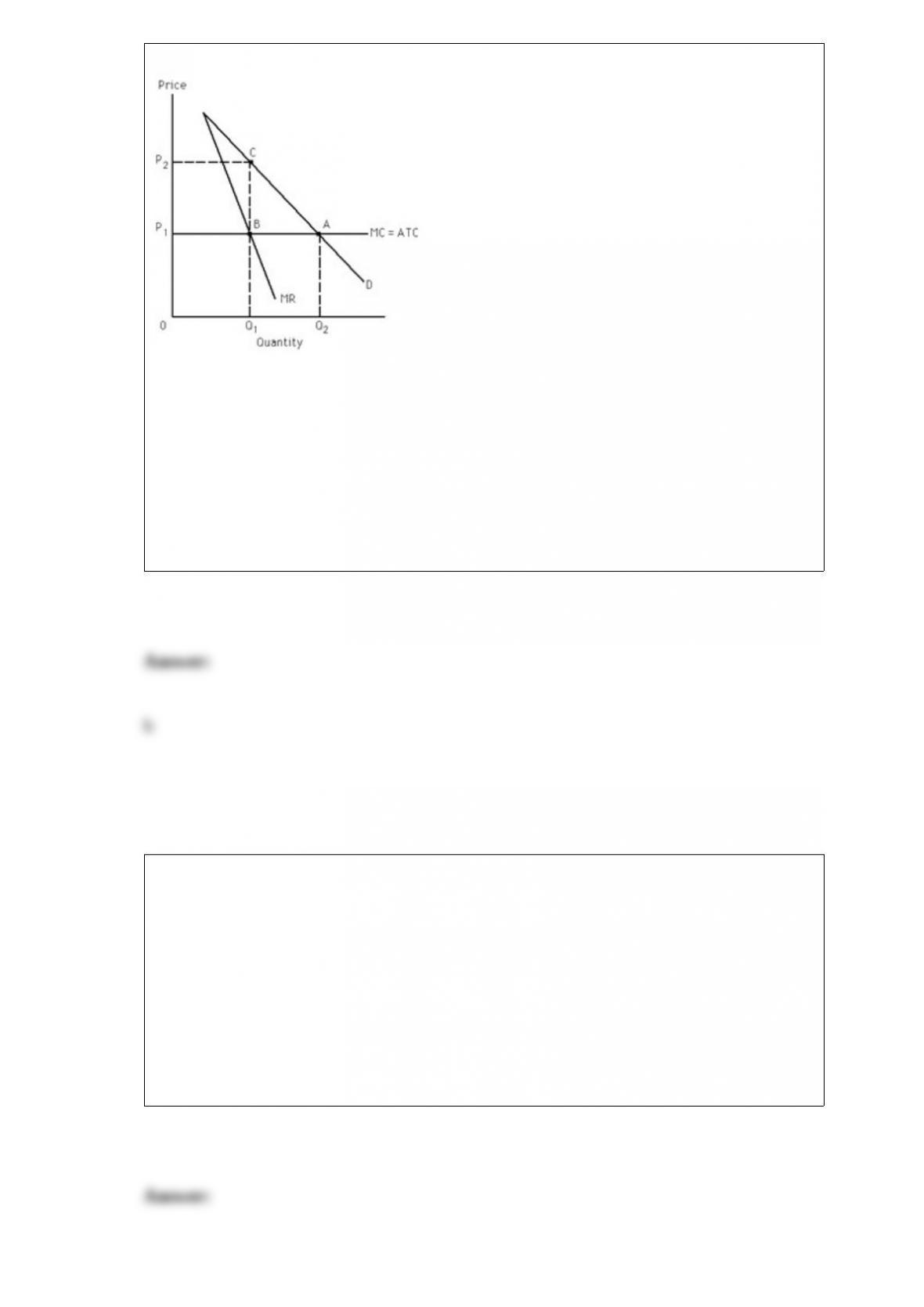
Refer to Exhibit 24-1 The deadweight loss of the profit-maximizing monopoly is
identified by what area?
Exhibit 24-1
a. area Q1BAQ2
b. area BCA
c. area P1P2CB
d. area 0P1BQ1
e. none of the above
The Federal Trade Commission Act of 1914 declared illegal
a. interlocking directorates.
b. anticompetitive mergers that occurred as a result of one company acquiring the
physical assets of another company.
c. unfair or overly aggressive methods of competition.
d. price discounting of goods supplied to large sellers.
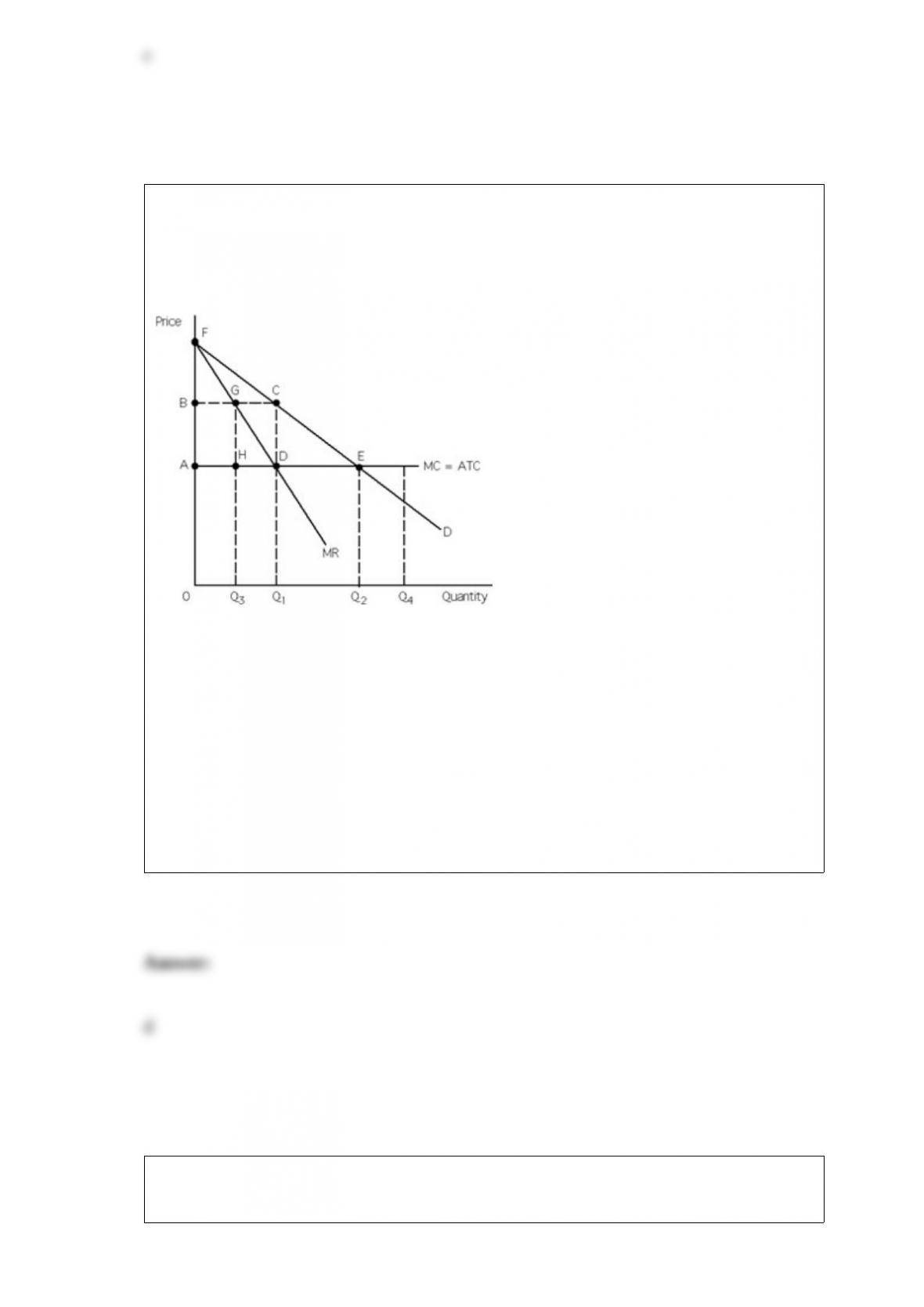
Refer to Exhibit 24-10. The profit-maximizing single-price monopolist earns profits
equal to what area?
Exhibit 24-10
a. ABGH
b. HGCD
c. DCE
d. ABCD
e. GFC
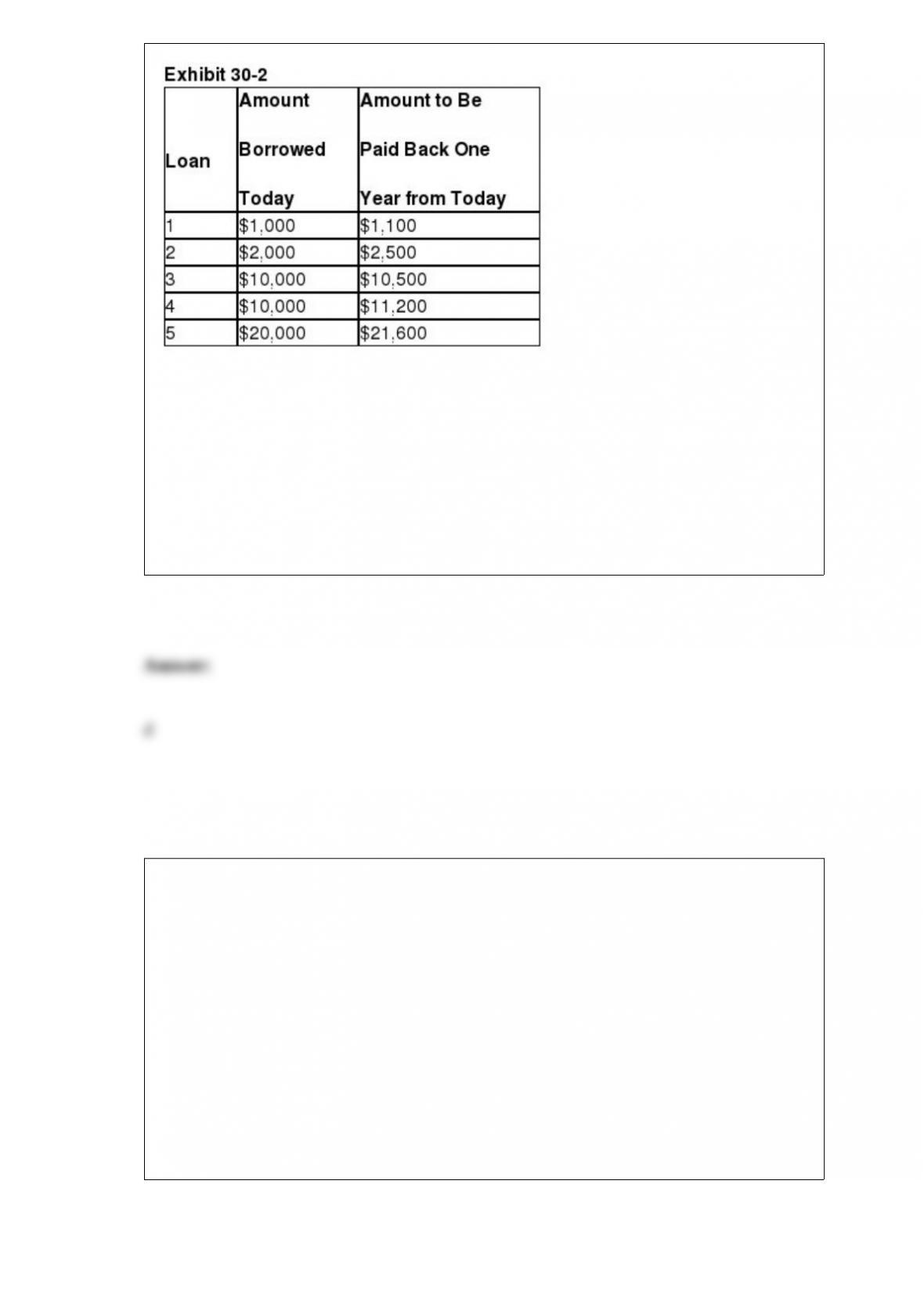
Refer to Exhibit 30-2. The interest and interest rate for loan 3 are, respectively,
a. $500 and 10.5 percent.
b. $10,500 and 5.0 percent.
c. $10,500 and 10.5 percent.
d. $500 and 5.0 percent.
e. none of the above
Which of the following is not a prediction of the theory on baseball caps and cheating?
a. More people will wear baseball caps on test days than on lecture days.
b. More people will wear baseball caps for multiple choice tests than for essay tests.
c. More people will wear baseball caps when students sit close to each other in class
and are taking a test than when students sit far apart from each other and are taking a
test.
d. b and c
e. none of the above

A monopolist maximizes profits at the output at which
a. total revenue is at its greatest, assuming that the firm has both fixed and variable
costs.
b. price equals marginal cost.
c. price exceeds marginal cost by the greatest amount.
d. none of the above
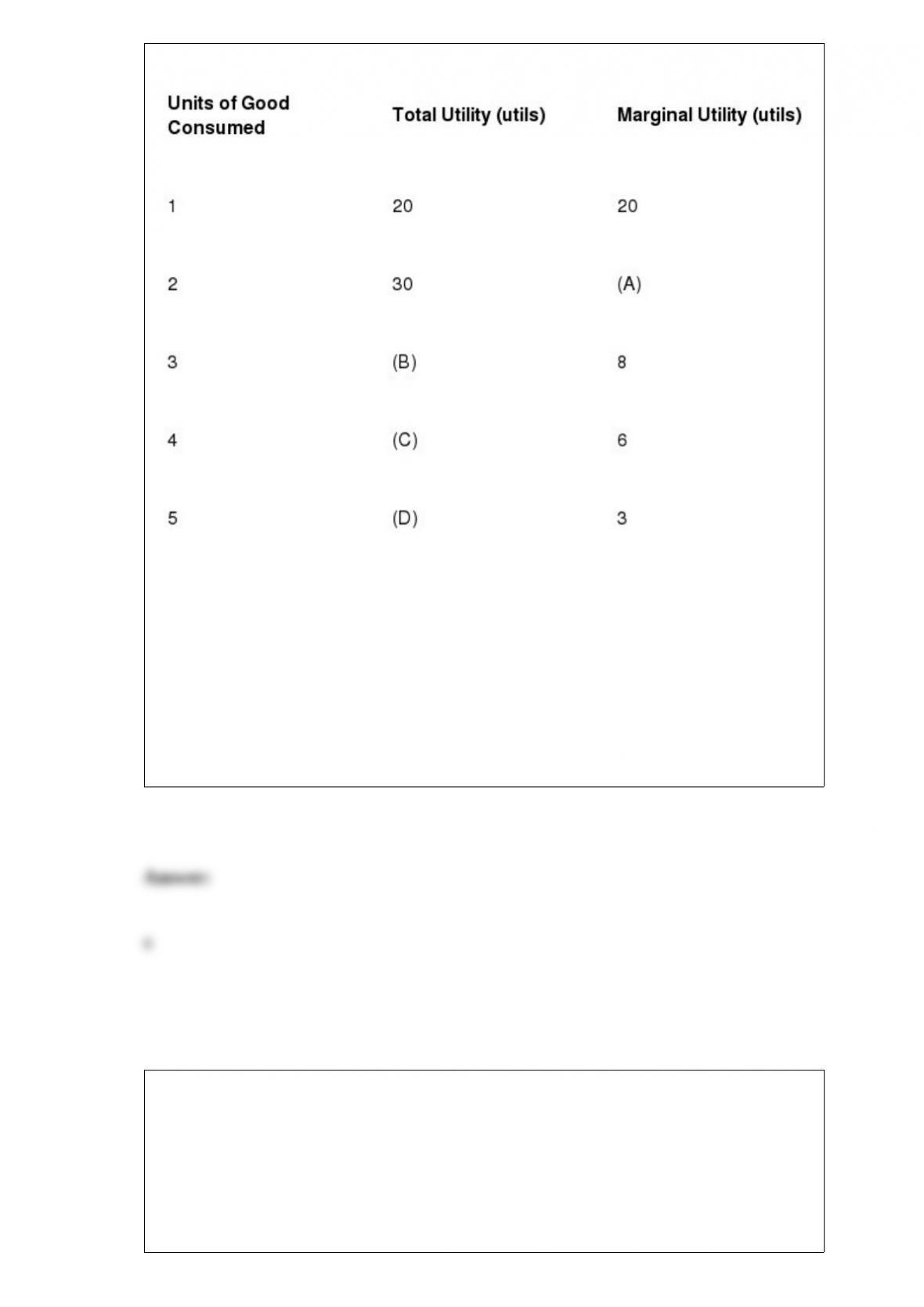
Refer to Exhibit 21-5.What value goes in blank (D)?
Exhibit 21-5
a. 47
b. 15
c. 35
d. 60
e. There is not enough information to answer this question.
Suppose that the price of peanut butter is $3 per pound and the price of almond butter is
$5 per pound.If the price of peanut butter rises to $3.60 and the price of almond butter
rises to $5.50, then the absolute price of peanut butter has _______________ and the
relative price of peanut butter has _______________.
a. risen; fallen

b. fallen; risen
c. risen; risen
d. fallen; fallen
The MPP of labor divided by its (labor’s) price is greater than the MPP of capital
divided by its (capital’s) price. Costs can be minimized by
a. buying more capital and less labor.
b. buying more labor and less capital.
c. maintaining the current MPP/P ratios.
d. buying twice as much labor as capital.
e. none of the above
The Herfindahl index for a monopoly is 1,000.
a. True
b. False
Suppose the production of a good results in negative externalities. If output is at the
intersection of the demand curve and the marginal social cost curve, then
a. the socially optimal level of output will be produced.
b. society will incur a net social cost.
c. society will want less output produced, and producers will be willing to satisfy this
desire at a price that society deems acceptable.
d. b and c
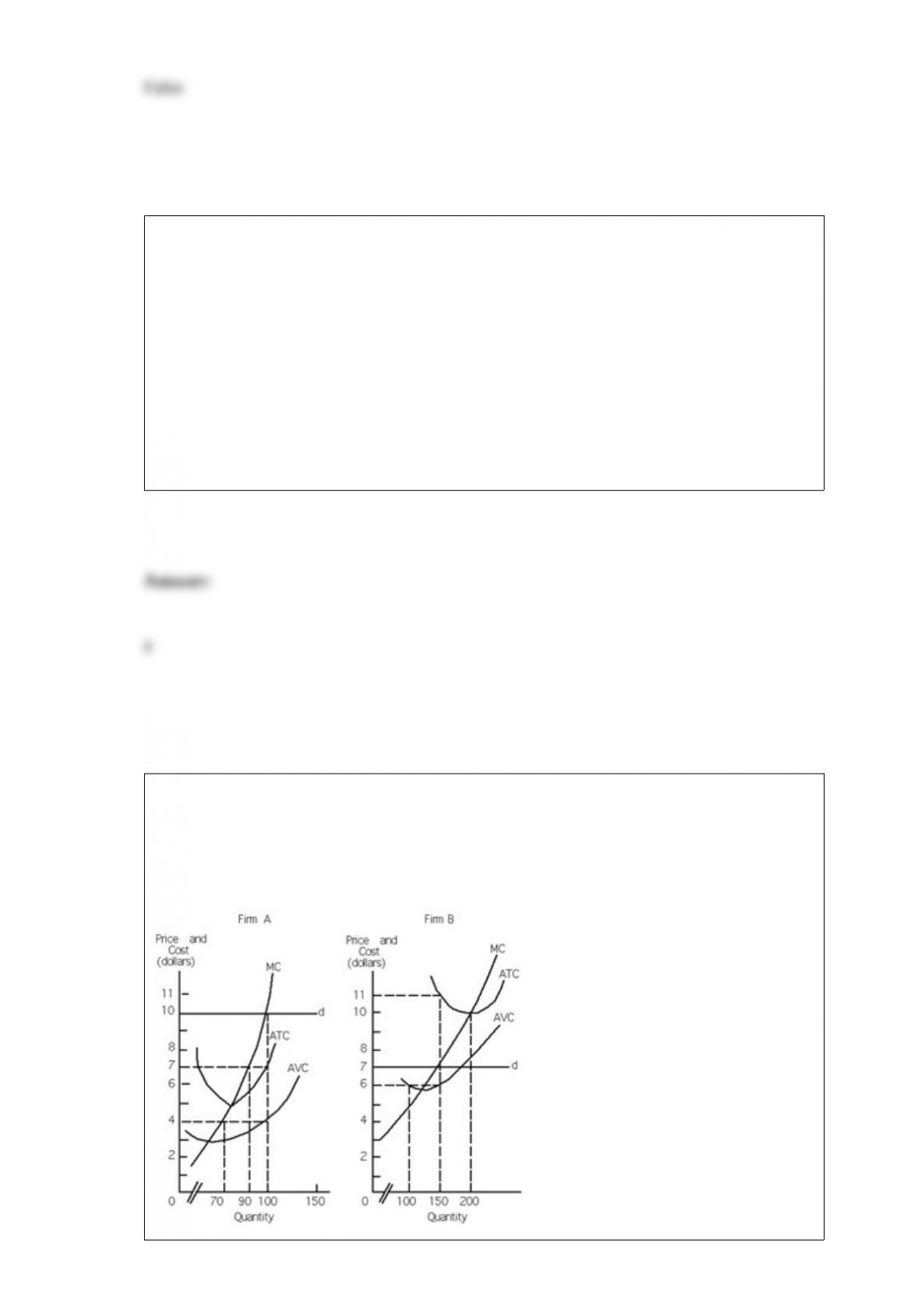
Refer to Exhibit 23-8. What is the total fixed cost of firm A at the profit-maximizing (or
loss-minimizing) level of output?
Exhibit 23-8
a. $3

b. $300
c. $90
d. $400
e. There is not enough information provided to answer this question.
An increase in supply is graphically represented by a leftward shift of the supply curve.
a. True
b. False
The condition often used in economics to isolate the relationship between two variables
is
a. causation.
b. abstraction.
c. ceteris paribus.
d. efficiency.
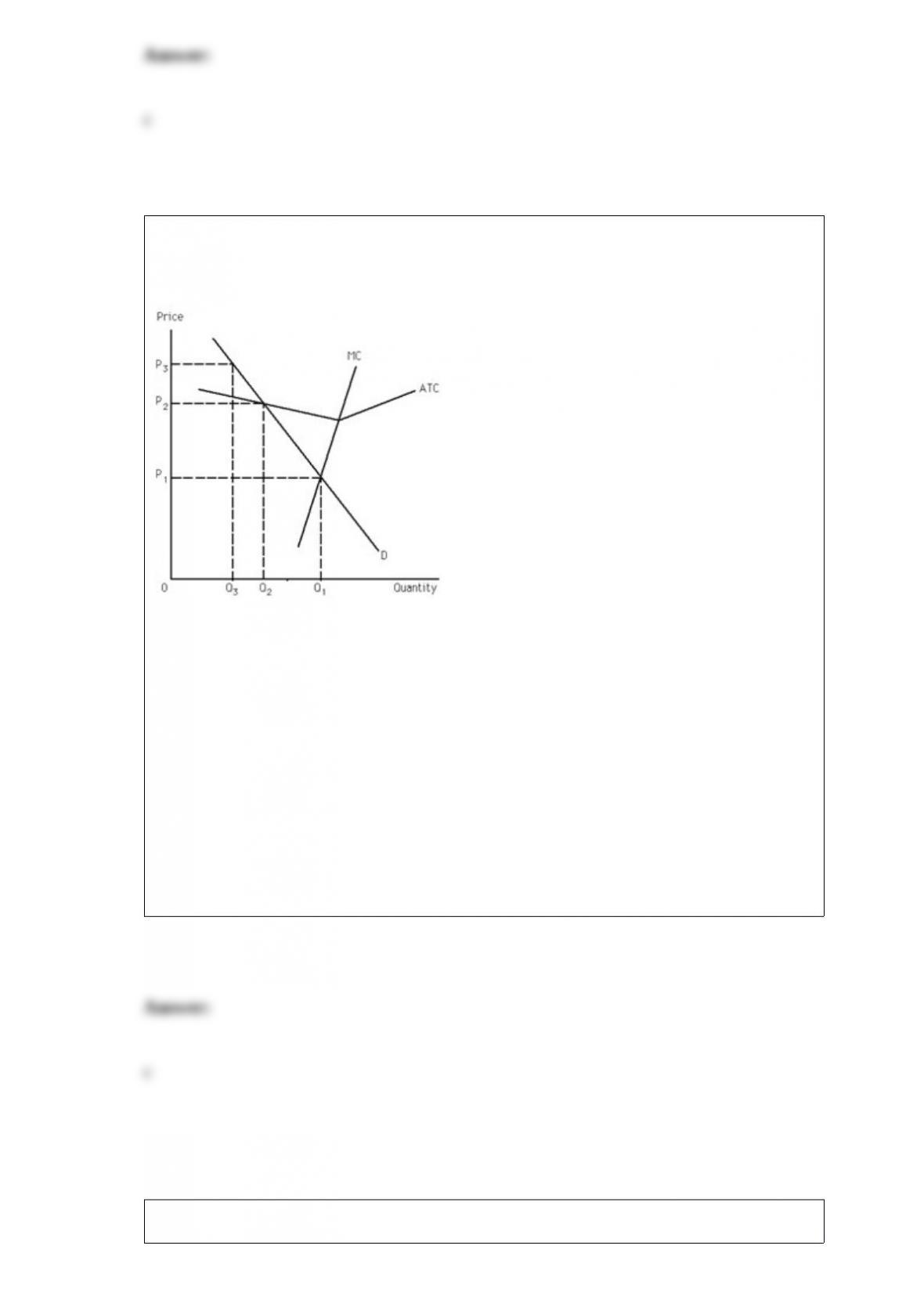
Refer to Exhibit 26-1. Which of the following statements is false?
Exhibit 26-1
a. If marginal-cost pricing is imposed on the natural monopoly firm, the firm takes a
loss.
b. If average-cost pricing is imposed on the natural monopoly firm, the firm earns zero
economic profits.
c. If the natural monopoly firm produces Q3 units of output and charges P3 per unit, the
firm earns zero economic profits.
d. a and b
e. a, b, and c
Based on the income data presented for the U.S. (in your text) the Gini coefficient was

around 0.45 in 2007, which is higher than it was in 1947.
a. True
b. False