
A perfectly competitive wheat farmer in a constant-cost industry produces 1,000
bushels of wheat at a total cost of $50,000. The prevailing market price is $48. What
will happen to the market price of wheat in the long run?
A) The price remains constant at $48.
B) The price falls below $48.
C) The price rises above $48.
D) There is insufficient information to answer the question.
In the long run, the Federal Reserve can control which of the following?
A) the inflation rate
B) the unemployment rate
C) the growth rate of real GDP in the economy
D) the natural rate of unemployment
Which of the following would you expect to result in faster economic growth?
A) the invention of new computers that increase labor productivity
B) a decrease in the average level of education in the economy
C) a decrease in the stock of capital per worker
D) a decrease in research and development spending
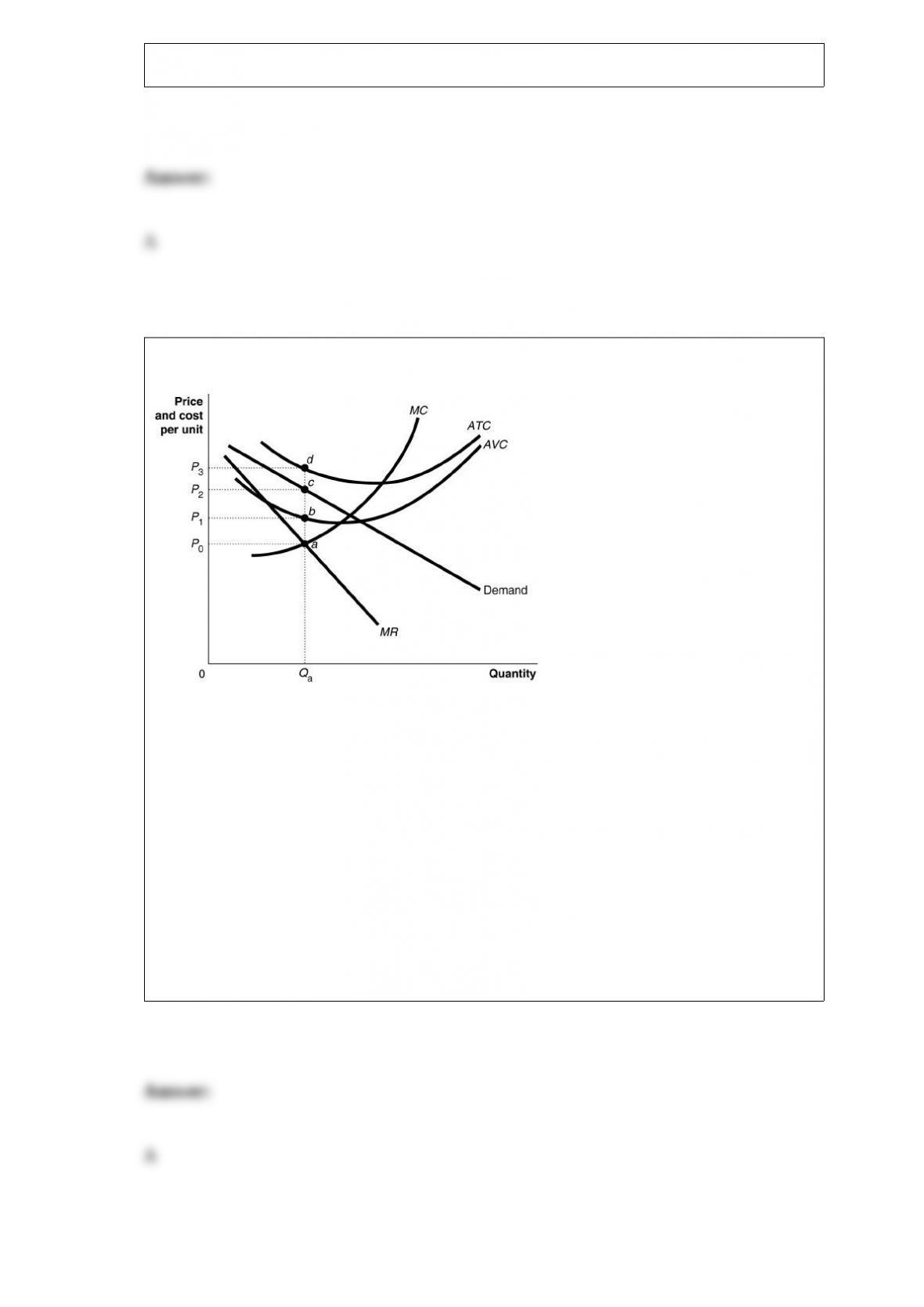
Figure 13-12
Figure 13-12 shows short-run cost
and demand curves for a monopolistically competitive firm in the market for designer
watches. If the diagram represents a typical firm in the designer watch market, what is
likely to happen in the long run?
A) Some firms will exit the market causing the demand to increase for firms remaining
in the market.
B) The firms that are making losses will be purchased by their more successful rivals.
C) Inefficient firms will exit the market and new cost efficient firms will enter the
market.
D) Firms will have to raise their prices to cover costs of production.

When aggregate expenditure is more than GDP, which of the following is true?
A) There was an unplanned decrease in inventories.
B) Firms spent less on capital goods than they planned.
C) Households bought fewer new homes than they planned.
D) All of the above must be true when aggregate expenditure is more than GDP.
When housing prices ________ as they did beginning in 2006 following the housing
market bubble, most banks and other lenders tightened the requirement for borrowers,
making it ________ for potential home buyers to obtain mortgages.
A) fell; easier
B) fell; harder
C) rose; easier
D) rose; harder
As a business type, corporations ________ in the United States.
A) earn the majority of revenues
B) are the most common
C) are the least common

D) are subject to the fewest taxes
The primary purpose of patents and copyrights is to
A) provide owners with large profit forever.
B) protect firms from being taken advantage of by competing firms.
C) protect domestic firms from foreign competition.
D) encourage the expenditure of funds on research and development to create new
products.
The federal government debt equals
A) tax revenues minus government spending.
B) government spending minus tax revenues.
C) the accumulation of past budget deficits.
D) the total value of U.S. Treasury bonds outstanding.
Suppose that the labor movement has a revival in the United States and the majority of
workers join labor unions. As a result we would expect
A) the labor force participation rate to fall.
B) the unemployment rate to fall.
C) the unemployment rate to rise.
D) no change in the unemployment rate or labor force participation rate.
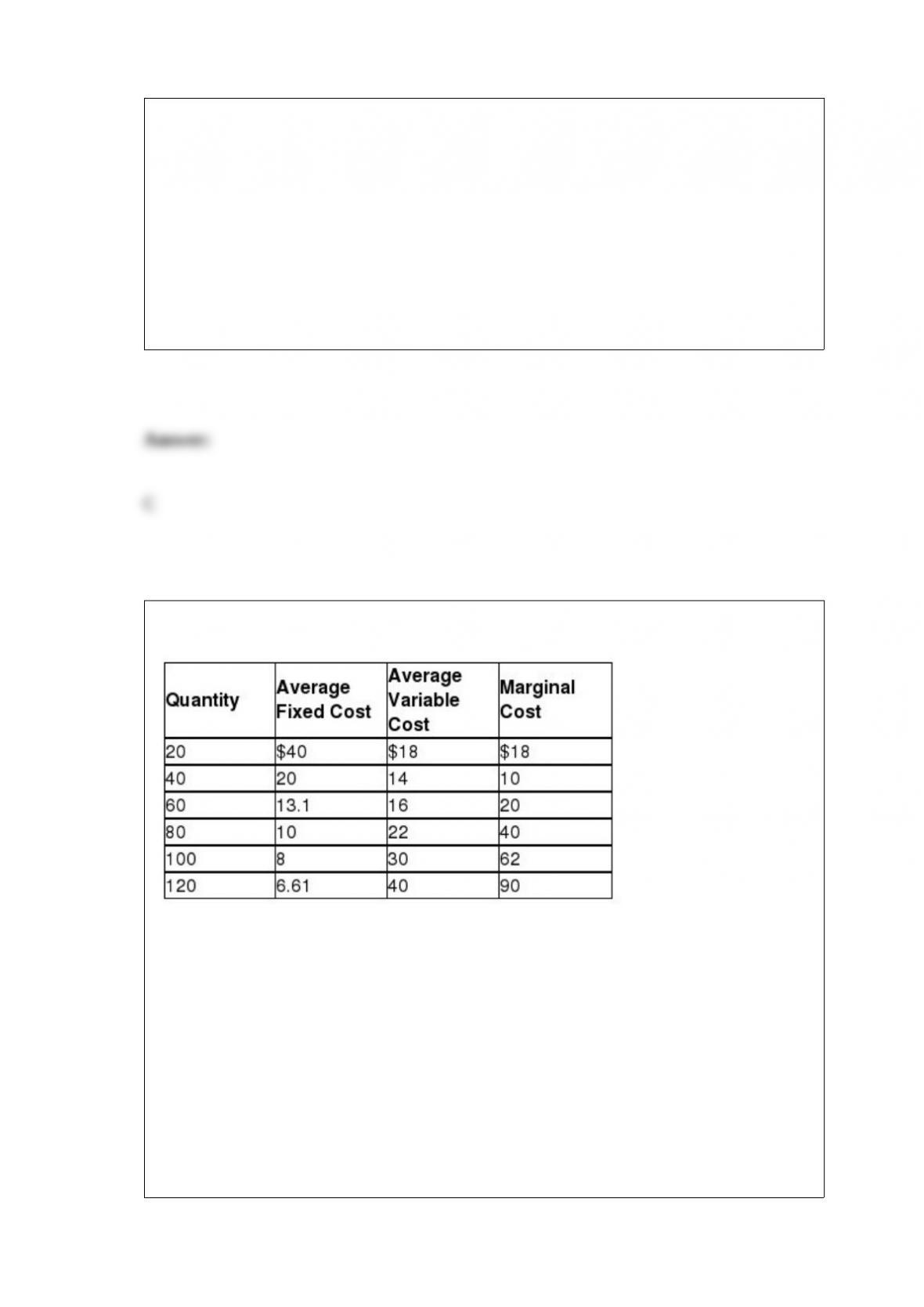
Table 12-4
Table 12-4 shows the short-run cost data of a perfectly competitive firm. Assume that
output can only be increased in batches of 20 units.
If the market price is $45, the firm
A) will earn a profit of $3,600.
B) will suffer a loss of $200.
C) will break even.
D) will earn profit of $1,040.

The federal government debt as a percentage of GDP did not rise
A) during the Great Depression.
B) during World War II.
C) during the 1960s.
D) during the 1980s.
Optimal decisions are made
A) in the marketplace.
B) if information about prices and marginal utilities is known.
C) when marginal utility is minimized.
D) at the margin.
The term ________ in economics refers to a group of buyers and sellers of a product
and the arrangement by which they come together to trade.

A) collective
B) cooperative
C) market
D) trade-off
During an expansion, how do inflation and unemployment typically change?
A) Inflation and unemployment both rise.
B) Inflation and unemployment both fall.
C) Inflation falls and unemployment rises.
D) Inflation rises and unemployment falls.
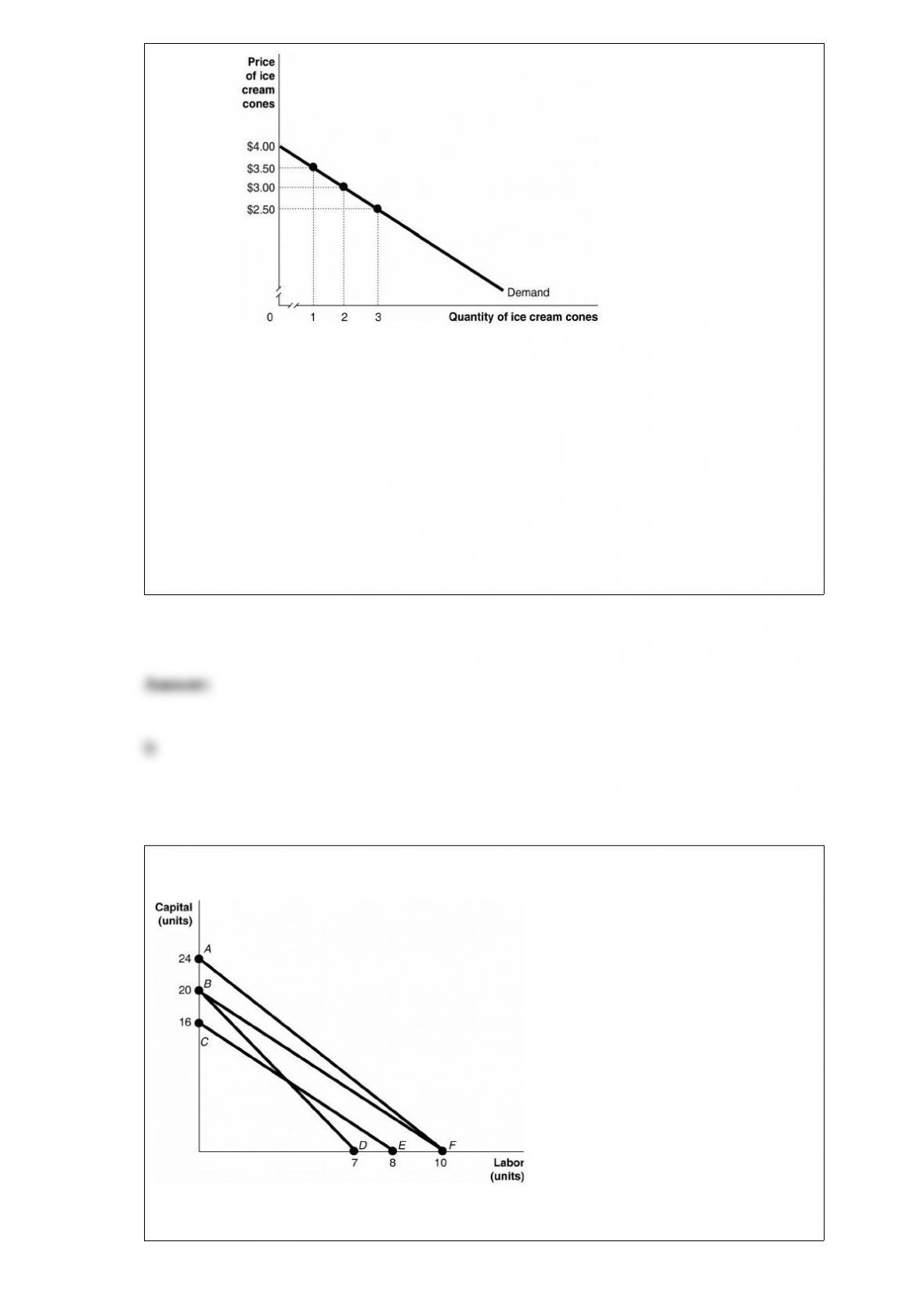
Figure 4-3 Figure 4-3 shows Kendra’s
demand curve for ice-cream cones.
Kendra’s marginal benefit from consuming the third ice cream cone is
A) $13.00
B) $2.50
C) $1.50
D) $0.50
Figure 11-13
The lines shown in the diagram are isocost lines. Which of the following shows a

decrease in the price of capital while the price of labor remains unchanged?
A) the movement from AF to BF
B) the movement from BF to AF
C) the movement from BF to BD
D) the movement from BF to CE