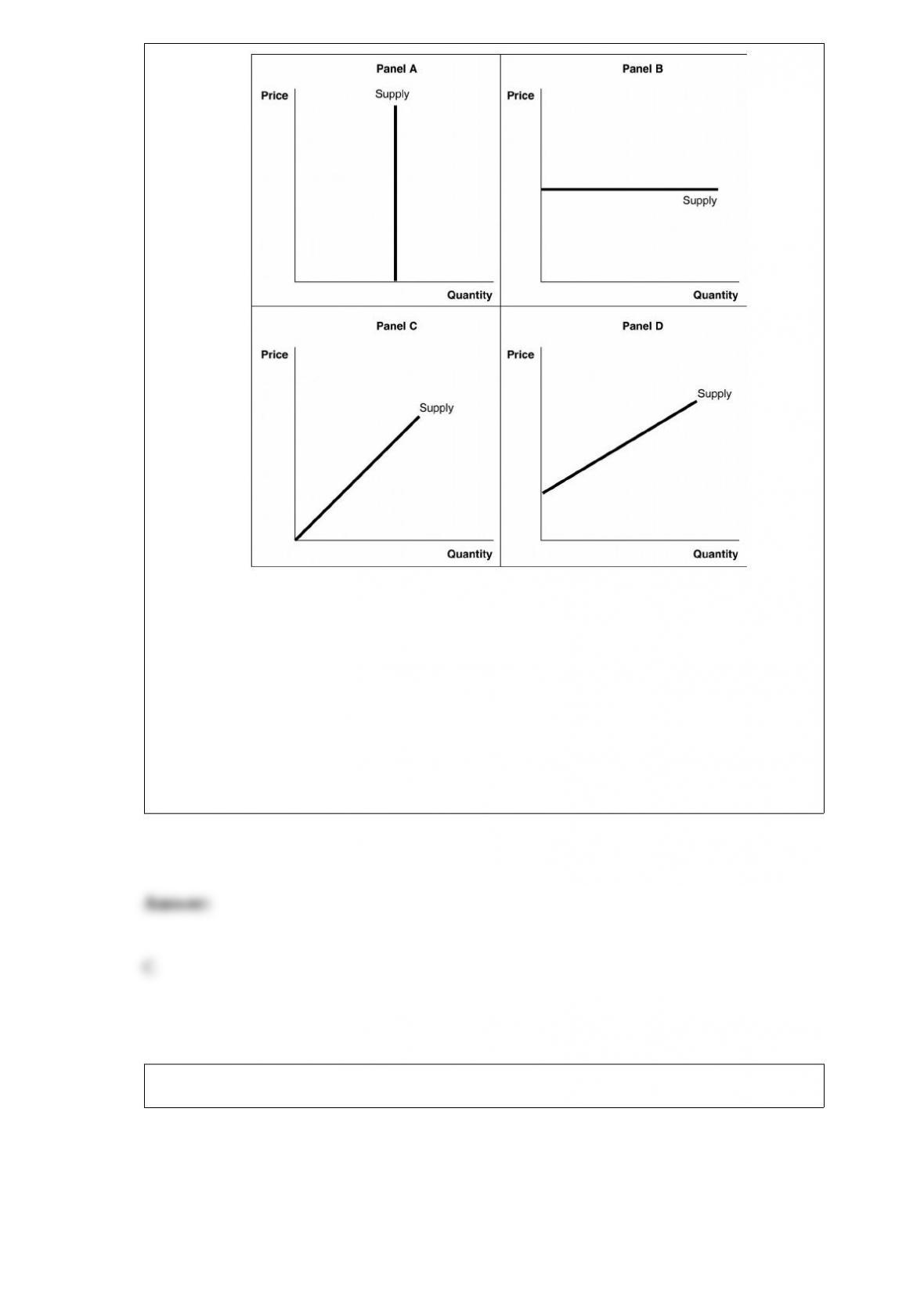
Figure 6-10
A unit-elastic supply curve is shown in
A) Panel A.
B) Panel B.
C) Panel C.
D) Panel D.
Figure 1-1
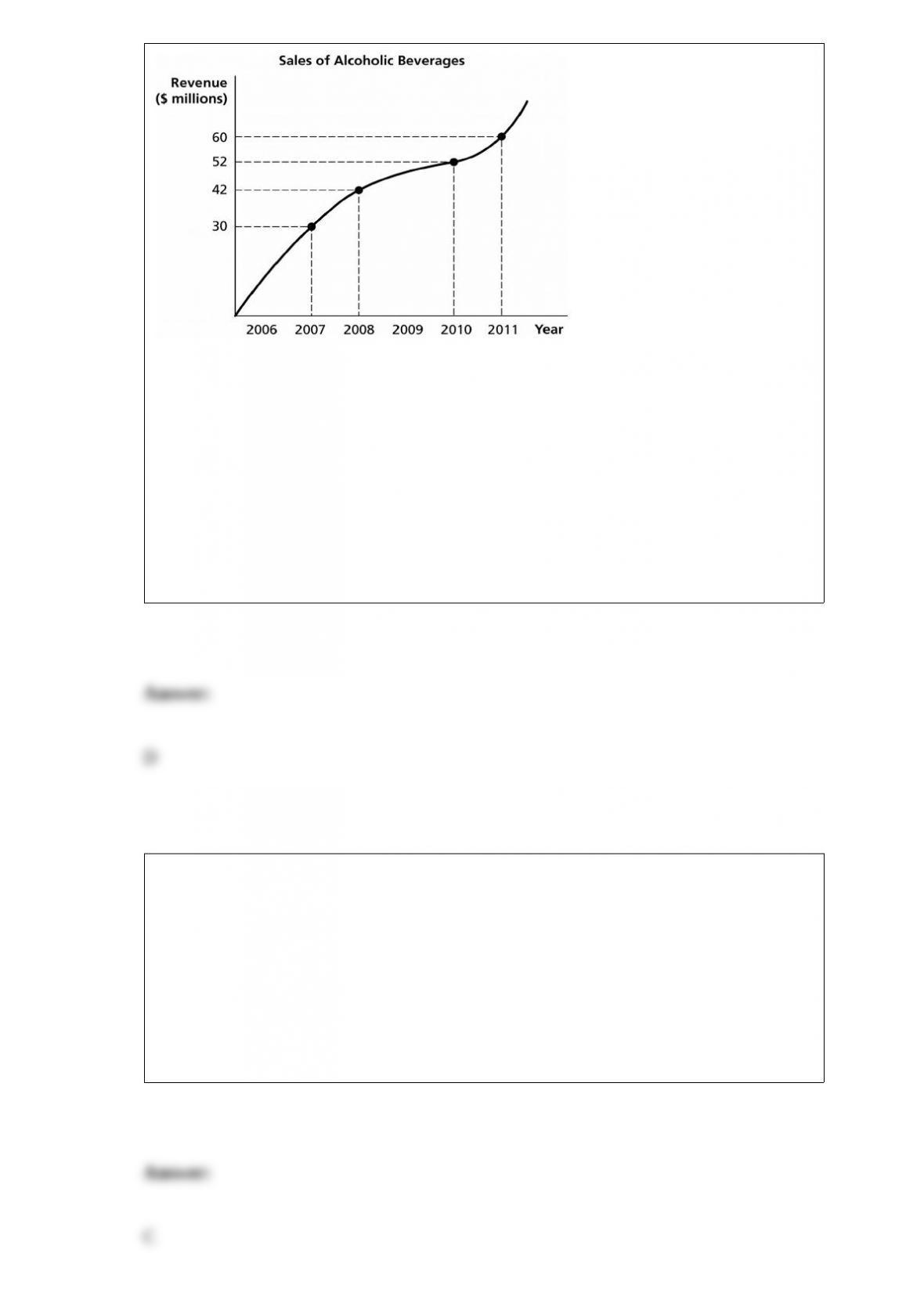
Using the information in the figure above, calculate the percentage change in sales of
alcoholic beverages between 2008 and 2011.
A) 23.1%
B) 23.8%
C) 30%
D) 42.9%
If Congress wanted to counteract the effects of a recession it could
A) increase tax rates.
B) increase taxes by a fixed amount.
C) increase government purchases.
D) decrease defense spending.
The decision about what goods and services will be produced made in a market
economy is made by
A) lawmakers in the government voting on what will be produced.
B) workers deciding to produce only what the boss says must be produced.
C) producers deciding what society wants most.
D) consumers and firms choosing which goods and services to buy or produce.
E) consumers dictating to firms what they need most.
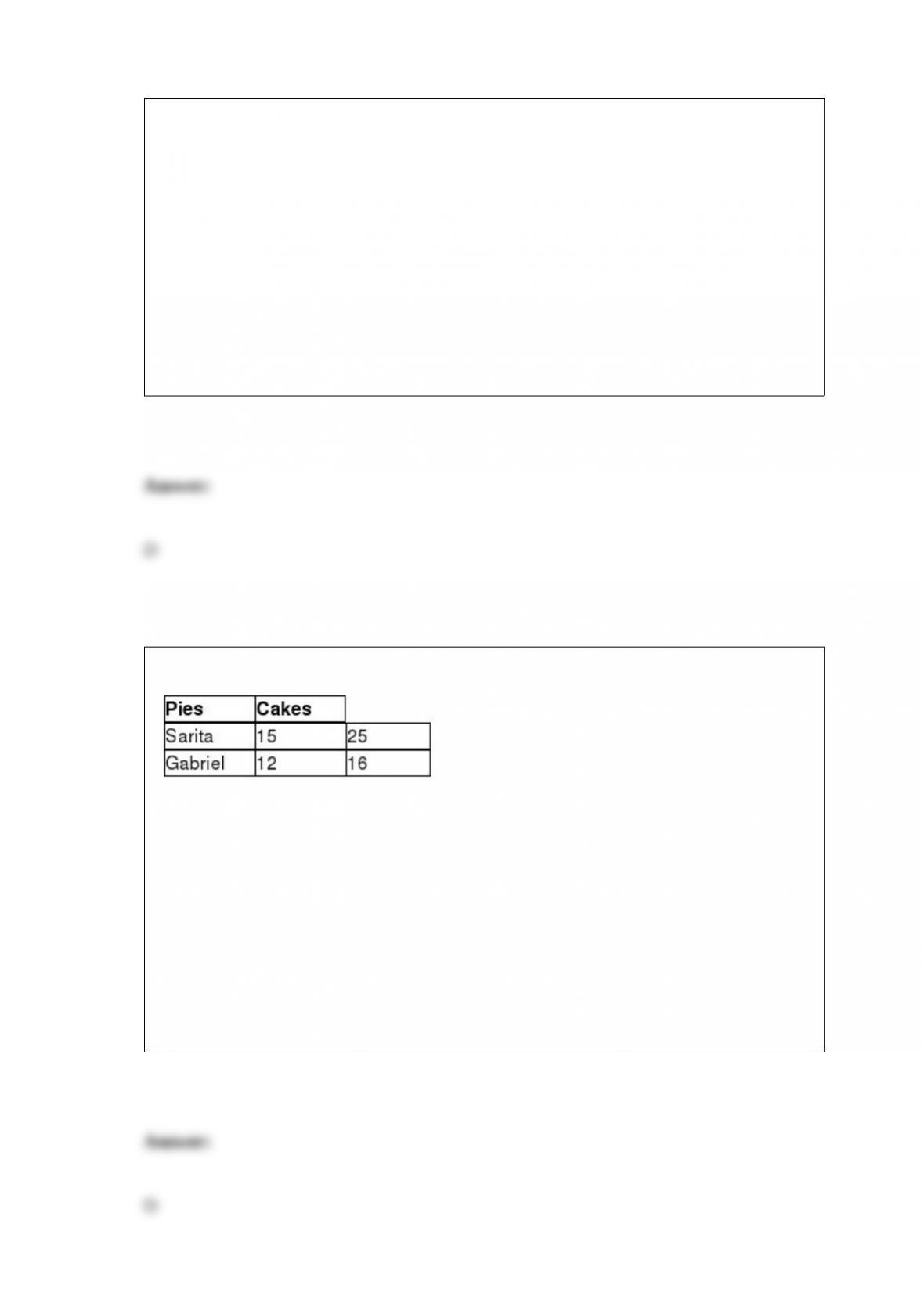
Table 9-2
Sarita and Gabriel own S&G Bakery. Table 9-2 lists the number of pies and cakes Sarita
and Gabriel can each bake in one day. Select the statement that accurately interprets the
data in the table.
A) Sarita has a comparative advantage in baking pies.
B) Gabriel has a comparative advantage in baking cakes.
C) Sarita has a comparative advantage in baking pies and baking cakes.
D) Sarita has a comparative advantage in baking cakes.

Jason, a high-school student, mows lawns for families in his neighborhood. The going
rate is $12 for each lawn-mowing service. Jason would like to charge $20 because he
believes he has more experience mowing lawns than the many other teenagers who also
offer the same service. If the market for lawn mowing services is perfectly competitive,
what would happen if Jason raised his price?
A) He would lose some but not all his customers.
B) Initially, his customers might complain but over time they will come to accept the
new rate.
C) If Jason raises his price, he would lose all his customers.
D) If Jason raises his price, then all others supplying the same service will also raise
their prices.
Which of the following is a correct statement?
A) Inflation is measured as the percent change in the CPI.
B) The CPI is a widely used measure of the inflation rate.
C) Real GDP is our best measure of economic growth.
D) The PPI measures inflation as experienced by producers.
The GDP deflator in year 2 is 105, using year 1 as the base year. This means that, on
average, the cost of goods and services is
A) 5% higher in year 2 than in year 1.
B) 105% higher in year 2 than in year 1.
C) 5% higher in year 1 than in year 2.
D) 105% higher in year 1 than in year 2.
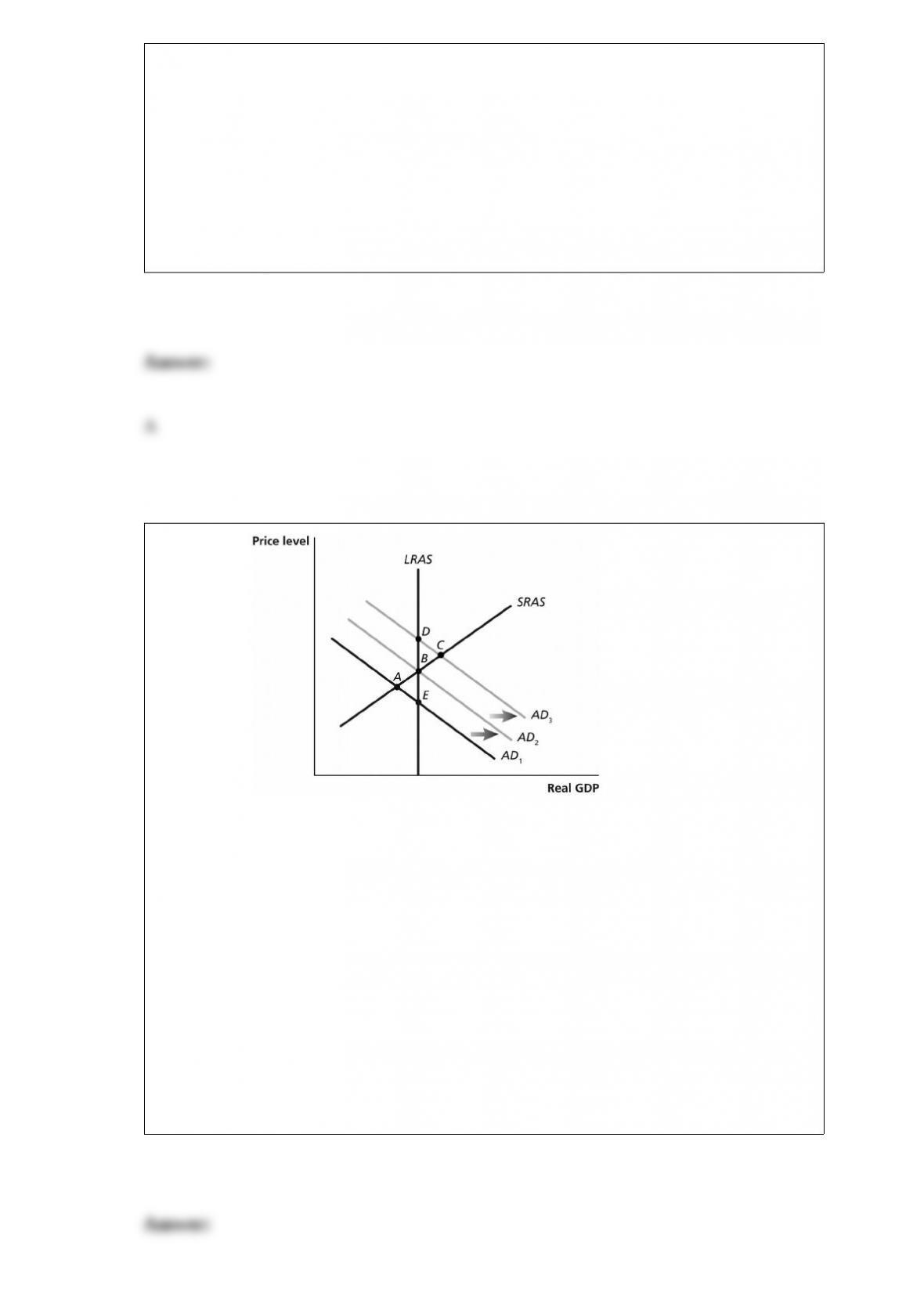
Figure 27-1
Suppose the economy is in short-run equilibrium below potential GDP and Congress
and the president lower taxes to move the economy back to long-run equilibrium. Using
the static AD–AS model in the figure above, this would be depicted as a movement from
A) A to B.
B) B to C.
C) C to B.
D) B to A.
E) A to E.
If the U.S. government places tariffs on imports from countries that have been accused
of deliberately undervaluing their currencies, the price of these imports will ________
and the demand for the undervalued currency will ________.
A) rise; rise
B) rise; fall
C) fall; rise
D) fall; fall
If rapid increases in oil prices caused price levels to increase and real GDP to decrease
in the short run, the economy would experience
A) stagflation.
B) long-run economic decline.
C) hyperinflation.
D) an increase in the natural rate of unemployment.
In October 2013, General Motors (GM) posted a price-earnings ratio of 10.13. If the
price of the stock at that time was $36 per share, which of the following must have been
true?
A) GM’s revenues that month were $364.68 million.
B) GM’s earnings per share was $3.55.
C) GM’s coupon payment was $36 per year.
D) GM’s dividend yield for the year was 36.5%.
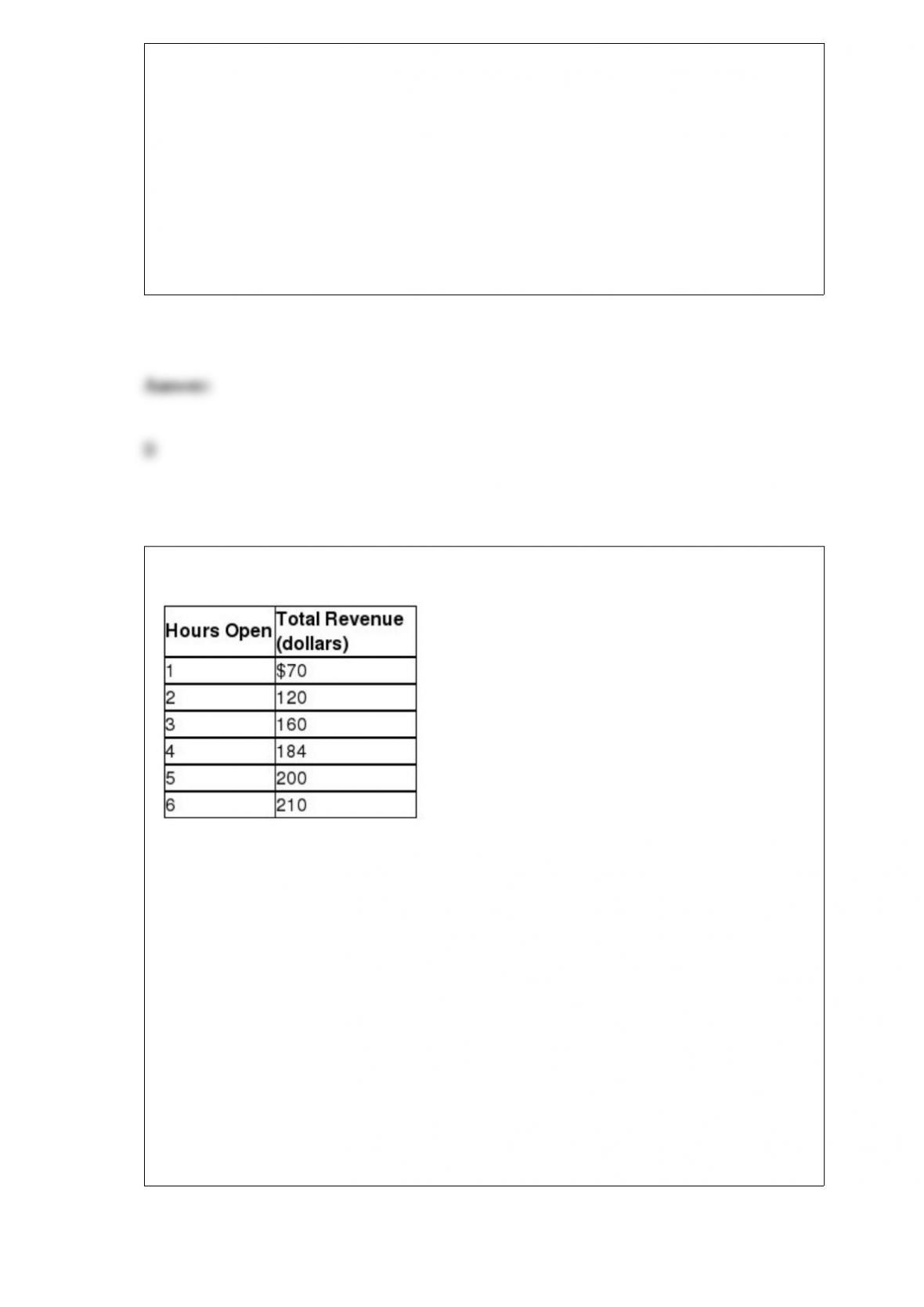
Table 1-3
Santiago runs a comic book store in the town of East Arbor. He is debating whether he
should extend his hours of operation. Santiago figures that his sales revenue will
depend on the number of hours the store is open as shown in the table above. He would
have to hire a worker for those hours at a wage rate of $18 per hour.
What is Santiago’s marginal benefit if he decides to stay open for two hours instead of
one hour?
A) $40
B) $50
C) $120
D) $190
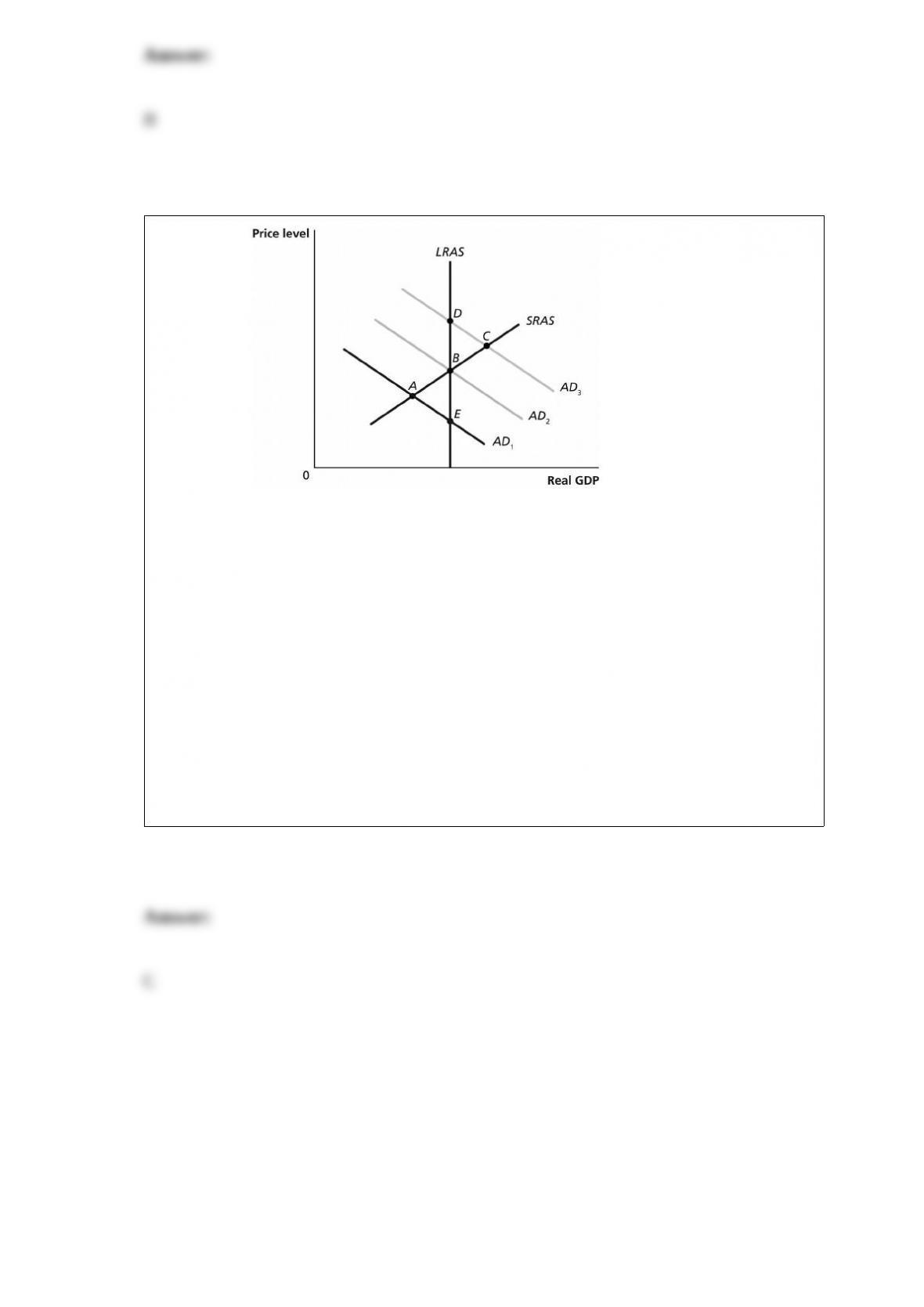
Figure 26-7
Suppose the Fed sells Treasury Bills in pursuit of contractionary monetary policy. Using
the static AD–AS model in the figure above, this situation would be depicted as a
movement from
A) A to B.
B) B to D.
C) C to B.
D) B to C.
E) C to D.