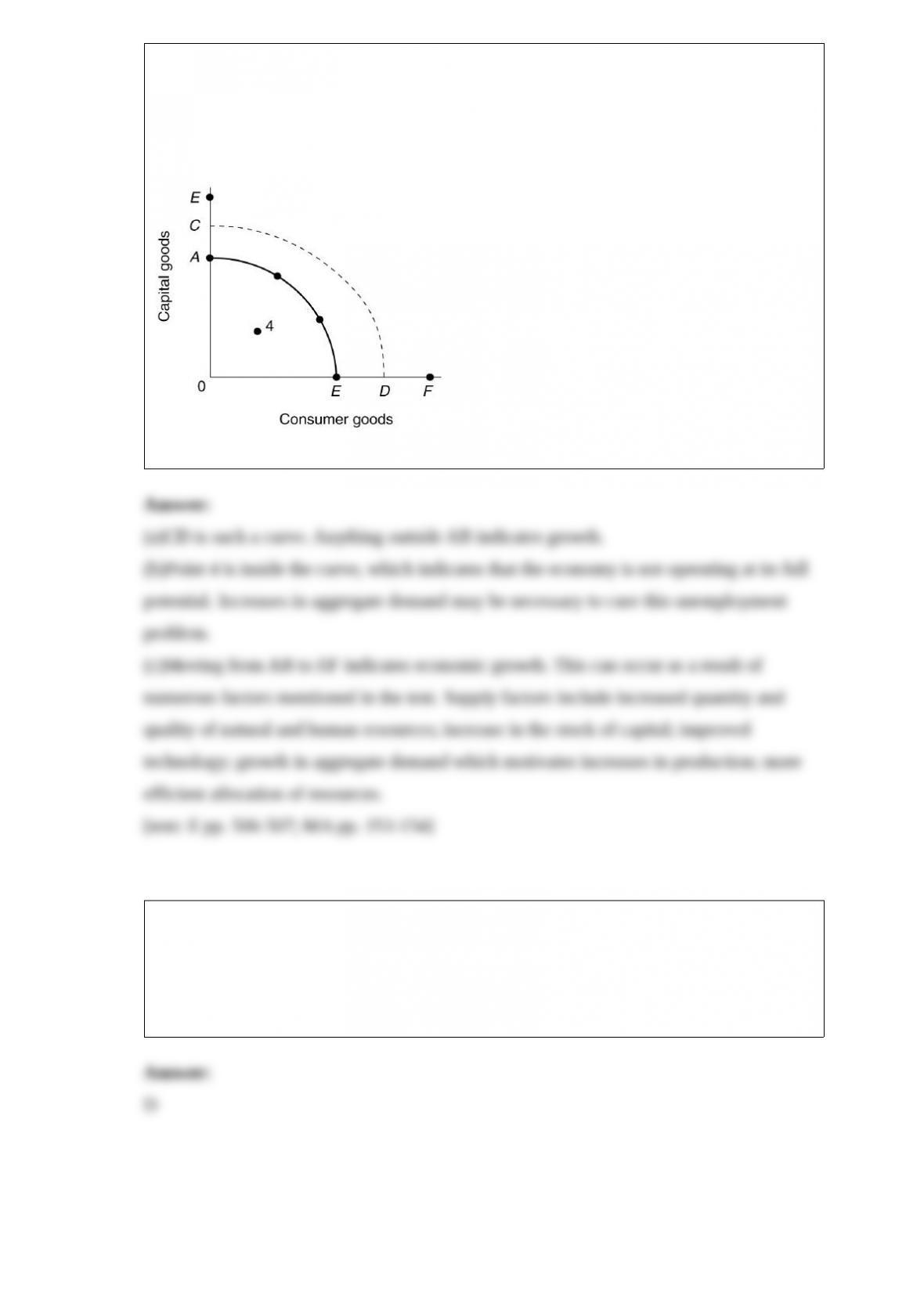
1) Use the diagram below to answer the questions.
(a)If the economys production possibilities curve is shown by curve AB, then draw in a
new curve which indicates positive economic growth.
(b)If the economy illustrated by production possibilities curve AB is producing at point
4, what economic problem does this represent for this economy?
(c)What are some of the factors which could
cause a shift from AB to EF?
2) The Gini ratio of income inequality ranges between:
A.0 and 10,000
B.1 and 10
C.-1 and +1
D.0 and 1
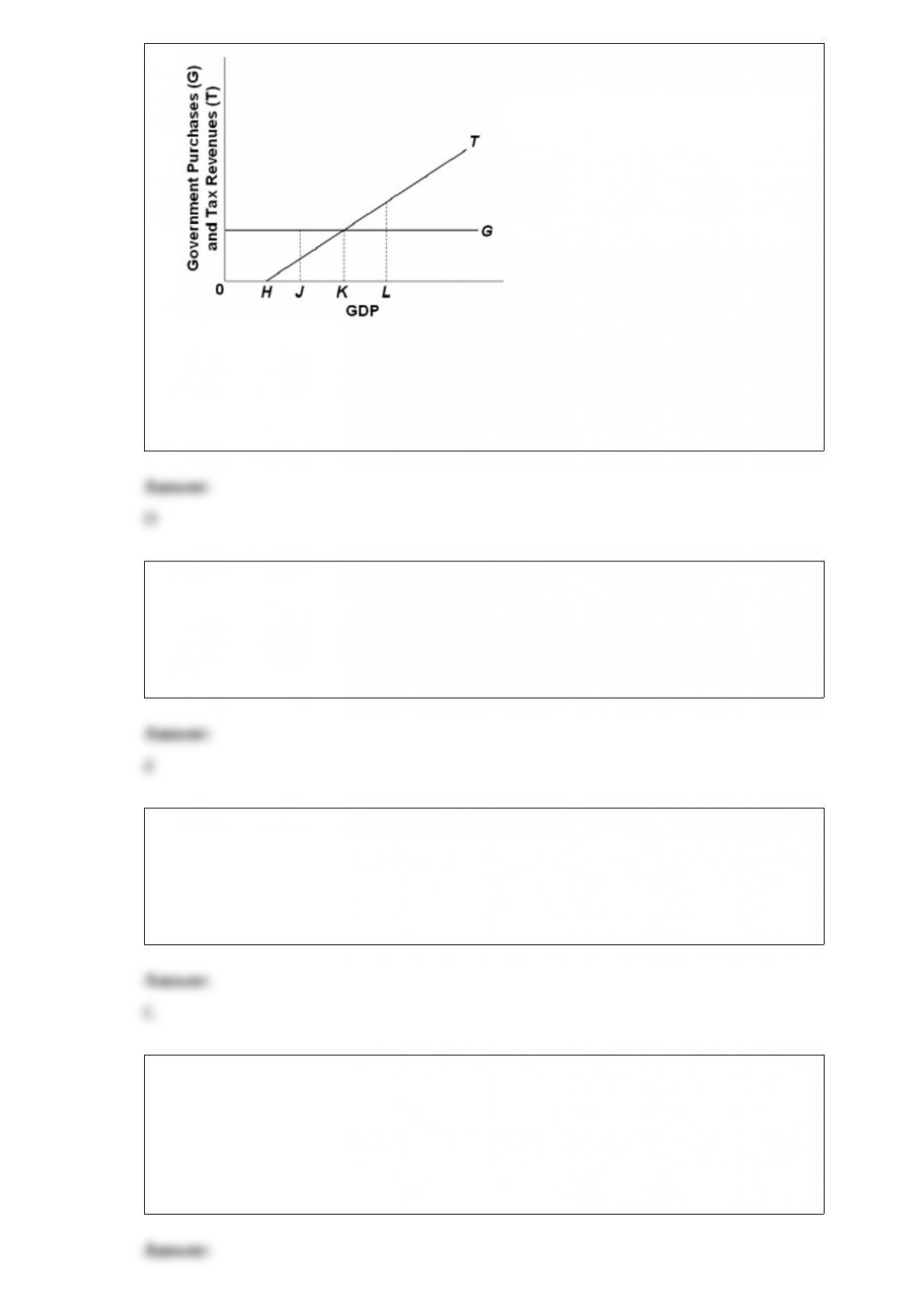
3)
If the full-employment GDP for the above economy is at L, the:
A.actual budget will have a deficit.
B.standardized budget will have a deficit.
C.actual budget will have a surplus.
D.standardized budget will have a surplus.
4) externalities weaken the efficiency of the market system because they:
a.are a major source of inflation.
b.mean that certain essential goods and services do not get produced at all.
c.are a major source of employment.
d.cause certain goods to be overproduced or underproduced.
5) Monetarists believe that:
A.prices and wages are inflexible or sticky.
B.both product and resource markets are monopolistic.
C.velocity is relatively stable.
D.the economy is more stable when active fiscal and monetary policy are used.
6) The labor demand curve of a firm:
A.will shift to the left if the price of the product the labor is producing falls.
B.is perfectly elastic if the firm is selling its product in a purely competitive market.
C.reflects a direct relationship between the number of workers hired and the money
wage rate.
D.is the same as its marginal product curve.

7) the simple circular flow model shows that:
a.households are on the buying side of both product and resource markets.
b.businesses are on the selling side of both product and resource markets.
c.households are on the selling side of the resource market and on the buying side of the
product market.
d.businesses are on the buying side of the product market and on the selling side of the
resource market.
8) nafta refers to the:
a.national association of free trade agencies.
b.national alliance for foreign trade and assistance.
c.north american free trade agreement.
d.northern alliance for tariff adjustment.
9) The largest proportion of the public debt is held by:
A.the U.S. public (individuals, businesses, financial institutions, etc.) and state and
local governments.
B.foreign individuals and institutions.
C.the Federal Reserve System.
D.U.S. government agencies.
10) debeers consolidated mines markets about:
a.55 percent of the world’s rough-cut diamonds.
b.80 percent of the world’s rough-cut diamonds.
c.45 percent of the world’s rough-cut diamonds.
d.33 percent of the world’s rough-cut diamonds.
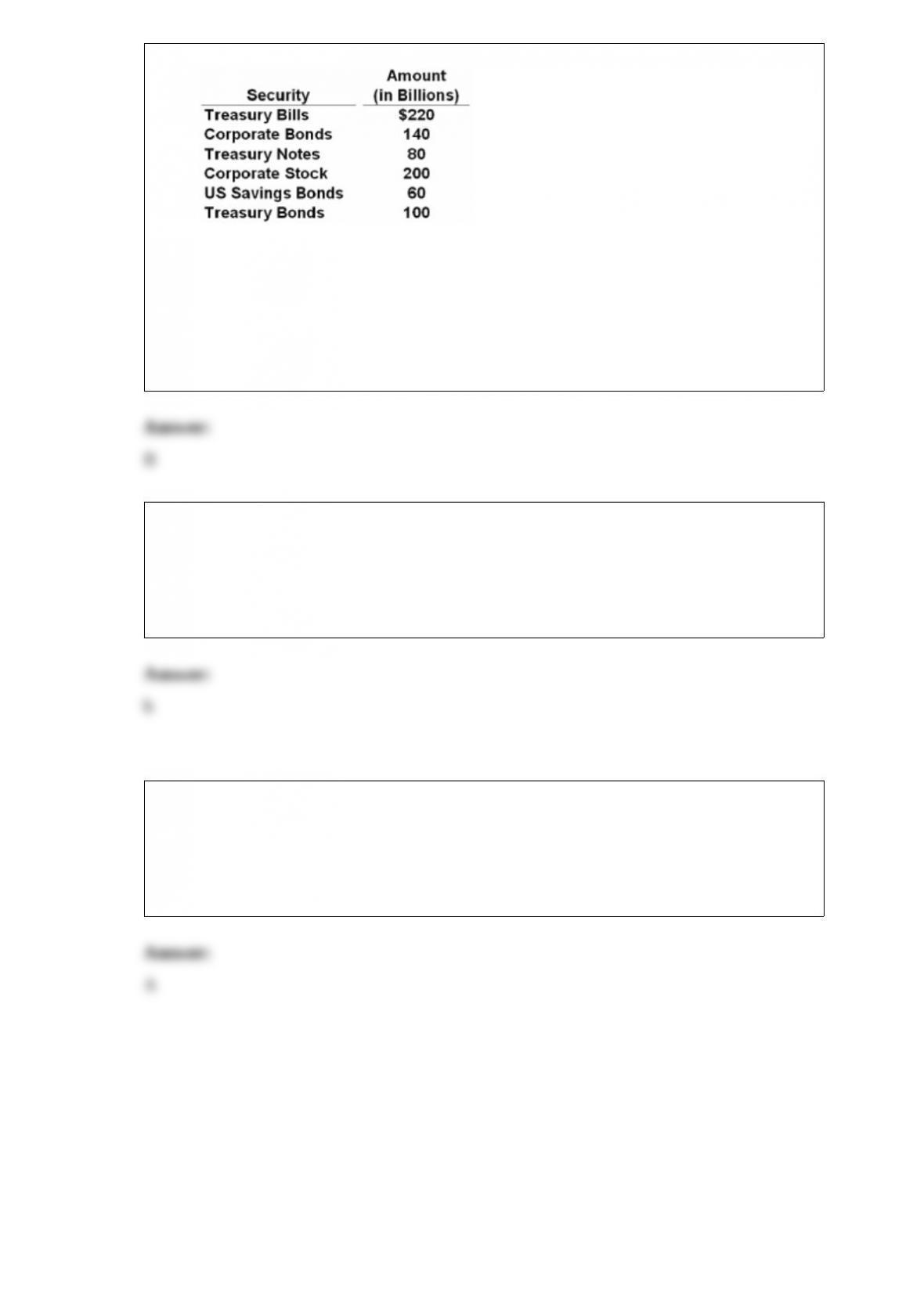
11)
Other things equal, an increase of Treasury bonds from $100 billion to $120 billion in
the above economy would:
A.not change the size of the public debt.
B.increase the public debt from $460 billion to $480 billion.
C.increase the public debt from $400 billion to $420 billion.
D.decrease the public debt by $20 billion.
12) which of the following best illustrates the post hoc, ergo propter hoc fallacy?
a.because it was 90 degrees today, i worked up a sweat playing tennis.
b.i took the day off work to go to the beach and that’s why it rained.
c.because it rained at the football game, my new sweater got wet.
d.because i have studied diligently this semester, my grade average has improved.
13) In a mixed open economy the equilibrium GDP is determined at that point where:
A.Sa + M + T = Ig + X + G.
B.the 45-degree line and the saving schedule intersect.
C.Sa + X + G = Ig + T.
D.Sa + Ig + X = G + T.
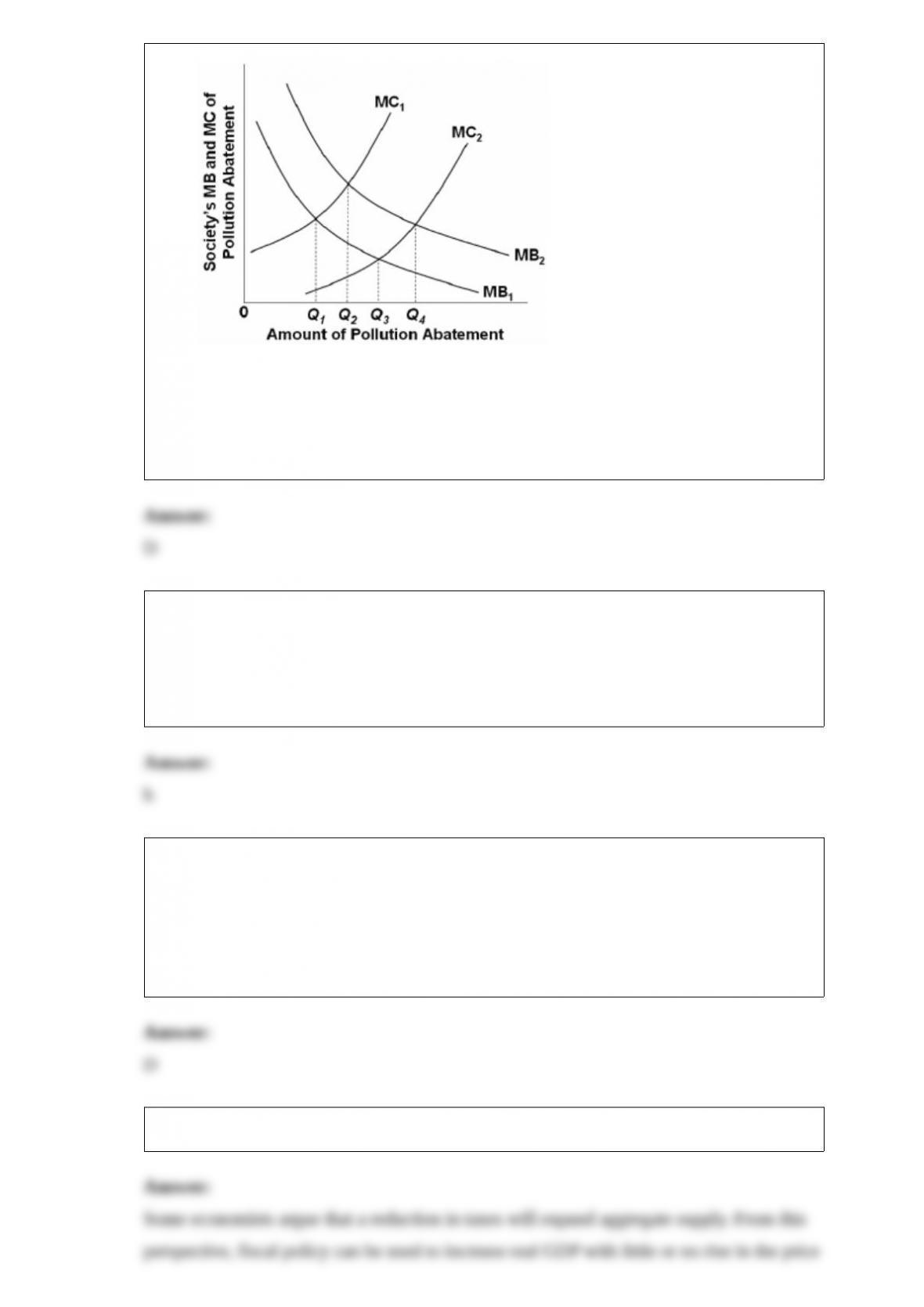
14)
The MC curves in the above diagram slope upward because of the law of:
A.demand.
B.conservation of matter and energy.
C.diminishing marginal utility.
D.diminishing returns.
15) in the short run it is impossible for an expansion of output to increase:
a.average total cost.
b.average fixed cost.
c.marginal cost.
d.average variable cost.
16) Public choice theorists contend that:
A.government can efficiently correct instances of market system failure.
B.the existence of cost-benefit analysis has brought about the efficient use of resources
in the public sector.
C.public bureaucracies are inherently more efficient than private enterprises.
D.public bureaucracies are inherently less efficient than private enterprises.
17) What is supply-side economics? What is the rationale for it? Is it effective?
18) In monopolistically competitive markets neither allocative nor productive efficiency
is realized. Explain.
19) Are economic growth and progress synonymous? How might they differ?
20) What conditions are necessary to determine if the purely competitive firm should
produce in the short run? State the marginal revenue and marginal cost conditions and
the total revenue and total cost conditions.
21) Explain how an increase or decrease in demand and supply will affect the value of a
nations currency.
22) Explain the basic arguments for supply-side economics.
23) Banks pursue two conflicting goals. Explain what they are and why the conflict.
24) What are the net costs of tariffs and quotas on consumption and income
distribution?