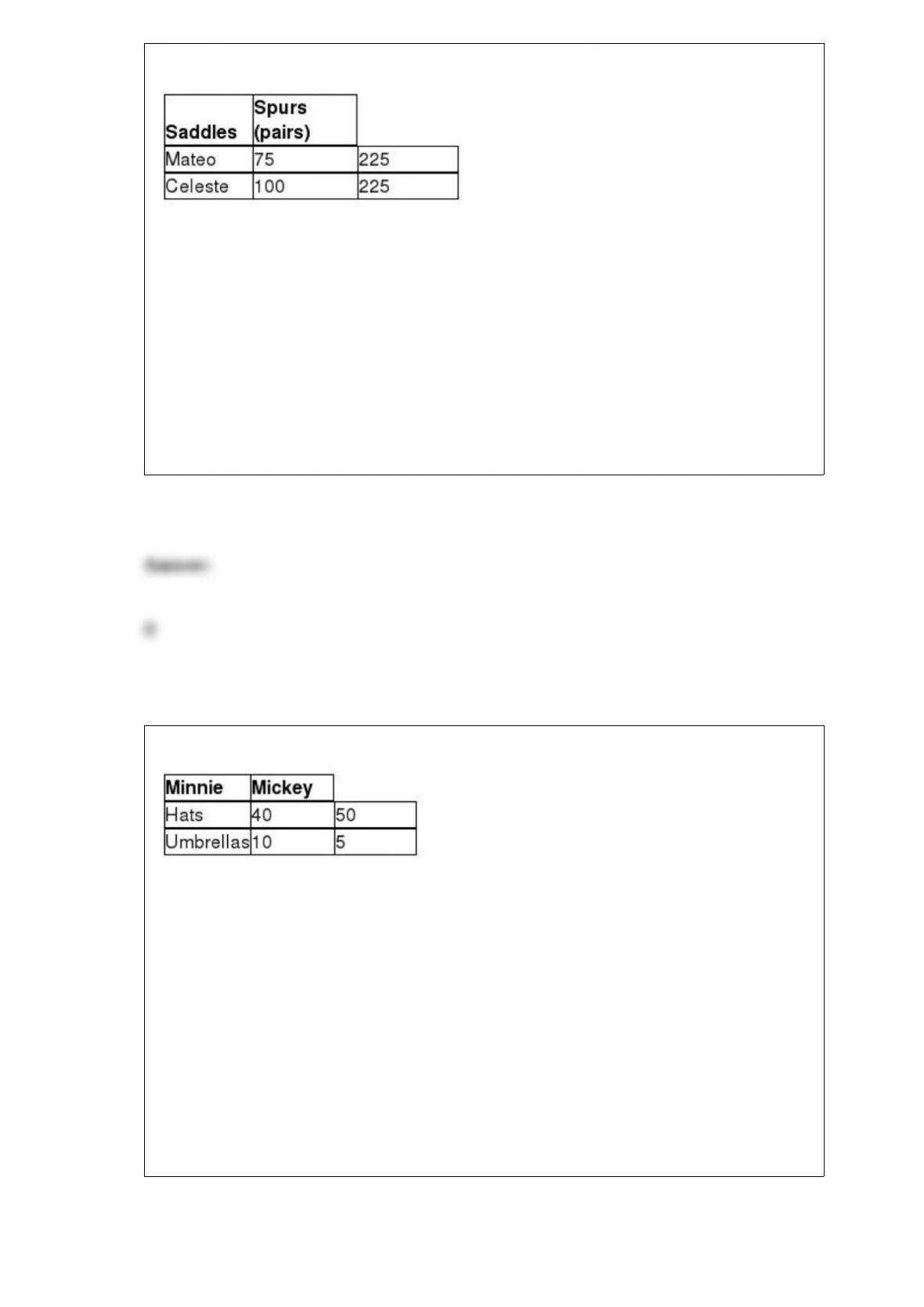
Table 9-6
Mateo and Celeste produce custom saddles and spurs. Table 9-6 lists the number of
saddles and pairs of spurs Mateo and Celeste can each produce in one month. Select the
statement that accurately interprets the data in the table.
A) Celeste has a comparative advantage in making spurs.
B) Mateo has a comparative advantage in making spurs.
C) Celeste has a comparative advantage in making saddles and making spurs.
D) Neither Mateo nor Celeste has a comparative advantage in making spurs.
Table 2-7
Table 2-7 shows the output per week of two people, Minnie and Mickey. They can
either devote their time to making hats or making umbrellas. Which of the following
statements istrue?
A) Minnie has a comparative advantage in making both products.
B) Mickey has a comparative advantage in making both products.
C) Minnie has a comparative advantage in making hats and Mickey in making
umbrellas.
D) Mickey has a comparative advantage in making hats and Minnie in making
umbrellas.

According to census figures and the Congressional Budget Office, the number of people
________ is projected to increase and the number of people ________ is projected to
decrease by the year 2020.
A) who are uninsured; who are insured
B) who are uninsured; age 65 and older
C) age 65 and older; who are uninsured
D) who are insured; age 65 and older
Imposing tariffs in cases of dumping
A) is allowed under the WTO agreement.
B) is not allowed under the WTO agreement.
C) is not addressed by the WTO agreement.
D) has never occurred, even though it is allowed under the WTO agreement.

“Free riding” is a characteristic of which type of good?
A) a private good
B) a common resource
C) a public good
D) a good that is both rival and excludable
In a survey of consumers, Daniel Kaheman, Jack Knetsch and Richard Thaler asked
their opinion of a hardware store’s decision to
A) go out of business because a larger hardware store opened in the same city; 82
percent of those surveyed believed it was unfair for the larger store to compete with the
smaller store.
B) raise the price of snow shovels the day following a snowstorm; 82 percent of those
surveyed believed this was unfair.
C) sell tickets to sporting and cultural events at prices higher than prices paid at the
ticket windows for the same events; 82 percent of those surveyed believed this was
unfair.
D) remain in business even though the store was not making an economic profit; 82
percent of those surveyed believed it would be unfair for the store to go out of business
if there no other hardware stores in the same area.
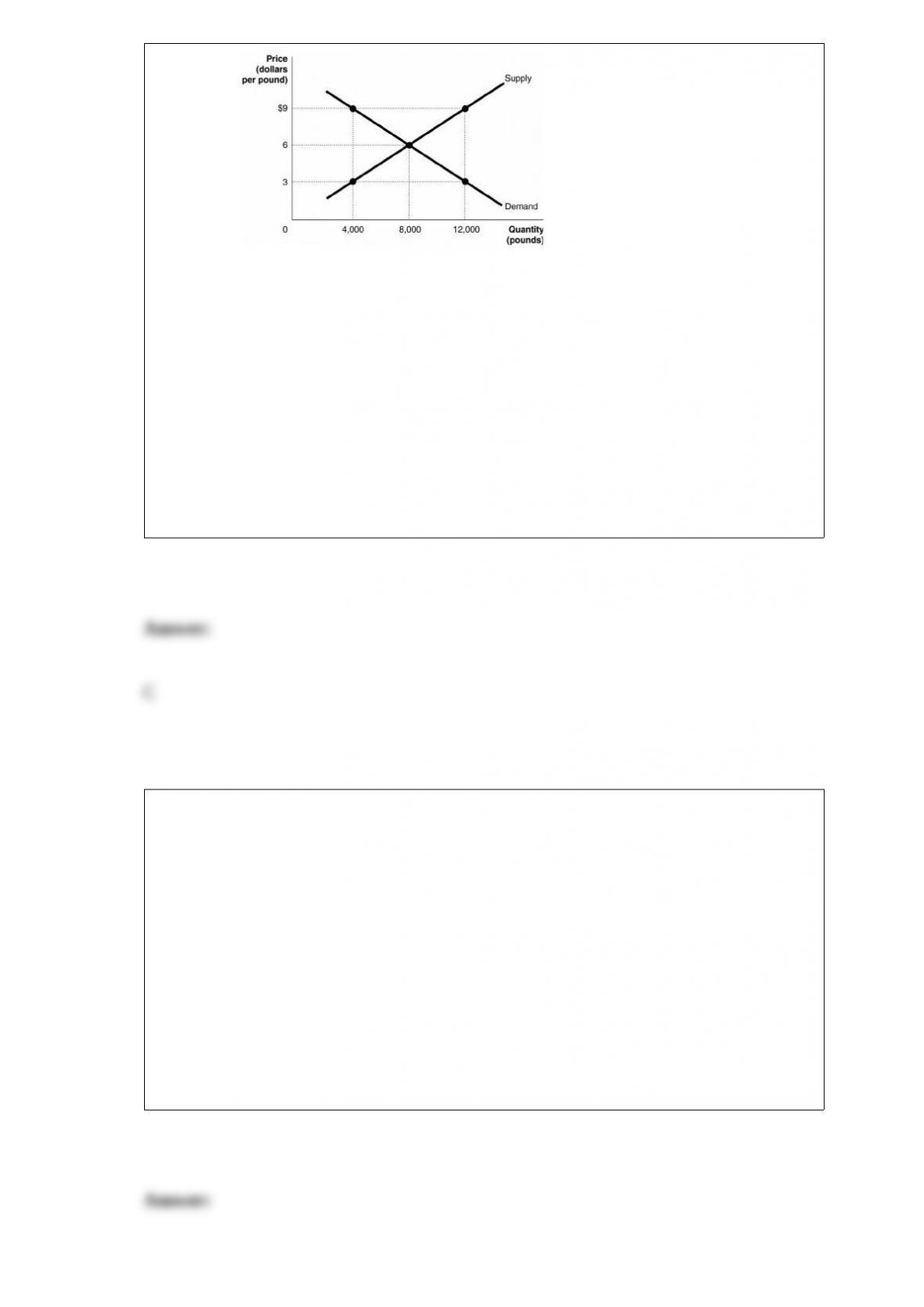
Figure 4-5
The figure above represents the market for pecans. Assume that this is a competitive
market. If the price of pecans is $3,
A) economic surplus is maximized.
B) not enough consumers want to buy pecans.
C) the quantity supplied is less than the economically efficient quantity.
D) the quantity supplied is economically efficient but the quantity demanded is
economically inefficient.
Which of the following statements about two-part tariffs is false?
A) Because each individual has a different individual demand curve, if there is just one
entrance fee, some consumers will be able to reap some consumer surplus.
B) The producer cannot capture the entire consumer surplus because the entrance fee
might discourage some potential consumers even though they would have been willing
to pay a lesser entrance fee.
C) Two-part tariff pricing allows a producer to capture the entire consumer surplus.
D) For two-part tariff pricing to be successful, the producer must be able to identify two
distinct customer groups.

The costs in time and other resources that parties incur in the process of facilitating an
exchange of goods and services are called
A) enforcement costs.
B) implicit costs.
C) explicit costs.
D) transaction costs.
Which of the following is a factor of production?
A) a necklace produced by a jewelry manufacturer
B) 50 shares of Google stock
C) the security guard at the local bank
D) $1,000 in casino chips
Once a country has lost its comparative advantage in producing a good, its income will
be ________ and its economy will be ________ if it switches from producing the good
to importing it.

A) higher; less efficient
B) higher; more efficient
C) lower; less efficient
D) lower; more efficient
Suppose you borrow $1,000 at an interest rate of 12 percent. If the expected real interest
rate is 5 percent, then the rate of inflation over the upcoming year that would be most
beneficial to you would be a rate of inflation
A) equal to 0 percent.
B) greater than 7 percent.
C) equal to 7 percent.
D) less than 7 percent.
A corporation’s board of directors
A) hires the managers of the corporation.
B) controls the day-to-day activities of the corporation.
C) is personally liable for the debts of the corporation.
D) is the sole owner of the corporation.
Before its IPO, Facebook was an example of a private firm. As a private firm, Facebook
was
A) not subject to government regulations and taxation.
B) run by stockholders and a board of directors.
C) run by its founder, Mark Zuckerberg.
D) not legally allowed to raise funds through venture capital firms.
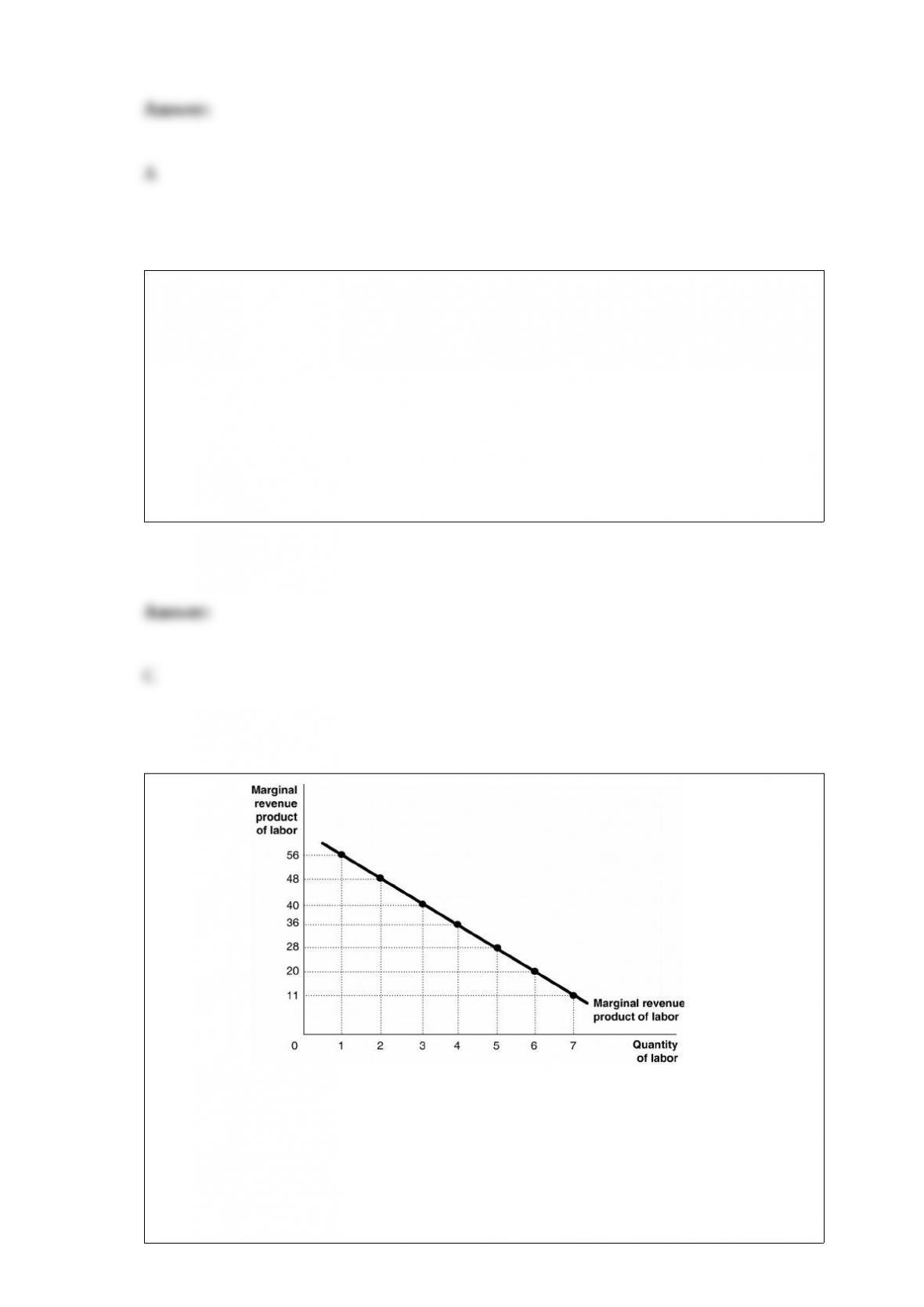
Figure 17-1 Figure 17-1
shows the marginal revenue product for Dale’s Hand-Sewn Doilies, a producer of linen
doilies. Suppose the market price of doilies rises to $3. What happens to the curve given
in the diagram?
A) Nothing, because labor’s productivity has not changed.
B) There will be a movement along the curve.

C) The curve shifts to the right.
D) We cannot answer the question without knowing if Dale would want to hire more
workers.