
The nominal interest rate tells you:
A) how fast the number of dollars in your bank account increases over time.
B) how fast the purchasing power of your bank account increases over time.
C) the number of dollars in your bank account.
D) the purchasing power of your bank account.
The economic view of traffic congestion considers:
A) that drivers ignore the costs they impose on other drivers by slowing other drivers’
commute time.
B) that driving is a right.
C) that most drivers are not good defensive drivers.
D) that the amount of driving should be reduced.
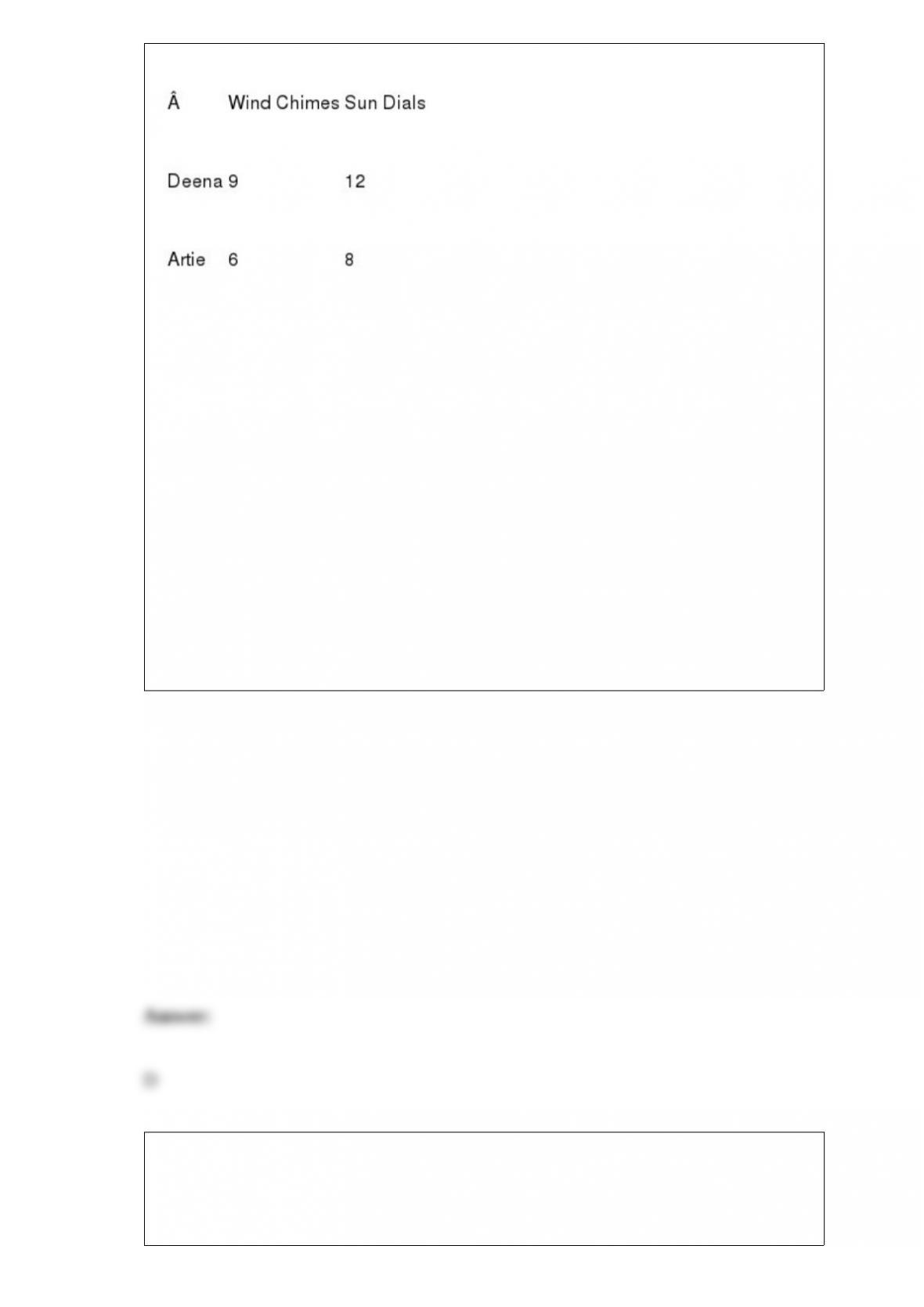
Table 3.4
Consider two individuals, Artie and Deena, who produce wind chimes and sun dials.
Artie’s and Deena’s weekly productivity are shown in Table 3.4. Which of the following
is true?
A) Deena has an absolute advantage in producing both goods, and a comparative
advantage in producing wind chimes.
B) Deena has an absolute advantage in producing both goods, and a comparative
advantage in producing sun dials.
C) Deena has an absolute and a comparative advantage in producing both goods.
D) Deena has an absolute advantage in producing both goods, but no one has a
comparative advantage in producing either good.
The combinations of goods a nation can consume after trade and specialization begin
are illustrated by the ________ curve.
A) supply

B) production possibilities
C) consumption possibilities
D) demand
During the financial crisis of 2008, the Fed
A) attempted to stabilize the economy by selling over $1 trillion in securities.
B) engaged in massive purchases of securities, adding over $1 trillion to its balance
sheet.
C) stopped its purchase of mortgage-backed securities to reduce its balance sheet.
D) was careful to balance its purchase and sale of securities so as not to drastically
change its balance sheet.
Seasonally adjusted unemployment rates
A) adjust for the predictable summer increase in the unemployment rate for teenagers.
B) adjust for the predictable summer decrease in the unemployment rate for teenagers.
C) are the same as the unadjusted rates in periods of bad weather.
D) are not calculated for the U.S. economy.
If the economy is in equilibrium at full employment, an increase in aggregate demand

will:
A) decrease the price level and leave the level of output unchanged in the long run.
B) increase the price level and leave the level of output unchanged in the long run.
C) increase both the price level and the level of output in the long run.
D) decrease both the price level and the level of output in the long run.
What was observed about labor markets during the Great Depression that was not
explained by classical models? This was also what most models developed after the
Great Depression tried to explain.
A) persistent unemployment
B) persistent inflation
C) persistent growth
D) persistent equilibrium
Suppose an economy that has been operating at full employment has been experiencing
4 percent annual inflation. If output later falls to a level that is less than potential
output, prices generally will begin to rise at
A) a rate of 4 percent.
B) a rate greater than 4 percent.
C) a rate less than 4 percent.
D) a rate of 0 percent.

Classical economists believed that:
A) unemployment could not persist for extended periods of time.
B) the government could lift the economy out of recession.
C) recessions were not self-correcting.
D) government could intervene in the economy and increase the level of output and
employment.
The typical relationship between inflation and unemployment is
A) as unemployment falls, inflation falls.
B) as unemployment falls, inflation increases.
C) as unemployment falls, nothing happens to inflation.
D) unemployment changes do not directly lead to changes in inflation, but inflation
changes may cause changes in unemployment.
Recall the Application about the relationship between economic growth and inequality
to answer the following question(s).
According to this Application, factors which are important for economic growth include
all of the following EXCEPT
A) a continuously increasing money supply.
B) well-functioning credit markets.
C) the quality of the political institution.
D) an economy’s openness to trade.

Suppose the economy has been at full employment for the past two years with a 7
percent inflation rate, and both the money supply and money demand were growing at 7
percent a year. If the Federal Reserve unexpectedly decreases the rate of money growth
to 3 percent, the following sequence of events occurs
A) real interest rates fall, investment spending decreases, GDP increases,
unemployment falls, and prices rise.
B) real interest rates rise, investment spending decreases, GDP decreases,
unemployment increases, and prices fall.
C) real interest rates fall, investment spending increases, GDP increases, unemployment
falls, and prices rise.
D) real interest rates rise, investment spending increases, GDP decreases,
unemployment increases, and prices fall.
Exporting nations often agree to voluntary export restraints in an attempt to
A) employ more workers in the importing nation.
B) avoid more restrictive trade policies.
C) increase global welfare.
D) decrease inflation.
A decrease in the price level in the economy leads to
A) a leftward shift in the demand for money curve.

B) a rightward shift in the demand for money curve.
C) a leftward movement along the demand for money curve.
D) a rightward movement along the demand for money curve.
Because the Fed can meet anytime in addition to the 8 scheduled meetings every year,
and because the Fed can implement policy changes during any of these meetings, it
follows that:
A) the Fed’s inside lag is very short.
B) the Fed’s inside lag is equally as long as the outside lag.
C) the Fed’s outside lag is shorter than the inside lag.
D) the Fed’s outside lag is very short.
Bridget wants to make an 8% real return on a loan that she is planning to make, and the
expected inflation rate during the period of the loan is 10%. She should charge an
interest rate of:
A) 8%.
B) 18%.
C) 2%.
D) -2%.

Suppose that for a given firm, the increase in output resulting from the last worker hired
is less than the increase in output of the previous worker hired. This is an example of
A) diminishing returns.
B) constant returns.
C) increasing return.
D) capital deepening.
Which of the following individuals benefit when the economy experiences
unanticipated inflation?
A) borrowers
B) fixed income earners
C) savers
D) lenders
Suppose Diego deposits $4,000 in his bank. If the reserve ratio is 10 percent, this will
lead to a maximum increase of ________ in checking account balances throughout all
banks..
A) $0
B) $4,000
C) $10,000
D) $40,000