If a country has a fixed exchange rate,
A) the equilibrium exchange rate in that market does not respond to changes in supply
and demand for currency.
B) central banks have more control over real GDP in the economy.
C) central banks must buy and sell their holdings of currencies to maintain a given
exchange rate.
D) the exchange rate is allowed to fluctuate in response to changes in the supply and
demand for currency.
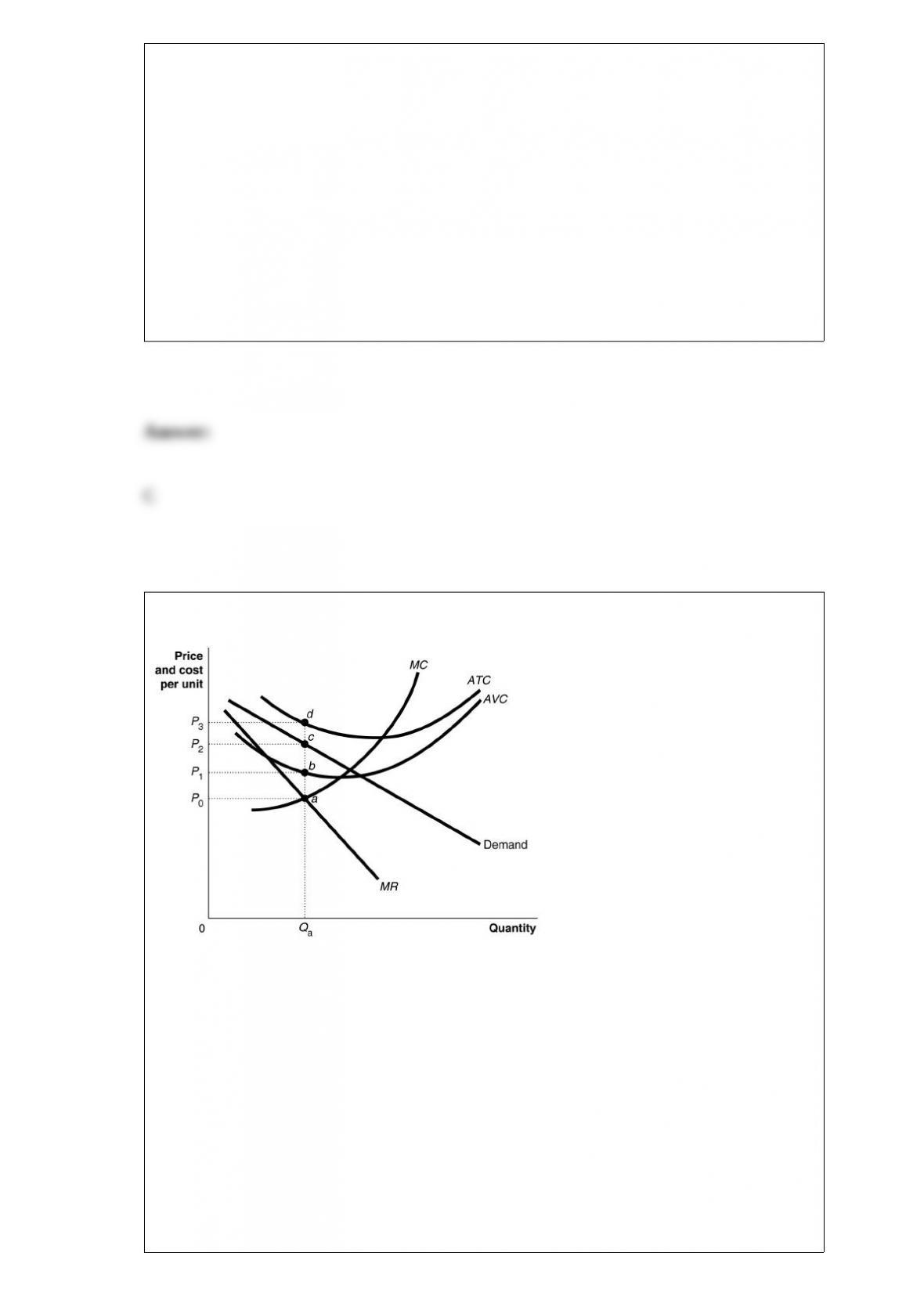
Figure 13-4
Figure 13-4 shows short-run cost
and demand curves for a monopolistically competitive firm in the market for designer
watches.
What is the area that represents the total fixed cost of production?
A) 0P1aQa
B) P0adP3
C) P1bdP3
D) That information cannot be determined from the graph.

If the dollar appreciates, how will aggregate demand in the United States be affected?
A) Aggregate demand will shift to the right as exports increase.
B) Aggregate demand will shift to the right as imports increase.
C) Aggregate demand will shift to the left as imports increase.
D) Aggregate demand will shift to the left as exports increase.
The satisfaction a person receives from consuming goods and services is called
A) contentment.
B) psychic income.
C) wealth.
D) utility.

How are the fundamental economic decisions determined in Cuba?
A) Individuals, firms, and the government interact in a market to make these economic
decisions.
B) These decisions are made by the country’s elders who have had much experience in
answering these questions.
C) The government decides because Cuba is a centrally planned economy.
D) The United Nations decides because Cuba is a developing economy.
For years economists believed that market structure explained the ability of some firms
to earn economic profits. For example, firms in industries with little competition and
high barriers to entry would earn higher profits than firms in competitive industries with
low entry barriers. Which of the following has caused economists to question this
explanation and seek other explanations for why firms are profitable?
A) Studies have shown that, on average, firms in competitive industries earn higher
profit rates than firms in industries with little competition.
B) In recent years new technologies have increased the potential entry of new firms in
industries with high entry barriers.
C) Studies have shown that firms in industries that have little competition and high
entry barriers are not very profitable. Economists conclude from this that some
competition is necessary in order to force firms to lower their costs and develop
products that satisfy new consumer demands.
D) The market structure explanation fails to explain how firms in the same industry can
have very different levels of profit.

The real interest rate equals the nominal interest rate ________ the inflation rate.
A) times
B) divided by
C) plus
D) minus
Suppose that households became mistrustful of the banking system and decide to
decrease their checking accounts and increase their holdings of currency. Using the
money demand and money supply model and assuming everything else is held constant,
the equilibrium interest rate should
A) increase.
B) decrease.
C) not change.
D) increase, then decrease.
GDP in a country grew from $10 billion to $14 billion over the span of 5 years. The
percentage change in GDP was
A) 4%.
B) 7%.

C) 10%.
D) 40%.
The process of an economy adjusting from a recession back to potential GDP in the
long run without any government intervention is known as
A) monetary policy.
B) an automatic mechanism.
C) “releasing sticky prices.”
D) fiscal policy.
Figure 13-4
Figure 13-4 shows short-run cost

and demand curves for a monopolistically competitive firm in the market for designer
watches.
What is the area that represents the loss made by the firm?
A) the area P0adP3
B) the area P1bcP2
C) the area P0acP2
D) the area P2cdP3
Competitive markets tend to eliminate economic discrimination, but there are many
historical examples of firms that hired few, or no, black or female workers. Which of
the following is not a reason for the persistence of this form of discrimination?
A) In many cases, white workers refused to work with black workers.
B) Some white consumers were unwilling to buy from companies that employed black
workers.
C) If discrimination makes it difficult for a member of a group to be hired in a
particular occupation, there is less incentive for members of the group to be trained to
enter that occupation.
D) Laws passed by the federal government made it more expensive to hire black or
female workers. As a result, it was less expensive for employers to hire mostly white
male workers.

Which of the following explains why the marginal cost curve has a U shape?
A) Initially, the marginal product of labor falls, then rises.
B) Initially, the average product of labor rises, then falls.
C) Initially, the marginal product of labor rises, then falls.
D) Initially, the average cost of production rises, then falls.
If Finland has an absolute advantage in the production of two goods compared to
Latvia, Finland can still benefit from trade with Latvia.
The law of one price states
A) federal and state statutes that prohibit price discrimination.
B) that all customers should pay the same price.
C) that identical products should sell for the same price everywhere.
D) government regulation of prices for all firms.

Which of the following statements about price elasticity of demand is false?
A) The value of the price elasticity of demand is the reciprocal of the value of the
demand curve’s slope.
B) If quantity demanded changes by a larger percentage than the percentage change in
price, demand is elastic.
C) The value of the price elasticity of demand along a downward-sloping demand curve
is always negative.
D) A linear downward-sloping demand curve has a varying price elasticity coefficient.
Recent estimates put the size of the underground economy in the United States at
________ of measured GDP.
A) 2 percent
B) 8 percent
C) 13 percent
D) over 50 percent
Table 17-2
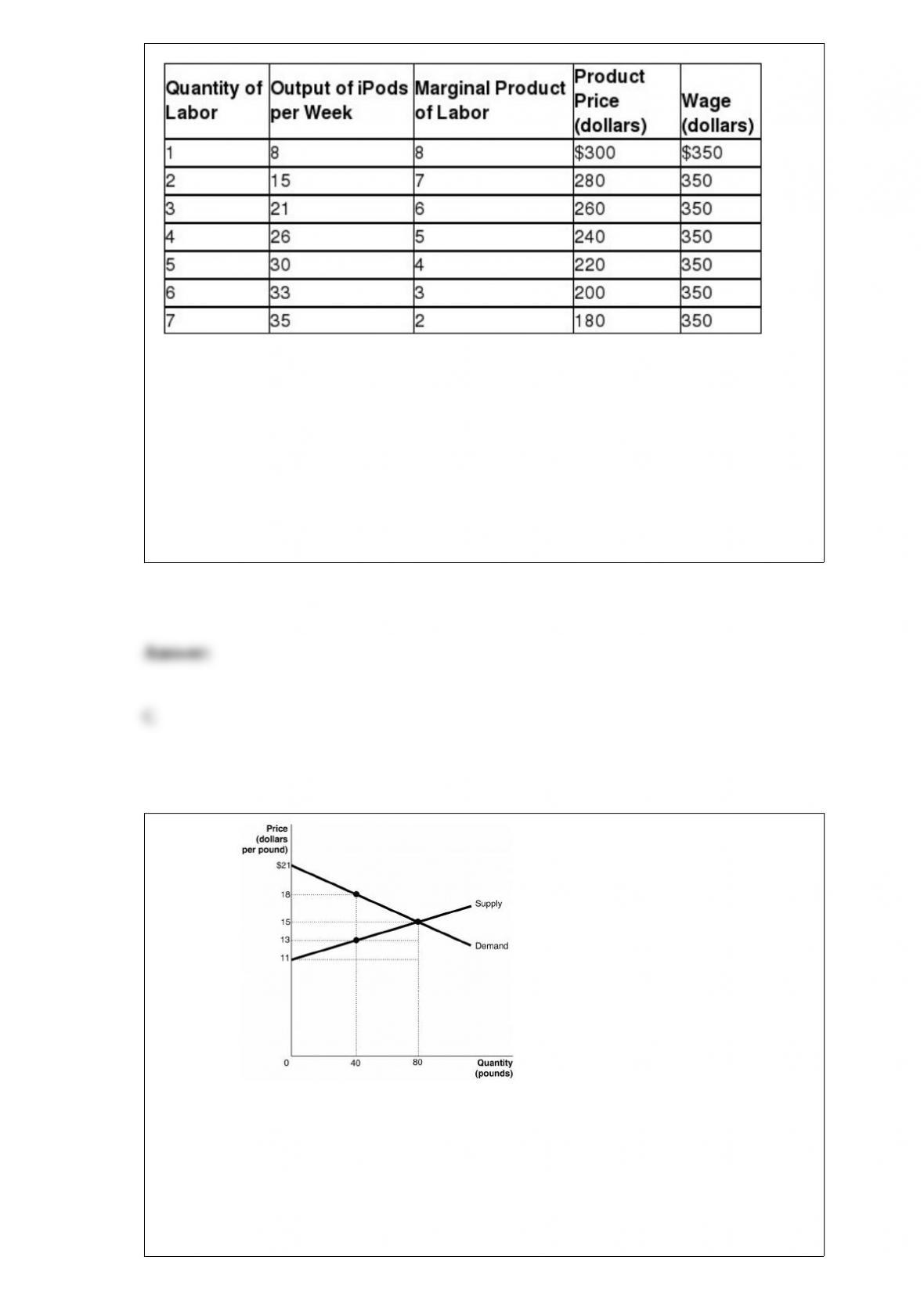
The marginal revenue product of labor from the third unit of labor is
A) $5,460.
B) $1,560.
C) $1,260.
D) $780.
Figure 4-4 Figure 4-4 shows the market for tiger
shrimp. The market is initially in equilibrium at a price of $15 and a quantity of 80.
Now suppose producers decide to cut output to 40in order to raise the price to $18.
At a price of $18 consumers are willing to buy 40pounds of tiger shrimp. Is this an
economically efficient quantity?
A) No, the marginal benefit of the 40th unit exceeds the marginal cost of that 80th unit.

B) Yes, otherwise consumers would not buy 40 units.
C) Yes, because $18 shows what consumers are willing to pay for the product.
D) No, the marginal cost of the 40th unit exceeds the marginal benefit of the 40th unit.
A patent
A) grants the creator of a book, film, or piece of music the exclusive right to use the
creation for 20 years.
B) grants the creator of a book, film, or piece of music the exclusive right to use the
creation during the creator’s lifetime.
C) gives a firm the exclusive right to a new product for 20 years from the date the
product is invented.
D) gives the firm the exclusive right to a new product during the product inventor’s
lifetime.