1) Banks create money when they:
A.add to their reserves in the Federal Reserve Bank.
B.accept deposits of cash.
C.sell government bonds.
D.exchange checkable deposits for the IOU’s of businesses and individuals.
2)
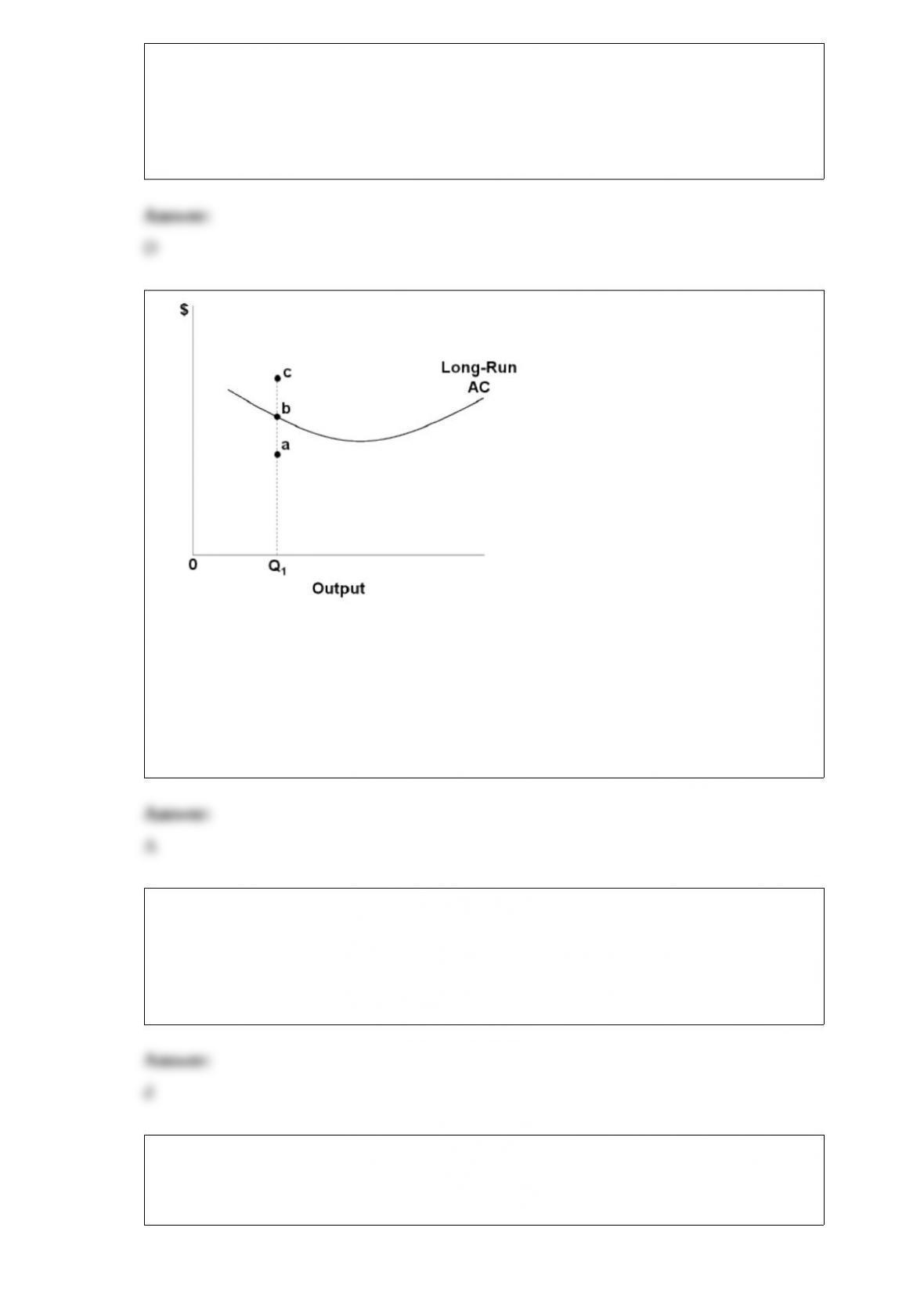
Refer to the above diagram. The production of Q1 units of output at an average cost of
a:
A.is not possible, given present technology and resource prices.
B.can be achieved if the firm would hire the optimal mix of resources.
C.would entail X-inefficiency.
D.can be realized if the last dollar spent on each input were equal to its marginal
product.
3) indifference curve analysis indicates that consumer equilibrium exists:
a.where an indifference curve has a slope of 1.
b.where any two indifference curves intersect.
c.at any point where the budget line intersects an indifference curve.
d.where the budget line touches the highest possible indifference curve.
4) A breakdown of the shares of economic production for two different countries is
listed below, along with per capita income and growth rate. Use this information to
calculate the growth rates per sector and answer the following questions.
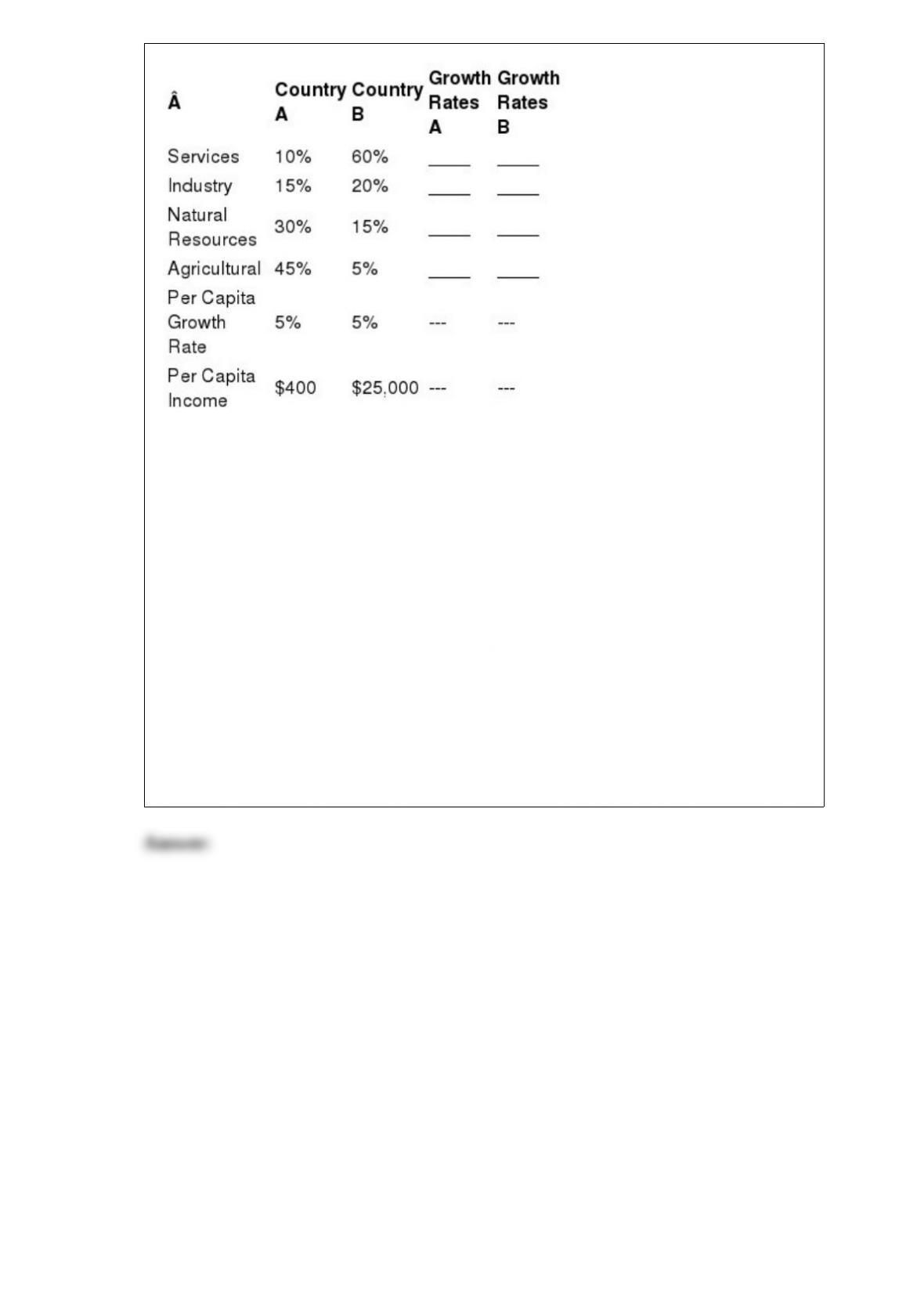
(a)What is the amount of per capita growth in countries A and B? Will the growth
increase, decrease or maintain the income gap?
(b)Suppose country As economy becomes more industrialized, increasing the
productive share of services and industry. What likely effect will this having on country
As growth rate? Suppose as a result of this change the growth rate of services and
industry is now 3.5% and 2.5% respectively, while the rates for natural resources and
agriculture remain the same. What is the new total growth rate? What is the new
distribution of the economy? What is the effect of the new growth on the income gap?
(c)What growth rate would country A have to maintain to reduce the income gap with
country B by 10%, assuming country B grew by 5%? If country B grew by 2%? If
country B experienced no growth?
(d)What growth rate would country A have to maintain to reduce the income gap with
country B completely if country B experienced 3% growth?
(e)What do your answers in (a) through (d) tell you about the situation facing
developing countries? How does the element of time (growth over several years)
change your answer?

5) which of the following congressional proposals relating to health care was recently
enacted?
a.establishment of health maintenance organizations to reduce health care costs.
b.establishment of deductibles and copayments in health insurance policies.
c.provision of prescription drug coverage under medicare.
d.establishment of fixed medicare payment to hospitals based on one of several hundred
diagnostic categories.
6) The ability-to-pay principle of taxation:
A.has been declared unconstitutional because it deprives individuals of property
without due process of law.
B.suggests that people should pay taxes in proportion to the benefits they derive from
public goods and services.
C.suggests that taxes should vary directly with people’s income and wealth.
D.suggests that taxes should vary inversely with people’s income and wealth.
7) which of the following is one of the five fundamental questions?
a.which products will be in scarce supply and which in excess supply?
b.who should appoint the head of the central bank?
c.how much should the society save?
d.what goods and services will be produced?
8) The discount rate is the interest:
A.rate at which the central banks lend to the U.S. Treasury.
B.rate at which the Federal Reserve Banks lend to commercial banks.
C.yield on long-term government bonds.
D.rate at which commercial banks lend to the public.
9) the european union (eu) comprises a group of european nations that have:
a.abolished tariffs among one another and established a system of common tariffs with
respect to nonmember nations.
b.fully integrated their economies by establishing a central bank, a common currency,
and a coordinated set of governmental budgetary policies.

c.agreed to trade only among one another.
d.eliminated all tariffs and trade barriers with nonmember nations.
10) in terms of the circular flow diagram, households make expenditures in the _____
market and receive income through the _____ market.
a.product; financial
b.resource; product
c.product; resource
d.capital; product
11) The Celler-Kefauver Act of 1950:
A.outlawed price fixing.
B.amended the Sherman Act.
C.amended the Clayton Act.
D.created the Civil Aeronautics Board (CAB).
12) assume in a competitive market that price is initially below the equilibrium level.
we can predict that price will:
a.decrease, quantity demanded will decrease, and quantity supplied will increase.
b.decrease and quantity demanded and quantity supplied will both decrease.
c.increase, quantity demanded will increase, and quantity supplied will decrease.
d.increase, quantity demanded will decrease, and quantity supplied will increase.