
Statements, propositions, or predictions about economic issues that can be tested in
principle by an appeal to the facts are called ________ economics.
a. positive
b. passive
c. normative
d. mechanical
e. comparative
High rates of inflation often characterize
a. depressions.
b. times of great unemployment.
c. wartime.
d. periods of falling aggregate demand.
e. rural areas.
Productivity is measured by the

a. rate of growth of output per hour of labor.
b. rate of growth in the money supply.
c. rate of unemployment.
d. rate of accelerated depreciation.
e. Phillips curve.
In a free market, the price system provides for an adequate rate of growth by
a. making the augmentation of a society’s resources unprofitable.
b. ensuring an upward-sloping supply curve.
c. meeting each consumer’s demand.
d. providing strong incentives for firms to introduce new technology.
e. ensuring that each good is produced in the proper amount.
When evaluating the size of the annual federal budget deficit, it is useful to express it as
a percentage of the
a. average deficit in other countries.
b. level of net exports.
c. economy’s GDP.
d. amount of government spending minus income.
e. assets of the commercial banking system.
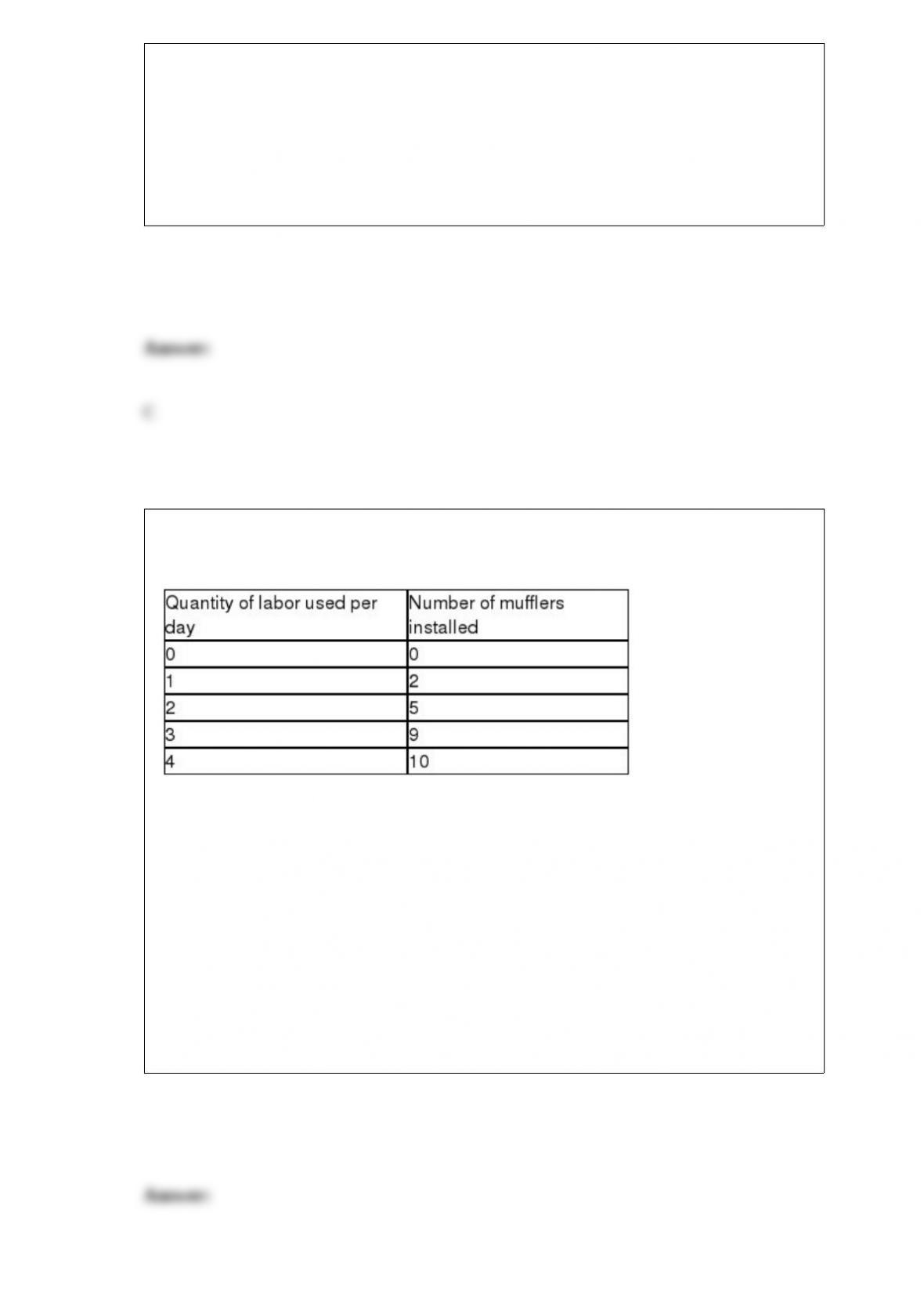
The following questions are based on the following information for an auto repair shop
specializing in muffler installation.
The relationship described in the table is called a ________ function.
a. production
b. consumption
c. marginal
d. cost
e. bodily

The distinction between positive and normative economics is that positive economics
deals with
a. inflation; normative economics deals with unemployment.
b. human wants; normative economics deals with resources.
c. economic benefits; normative economics deals with economic costs.
d. opportunity costs; normative economics deals with choice.
e. descriptive statements and predictions about the world; normative economics deals
with what ought to be.
Historically, the inverse relationship between the level of unemployment and the rate of
increase of wages is known as the ________ curve.
a. labor demand
b. aggregate supply
c. Phillips
d. Laffer
e. production possibilities

Creeping inflation
a. erodes the value of a country’s money over a long period of time.
b. inevitably tends to die out.
c. has been the experience of the United States since its founding.
d. does not tend to redistribute income.
e. inevitably leads to runaway inflation.
When a government puts a tax on an imported good that effectively stops all imports of
that good, it is a(n)
a. prohibitive tariff.
b. export subsidy.
c. quota.
d. special drawing right.
e. negative import tax.

The interest rate
a. equals the expected rate of return minus depreciation.
b. expresses the relationship between saving and disposable income.
c. has no effect on the volume of investment in the economy.
d. is another name for profit.
e. is the annual amount a borrower must pay for the use of a dollar.
What effect did the U.S. contribution to the war effort during World War II have on
GNP?
a. It boosted GNP dramatically.
b. It boosted GNP slightly.
c. GNP fell to its lowest level in years as resources were depleted.
d. Since resources were only transferred from one kind of production to another, there
was virtually no effect.
e. It made GNP difficult to estimate accurately, since output was being diverted to the
government.

Inflationary conditions that emerge because of specific resource shortages or scarcities
are called ________ inflations.
a. cost-overrun
b. sedentary-spending
c. supply-side
d. demand-side
e. parity-price
If the estimated current dollar GDP is $5,616 billion while real GDP is $4,129 billion,
then the prices of goods and services have risen by what percentage from their
base-year levels?
a. 26 percent
b. 36 percent
c. 44 percent
d. 74 percent
e. impossible to determine from the information given

The decline in additional satisfaction received as more and more units of a commodity
are consumed (the consumption of other commodities held constant) is known as the
law of
a. consumer demand.
b. nature.
c. declining desire.
d. supply and demand.
e. diminishing marginal utility.
When the government finances its expenditures by borrowing from consumers and
business firms
a. it creates a surplus.
b. it is more inflationary than if it borrows from the central bank.
c. it creates new money, making the deficit greater than it would otherwise have been.
d. the national debt goes down.
e. interest rates rise, reducing private investment spending.

The Federal Reserve can set the required reserves for checkable deposits
a. below 50 percent only if a majority of the governors agree.
b. above 3 percent only if five of seven governors agree.
c. at any level it deems necessary in extraordinary circumstances.
d. by majority vote between the limits of either 4 percent above or below the $1 in
reserve per $6 in demand deposit average the Fed would like the bank to retain.
e. above what banks would normally require to meet day-to-day fluctuations in
withdrawals if five of the seven governors agree.
Which of the following countries had the lowest per capita income in 2012?
a. Russia
b. France
c. Japan
d. Canada
e. Sweden
In today’s world market, the value of a dollar at any given time depends on

a. congressional mandate.
b. signed international agreements.
c. the price of gold.
d. the current exchange rate.
e. EMS guidelines.
The shape of the total revenue curve of a perfectly competitive firm is a(n)
a. horizontal line.
b. vertical line.
c. downward-sloping straight line.
d. upward-sloping straight line.
e. parabolic line, rising at first and then falling.
Those who argue for income inequality say that
a. reducing inequality will not help the poor very much and may very well reduce
society’s output.

b. every dollar taken from the rich puts $1.05 into the pockets of the poor.
c. the poor are necessary so that the rich can be altruistic.
d. people framing a constitution for society without knowing what their class position
would be would automatically opt for inequality.
e. greater inequality produces lower saving and greater consumption, thereby ensuring
high levels of aggregate demand and employment.
Adam Smith wrote that
a. the economic problems of eighteenth-century Britain were in part caused by
overspecialization.
b. the government should control the economy with an invisible hand.
c. the pursuit of private self-interest tends to promote the public interest.
d. the owners of resources should be given subsidies to induce them to employ those
resources in the most efficient way.
e. eighteenth-century Britain needed a better-planned economy.
The slope of the consumption function is equal to the

a. average propensity to consume.
b. marginal propensity to consume.
c. rate of interest.
d. saving function.
e. multiplier.
A group of firms and individuals in touch with each other to buy or sell something is
called a
a. model.
b. market.
c. merger.
d. microcosm.
e. melee.
One group that feared the negative impact of the TVA on the demand for the output of
its industry was the
a. electrical equipment manufacturers.

b. homebuilders.
c. farmers.
d. barge operators.
e. coal miners.
Which of the following best describes the equation of exchange?
a. GDP = PQ
b. MV = PQ
c. MQ = GDP
d. MP = VQ
e. GDP = V/Q
A major purpose of Keynes’s General Theory was to explain
a. how a less-than-full employment equilibrium was possible in a capitalist economy.
b. the automatic mechanisms in a capitalist society that generate a high level of
employment.
c. how supply creates its own demand.

d. the close interrelationships between the savers and investors in any society.
e. why Marx’s predictions about capitalism were inevitable.
Transfer payments are payments
a. by individuals of taxes to the government.
b. for newly produced goods and services.
c. to individuals who do not contribute to production in exchange for them.
d. for intermediate goods and services.
e. for government services.
To be considered money, a financial asset must
a. be convertible into gold or silver.
b. be coins, currency, or fractional reserve.
c. be issued by the Federal Reserve System.
d. serve as a medium of exchange, store of value, and standard of value.
e. be kept in banks.

The average annual growth rate of labor productivity
a. has remained relatively constant at about 3 percent.
b. fell to an average rate of about 1.5 percent during the period 1977 to 1995 and has
averaged 3.2 percent since then.
c. steadily rose to about 4.5 percent in the late 1990s and early 2000s.
d. fell steadily to its postwar low in 1984 but has risen rapidly since then.
e. reached a peak in 1995 but has fallen steadily since then.