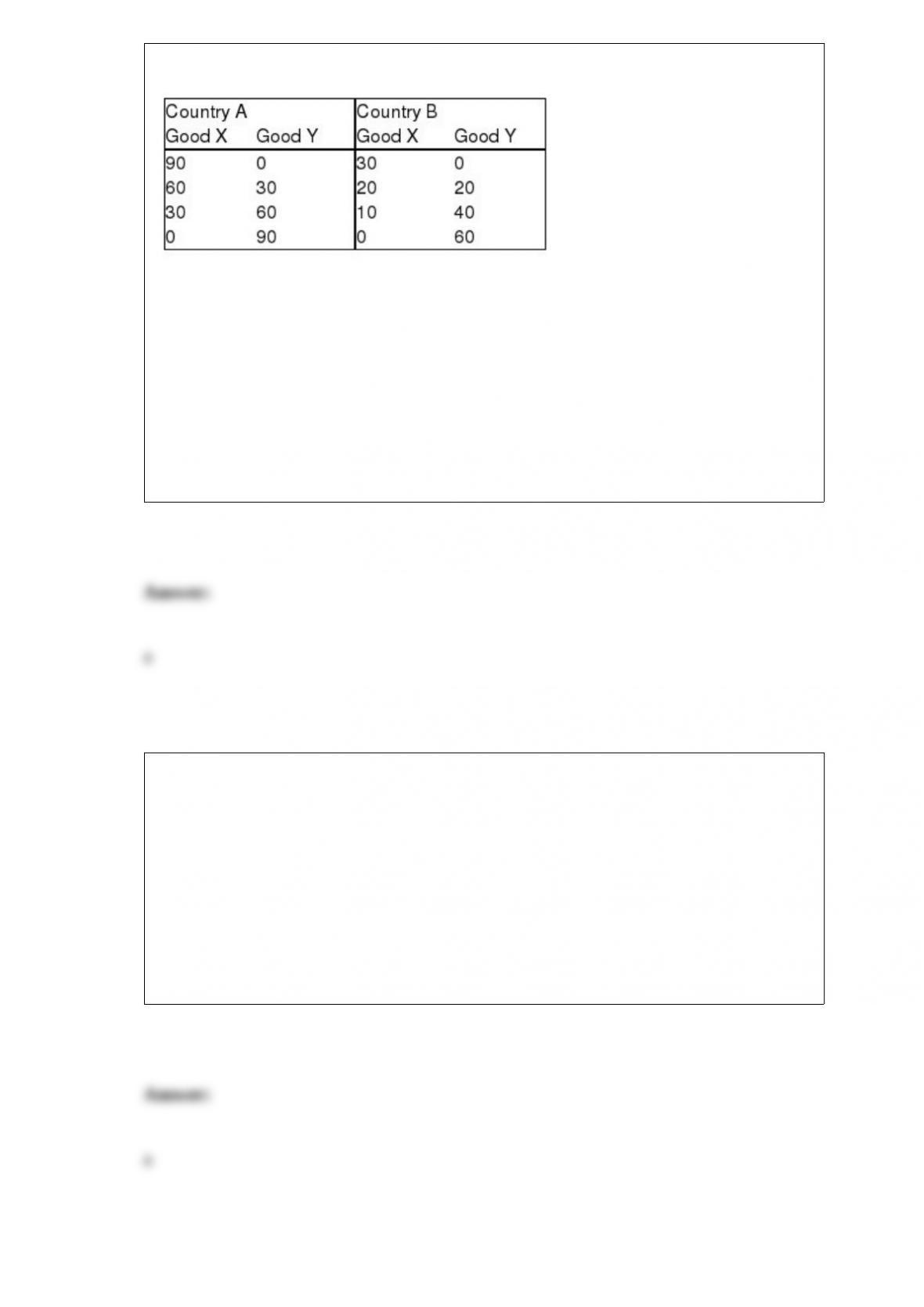
Exhibit 34-1
The opportunity cost of one unit of Y in country B is
a. 0.5 units of X.
b. 1 unit of X.
c. 2 units of X.
d. 20 units of X.
A firm produces the quantity of output at which P = MC and P = ATC. It follows that
the firm is
a. resource allocative efficient, but not necessarily productive efficient.
b. productive efficient, but not necessarily resource allocative efficient.
c. both resource allocative and productive efficient.
d. neither resource allocative nor productive efficient.
In the foreign exchange market between dollars and pesos, the demand for dollars by
Mexicans creates the supply of pesos.
a. True
b. False
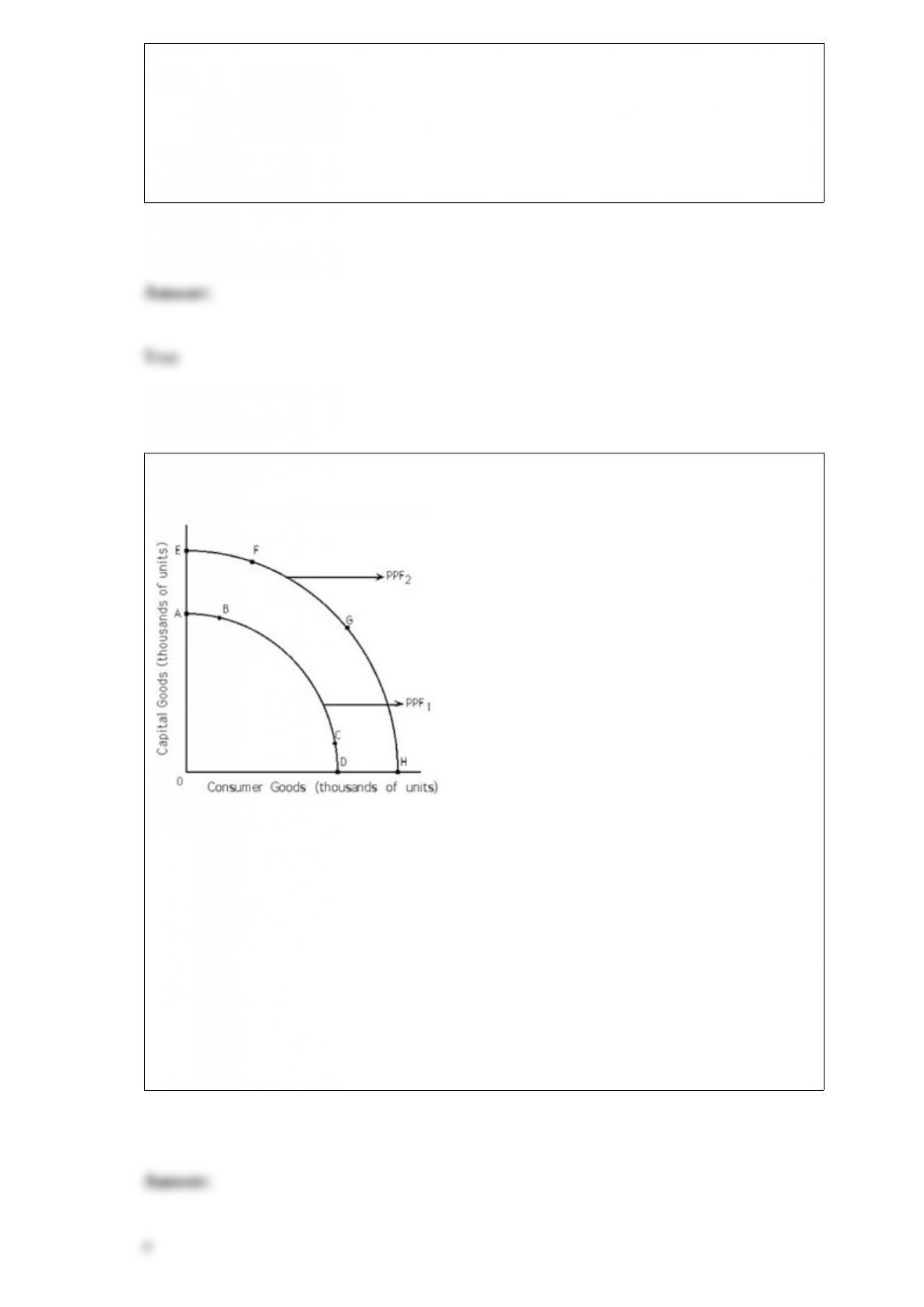
Exhibit 2-3
If PPF1 is the relevant production possibilities frontier, PPF2 may depict
a. economic growth.
b. an increase in resources.
c. an increase in technology.
d. both b and c
e. all of the above

Attempts to determine “what is” are part of __________ economics.
a. positive
b. normative
c. positive and normative
d. neither positive nor normative
Arbitrage is
a. a form of negotiation between two parties having a disagreement.
b. buying a good in one market and selling it in another for a profit.
c. a form of price discrimination where the producer sells its product at two different
prices.
d. a means of deciding the most efficient way of producing a product.
The Wheeler-Lea Act of 1938 empowered the Federal Trade Commission to
a. deal with anticompetitive mergers that occurred as a result of one company acquiring
the physical assets of another company.
b. deal with false and deceptive advertising.

c. deal with unfair methods of competition and to determine which actions taken by
businesses were too aggressive.
d. regulate the trucking and railroad industries.
e. decrease the failure rate of small businesses by protecting them from competition
from large and growing chain stores.
The Robinson-Patman Act of 1936 was passed in an attempt to
a. strengthen unions’ powers to deal with businesses during the Great Depression.
b. close the loophole that remained in the Clayton Act with respect to mergers.
c. decrease the failure rate of small businesses.
d. protect consumers from large retailers who were receiving price discounts from their
suppliers but were not passing on the price savings to the consumers.
e. protect all U.S. businesses from foreign competition during the Great Depression.
Refer to Exhibit 35-4. Under a fixed exchange rate system, at the exchange rate of E1,
the dollar is __________ and there is a __________ of pesos.
a. overvalued; surplus
b. undervalued; surplus
c. overvalued; shortage
d. undervalued; shortage
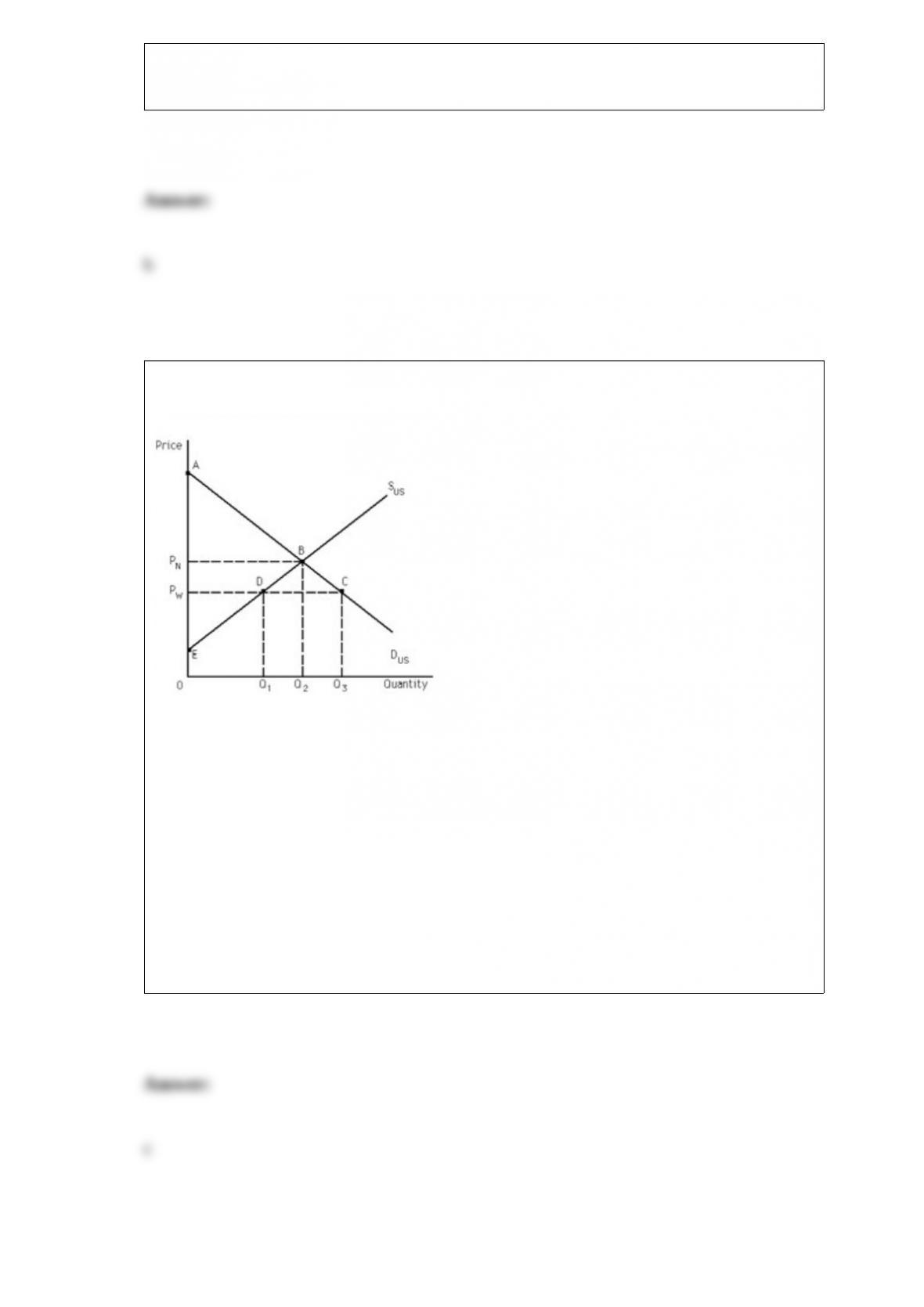
Exhibit 34-2
The U.S. demand and supply for a good are shown. Under a policy of free trade, the
world price is PW. At this price, consumers’ surplus equals the area of
a. PW DE.
b. PW AB.
c. PW AC.
d. PW PNBD.
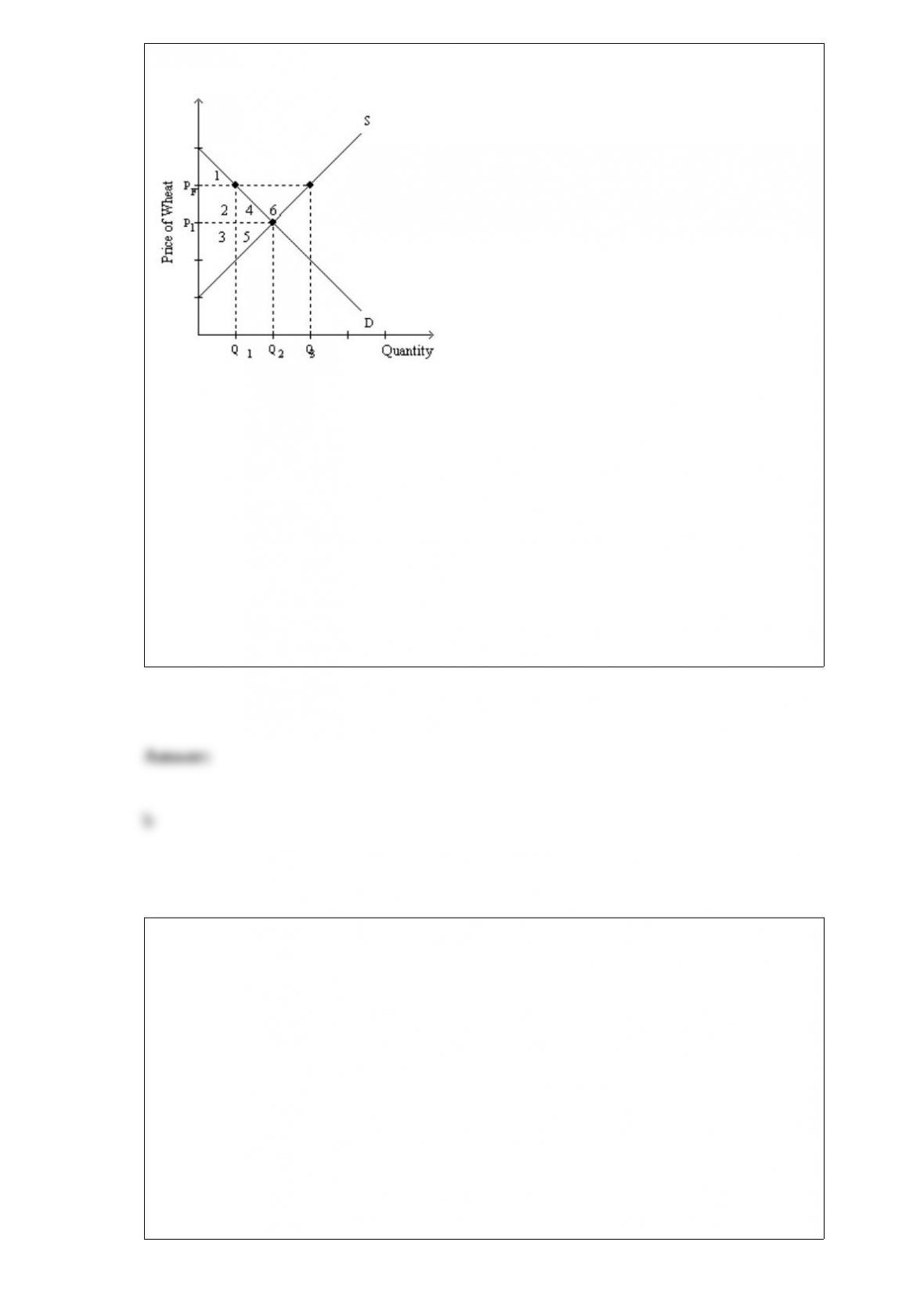
Exhibit 4-8
If the wheat market is in competitive equilibrium, the consumers€ surplus will equal
a. area 1 + 2 + 3
b. area 1 + 2 + 4
c. area 3 + 5
d. area 1 + 2 + 3 + 4 + 5
e. area 6
If the law of increasing opportunity costs is operable, and currently the opportunity cost
of producing the 1,000th unit of good X is 0.5Y, then the opportunity cost of producing
the 2,001st unit of good is X is most likely to be
a. less than 0.5Y.
b. more than 0.5Y but less than 2Y.
c. more than 0.5Y
d. less than 0.5Y but more than zero.
e. none of the above

The condition in an economy that makes a “rationing device” a necessity is:
a. the economy is organized around free markets.
b. the economy is centrally planned by the government.
c. scarcity exists.
d. there are fewer types of goods than there are people in the economy.
If union action leads to a rise in the relative price of factors that are substitutes for union
labor,
a. the supply of union labor falls.
b. the quantity demanded of union labor falls.
c. the demand for union labor rises.
d. the supply of union labor rises.

Dumping refers to a country
a. imposing a retaliatory tariff against the subsidized products of a foreign country.
b. selling a good abroad at a price that is below its cost and lower than the price charged
in the domestic market.
c. selling a good abroad at a price that is above its cost and higher than the price
charged in the domestic market.
d. a and c
e. all of the above
The higher the opportunity cost of doing something, the more likely it will be done.
a. True
b. False
Exhibit 4-5
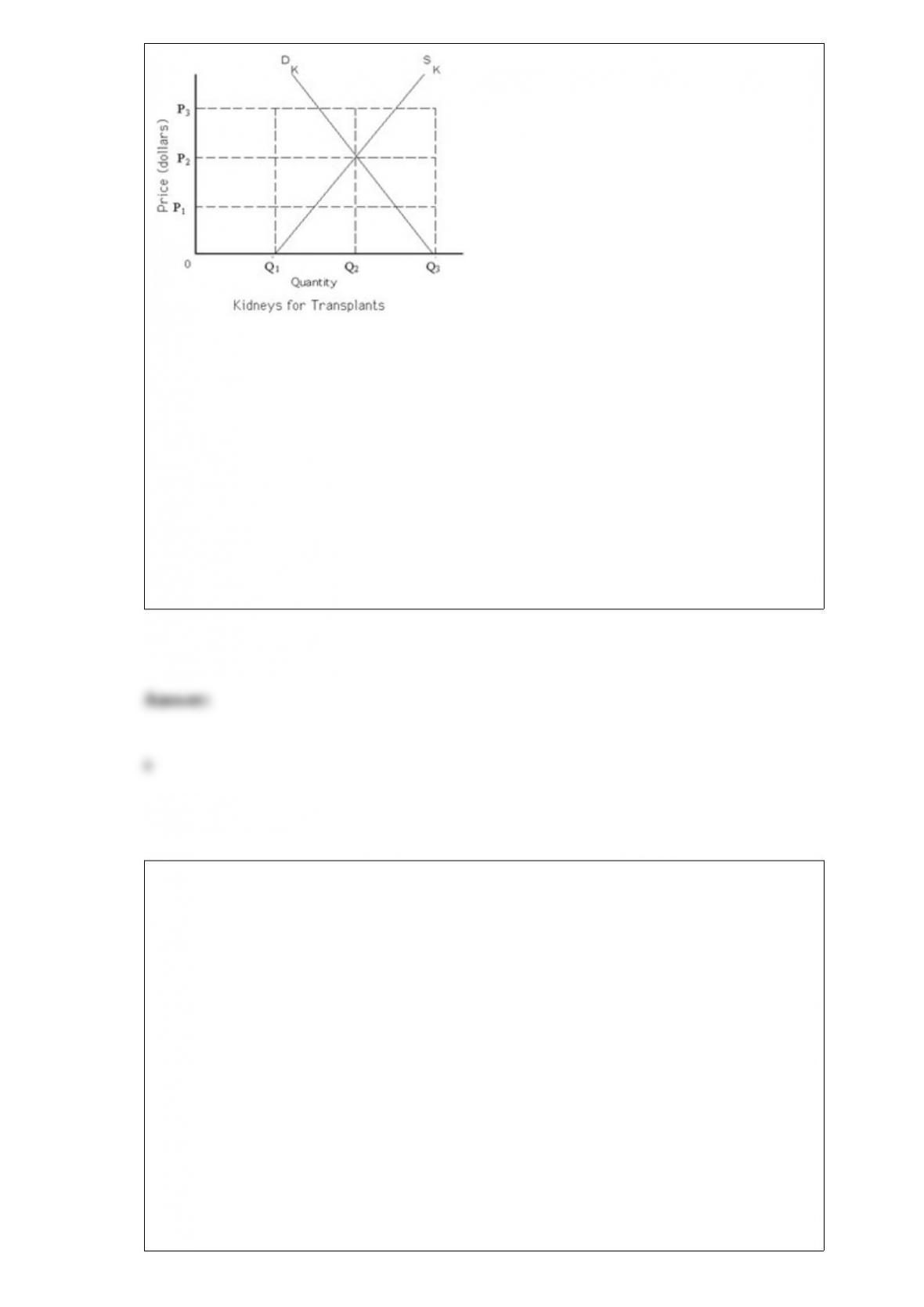
Suppose the government imposes a price ceiling at P = $0 for transplanted kidneys. The
result will be a
a. shortage of kidneys equal to (Q3 – Q1).
b. surplus of kidneys equal to (Q3 – Q1).
c. shortage of kidneys equal to (Q2 – Q1).
d. surplus of kidneys equal to (Q2 – Q1).
Situation 22-1
Diane’s Donuts will begin selling donuts next week. Diane figures that the average
variable cost to make each donut will be constant at $0.30. She has already paid
$20,000 for the donut-making machinery and one year’s rent.
What will Diane’s average total costs be if she sells 2,500 donuts in her first week and
then goes out of business?
a. $8.30
b. $1.81
c. $1.08
d. $9.71