
1) All of the following can file antitrust charges under the Sherman Act except:
A.the U.S. Justice Department.
B.state attorney generals.
C.injured private parties.
D.the Federal Energy Regulatory Commission.
2) The demand for agricultural products rises less rapidly than income. This means that
the demand for agricultural products is:
A.income inelastic.
B.income elastic.
C.price inelastic.
D.price elastic.
3) If the Fed were to increase the legal reserve ratio, we would expect:
A.lower interest rates, an expanded GDP, and depreciation of the dollar.
B.lower interest rates, an expanded GDP, and appreciation of the dollar.
C.higher interest rates, a contracted GDP, and appreciation of the dollar.
D.higher interest rates, a contracted GDP, and depreciation of the dollar.
4) for a pure monopolist marginal revenue is less than price because:
a.the monopolist’s demand curve is perfectly elastic.
b.the monopolist’s demand curve is perfectly inelastic.
c.when a monopolist lowers price to sell more output, the lower price applies to all units
sold.
d.the monopolist’s total revenue curve is linear and slopes upward to the right.
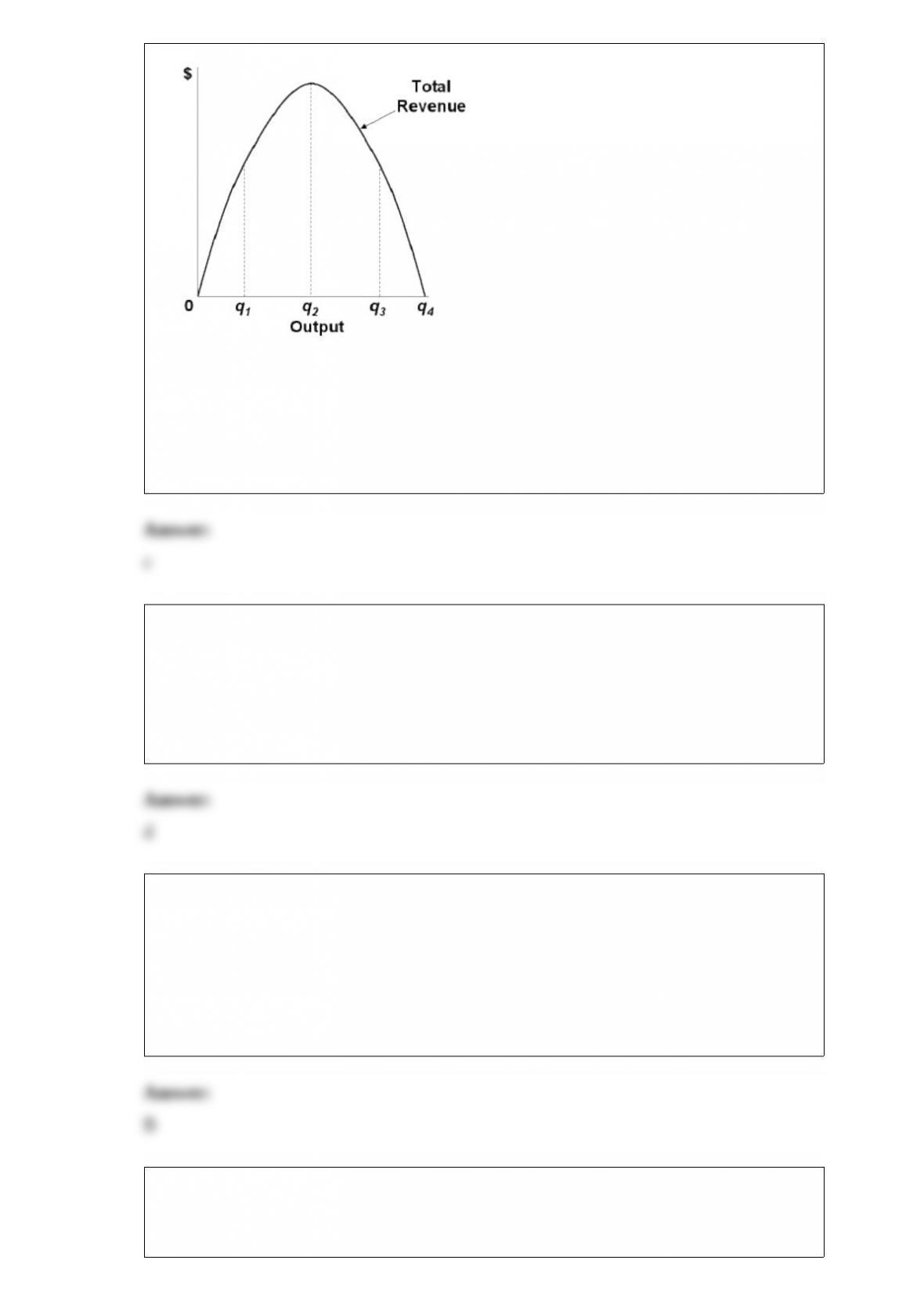
5)
refer to the above diagram for a nondiscriminating monopolist. the profit-seeking
monopolist will:
a.always produce at output q2.
b.always produce more than q2.
c.never produce an output larger than q2.
d.never produce an output larger than q1.
6) for a nondiscriminating imperfectly competitive firm:
a.the marginal revenue curve lies above the demand curve.
b.the demand and marginal revenue curves coincide.
c.the demand curve intersects the horizontal axis where total revenue is at a maximum.
d.marginal revenue will become zero at that output where total revenue is at a
maximum.
7) The actual budget deficit of the Federal government in 1991 was about $269 billion.
On the basis of this information it:
A.can be concluded that the economy was faced with serious inflation in 1991.
B.cannot be determined whether fiscal policy had an expansionary or a contractionary
impact in 1991.
C.can be concluded that fiscal policy was contractionary in 1991.
D.can be concluded that fiscal policy was expansionary in 1991.
8) if incomes rise rapidly in the united states and u.s. preferences for foreign goods
strengthen, we would expect:
a.the dollar to appreciate in value.
b.the dollar to depreciate in value.
c.the dollar price of foreign monies to decrease.
d.u.s. exports to increase.
9) The World Bank:
A.provides military assistance to those nations interested in improving national defense.
B.makes and guarantees loans for basic development projects such as the construction
of dams, roads, and schools.
C.provides gold for DVCs that want to go on the gold standard.
D.provides short-term loans to DVCs that are incurring balance of payments deficits.
10) (1) The composite index of leading indicators turns downward for three consecutive
months, suggesting the possibility of a recession; (2) Economists reach agreement that
the economy is moving into a recession; (3) A tax cut is proposed in Congress; (4) The
tax cut is passed by Congress and signed by the President; (5) Consumption spending
begins to rise, aggregate demand increases, and the economy begins to recover.
Refer to the above information. The operational lag of fiscal policy is reflected in
event(s):
A.1 and 2.
B.2 and 3.
C.3 and 4.
D.5.
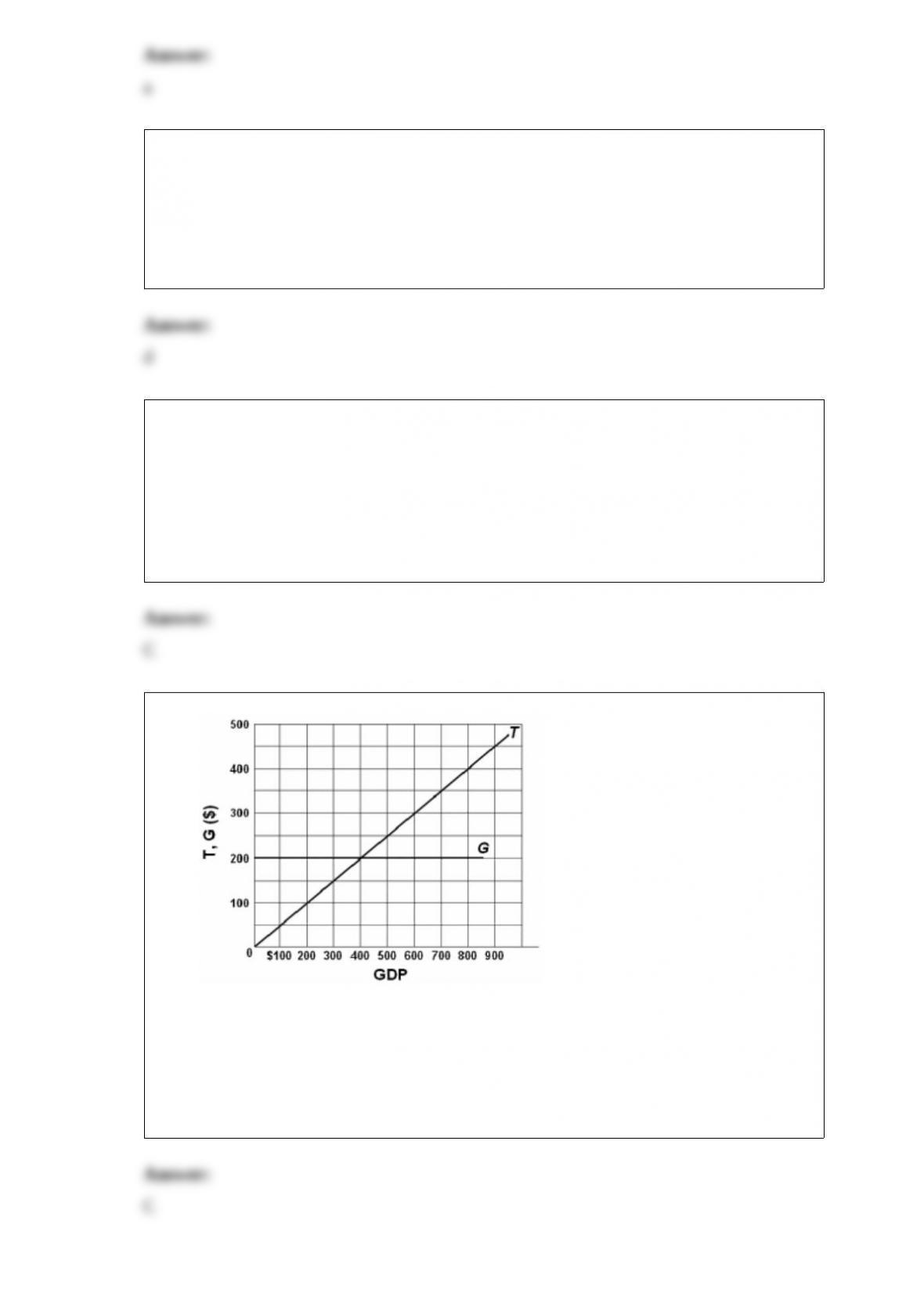
11)
refer to the above table. in relation to column (3), a change from column (2) to column
(1) would indicate a(n):
a.increase in demand.
b.decrease in demand.
c.increase in supply.
d.decrease in supply.
12) the supply of product x is inelastic (but not perfectly inelastic) if the price of x rises
by:
a.5 percent and quantity supplied rises by 7 percent.
b.8 percent and quantity supplied rises by 8 percent.
c.10 percent and quantity supplied remains the same.
d.7 percent and quantity supplied rises by 5 percent.
13) If Kelly deposits $10,000 into an account that pays 8 percent interest, compounded
annually, and she makes no further deposits or withdrawals, how much will Kelly have
in her account at the end of 5 years?
A.$14,000
B.$14,482
C.$14,693
D.$15,000
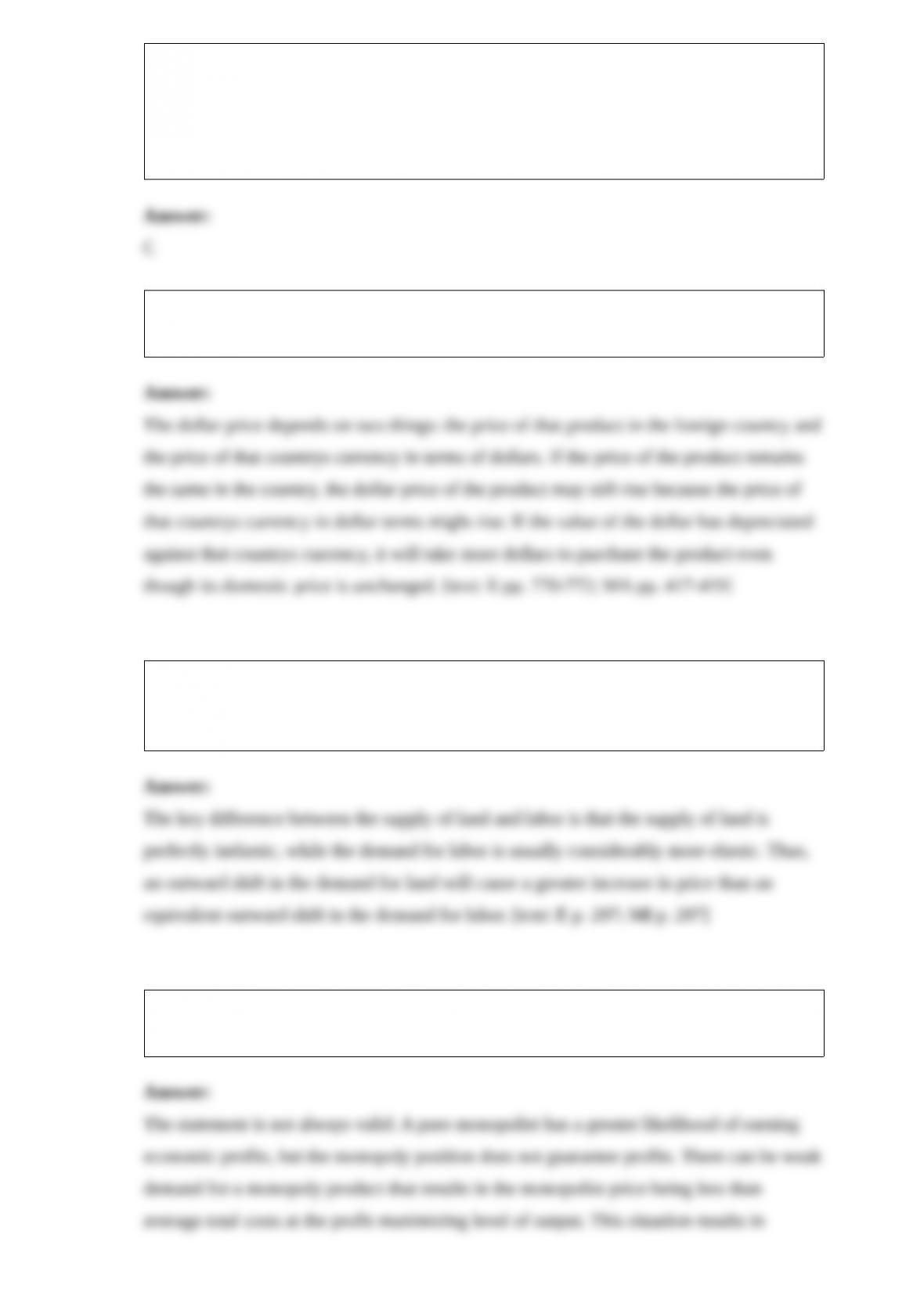
14)
Refer to the above diagram in which T is tax revenues and G is government
expenditures. All figures are in billions. The tax system of this economy is such that:
A.it is regressive.
B.it is progressive.
C.tax revenues equal 50 percent of GDP.
D.it tends to destabilize the economy.
15) Depletion of fish stocks through overfishing is a good example of the:
A.public good problem.
B.moral hazard problem.
C.tragedy of the commons.
D.the Coase theorem.
16) Explain how the dollar price of an imported good may change even though the
foreign production cost of that product remains unchanged.
17) How does the supply of land differ from the supply of most labor? How will the
effect on price of an outward shift in demand for labor differ from the effect on price of
an equivalent shift in the demand for land?
18) Pure monopoly guarantees economic profits. Discuss whether this is a valid
statement.
19) The theory of resource pricing is sometimes referred to by economists as the theory
of income distribution. Why?
20) Explain the crowding-out effect.
21) Suppose an economys real GDP is $125 billion in year 1 and $130 billion in year 2.
What is the growth rate of its GDP?
22) Explain how the Gini ratio is measured and what it means.