Suppose that when the price of strawberries decreases, Simone increases her purchase
of whipped cream. To Simone
A) strawberries and whipped cream are complements.
B) strawberries and whipped cream and substitutes.
C) strawberries and whipped cream are normal goods.
D) strawberries are a normal good and whipped cream is an inferior good.
Figure 2-10
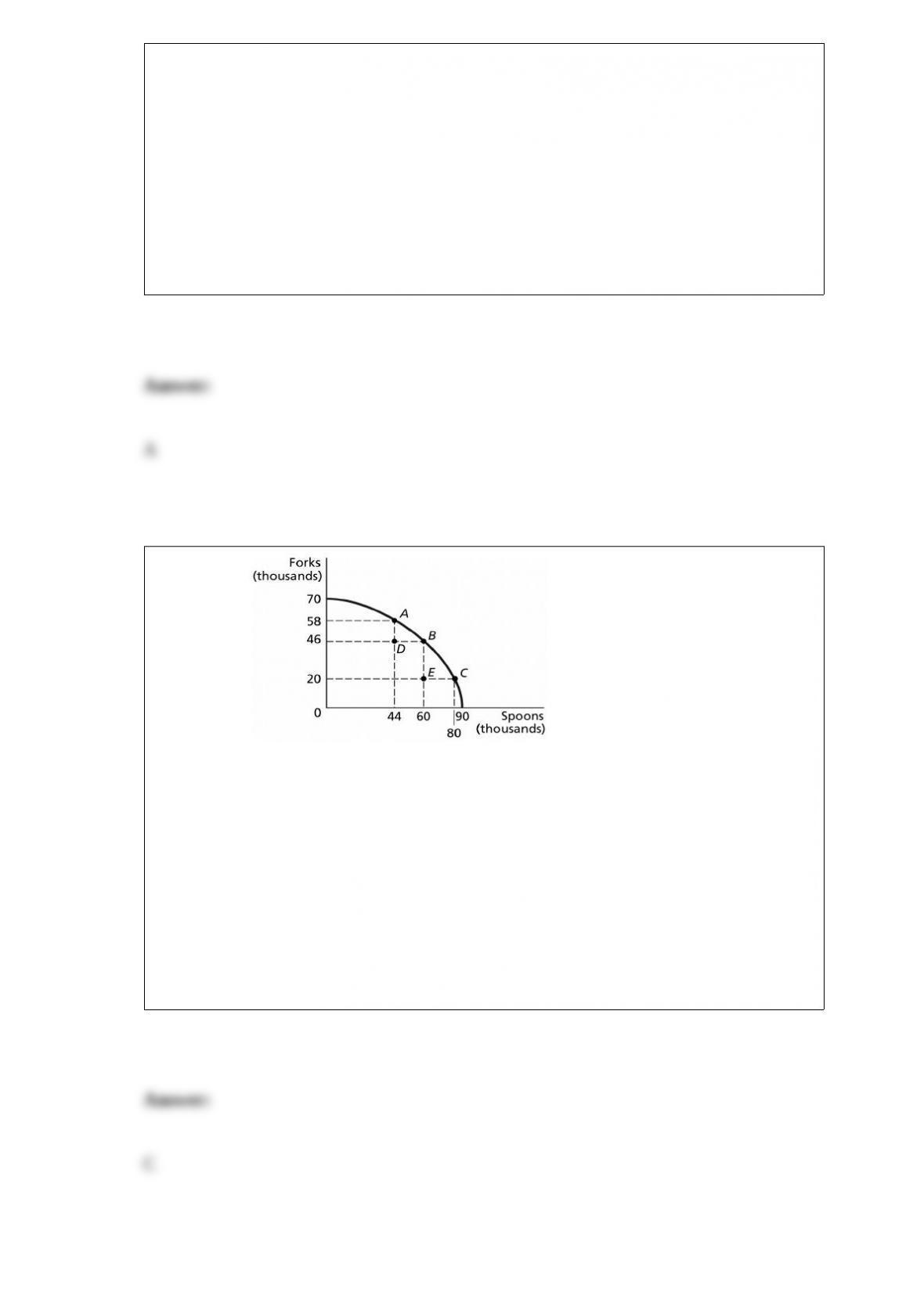
If the economy is currently producing at point E, what is the opportunity cost of moving
to point D?
A) 26 thousand forks
B) 20 thousand forks
C) 16 thousand spoons
D) 0 spoons
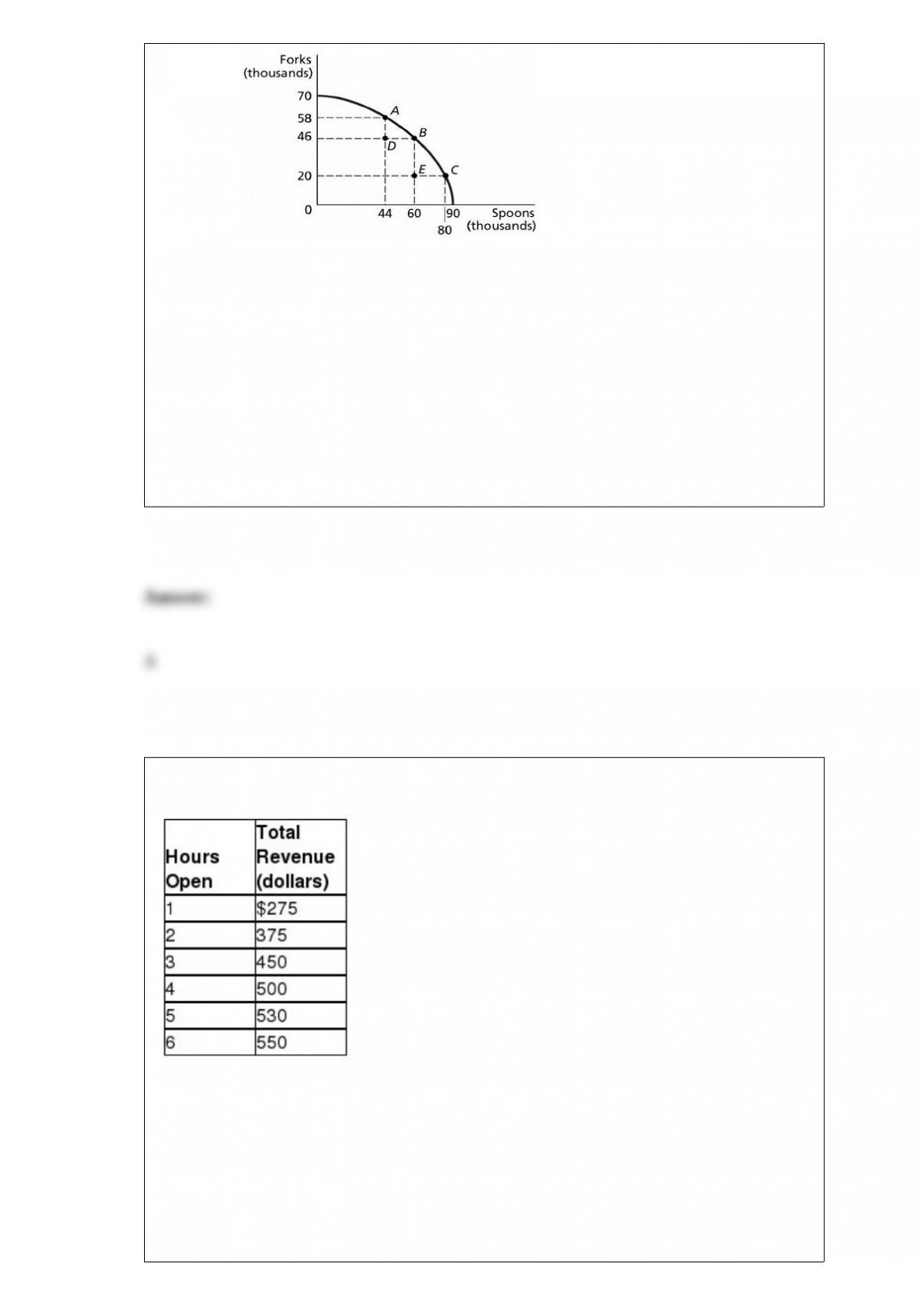
Figure 2-6
If the economy is currently producing at point C, what is the opportunity cost of
moving to point B?
A) 20 thousand spoons
B) 26 thousand forks
C) 40 thousand spoons
D) 46 thousand forks
Table 1-3
Ivan runs a custom jewelry shop in Sparkle City. He is debating whether he should
extend his hours of operation. Ivan figures that his sales revenue will depend on the
number of hours the jewelry shop is open as shown in the table above. He would have
to hire a worker for those hours at a wage rate of $25 per hour. What is Ivan’s marginal
cost if he decides to stay open for six hours instead of five hours?
A) $10

B) $20
C) $25
D) $91.67
One reason patent protection is vitally important to pharmaceutical firms is
A) successful new drugs are not profitable. If firms are not granted patents many would
go out of business and health care would be severely diminished.
B) the approval process for new drugs through the Food and Drug Administration can
take more than 10 years and is very costly. Patents enable firms to recover costs
incurred during this process.
C) that taxes on profits from drugs are very high; profits from patent protection enable
firms to pay these taxes.
D) the high salaries pharmaceutical firms pay to scientists and doctors make their labor
costs higher than for any other business. Profits from patents are needed to pay these
labor costs.
In the United States, out-of-pocket spending on health care as a percentage of all
spending on health care has ________ since 1960.
A) slowly risen
B) steadily declined
C) more than doubled

D) remained stable
Substantial co-payments are typically not required as a part of the health care system in
A) Canada and the United Kingdom.
B) Japan and Canada.
C) the United States and Japan.
D) Japan and the United Kingdom.
Which of the following is not part of the ‘state health exchanges” provision of the
Patient Protection and Affordable Care Act (ACA)?
A) Each state is required to establish an Affordable Insurance Exchange by 2014.
B) Small businesses with fewer than 50 employees will be exempt from being required
to participate in the program.
C) Low-income individuals will be eligible for tax credits to offset the costs of buying
health insurance.
D) Health insurance policies that meet certain specified requirements will be offered by
state-run agencies, by non-profit firms, or by the federal government.

Which of the following models relies on emphasizing the importance of sticky wages
and prices?
A) the monetarist model
B) the new classical model
C) the real business cycle model
D) the new Keynesian model
Economists have shown that the burden of a tax is
A) greater on the buyer when the tax is collected from the buyer.
B) greater on the seller when the tax is collected from the seller.
C) greater on the buyer when the tax is collected from the seller and greater on the
seller when the tax is collected from the buyer.
D) the same whether the tax is collected from the buyer or the seller.
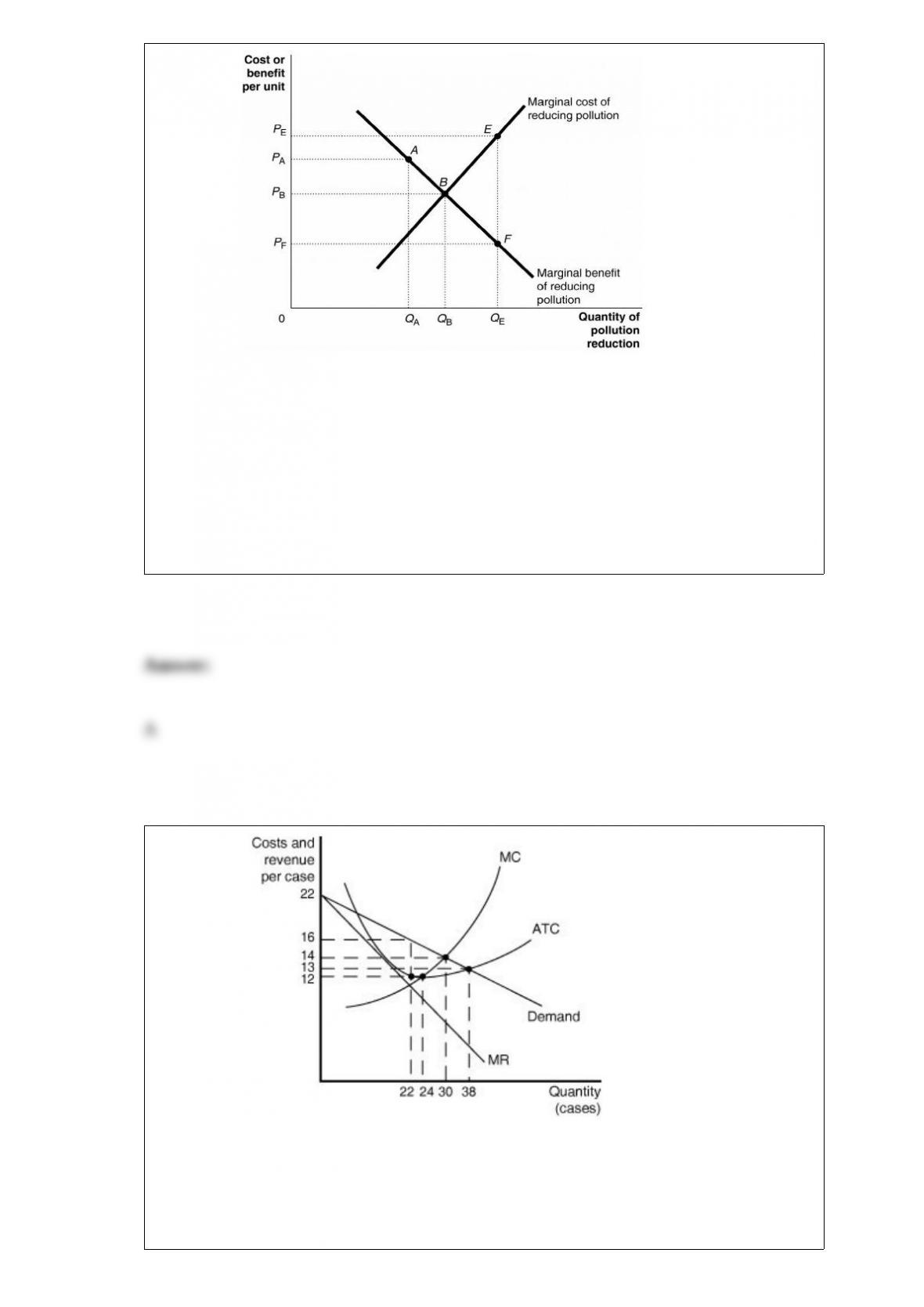
Figure 5-7 The marginal cost of
reducing pollution curve is the same curve as
A) the supply of pollution reduction curve.
B) the demand for pollution reduction curve.
C) the negative externality curve.
D) the value of pollution reduction curve.
Figure 13-8 Figure 13-8 shows cost and
demand curves for a monopolistically competitive producer of iced-tea. At the
profit-maximizing output level the firm will
A) earn a profit of $176.

B) break even.
C) earn a profit of $88.
D) earn a profit of $60.
The Coase theorem states that
A) government intervention is always needed if externalities are present.
B) assigning property rights is the only thing the government should do in a market
economy.
C) if transactions costs are low, private bargaining will result in an efficient solution to
the problem of externalities.
D) a free market equilibrium is the best solution to address externalities.