
Inflation refers to an increase in the
a. price level.
b. rate of inflation.
c. total income.
d. real GDP.
A society must make three sorts of decision: what goods to produce, how to produce
them, and how to distribute them.
a. True
b. False
An increase in the price of gasoline shifts the demand for tires to the
a. left, because gasoline and tires are substitutes.
b. left, because gasoline and tires are normally used together.
c. right, because gasoline and tires are substitutes.
d. right, because gasoline and tires are normally used together.

An efficient distribution of goods requires that
a. everyone gets an equal share of each good.
b. marginal cost equal marginal utility for the last unit produced.
c. each person derives the same total utility from the good.
d. since tastes differ, every person pays a different price in accordance with different
marginal utilities.
Lately, the ratio of debt to GDP has been
a. rising at a small rate.
b. rising steadily.
c. falling modestly.
d. staying constant.

The most volatile part of wealth is:
a. transfer payments
b. bonds
c. the stockmarket
d. savings accounts
Development assistance is designed to encourage a developing country to
a. increase consumer goods today.
b. restrict the inflow of foreign direct investment.
c. invest in its capital stock.
d. reduce labor productivity.
Price controls on resources generally lead to surpluses.
a. True
b. False

Economists object to monopoly because
a. monopoly profits go to the rich.
b. monopolies overproduce to maximize profits.
c. monopolies are usually polluters.
d. monopolists keep output below efficient levels.
In the long run, profit-maximizing monopolists facing a downward-sloping demand
curve
a. may earn profits greater than their opportunity costs of capital.
b. do not produce every possible unit of output for which marginal utility is greater than
or equal to marginal cost.
c. may or may not have lower costs than perfectly competitive firms in the same
industry.
d. All of the above are correct.

Faster economic growth in the United States may lead to the serious macroeconomic
problem of higher
a. levels of unemployment.
b. federal budget deficits.
c. levels of inflation.
d. levels of poverty.
Economic theory simplifies relationships to explain how the relationships interact.
a. True
b. False
Table 20-2
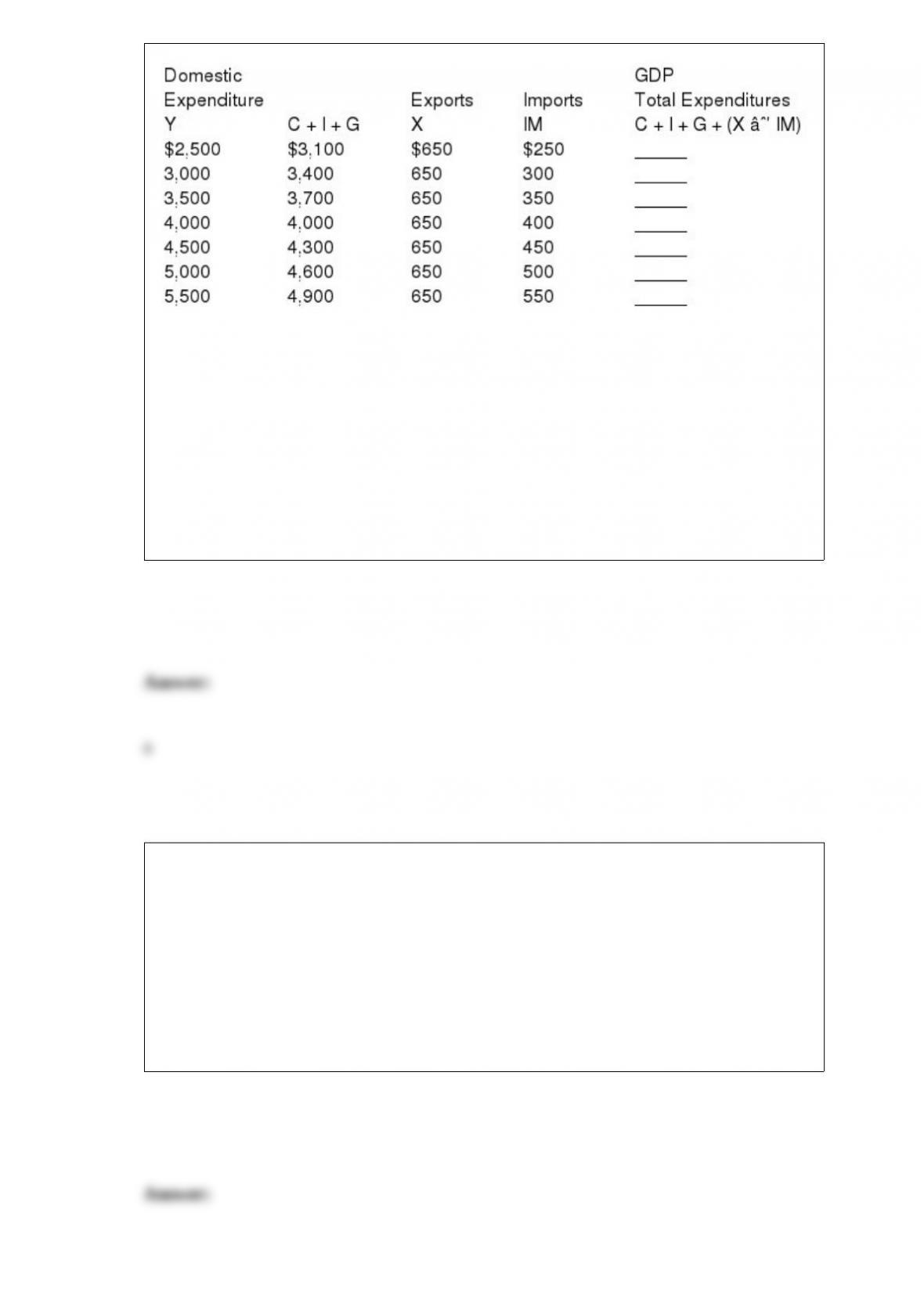
In Table 20-2, assume that exports rise to $900. What is the new equilibrium GDP?
a. $5,000
b. $4,500
c. $4,000
d. $3,500
In order to “defend” its overvalued currency, Argentina in 2002 had to reduce its
a. interest rates.
b. tax levels.
c. holdings of foreign reserves.
d. balance of payments surpluses.

In labor markets, risk taking accounts for some income differences.
a. True
b. False
In the 1990s, the rising value of the U.S. dollar made imported goods cheaper and this
shifted the
a. aggregate demand curve outward.
b. aggregate supply curve inward.
c. aggregate supply curve outward.
d. total expenditures curve upward.
The basic equation for a bank’s balance sheet is ____.
a. assets = liabilities − net worth
b. net worth = assets − liabilities

c. net worth = assets + liabilities
d. liabilities = net worth + assets
Which of the following will lead to a movement along the same demand curve?
a. Changes in income.
b. Changes in the price of substitute goods.
c. Changes in the price of the product.
d. Changes in the preference of the consumer.
An efficient allocation of resources exists if
a. one group of people can get more of the things they want without someone else
having to give up anything.
b. no one can get more of the things he wants without someone else having to give up
something.
c. the economy operates at any point under the production possibilities frontier.
d. the economy is operating at any point above the production possibilities frontier.

The objective of the Fed and the government is to
a. prevent asset bubbles by recognizing them in real time.
b. mitigate the consequences of asset bubbles by recognizing them in real time.
c. prevent asset bubbles by recognizing bad lending practices.
d. mitigate the consequences of asset bubbles by recognizing bad lending practices.
The business sector in the United States has the most influence on
a. primary education.
b. on-the-job training.
c. teacher training.
d. higher education.

A recessionary gap causes national debt to increase because
a. the growth in GDP slows.
b. interest on previously incurred debt must be paid.
c. recessionary periods require huge buildups of defense materials.
d. income tax receipts drop off markedly.
Government ownership of property and resources in the United States is
a. about as common as it is in European countries.
b. widespread; the United States is a leader in the amount of government ownership of
resources.
c. relatively rare; the United States is mostly privatized.
d. rare, but has been increasing rapidly as the United States catches up to other
countries.
Symmetric information generally leads to efficient allocations of resources.
a. True

b. False
A movement from an upper point to a lower point on the Phillips curve shows
a. decrease in the inflation and decrease in the unemployment.
b. increase in the inflation and decrease in the employment.
c. increase in the inflation and increase in the employment.
d. decrease in the inflation and increase in the unemployment.
Figure 10-7
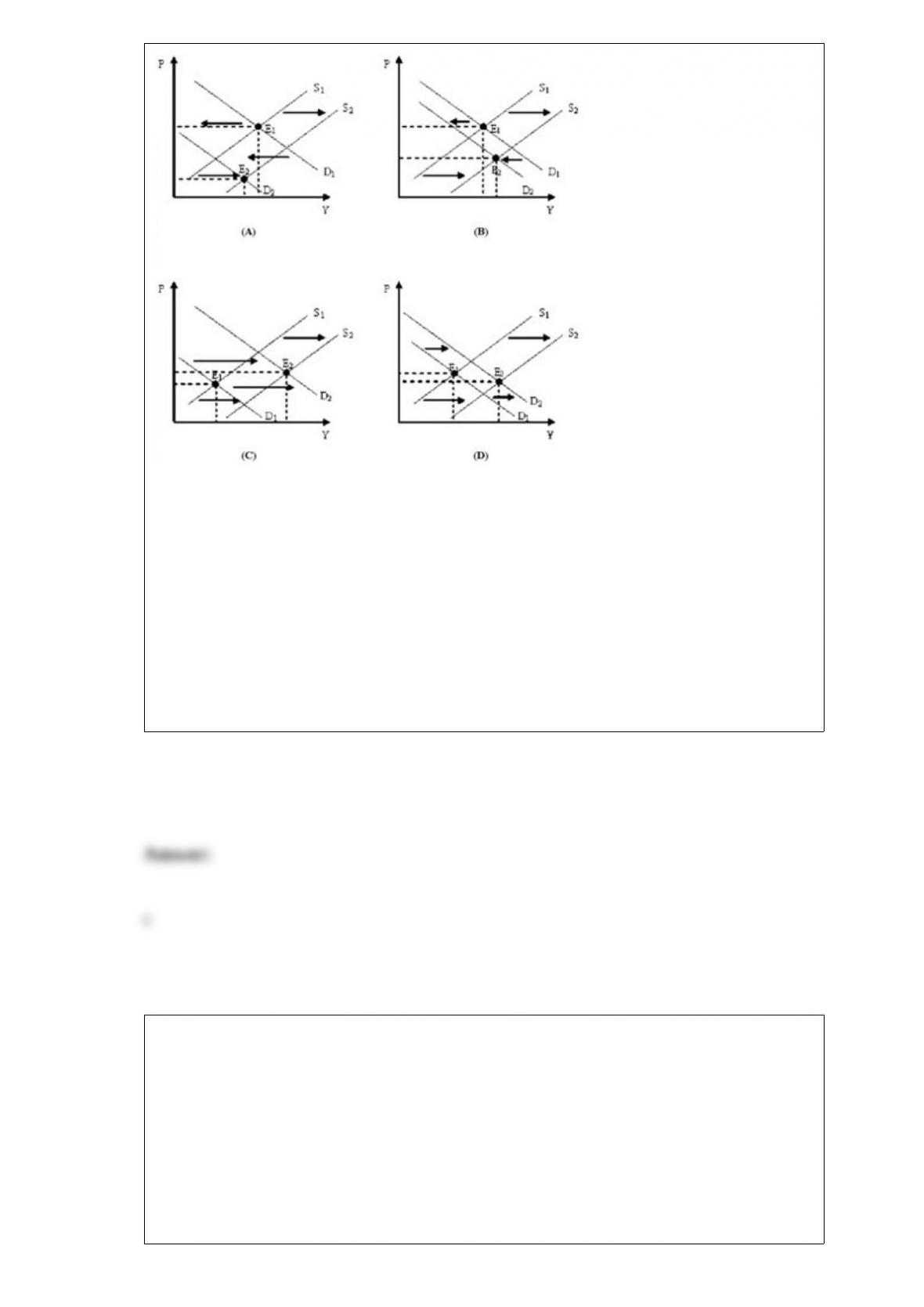
Refer to Figure 10-7. Which of the diagrams in Figure 10-7 represents a period of
economic growth and inflation?
a. Panel (A)
b. Panel (B)
c. Panel (C)
d. Panel (D)
At the natural rate of unemployment, the long-run Phillips curve has a(n)
a. vertical slope.
b. horizontal slope.
c. upward slope.
d. downward slope.

Direct controls have a clear advantage when a total ban is necessary.
a. True
b. False
Voluntary exchange is based on the principle that all parties must gain from trade.
a. True
b. False
The theory of land rent holds that
a. all plots of land are identical.

b. all land yields a positive rent return.
c. rent on any piece of land will equal the difference between the cost of producing the
output on that land and the cost of producing it on marginal land.
d. competition for superior plots of land will force the rent on those lands to a marginal
return of zero.
A shift of the demand curve for a good occurs whenever new technologies make inputs
used in producing that good available at lower prices.
a. True
b. False