
Increased international trade results in greater incomes for low-skilled workers.
The poverty rate in the United States is lowest for whites.
A dominant strategy is one that is the best choice regardless of other firms’ decisions.
A monopolist’s marginal cost is less than the price it charges.
Command-and-control policies generally reduce pollution more than pollution taxes do.
If the reservation price is lower than the discovered price, additional searching by the
consumer is sensible.
Economic costs are measured by all monetary payments.
In a perfectly competitive market, an individual firm faces a perfectly elastic demand
curve.

If Tom can produce 20 multiple choice questions or 30 true/false questions in an hour,
and Mary can produce 15 multiple choice questions or 15 true/false questions in an
hour, then Mary has a comparative advantage in writing multiple choice questions.
The adverse selection problem happens when an informed buyer or seller must choose
from an undesirable selection of goods.
Assuming that the supply for a product is stable, an increase in price will lead to an
increase in producer surplus.
Advertising is a waste of money and just drives up costs and thus price to consumers.
Under a market system, the people with information about buyers’ desires, production
technology, and resources make the decisions.
Entry deterrence is always the best strategy for a monopolist.
Deterrence quantity is always equal to the zero profit quantity.

If marginal revenue is $8 and marginal costs is $10, the firm should increase its output.
If a decrease in consumer prices and a decrease of consumer’s nominal income offset
each other by the same amount, the consumer’s real income is not changed.
If a firm’s long-run average cost curve is horizontal the firm is experiencing economies
of scale

A firm should shut down in the short run if it s revenue is smaller than its variable costs.
Suppose that the price elasticity of supply of cheese is 0.80. If the price of cheese rises
by 20%, the quantity supplied will increase by 16%.
If each firm in a perfectly competitive industry is in market equilibrium, the market
price is equal to the break-even price.
When applying the marginal principle, you should pick the level at which the activity’s
marginal benefit is less than its marginal cost.
In the last few decades there has been considerable progress in lowering the barriers to
international trade.
Accurately incorporating the present consequences of an action, but ignoring or
underestimating the future consequences is a description of present bias.
Deterring entry into an industry will be more profitable than sharing the market with
another firm.
When a hair stylist charges men less than women for a haircut because men’s hair take
less time to cut, the hairstylist is price discriminating.
The law of demand states that there is a negative relationship between price and
quantity demanded, ceteris paribus.
The law of diminishing marginal utility is that as the consumption of a particular
product increases, marginal utility decreases.
A dominant strategy exists when a firm’s choice is the best regardless of other firms’
decisions.

When you have a job and your employer compensates you for your time with money,
resulting in both of you being better off, it is an example of a voluntary exchange.
The reason that movie videotapes cost more money immediately after they are released
than they do six months later is due to price discrimination.
According to the book, the general consensus is that our policy-makers do not know
what they are doing and are managing our economy ineffectively.
Game tree is a graphical representation of the consequences of different actions in a
strategic setting.
An economic model is a detailed version of an economic environment.
The rate at which units of one product can be exchanged for units of another product is
called the terms of trade.
For effective price discrimination, the firm must ensure that the product is able to be
resold.

Suppose that people expect that the price of orange juice will fall next month. We
would predict that the equilibrium quantity of orange juice will ________ and the
equilibrium price of orange juice will ________ this month.
A) rise; rise
B) rise; fall
C) fall; rise
D) fall; fall
If consumers have a long time to respond to an increase in electricity prices their
demand is likely to be ________ than if they are only given a short time.
A) no different
B) higher
C) more elastic
D) less elastic

Recall the Application. The decrease in price of illegal drugs could be caused by either
a(n) ________ in demand or a(n) ________ in supply of the drugs.
A) increase; increase
B) increase; decrease
C) decrease; increase
D) decrease; decrease
The ability of one person or nation to produce a good at a lower resource cost than
another is called a(n):
A) market advantage.
B) comparative advantage.
C) absolute advantage.
D) specialization advantage.
Suppose that the price of a laptop computer drops from $700 to $550. Quantity
demanded for laptop computers will ________ and consumer surplus will ________.
A) increase; increase
B) increase; decrease
C) decrease; increase
D) decrease; decrease
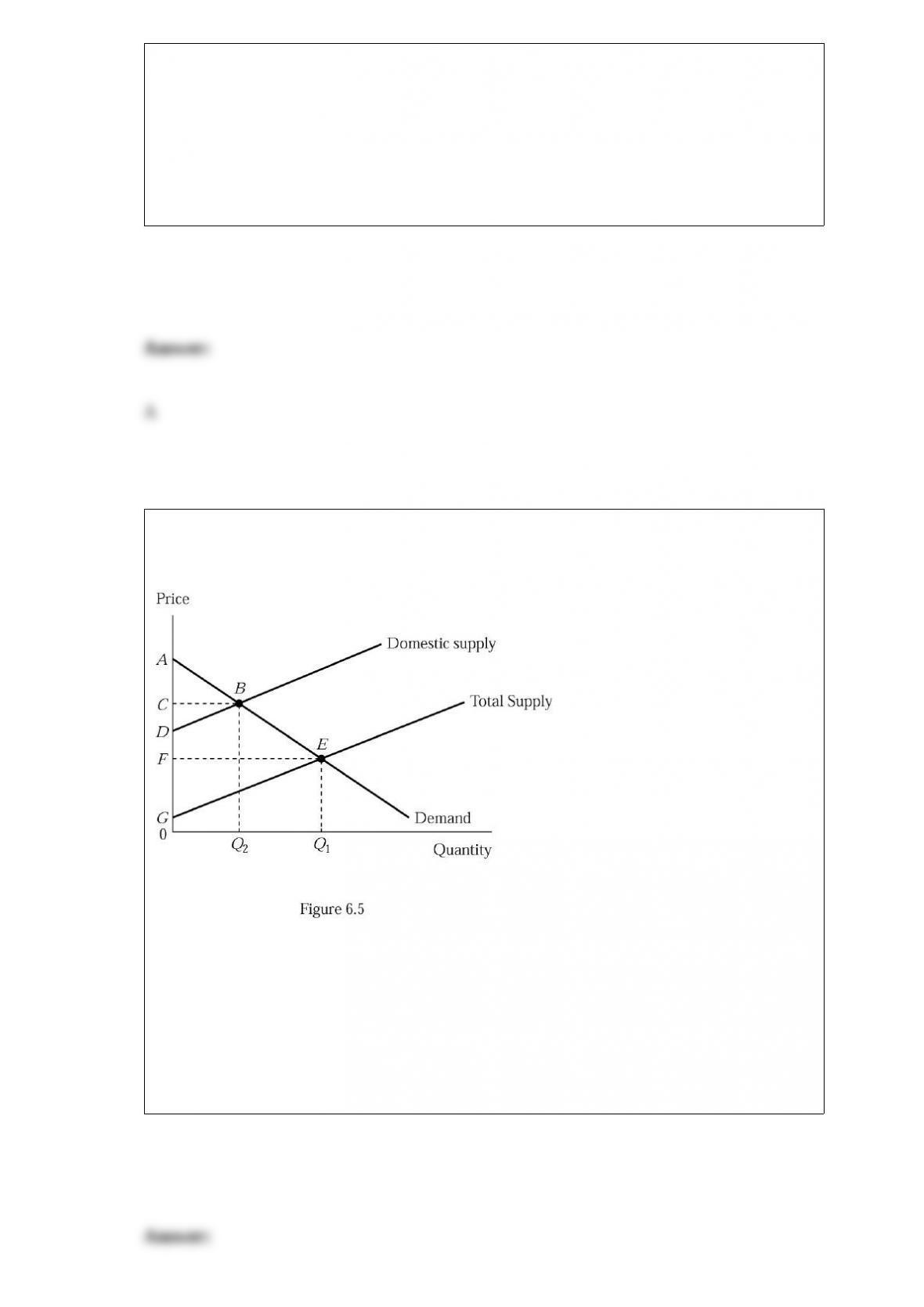
Figure 6.5 illustrates the market for sugar. With free trade, total surplus in the market
would be shown as area:
A) ABC.
B) AEF.
C) AEG.
D) FEG.

Recall the Application about the wireless phone service provided by thousands of
entrepreneurial women in Pakistan to answer the following question(s).
Recall the Application. What makes the wireless telephone market in Pakistan perfectly
competitive?
A) many buyers and many sellers
B) Any entrepreneur who invests $310 can enter the market.
C) Wireless phone calls are standardized product.
D) All of the above are correct.
What is the most likely reason that snack foods sold in vending machines is so much
more expensive than the snack foods sold in grocery stores?
A) Snack foods sold in vending machines come in smaller packages, so the per-package
costs are higher.
B) Grocery stores buy in bulk, while vending machine companies tend to buy in smaller
quantities.
C) People who purchase snack foods from vending machines tend to have less elastic
demand for snack foods.
D) Owners of vending machine companies are greedier than owners of grocery stores.

Which of the following is a way of how the government runs a system of marketable
pollution permits?
A) picks a target pollution level
B) oversupplies the market with permits
C) prohibits the trading of permits
D) all of the above.
Poverty rates for Hispanics are more than the poverty rates for ________.
A) Asians.
B) Whites.
C) female-headed households.
D) A and B are correct.
Prices below the free market equilibrium price are inefficient because:
A) producer surplus is lower than in equilibrium.
B) consumer surplus is higher than in equilibrium.
C) total surplus is lower than in equilibrium.
D) total surplus is higher than in equilibrium.
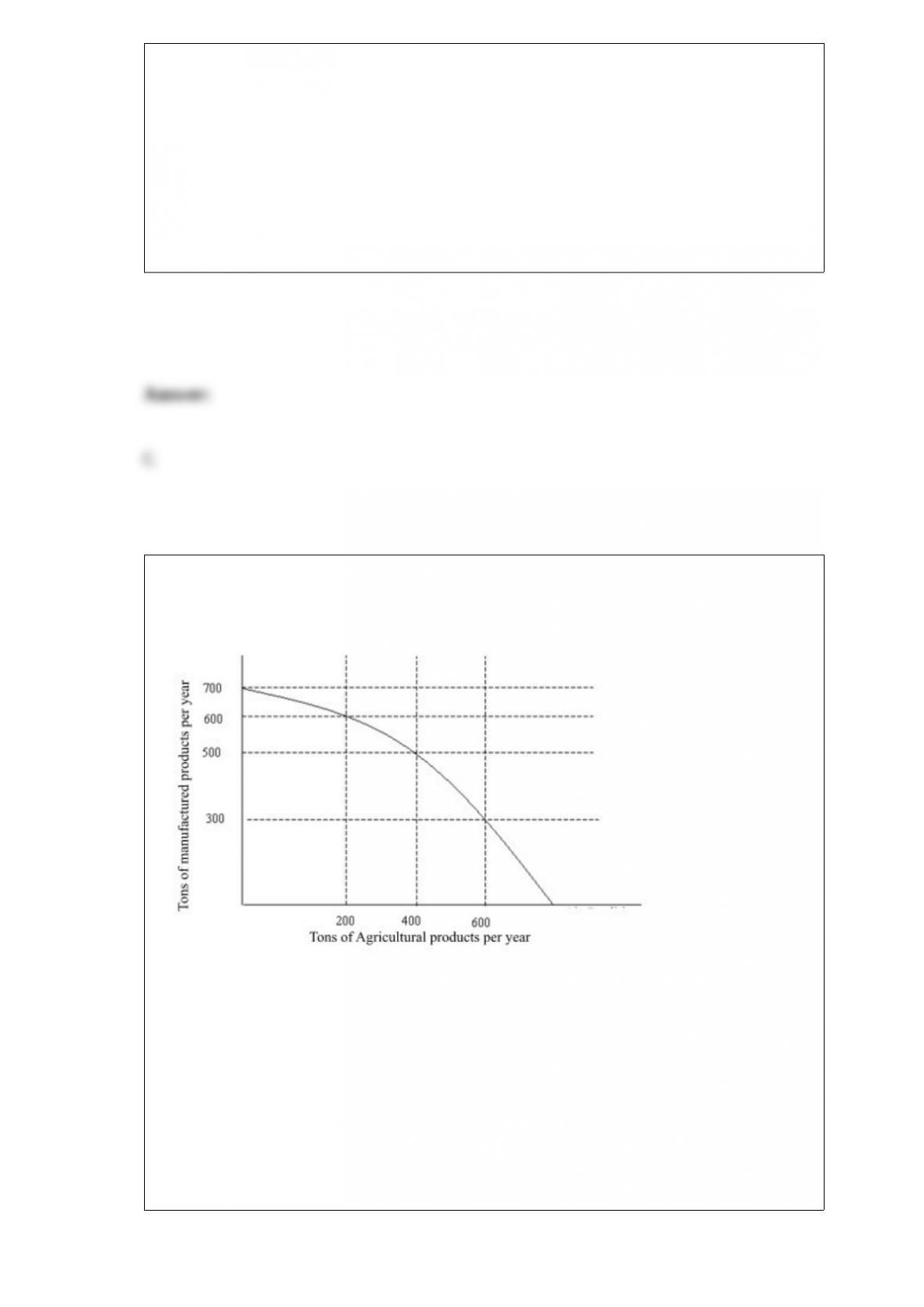
On the production possibilities curve in Figure 2.1 the opportunity costs of increasing
agricultural production from 200 tons to 400 tons is:
Figure 2.1
A) 600 tons of manufacturing products.
B) 500 tons of manufacturing products.
C) 200 tons of manufacturing products.
D) 100 tons of manufacturing products.

According to the text, economists identify that the reason why traffic congestions exists
and waste large amounts of resources in the economy is because:
A) the drivers are not mindful of the additional time they impose on other drivers if
they enter a highway.
B) the cars are too big.
C) the drivers are mindful of the additional time they impose on other drivers if they
enter a highway.
D) the roads are too small.
Figure 12.8 depicts an advertising game between two stores. Store A’s dominant
strategy is ________ and Store B’s dominant strategy is ________.
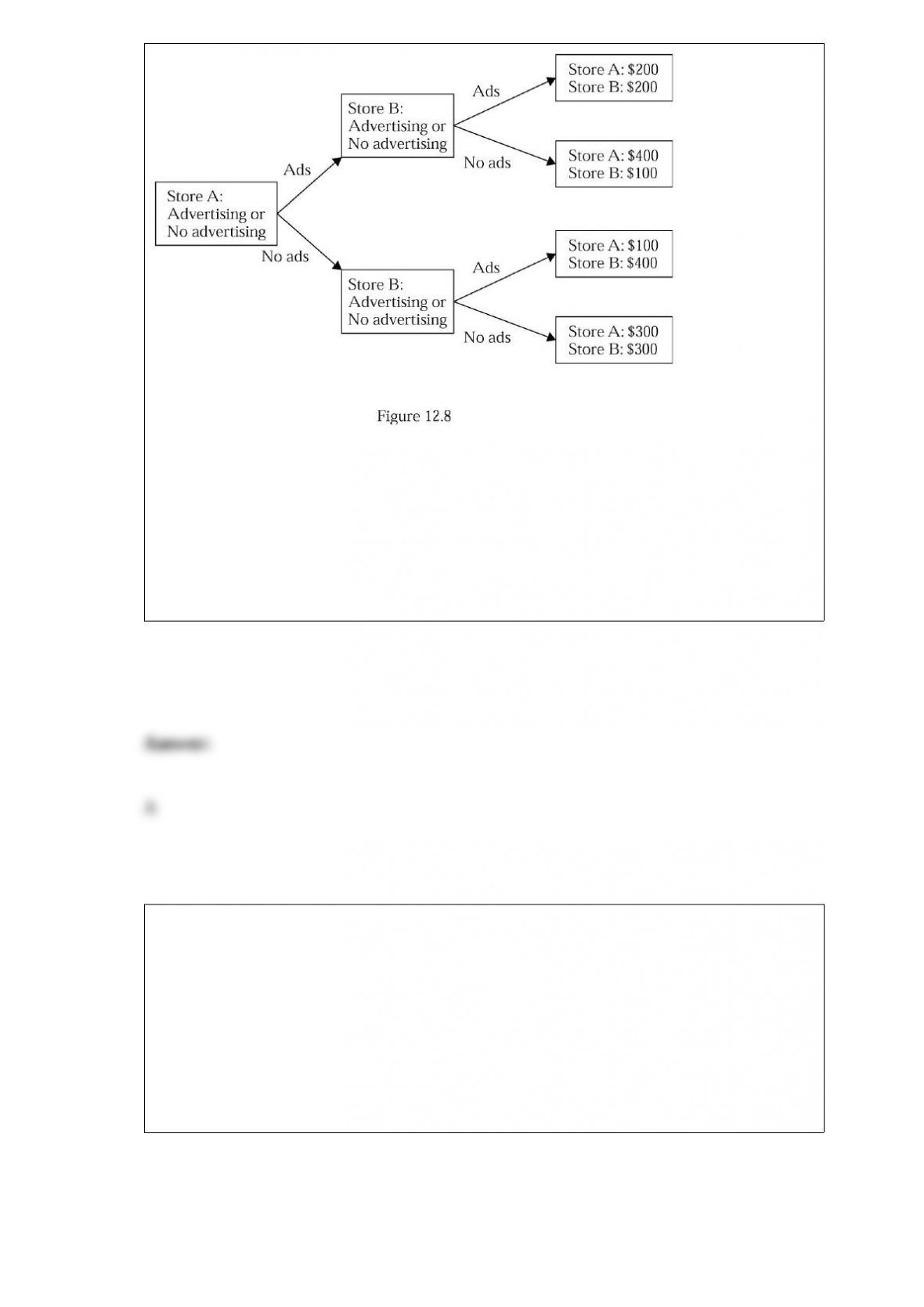
A) advertising; advertising
B) advertising; no advertising
C) no advertising; advertising
D) no advertising; no advertising
A contract:
A) specifies the term of exchange, facilitating exchange between strangers.
B) increases the profitability of inventions, encouraging firms to develop new products.
C) provides the public with reliable information about the performance of a firm.
D) increases the risk faced by entrepreneurs.
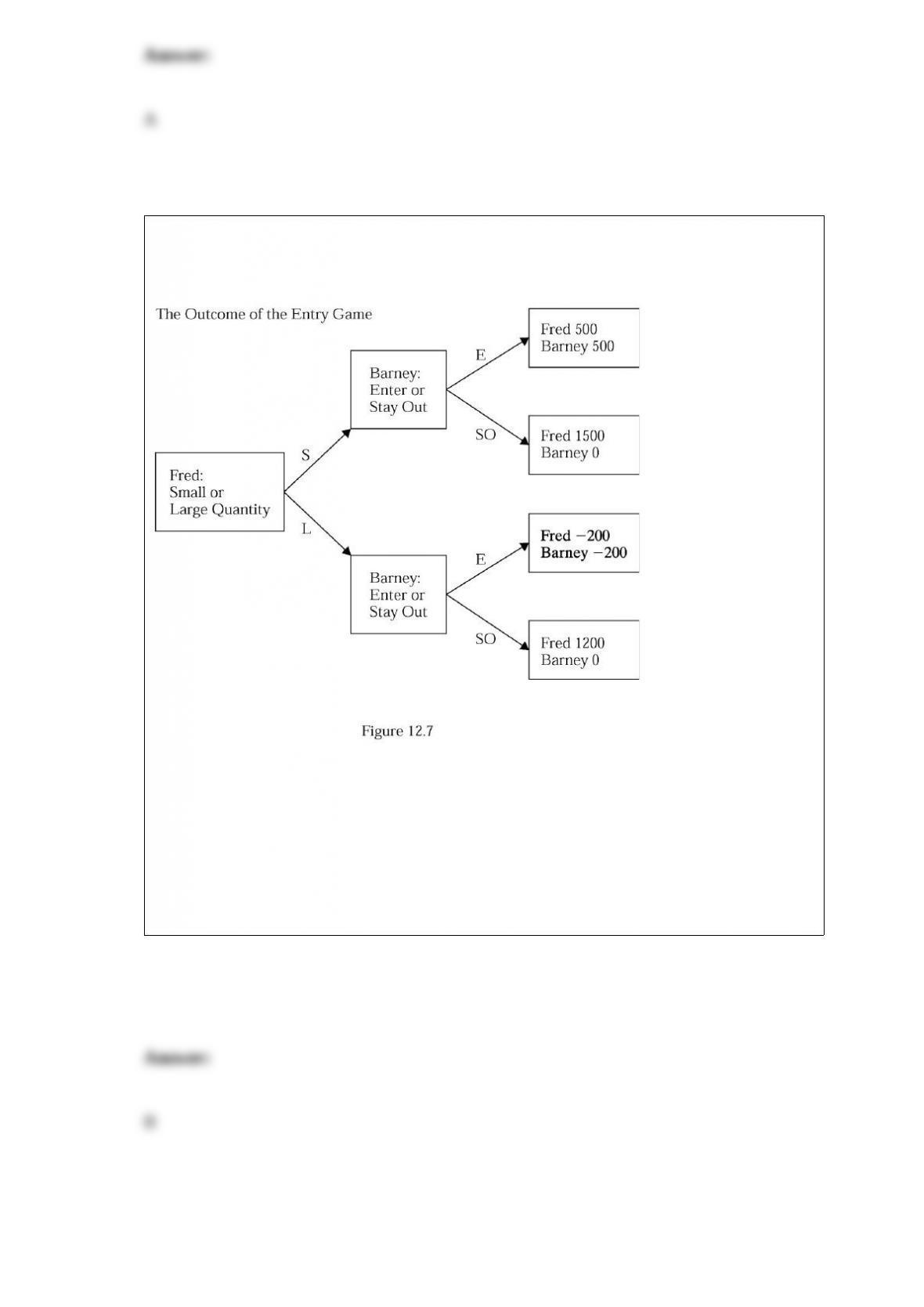
Refer to Figure 12.7. If Fred’s profit in the second rectangle from the top were 1,600
instead of 1,500 then the path of the game would be:
A) Fred chooses a small quantity and Barney enters.
B) Fred chooses a large quantity and Barney stays out.
C) Fred chooses a large quantity and Barney enters.
D) Fred chooses a small quantity and Barney stays out.
According to the text, the solution economists propose to the problem of traffic
congestion is to:
A) impose a tax for the use of a road during peak times.
B) make cars smaller.
C) make gasoline cheaper.
D) make the roads wider.
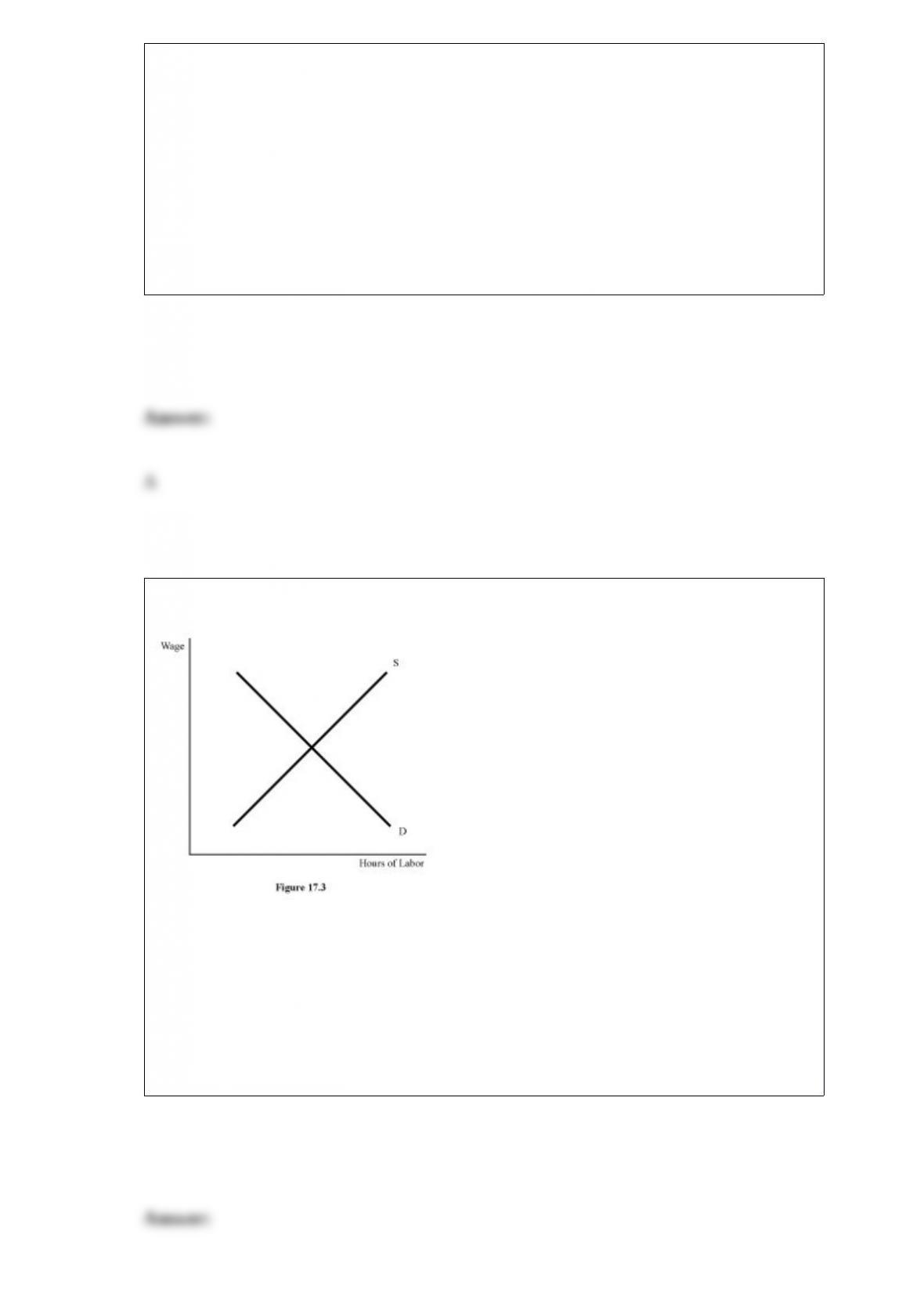
In Figure 17.3 an increase in the demand for labor will cause the equilibrium:
A) wage and hours of labor used to increase.
B) wage and hours of labor used to decrease.
C) wage to increase and hours of labor used to decrease.
D) wage to decrease and hours of labor used to increase.

An example of adverse selection is:
A) when high-quality loan applicants drive low-quality loan applicants out of the
market for bank loans.
B) when a person discovers that he has a serious illness and then purchases health
insurance.
C) when consumers are not willing to pay top dollar for a used car because of imperfect
information.
D) All of the above are examples of adverse selection.
If the number of banana producers increases:
A) the demand for bananas increases.
B) the demand for bananas decreases.
C) the supply of bananas increases.
D) the supply of bananas decreases.

Which of the following is necessary for a system of marketable pollution permits to
lead to beneficial trades between polluting companies?
A) Companies must have common abatement costs.
B) There must be differences in abatement costs between companies.
C) Company owners must have a social conscience and must be devoted to pollution
abatement.
D) The government must direct companies toward beneficial trades.
If the equilibrium wage is below the actual wage:
A) the demand for labor will increase.
B) the demand for labor will decrease.
C) the wage rate will fall.
D) the wage rate will rise.
When a specialized worker gains insights into a particular task that leads to better
production methods it is called:
A) continuity.

B) innovation.
C) specialization.
D) repetition.
What is the real value of money?
A) its face value
B) its compounded earnings in banks
C) the quantity of goods and services it can buy
D) the amount of it you have
A firm that generates pollution is illustrated in Figure 16.1. If the government imposes a
pollution tax equal to P1 the marginal benefit to the firm of abating A2 is:
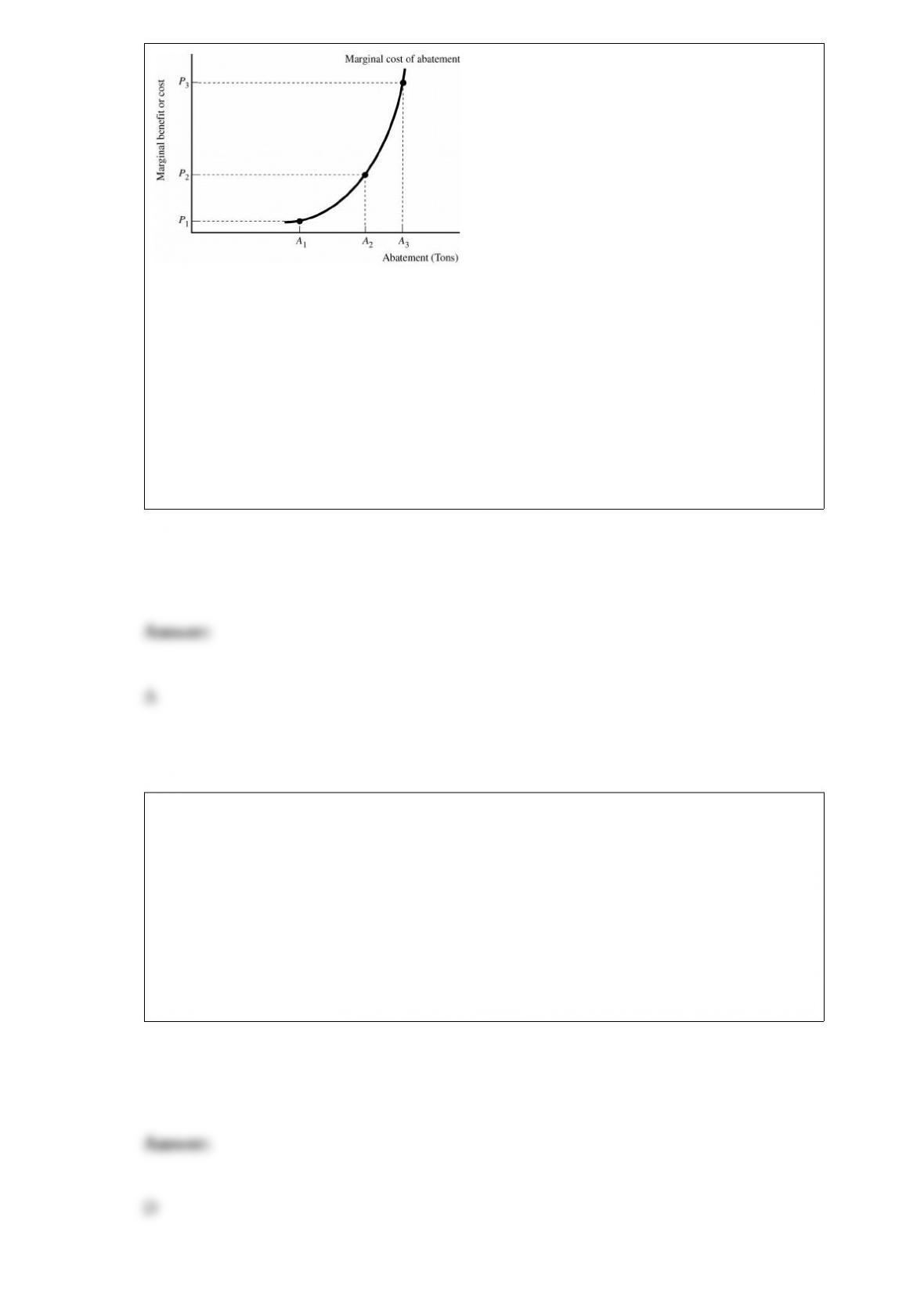
Figure 16.1
A) P1.
B) P2.
C) P1 – P2.
D) P2 – P3.
Which of the following situations contains most of the characteristics of a private good:
A) free bread handed out by the government.
B) an apartment in a public housing project.
C) a hamburger.
D) all of the above.

When a local casino spends millions in TV ads convincing town residents to reject
another casino’s bid to operate in the area, the casino is:
A) rent seeking.
B) seeking rent controls.
C) acting fraudulently.
D) allocating resources efficiently.
If quantity demanded of a good falls by 2% when income falls by 10%, the good’s
demand is:
A) price sensitive.
B) income-inelastic.
C) income-elastic.
D) price insensitive.
The key region of the brain for benefit valuation is the:
A) insular cortex.
B) amygdala.
C) Nucleus Accumbens (NAcc).
D) Both A and B are correct.
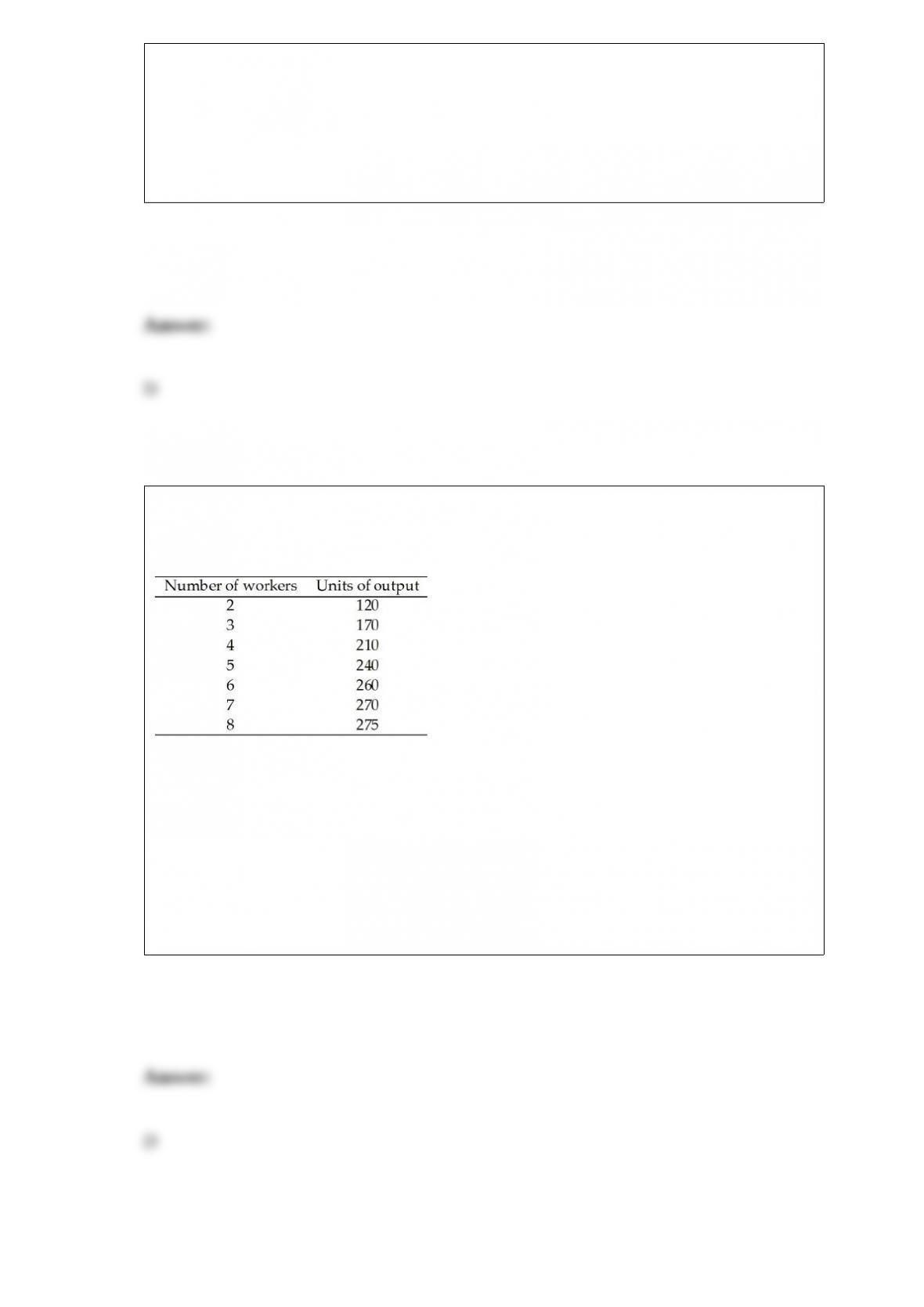
Refer to Table 17.2. If the price of output is $2 per unit and we observe the firm hiring
four workers, if the firm is maximizing profit, the wage rate must be between ________
and ________.
Table 17.2
A) $25; $45
B) $30; $35
C) $45; $60
D) $60; $80

Recall Application 1, “Absolute Advantage and Comparative Disadvantage in
Latvia,” to answer the following questions:
According to the Application, which good does Latvia have absolute advantage on?
A) timber
B) grain
C) milk
D) none of the above.
The marginal revenue product of labor is the:
A) change in labor necessary to produce an additional unit of output.
B) cost of additional labor necessary to produce an additional unit of output.
C) change in output resulting from adding an additional unit of labor.
D) change in revenue resulting from adding an additional unit of labor.
Provide four examples of goods that are sold in monopolistically competitive markets.
When does the advertisers’ dilemma occur?
Maxine’s Cookie Shop sells chocolate chip cookies in a perfectly competitive market
for $2 per dozen. Maxine currently produces 200 dozen cookies per day and average
total cost at this level of production is $1.75. What level of profit is this firm earning?
Explain.
The price elasticity of demand for shirts is .75 and the price elasticity of supply of shirts
is 2.5. If the supply of shirts rises by 10%, what will happen to the price of shirts?
Comment on the following statement: “If a tax is placed on sellers, sellers will bear the
entire burden of the tax.”
What are the similarities and differences between an import tariff and a voluntary
export restraint? What are the differences?
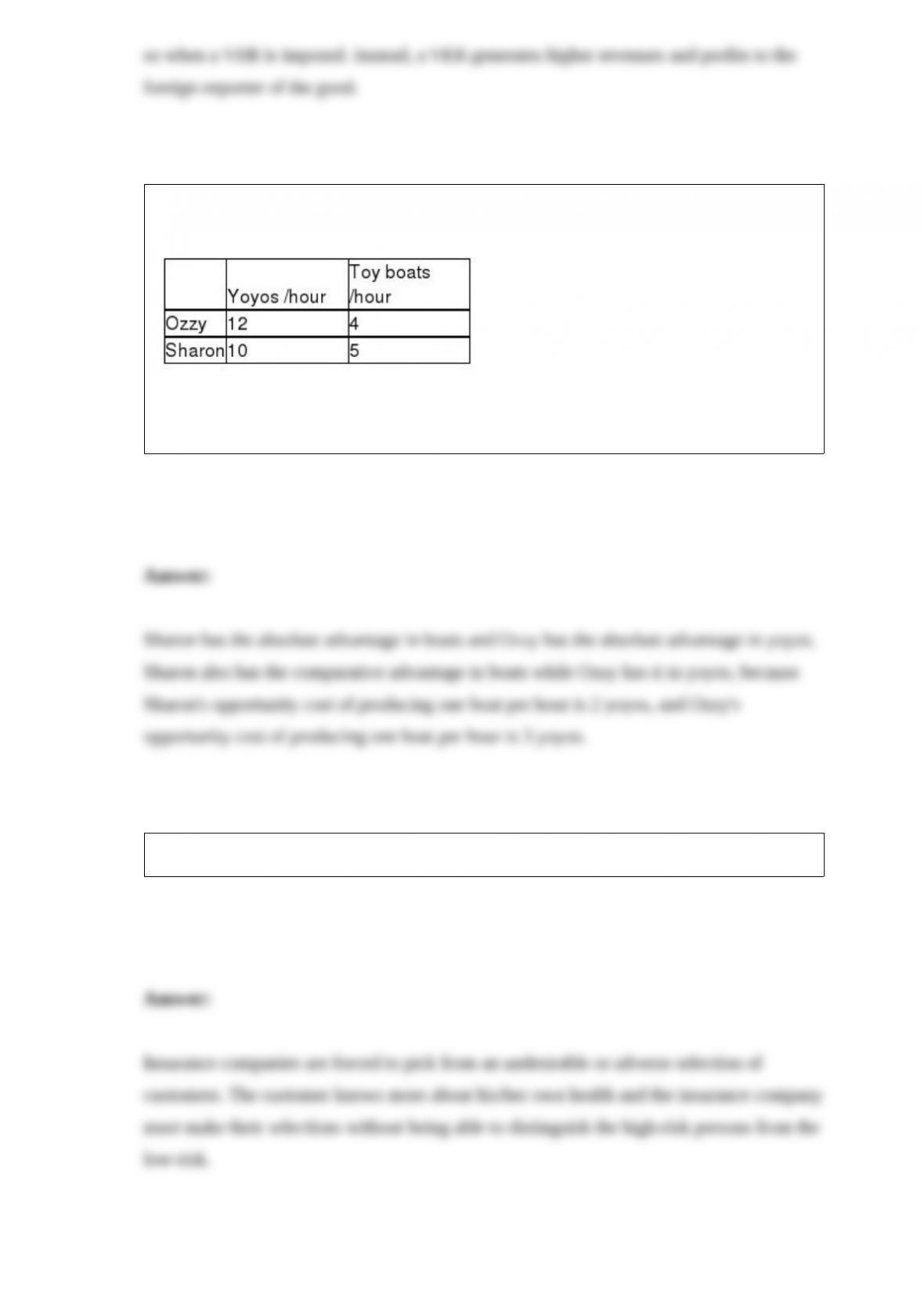
Consider two individuals, Ozzy and Sharon, who produce toy boats and yoyos. Ozzy’s
and Sharon’s hourly productivity are as follows:
Who has the absolute advantage or comparative advantage in the production of yoyos
or boats?
Explain why the insurance market suffers from the adverse-selection problem.
Would consumers benefit more from a tariff or a quota on imports? Explain.
If you were thinking of entering the ice cream business, would you make a product that
is just like one that is already being produced? Explain.
What is the prisoners’ dilemma?
What is a price ceiling and why must it be below the equilibrium price to be effective?
If your salary increases at a lower rate than prices are increasing, what would happen to
your buying power?
Explain the underlying assumptions of the price leadership model. What conclusions
can be made about the price charged and the output produced in an industry that has an
implicit price leader?
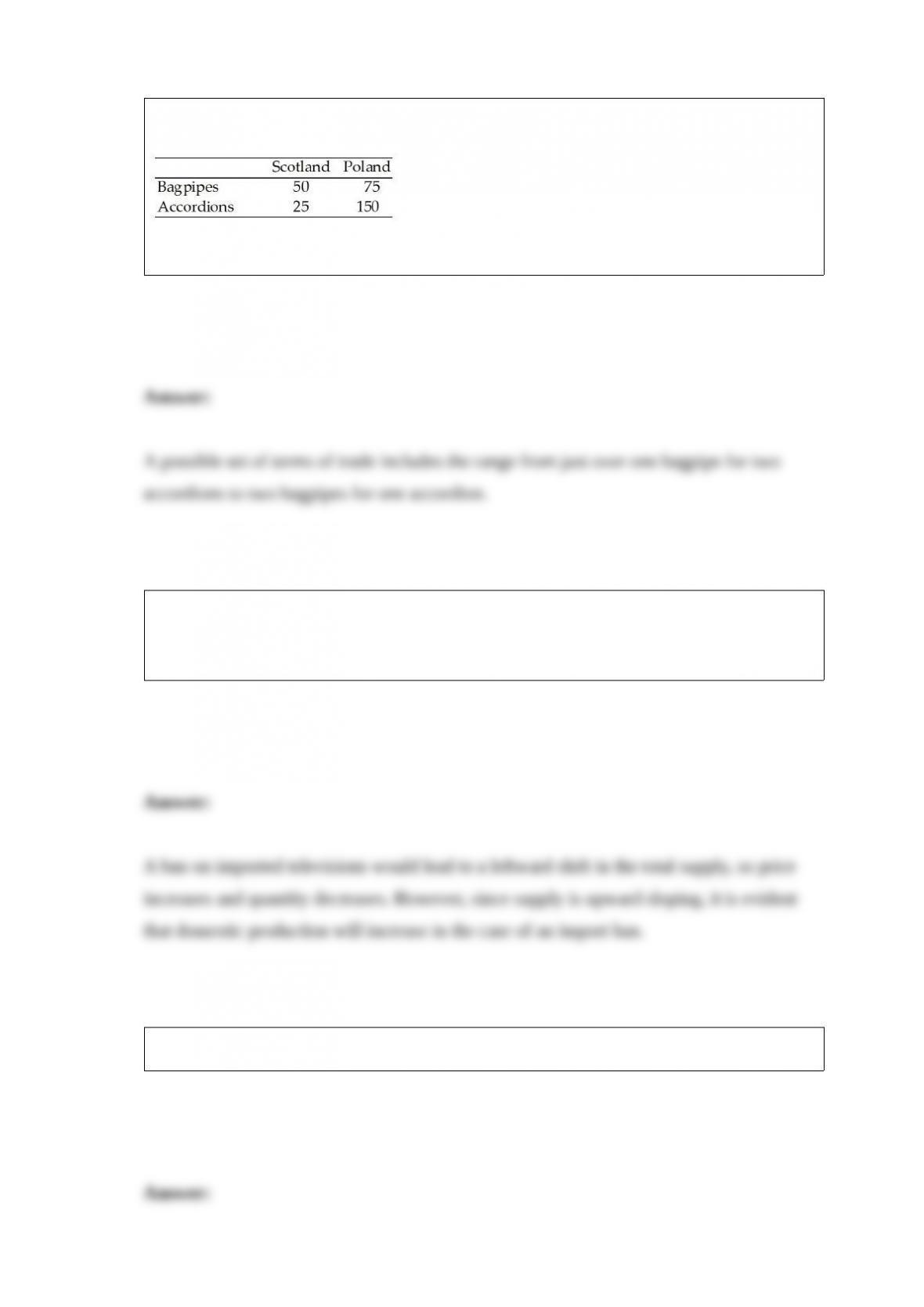
Consider the following weekly production possibilities of bagpipes and accordions in
Poland and Scotland:
What is the possible range of terms of trade between Poland and Scotland?
Suppose that televisions are produced both domestically and abroad. What would a ban
on imported televisions do to the price of televisions, the quantity of televisions, and the
output of the domestic television industry?
List four examples of oligopolies in the United States.
What does the income elasticity of demand measure? How is it calculated?
What is economic profit?