
The price elasticity of demand for nursery products is -10. The advertising elasticity of
demand is 0.4. Using the “Rule of Thumb for Advertising,” the profit maximizing level
of advertising will be set at ________ of sales.
A) 0.25 percent
B) 0.4 percent
C) 4 percent
D) 40 percent
Scenario 12.3:
Suppose a stream is discovered whose water has remarkable healing powers. You
decide to bottle the liquid and sell it. The market demand curve is linear and is given as
follows:
P = 30 – Q
The marginal cost to produce this new drink is $3.
Refer to Scenario 12.3. What will be the price of this new drink in the long run if the
firms in the industry collude with one another to maximize joint profit?
A) $3
B) $9
C) $12
D) $16.50
E) none of the above

Because trucking as an industry involves the generation of pollutants in engine exhaust,
A) the supply curve of trucking services overstates the true cost of providing those
services.
B) the supply curve of trucking services understates the true cost of providing those
services.
C) the demand curve for trucking services overstates the true benefit of providing those
services.
D) the demand curve for trucking services understates the true benefit of providing
those services.
E) the market for trucking services will always be away from equilibrium by an amount
equal to the value of the externality.
Consider the following statements when answering this question
I. Employers are always hurt by minimum wage laws.
II. Workers always benefit from minimum wage laws.
A) I and II are true.
B) I is true, and II is false.
C) I is false, and II is true.
D) I and II are false.

Cornucopia Media provides cable television service to several cities in the mid-Atlantic
region. The firm has access to two new channels that focus on reality television
programming, and the marginal cost of providing both new channels is zero. The first
channel is Extreme Scottish Sports (ESS) and appeals to younger viewers, and the
second channel is Delaware Entertainment and Tourism (DET) and appeals to older
viewers. Based on Cornucopia’s market research, younger viewers are willing to pay $5
per month for ESS, and their reservation price for DET is $0.50 per month. The same
research indicates that older viewers have a reservation price of $1.00 per month for
ESS and $4.00 per month for DET.
a. Please show how Cornucopia media can increase sales revenue by bundling the two
channels rather than selling access to the channels separately.
b. The US Congress has recently considered legislation that would allow cable
television subscribers to purchase access to separate channels (without bundling). If the
law is enacted, what should we expect to happen to sales revenue in cable television
markets?
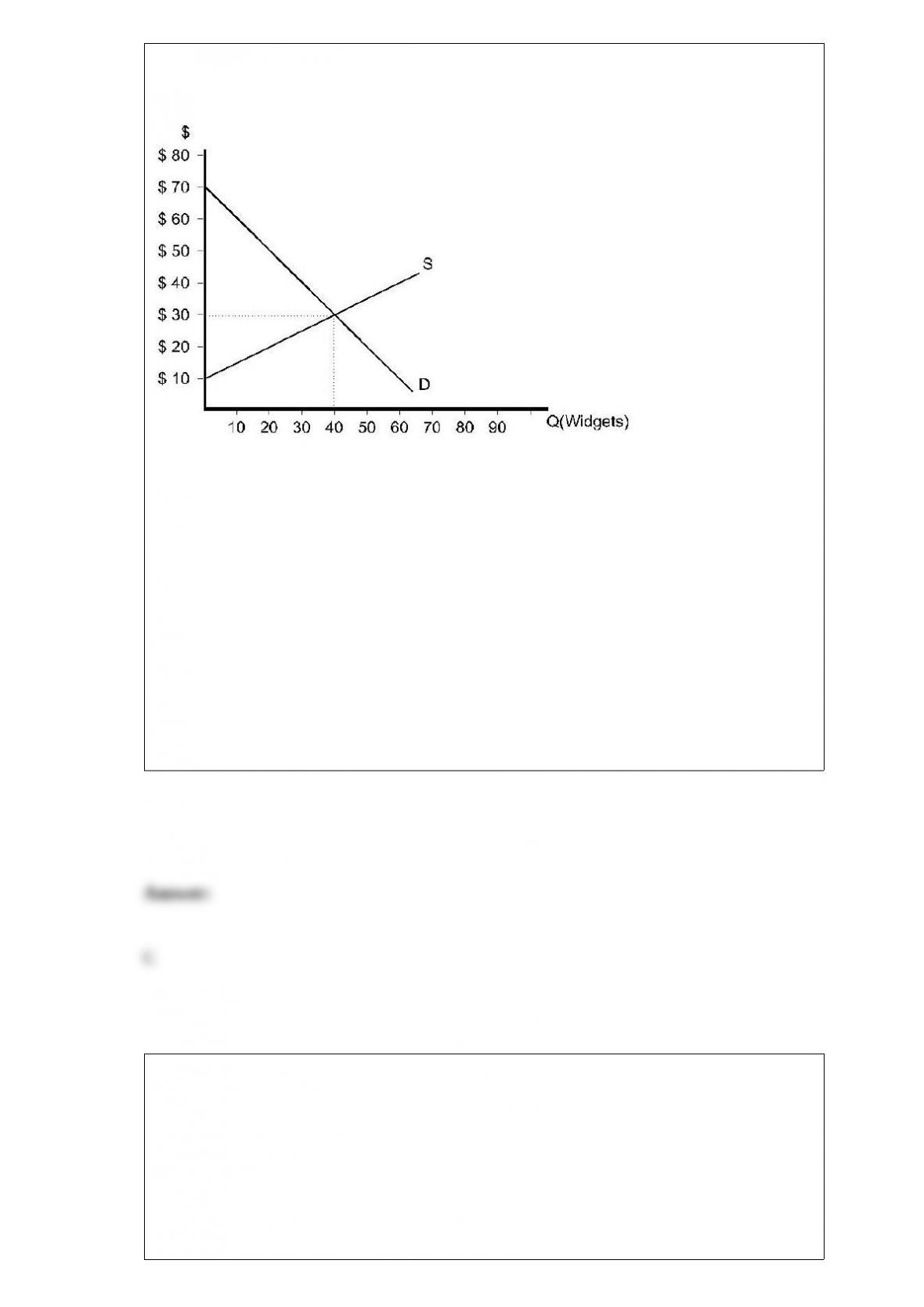
Figure 9.4
Refer to Figure 9.4. If the government establishes a price floor of $40 and government
purchases the surplus over quantity demanded, the resulting deadweight loss will be
A) $15.
B) 10 widgets.
C) $1,050.
D) $1,200.
E) $2,400.
Majority-rule voting
A) usually emphasizes the preferences of extremist voters on one side or the other.
B) usually allows extremist voters to band together and swamp the preferences of the
median voter.
C) never reflects the preferences of the median voter.

D) reflects the preferences of the median voter.
E) generates economically efficient outcomes in most cases.
In the Bertrand model with homogeneous products,
A) the firm that sets the lower price will capture all of the market.
B) the Nash equilibrium is the competitive outcome.
C) both firms set price equal to marginal cost.
D) all of the above
E) the outcome is inconclusive.
An individual consumes products X and Y and spends $25 per time period. The prices
of the two goods are $3 per unit for X and $2 per unit for Y. The consumer in this case
has a utility function expressed as:
U(X,Y) = .5XY MUX = .5Y MUY = .5X.
a. Express the budget equation mathematically.
b. Determine the values of X and Y that will maximize utility in the consumption of X
and Y.
c. Determine the total utility that will be generated per unit of time for this individual.

Use the following two statements to answer this question:
I. According to the three basic assumptions regarding people’s preferences, a person
will always prefer to earn a living through honest work rather than a life of crime.
II. When we say that preferences are complete, we mean that if a consumer prefers
market basket A to market basket B, and prefers market basket B to market basket C,
then the consumer prefers market basket A to market basket C.
A) Both I and II are true.
B) I is true and II is false.
C) I is false and II is true.
D) Both I and II are false.
A firm has two customers with non-identical demands and a constant marginal cost of
production. At any positive price, the consumer surplus values for the two customers
are related as CS2 ≥ CS1 . What can we say about the optimal two-part tariff for the
firm?
A) The firm sets the price equal to MC and the optimal tariff is equal to CS2.
B) The firm sets the price equal to MC and the optimal tariff is equal to CS1.
C) The firm sets the price equal to MC and the optimal tariff is equal to zero.
D) The optimal price is greater than MC and the optimal tariff is equal to CS1.
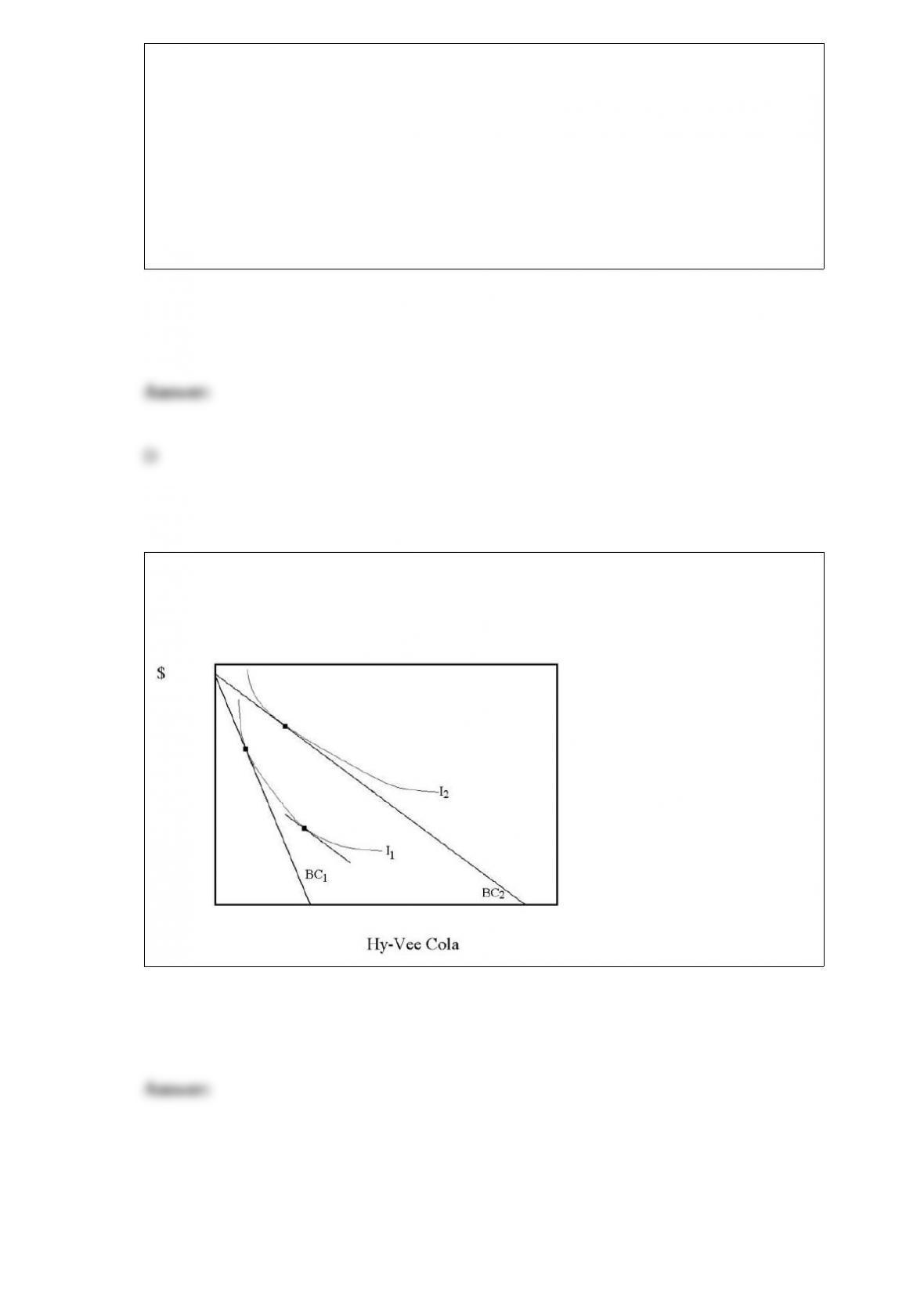
Margaret’s optimal consumption is shown in the diagram below for two different prices
of Hy-Vee Cola. Decompose the change in Hy-Vee Cola consumption into income and
substitution effects. Do the effects work in opposite directions?

Which of the following is NOT associated with a high degree of monopoly power?
A) A relatively inelastic demand curve for the firm
B) A small number of firms in the market
C) Significant price competition among firms in the market
D) Significant barriers to entry
What do we mean when we state that a particular principal-agent payment scheme is
inefficient?
A) The principal and agent could find another agreement that would increase the sum of
the owner’s revenue and the worker’s payment.
B) The agreement involves the highest level of effort for the worker.

C) The agreement leads to the lowest level of revenue for the owner.
D) The sum of the income taxes paid by the owner and the worker is too high.
The food stamp program provides low income households with coupons which can be
exchanged for some specified dollar value worth of food. Many economists argue that
this program is an inefficient means of increasing the well being of low income
families. Proponents of this view argue that an equivalent cash subsidy would bring
about a greater increase in the well being of the low income families receiving aid.
Although many economists hold this view, not all policy analysts agree with the
advocates of cash payments instead of food stamps. Advocates of the existing program
argue that food stamps provide an incentive for low income families to increase the
nutritional quality of their diets.
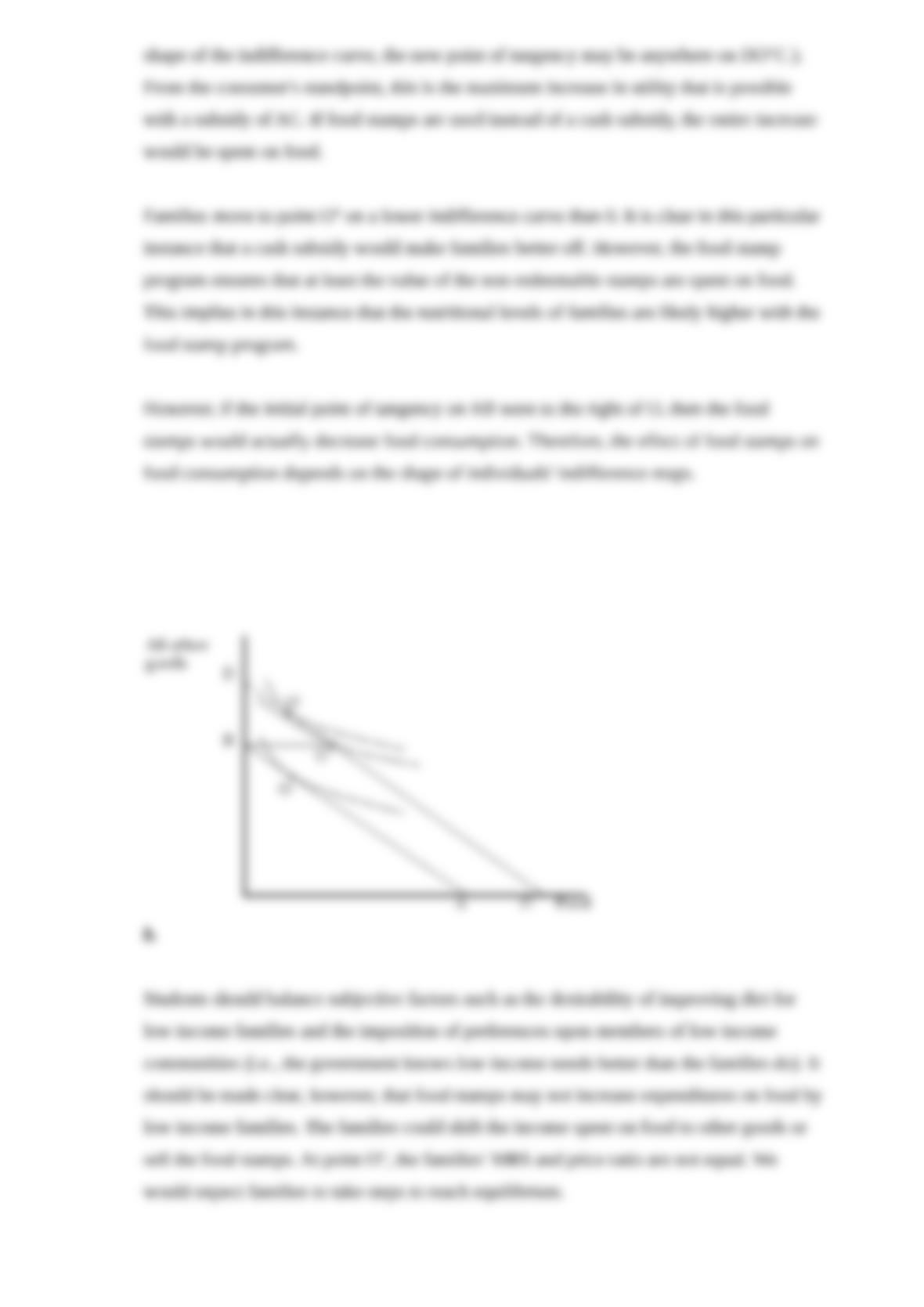
a. Carefully analyze the arguments regarding increases in well being under cash
payments and food stamp programs. Use graphical analysis to present your arguments.
b. Critically evaluate the pros and cons of the food stamp program. Do food stamps
ensure that low income families increase their consumption of food?

Scenario 12.2:
You are studying a market for which the kinked demand curve model applies. The
kinked demand curve is as follows:
Q = 1200 – 5P for 0 Q < 150
Q = 360 – P for 150 Q
The marginal cost is given as:
MC = Q
Refer to Scenario 12.2. Suppose that the marginal cost increases such that:
MC = Q + 10
What is the profit maximizing level of output?
A) 43
B) 120
C) 150
D) all of the above
E) none of the above
Evelyn Lips’ preferences are depicted by the set of indifference curves in the diagram
below. Her budget line is also shown in the diagram. Use the information in the diagram
to answer the following questions.
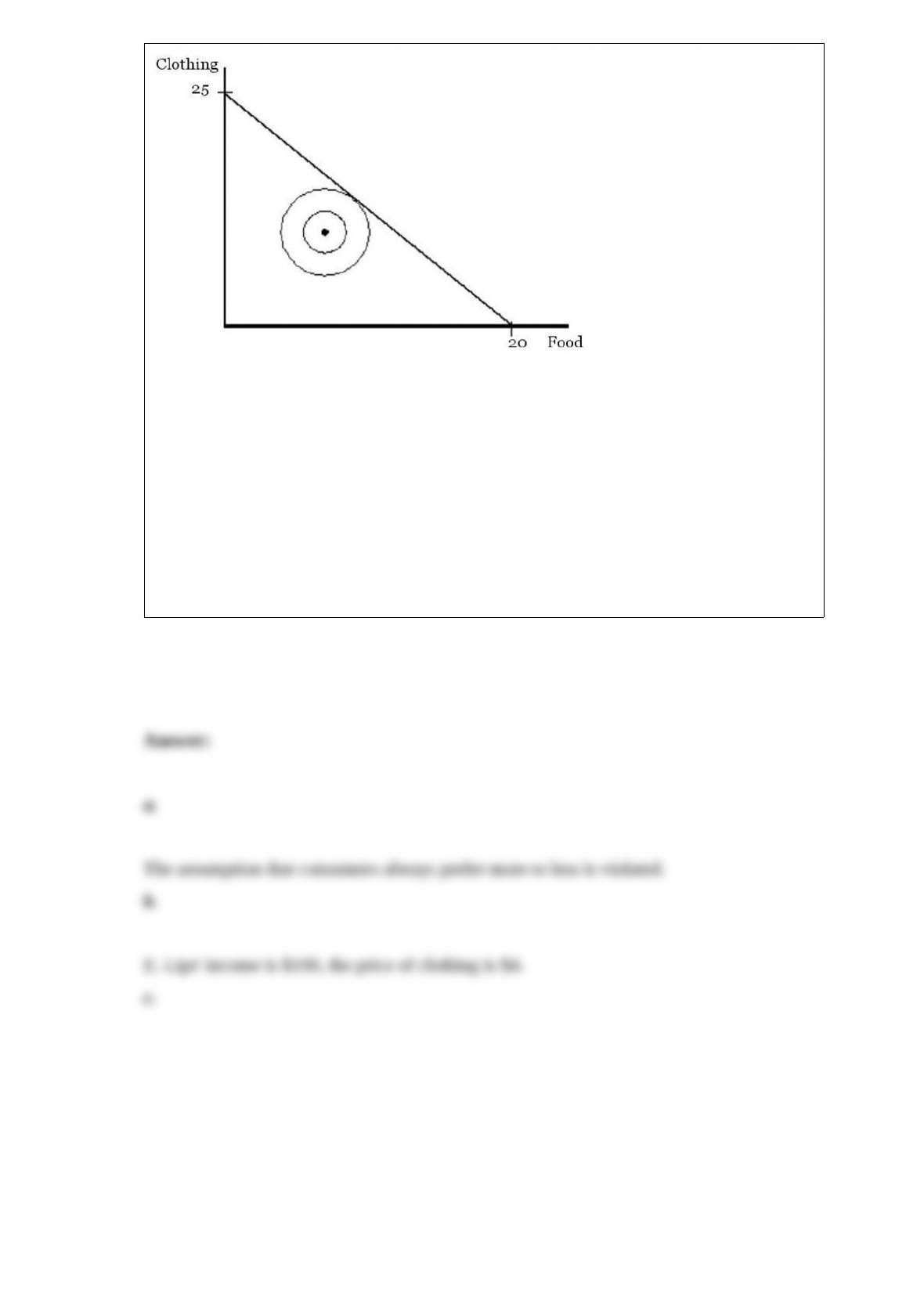
a. Which of the basic assumptions of consumer preferences are violated by E. Lips’
indifference curves? Explain.
b. The price of food is $5 per unit. What is E. Lips’ income and what is the price of
clothing?
c. Show the market basket of food and clothing that maximizes E. Lips’ satisfaction.
When satisfaction is maximized, has E. Lips equated the marginal rate of substitution
(of food for clothing) to the ratio of the prices (of food to clothing)? If so, explain why.
If not, explain why not.
The concerns about world food production raised by Malthus have not materialized
because:
A) input prices have fallen over time.
B) crop prices have risen over time.
C) Malthus was wrong about the diminishing returns to labor in agriculture.
D) technological improvements have increased our ability to produce food over time.
Scenario 5.3:
Wanting to invest in the computer games industry, you select Whizbo, Yowzo and

Zowiebo as the three best firms. Over the past 10 years, the three firms have had good
years and bad years. The following table shows their performance:
Refer to Scenario 5.3. Where is the highest expected revenue, based on the 10 years’
past performance?
A) Whizbo
B) Yowzo
C) Zowiebo
D) Whizbo and Yowzo
E) Yowzo and Zowiebo
Which of the following inputs are variable in the long run?
A) labor.
B) capital and equipment.
C) plant size.
D) all of these.
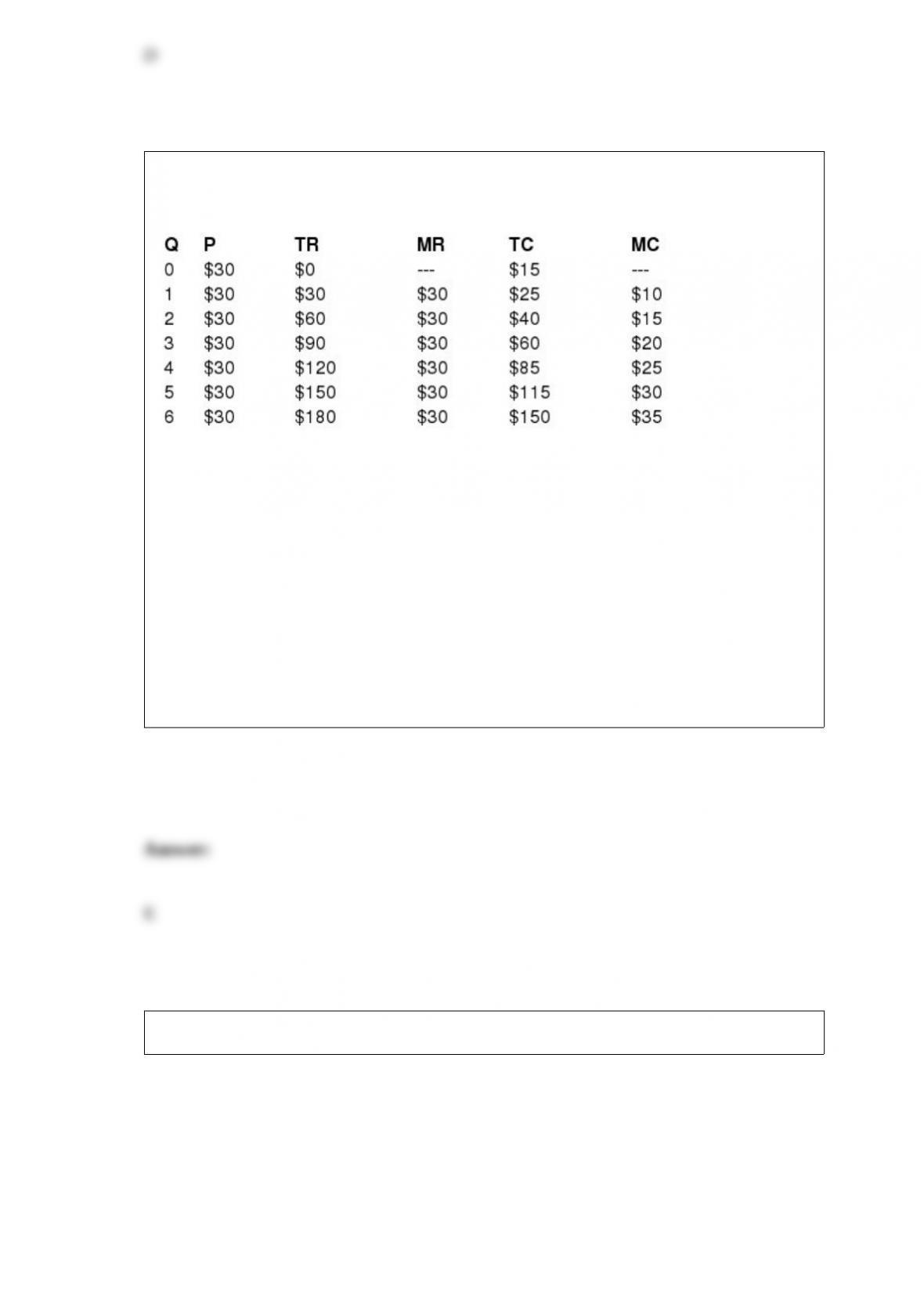
TABLE 8.1
Average cost for the firm in Table 8.1
A) cannot be determined from the information given.
B) is upward-sloping for all output values shown.
C) is constant for all output values shown.
D) is downward-sloping for all output values shown.
E) is U-shaped.
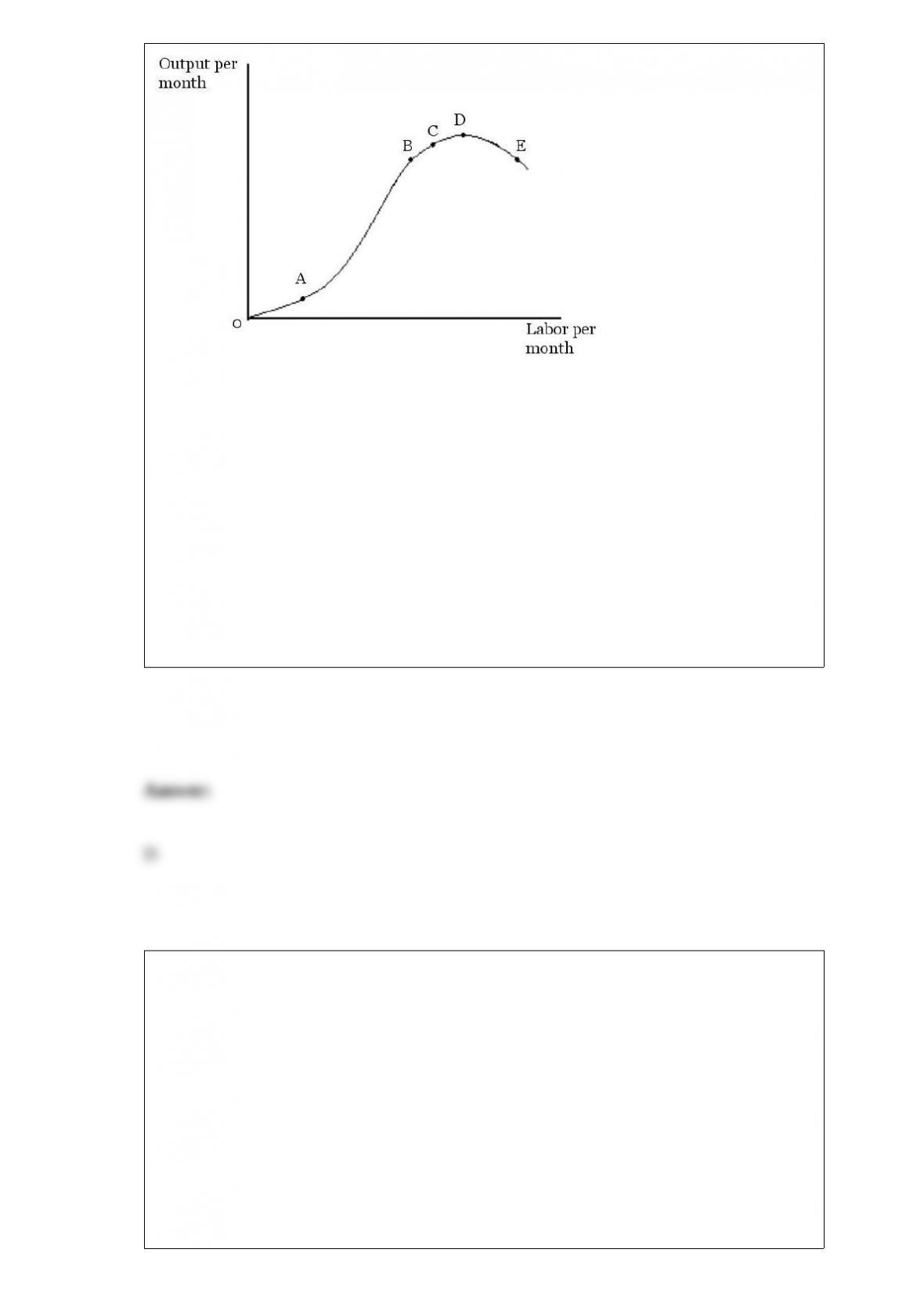
Figure 6.1
Refer to Figure 6.1. Which of the following statements is false?
A) At point E the marginal product of labor is decreasing.
B) At point E the marginal product of labor is negative.
C) At point E the average product of labor is decreasing.
D) At point E the average product of labor is negative.
E) At point E the marginal product of labor is less than the average product of labor.
You work as a marketing analyst for a pharmaceutical firm, and you are trying to gather
information about the marginal cost of production for a competing firm. You know that
they have a patent on a popular medication that sells for $20 per dose, and you believe
the elasticity of demand for this product is roughly -4. Assuming the competing firm
acts as a profit-maximizing monopolist, what is the competing firm’s approximate
marginal cost of production?
A) $10 per dose
B) $12.50 per dose
C) $15 per dose

D) $20 per dose
If both players in a game have dominant strategies, we say that the game has:
A) a constant sum.
B) a nonconstant sum.
C) independence of irrelevant alternatives.
D) an equilibrium in dominant strategies.
Many communities use a mixed-flow recycling program in which various types of
bottles, cans, and other containers are placed in a single recycling bin. Suppose a
community alters its recycling program by mandating that the containers must be sorted
by type of material (i.e., glass, aluminum, plastic). What is the expected impact of this
change on the optimal quantity of unredeemed (scrapped) containers?
A) Optimal quantity increases
B) Optimal quantity decreases
C) Optimal quantity remains unchanged
D) We cannot determine the outcome of this policy change without having more
information
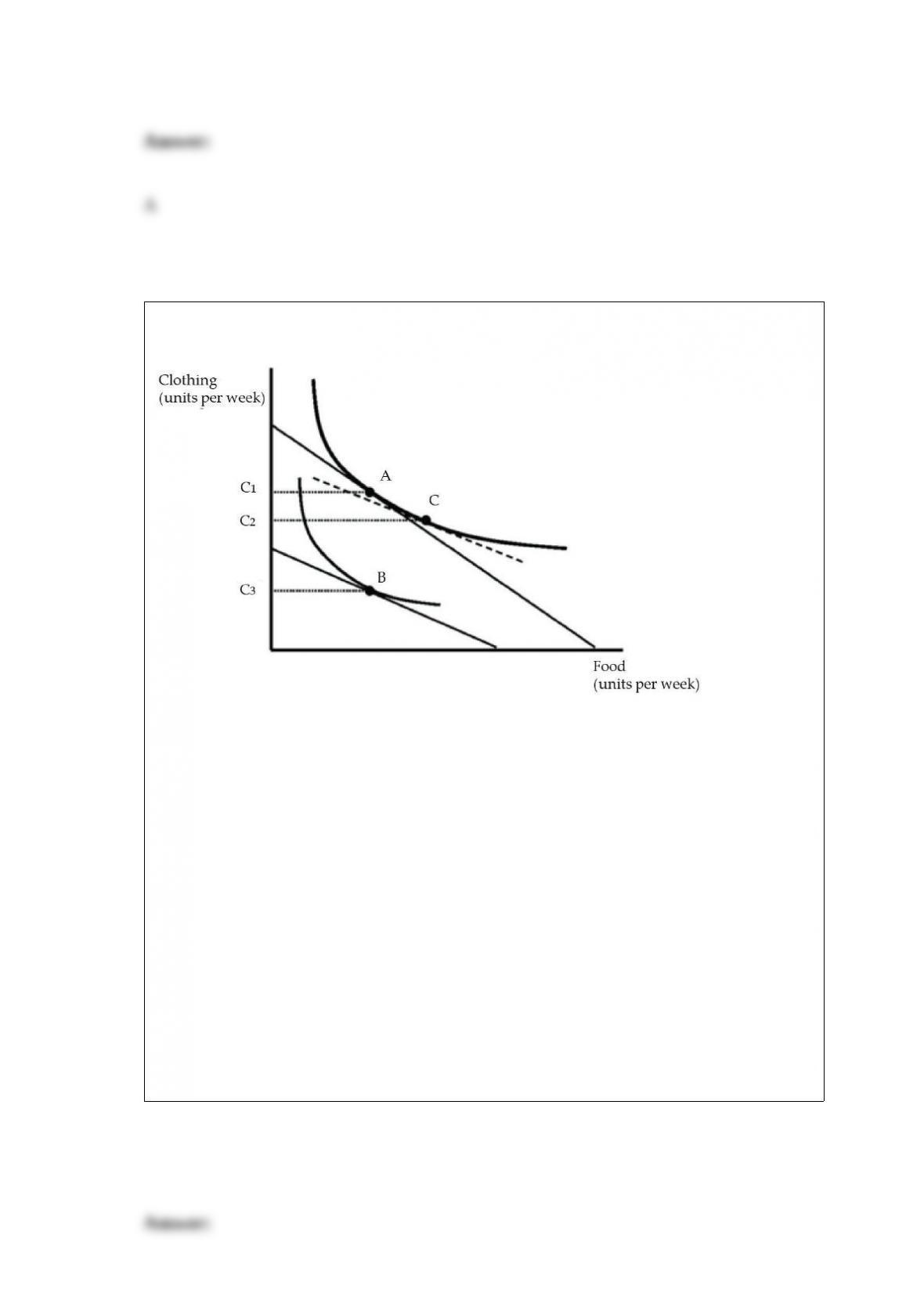
Figure 4.2
A consumer’s original utility maximizing market basket of goods is shown in Figure 4.2
as point A. Following a price change, the consumer’s utility maximizing market basket
is at point B.
Refer to Figure 4.2. The income effect on the quantity of clothing purchased is:
A) the change from C1 to C3.
B) the change from C1 to C2.
C) the change from C2 to C3.
D) the change from C3 to C2.
E) none of the above

Which of the following is NOT true about the supply of labor to the firm in a
competitive labor market?
A) It is horizontal.
B) It is perfectly elastic.
C) It is equal to the marginal expenditure curve.
D) It is upward sloping.
Mixed bundling is more profitable than pure bundling when
A) the marginal cost of each good being sold is positive.
B) the consumers’ reservation values of each good being sold are not perfectly
negatively correlated with one or another.
C) Both A and B are correct.
D) the marginal cost of one good is zero.

Scenario 10.2:
A monopolist faces the following demand curve, marginal revenue curve, total cost
curve and marginal cost curve for its product:
Q = 200 – 2P
MR = 100 – Q
TC = 5Q
MC = 5
Refer to Scenario 10.2. Suppose that a tax of $5 for each unit produced is imposed by
state government. What is the profit maximizing level of output?
A) 0
B) 90
C) 95
D) 100
E) none of the above
Which of the following is a negative externality connected to automobile
transportation?
A) Driving faster than the 65 mph speed limit is not allowed, even though individuals
are able to do it, and many want to.
B) In an accident, a person who chooses not to wear a seatbelt becomes an object
moving around the inside of the car, possibly hitting other, belted-in, passengers with
lethal force.
C) Gasoline is taxed on a per-gallon basis.

D) Gasoline is imported, and thus increases the trade deficit.
E) While stuck in traffic, you have a chance to listen to your favorite CD, which you
haven’t had the time to do in other places.
A major computer software company maintains a technical support center in a rural area
and is the only employer in this region. Suppose the firm develops a new software
system for managing technical support calls, and the marginal product of labor
increases. What happens to the equilibrium outcome in this labor market?
A) Labor demand shifts rightward, equilibrium wage and employment levels decline
B) Labor demand shifts rightward, equilibrium wage and employment levels increase
C) Labor demand curve remains the same, equilibrium wage and employment levels
increase
D) Labor demand curve remains the same, equilibrium wage and employment do not
change
E) none of the above
Consider the information below:
For Group A the cost of attaining an educational level y is
CA(y) = $6,000y

and for Group B the cost of attaining that level is
CB (y) = $10,000y.
Employees will be offered $50,000 if they have y < y*, where y* is an education
threshold determined by the employer. They will be offered $130,000 if they have y >
y*.
If the threshold educational level y* is set at 13 1/3,
A) only individuals in Group K will attain it.
B) only individuals in Group M will attain it.
C) individuals in both groups will attain it.
D) no individuals will attain it.
E) some fraction of individuals in each group will attain it.
The law of diminishing returns refers to diminishing
A) total returns.
B) marginal returns.
C) average returns.
D) all of these.

Consider the following statements when answering this question;
I. The variance of the returns of an investor’s portfolio can be reduced by selling assets
from the portfolio, and investing the proceeds in other assets where returns are
positively correlated with the portfolio’s remaining assets.
II. The value of complete information is always positive.
A) I and II are true.
B) I is true, and II is false.
C) I is false, and II is true.
D) I and II are false.