Why is bad weather sometimes good news for farmers?
a. Bad weather shifts the supply curve of agricultural products leftward, driving up
price and total revenue (assuming demand is inelastic).
b. Bad weather shifts the supply curve of agricultural products leftward, driving down
price, and raising total revenue (assuming demand is elastic).
c. Bad weather increases the demand for and price of agricultural products.
d. Bad weather increases both the demand for and supply of agricultural products.
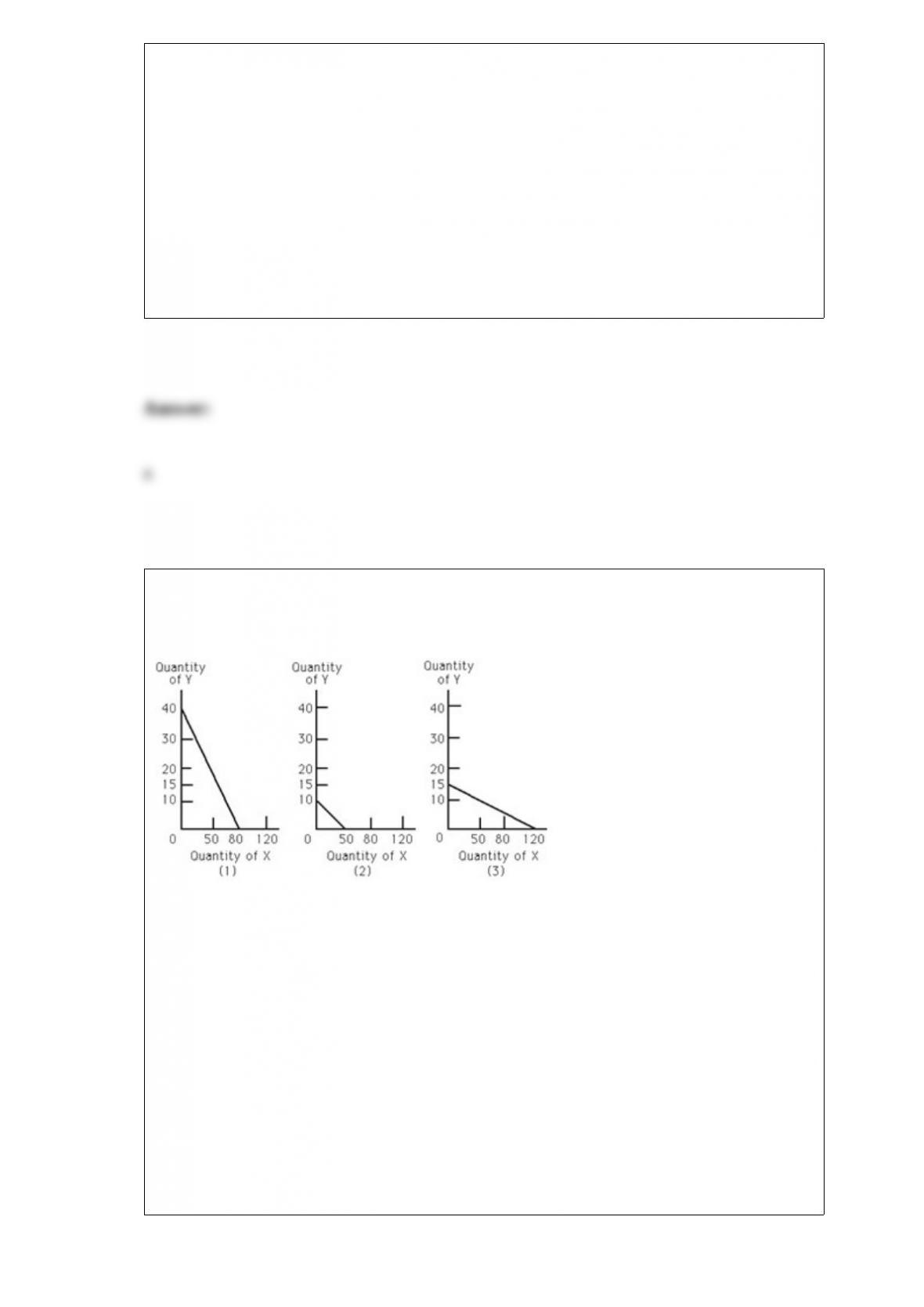
Exhibit 21-7
The price of X is $40 and the price of Y is $80. Assuming that the consumer allocates
all of his income to good X, how many units of X will he purchase? (Request: Do not
ask the instructor to which graph the question is referring.)
a. 40
b. 50
c. 80
d. 90
e. 120
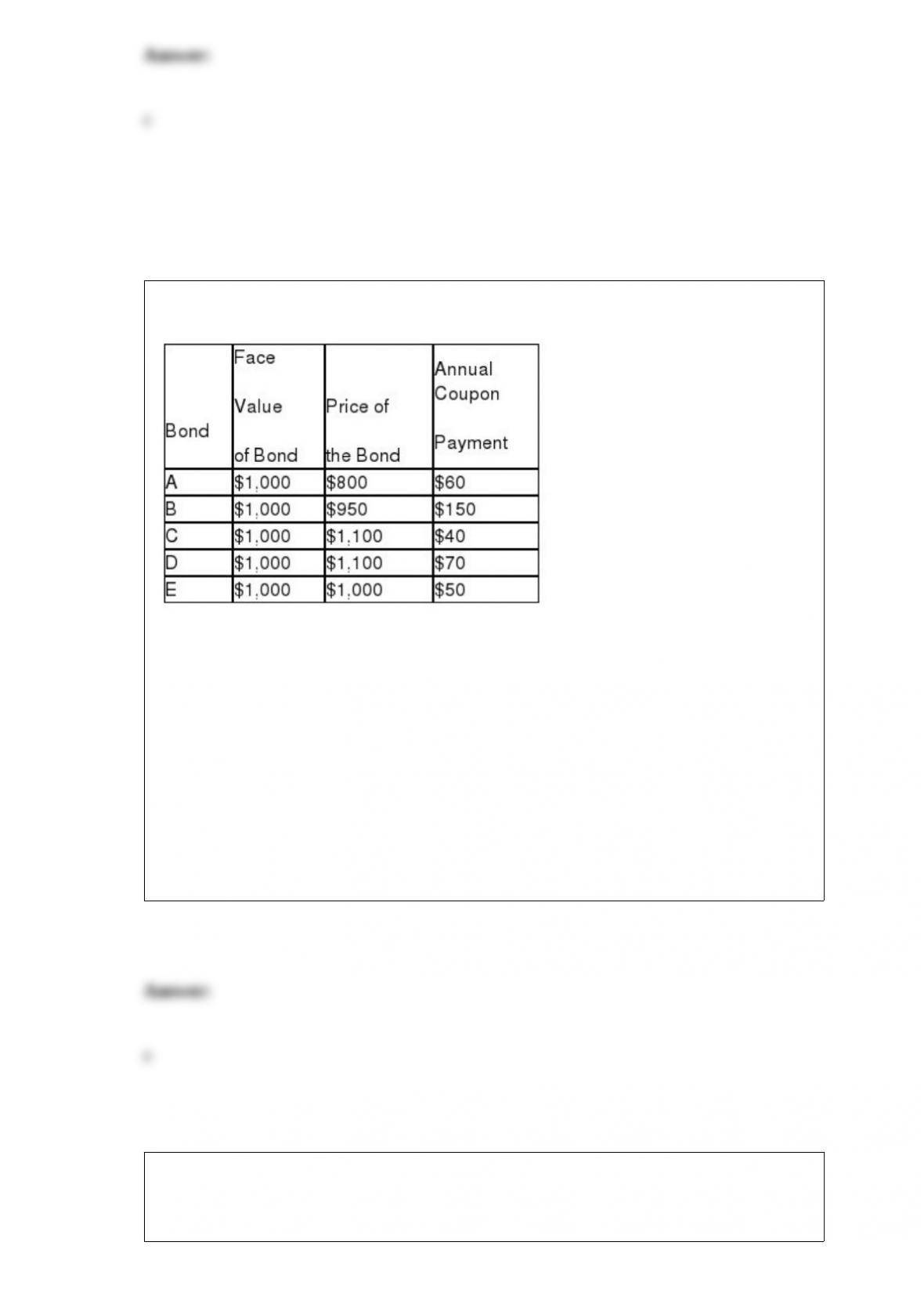
Exhibit 38-1
For which bond is the yield and the coupon rate the same?
a. Bond A
b. Bond B
c. Bond C
d. Bond D
e. Bond E
Economists use the terms resource and input as synonyms.
a. True

b. False
A decrease in the supply of an agricultural product will increase the total revenue of
farmers if the demand for the agricultural product is
a. income elastic.
b. income inelastic.
c. price elastic.
d. price inelastic.
e. none of the above
Which of the following is an implicit cost?
a. Jones buys $100 worth of supplies from Smith.
b. Brown pays the bill he received in the mail.
c. Smith, who could work for someone else, works for himself.
d. Williamson pays his income taxes on April 15.
e. a, c, and d

A perfectly competitive firm can produce its current level of output at an average total
cost of $10 and a marginal cost of $8.If the market price of the product is currently $8,
what should the firm do?
a. The firm should definitely shut down since average total cost exceeds price.
b. The answer depends upon the relationship between price and average variable
cost.The firm should shut down if average variable cost is $8 or greater, but the firm
should continue to produce the current level of output if average variable cost is less
than $8.
c. The firm should increase production in order to increase profit.
d. The firm should continue to produce, but they should decrease production in order to
increase profit.
Americans buying Japanese cars create a
a. demand for U.S. dollars and supply of Japanese yen.
b. demand for both U.S. dollars and Japanese yen.
c. supply of U.S. dollars and demand for Japanese yen.
d. supply of both U.S. dollars and Japanese yen.
Total utility is defined as the
a. change in marginal utility a person derives from the consumption of a good.
b. change in total utility a person derives from the consumption of a good divided by
the price of that good.
c. change in total utility a person derives from the consumption of a good divided by the
change in the consumption of that good.
d. sum of the amounts of satisfaction a person receives from consuming a good.
e. change in total utility a person derives from the consumption of a good.
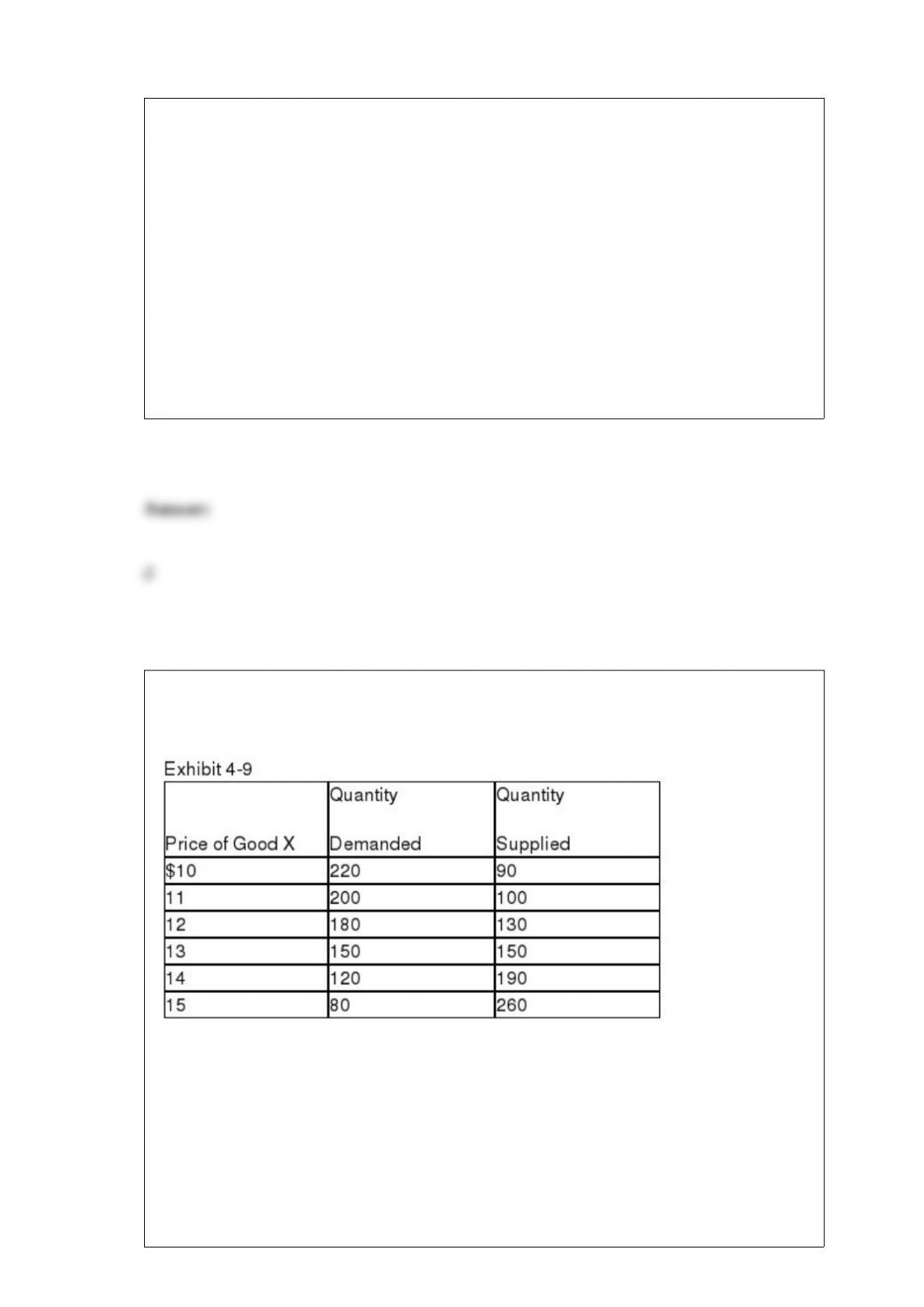
Suppose that the government imposes a price ceiling at a price of $15.The number of
units that would be exchanged in this market would be
a. 150, since that is the equilibrium quantity and the price ceiling is above the
equilibrium price.
b. 80, since that is the number of units demanded at the price ceiling.

c. 260, since that is the number of units supplied at the price ceiling.
d. 170, since that is the average of the quantity demanded and the quantity supplied at
the price ceiling.
For a perfectly competitive firm, the demand curve it faces is horizontal at the price
determined in the market.
a. True
b. False
If tobacco is a normal, income inelastic good, it follows that a 10 percent decrease in
income will __________ quantity demanded by __________ than 10 percent.
a. increase; less
b. increase; more
c. decrease; less
d. decrease; more

A perfectly competitive firm is a price taker.
a. True
b. False
A theory predicts that the more a student studies, the higher his or her grades will
be.This theory is
a. not falsifiable.
b. falsifiable.
c. too difficult a theory to test.
d. inconsistent with the fact that some students study less than other students, yet
receive higher grades.
e. b and d
Exhibit 3-6
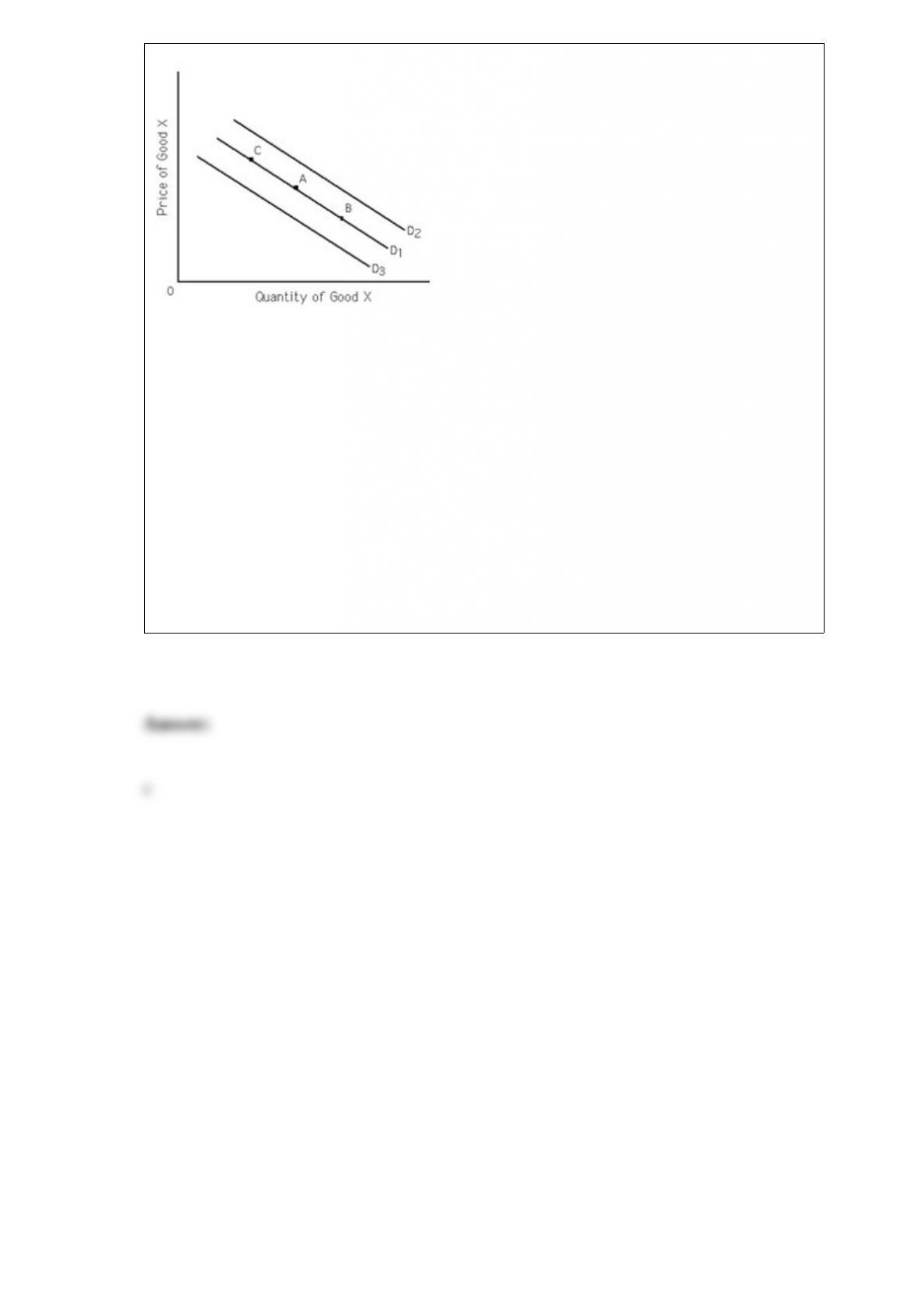
If an increase in the price of good Y causes the demand for good X to shift from D1 to
D2, goods X and Y are
a. normal goods.
b. inferior goods.
c. substitutes.
d. complements.
e. neutral goods.