Define the following terms and explain their importance to the study of
macroeconomics.
a. the relationship between interest rates and velocity
b. lags in stabilization policy
c. rules versus discretion
An improvement in productivity will usually increase profits.
a. True
b. False
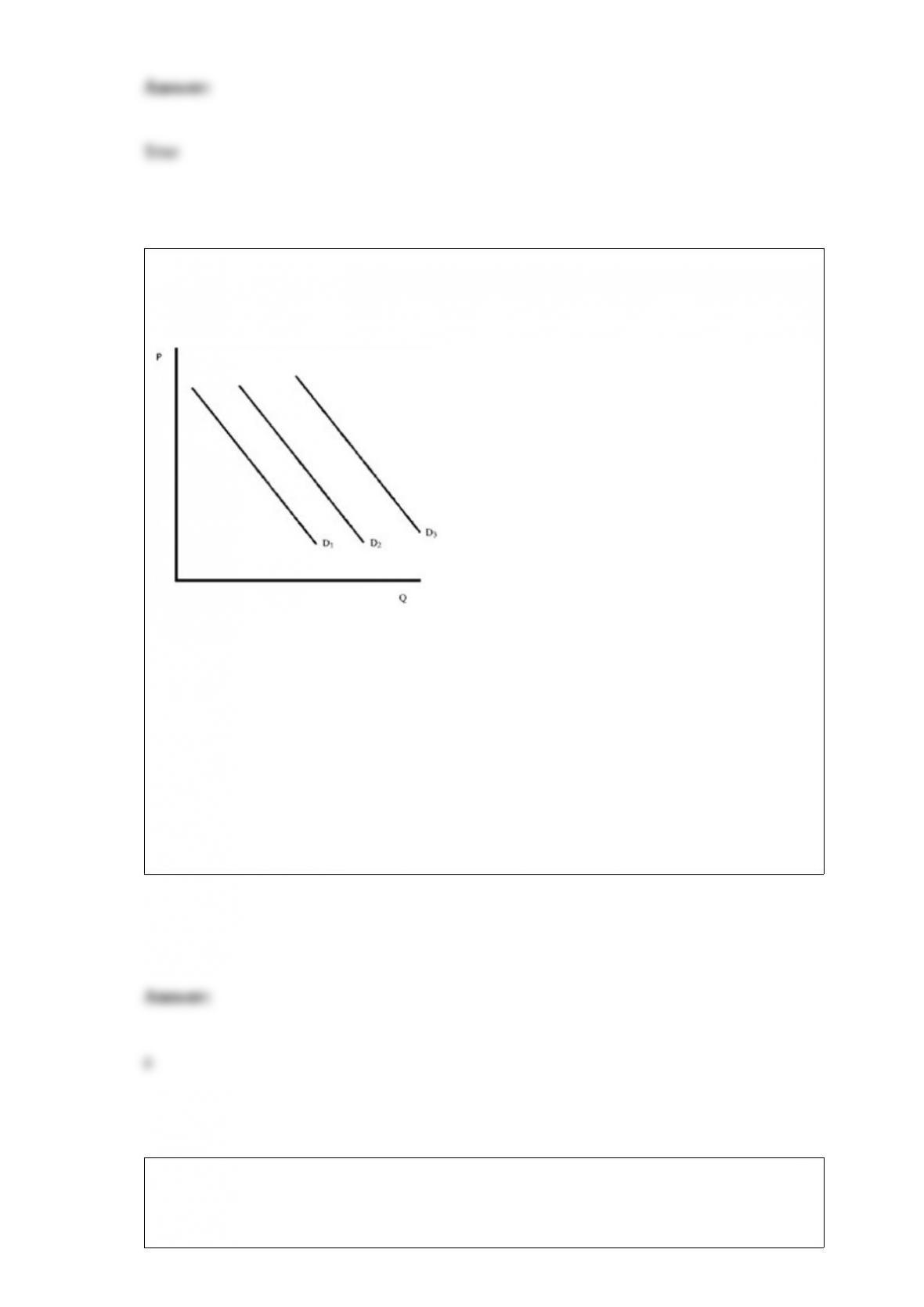
Figure 4-4
In Figure 4-4, an increase in population will change demand from
a. D1 to D2.
b. D2 to D1.
c. D3 to D2.
d. D3 to D1.
Countries like Malaysia and Thailand that tried to maintain overvalued currencies in the
late 1990s inevitably faced increased
a. balance of payments surpluses.
b. runs on their currencies.
c. balance of payments deficits.
d. both b and c.
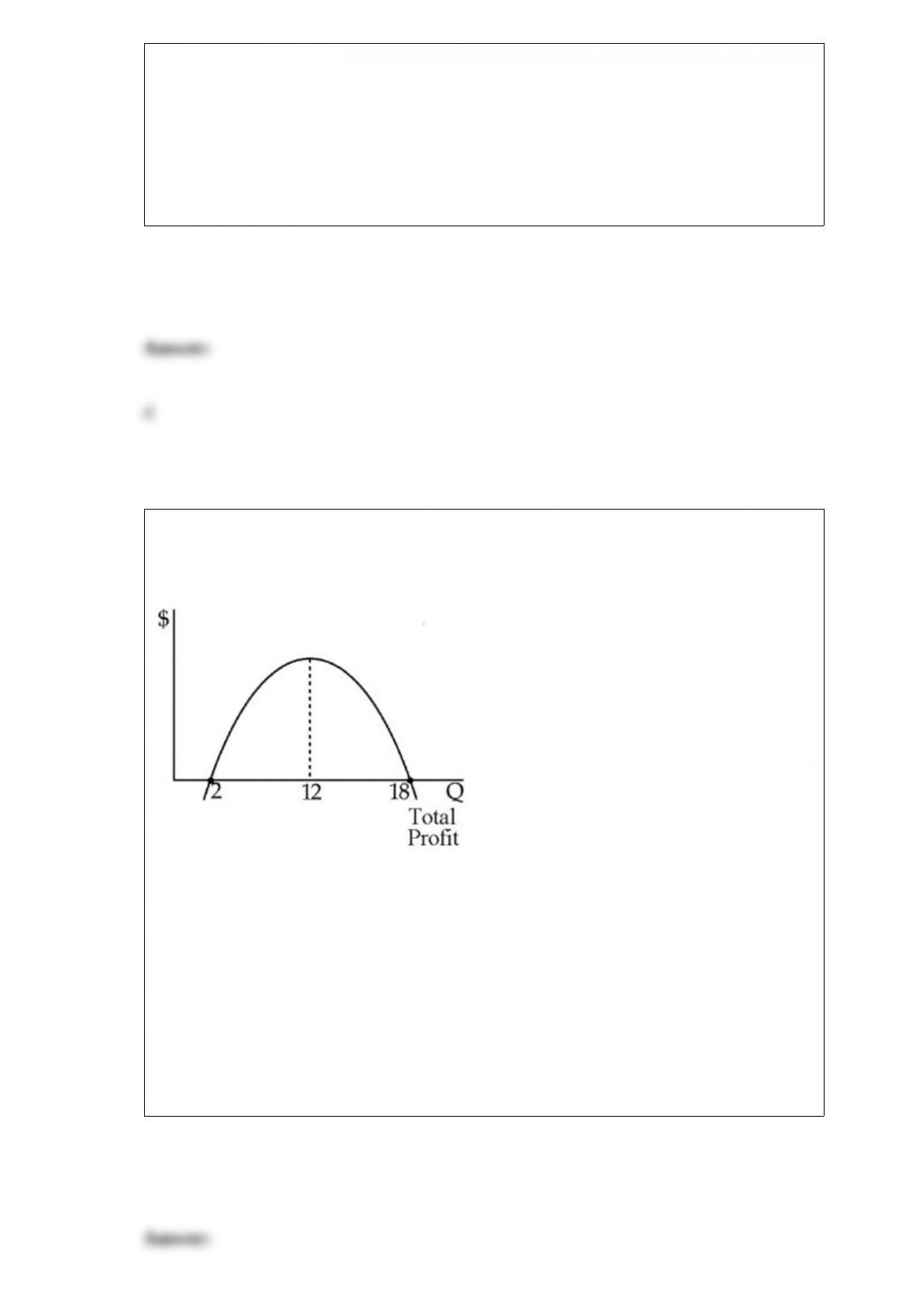
Figure 8-2
Figure 8-2 shows a manufacturer’s total profit curve. To maximize her total profit, the
manufacturer should produce ____ units of output.
a. 10
b. 12
c. 16
d. 18

The years 2002 through 2007 can be described as a period of
a. falling output accompanied by increasing inflation.
b. falling output accompanied by decreasing inflation.
c. rising output accompanied by increasing inflation.
d. rising output accompanied by decreasing inflation.
The largest single source of revenue for the federal government is the
a. corporate income tax.
b. federal excise tax.
c. personal income tax.
d. Social Security tax.
The U.S. fiscal stimulus in 2009 did not increase GDP substantially because

a. the Federal Reserve was decreasing interest rates and real world estimates for the
multiplier might be less than one.
b. the Federal Reserve was increasing interest rates and real world estimates for the
multiplier might be less than one.
c. state governments were decreasing spending and real world estimates for the
multiplier might be less than one.
d. state governments were increasing spending and real world estimates for the
multiplier might be less than one.
Compared to workers in richer countries, workers in developing countries have
a. lower productivity and lower wages.
b. higher productivity and higher wages.
c. higher productivity but lower wages.
d. the same productivity but lower wages.
The information technology revolution seems to have had its greatest positive effect on
labor productivity growth in the ____ period.
a. 1948-1973

b. 1973-1995
c. 1995-2005
d. 1948-2005
If total spending is greater than current output, GDP will rise.
a. True
b. False
If, as price increases by 10 percent, total revenue decreases by 10 percent demand is
a. elastic.
b. unit elastic.
c. inelastic.
d. perfectly inelastic.
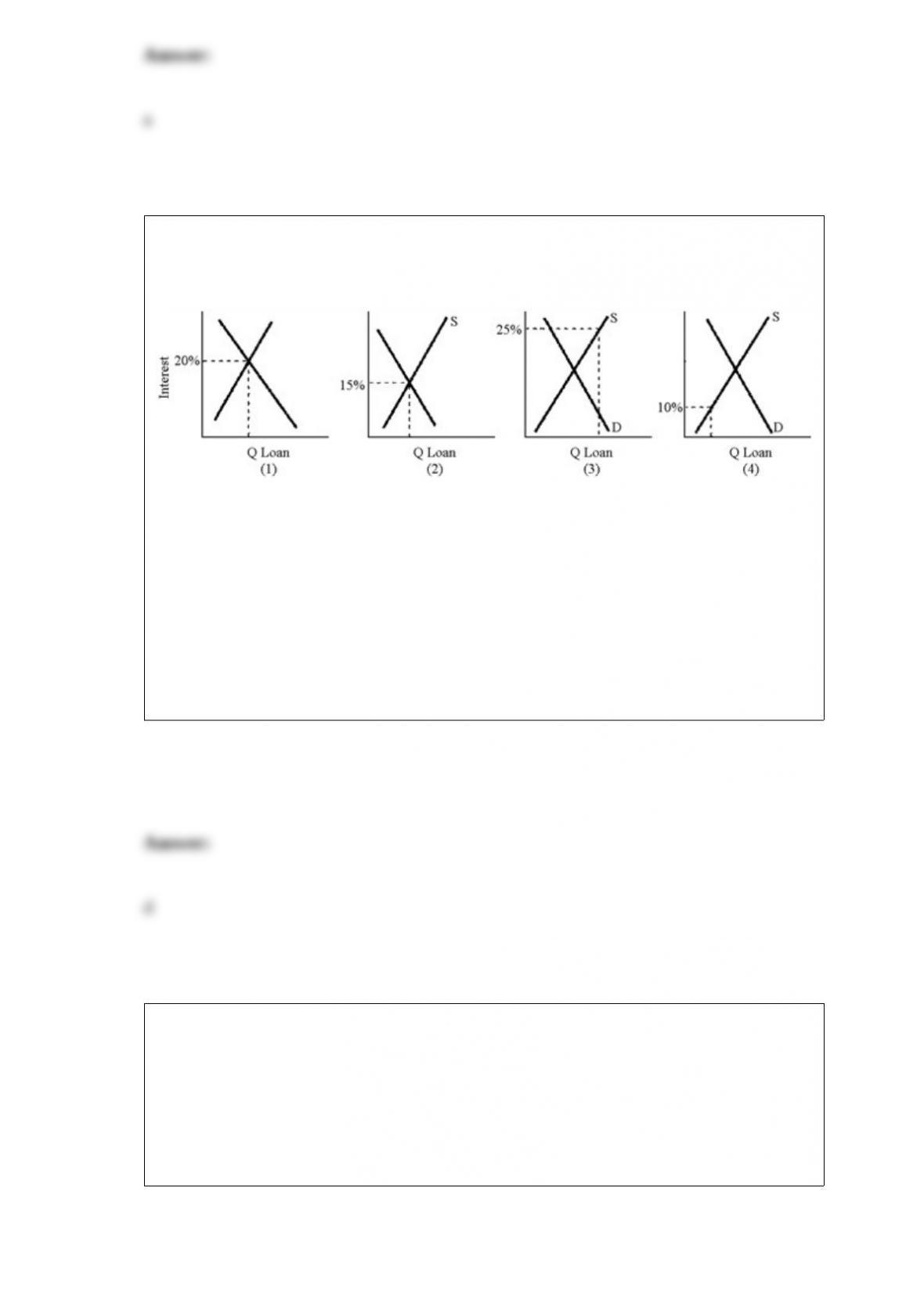
Figure 19-3
Which panel in Figure 19-3 represents the case of an effective usury law?
a. 1
b. 2
c. 3
d. 4
When unions and management fail to reach agreement and the public interest is
compromised, the government may require the union and management to undertake
mediation.
a. True
b. False

According to the principle of marginal productivity, the quantity of an input demanded
depends on the
a. price of the input.
b. price of outputs in which the input is used.
c. technology of production.
d. All of the above are correct.
Fractional reserve banking began as a search for
a. a different metallic monetary system.
b. additional sources of gold.
c. different types of borrowers.
d. additional profits.

The difference between slope and elasticity is that slope measures absolute change and
elasticity measures percentage change.
a. True
b. False
Which of the following observations is true?
a. Free markets will achieve all of society’s goals.
b. The ability to buy goods is divided equally among consumers.
c. The market deals with efficiency in production through the profit motive.
d. The market system encourages firms to use inputs wastefully.
If two families are equally situated except that one rents and the other owns their home,
the existing tax system will lead to
a. vertical inequity.
b. equal treatment of both.
c. horizontal inequity.
d. equal burden sharing.
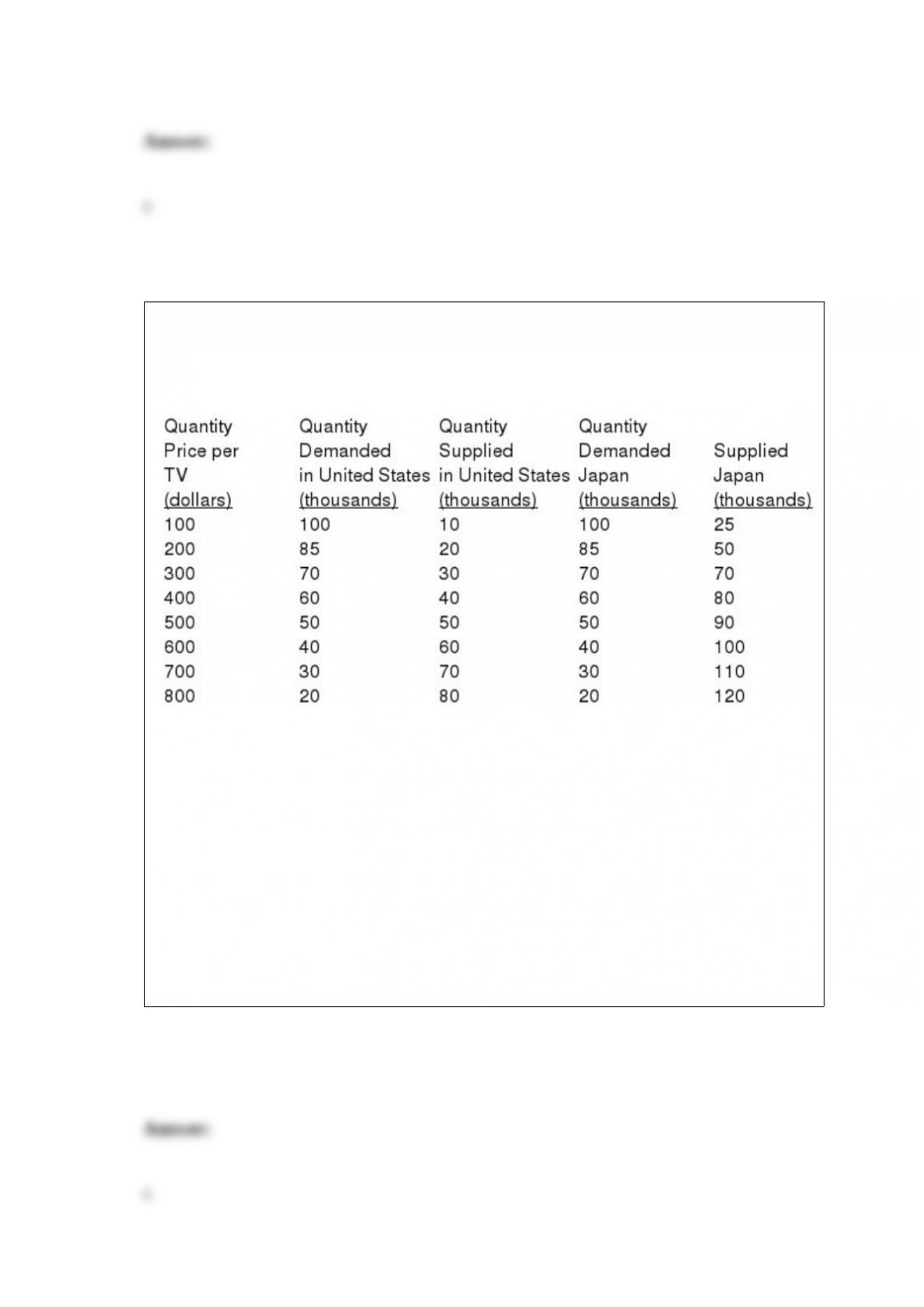
Table 22-4
Table 22-4 presents the demand and supply schedules for television sets in Japan and
the United States. If there is no trade between these countries, what are the equilibrium
price and quantity in Japan?
a. P = $100, Q = 100
b. P = $200, Q = 85
c. P = $300, Q = 70
d. P = $400, Q = 60

Which of the following should be subtracted while calculating aggregate demand of the
U.S.?
a. Pakistan’s purchase of F-16s from the U.S.
b. Computers imported by China from the U.S.
c. Memorabilia purchases in the U.S. by a foreign tourist.
d. A U.S. firm’s purchase of German machinery.
In the United States during the period from 1870 to 1940, the price level was most
likely to
a. fluctuate.
b. increase.
c. decrease.
d. trend generally upward.
The 2009 fiscal stimulus bill represented approximately
a. 5.5% of GDP and was designed to close the expansionary gap.
b. 5.5% of GDP and was designed to close the recessionary gap.

c. 7.8% of GDP and was designed to close the expansionary gap.
d. 7.8% of GDP and was designed to close the recessionary gap.
Two variables that systematically change together are correlated.
a. True
b. False
The head tax is regressive.
a. True
b. False

TANF sets a lifetime cap for benefits at 10 years.
a. True
b. False
Although asset price bubbles seem obvious after the fact, it is much more difficult to
draw such a conclusion before the fact.
a. True
b. False
If exchange rates are determined in a floating rate system, what determines the value of
a U.S. dollar in terms of euros?
a. government exchange rate policies
b. IMF rules and policies
c. demand and supply
d. central bank interventions

What is new about environmental problems today is
a. that for the first time in history we have environmental problems.
b. the increased rate at which air and water pollution is occurring in the United States.
c. the amount of attention the community now gives them.
d. that environmental problems with pollution and garbage disposal have almost
completely disappeared.
The government redistributes income to the poor, primarily through
a. progressive taxes.
b. transfer payments.
c. government purchases.
d. both a and b.

The term “fiscal federalism” refers to
a. deficit financing of government programs.
b. the power of Congress to tax and to determine how tax revenues are spent.
c. transferring money between levels of government (for example, from a state
government to a local government).
d. the system under which governments ask citizens to vote on major revenue-raising
measures (for example, on issues of municipal bonds).
Politicians and economists who are generally conservative tend to believe that
a. the self-correcting mechanism is slow and unpredictable.
b. the short-run Phillips curve is relatively steep.
c. the costs of unemployment are high.
d. expectations in reaction to policy measures are very slow to change.
The lion’s share of purchases and transactions in the U.S. economy are made with coins
and paper money.
a. True

b. False
One objection to supply-side tax cuts is that demand-side changes
a. are smaller than supply-side changes.
b. and supply-side changes are about equal.
c. are more unpredictable than supply-side changes.
d. are larger than supply-side changes.