
The total amount of producer surplus in a market is equal to the area below the supply
curve.
If the number of firms producing mouthwash increases and consumer preference for
mouthwash increases, the equilibrium price of mouthwash will definitely increase.
All of the following are critical functions of the government in facilitating the operation
of a market economy except
A) protecting private property.
B) enforcing property rights.
C) ensuring an equal distribution of income to all citizens.
D) enforcing contracts.
A decrease in the real interest rate will

A) cause consumers to spend less and save more.
B) most likely increase consumer’s purchases of durable goods.
C) most likely increase the reward to savings.
D) most likely increase the cost of borrowing.
A characteristic of the long run is
A) there are fixed inputs.
B) all inputs can be varied.
C) plant capacity cannot be increased or decreased.
D) there are both fixed and variable inputs
Using the Taylor rule, if the current inflation rate equals the target inflation rate and real
GDP is less than potential GDP, then the federal funds target rate ________ the sum of
the current inflation rate plus the real equilibrium federal funds rate.
A) will be greater than
B) will be less than
C) will be the same as
D) may be greater than or less than

When the government taxes a good or service, it
A) affects the market equilibrium for that good or service.
B) eliminates the deadweight loss associated with the good or service.
C) increases consumer surplus for the good or service.
D) increases producer surplus for the good or service.
Mike has been unemployed for over a year. He hasn’t looked for a job in the last three
months, but he’s just started looking for work again. Because Mike started looking for a
new job,
A) the unemployment rate increased.
B) the labor force participation rate decreased.
C) the unemployment rate decreased.
D) the working-age population increased.

If we have information about workers’ marginal products, then total and average
product can be found by
A) dividing marginal costs by the number of workers.
B) multiplying the average marginal product times the number of workers.
C) summing the marginal values to find the total and multiplying it times the number of
workers to get the average.
D) summing the marginal values to find the total and dividing it by the number of
workers to get the average.
How has organizing a successful firm in a market economy changed over the last
century?
A) It has become easier as more and more firms discover how to do it.
B) As government intervention has decreased, firms now have more freedom.
C) There has been no change one way or the other over the last century.
D) It has become more difficult to organize an efficient and successful firm.
The price a perfectly competitive firm receives for its output
A) is determined by the interaction of the firm and all of the consumers who buy from
the firm.
B) is determined by the interaction of all sellers and all buyers in the firm’s market.
C) will not change in response to changes in market demand and supply because the
firm is a price taker.
D) will be lowered by the firm in order to sell more output.
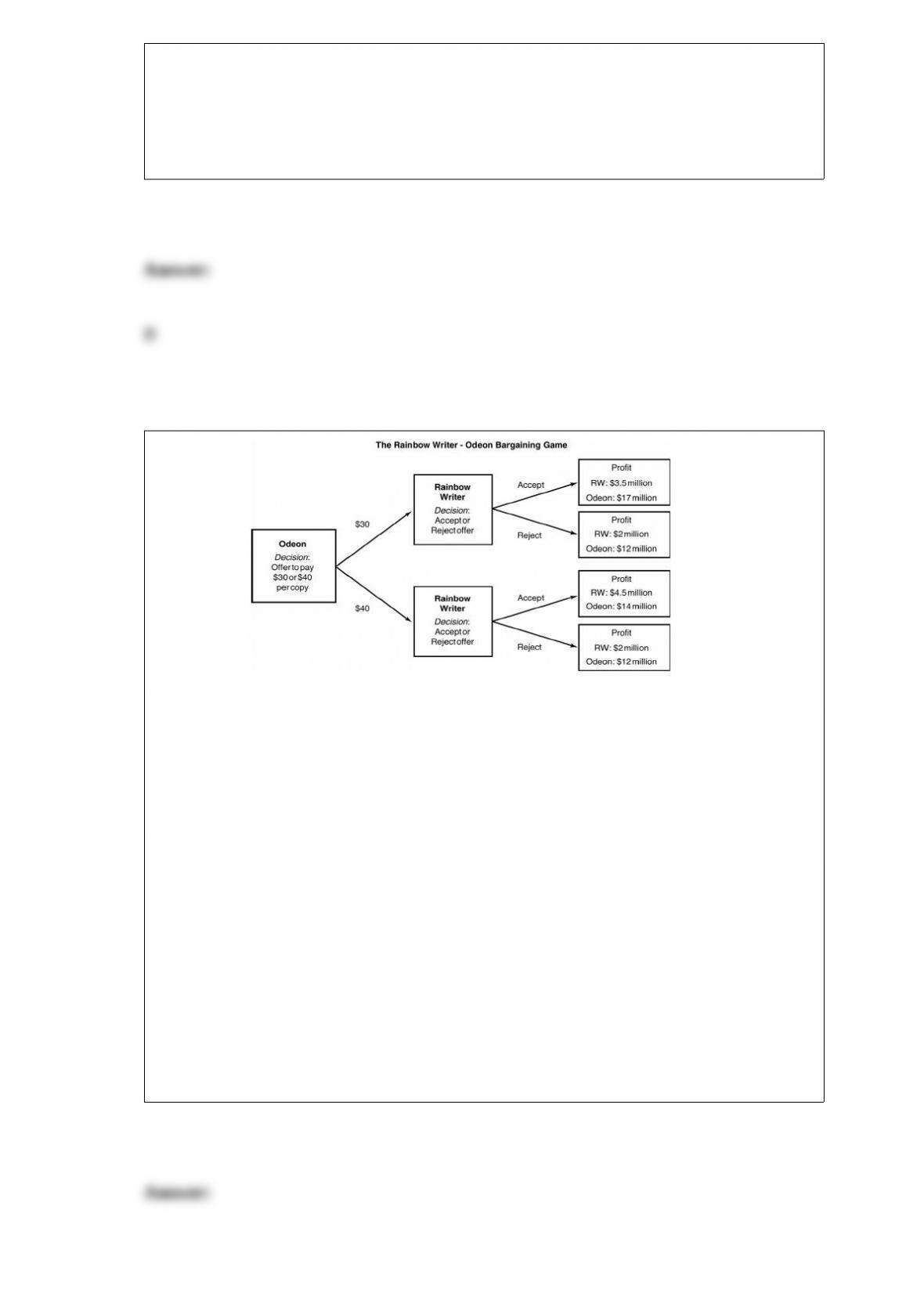
Figure 14-4 Rainbow Writer
(RW) is a small online company selling a highly rated software package for printing
color labels directly onto CDs. The firm currently earns a profit of $2 million per year
selling its package exclusively on its Web site. Odeon, the producer of the most popular
software package for editing and burning CDs and DVDs, has expressed interest in
bundling Rainbow Writer’s product into its own package. Odeon expects that bundling
would further boost its sales and allow it to sell the new bundled product at a higher
price, thus raising its profits beyond its current profit of $12 million. Figure 14-4 shows
the decision tree for the Rainbow Writer-Odeon bargaining game.
How will Rainbow Writer respond to Odeon’s two possible offers?
A) Rainbow Writer will reject either offer.
B) Rainbow Writer will only accept an offer of $30 per copy of the software package.
C) Rainbow Writer will only accept an offer of $40 per copy of the software package.
D) Rainbow Writer will accept either offer.
At the profit-maximizing level of output for a perfectly competitive firm
A) price equals marginal cost.
B) average revenue equals average variable cost and price equals marginal cost.
C) marginal revenue equals marginal cost and average total cost equals average fixed
cost.
D) price equals average revenue and marginal cost equals average variable cost.
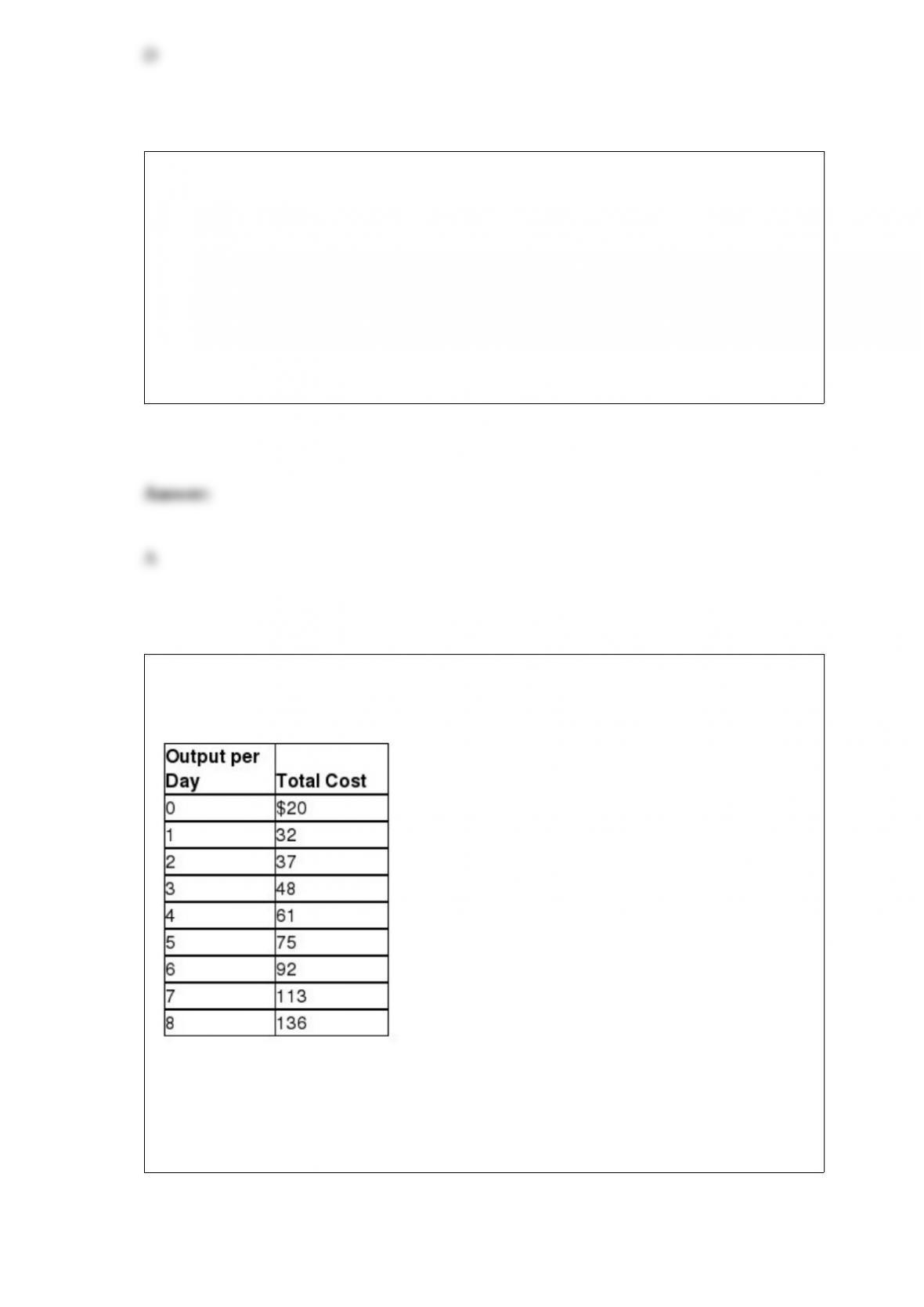
Suppose Veronica sells teapots in the perfectly competitive teapot market. Her output
per day and her costs are as follows:
Suppose the current equilibrium price in the teapot market is $20. To maximize profit,
how many teapots will Veronica produce, what price will she charge, and how much
profit (or loss) will she make? Draw a graph to illustrate your answer. Your graph
should include Veronica’s demand, ATC, AVC, MC, and MR curves, the price she is
charging, the quantity she is producing, and the area representing her profit (or loss).
Suppose real GDP is currently $12.5 trillion and potential real GDP is $13 trillion. If the
president and the Congress increased government purchases by $500 billion, what
would be the result on the economy?
What is the difference between the nominal interest rate and the real interest rate?
Assume that it will cost a plumber an additional $35,000 each year by keeping her shop
open for one additional hour per week. What must the additional revenue from keeping
the shop open this additional hour per week be to make staying open for the extra hour
economically rational?
How effective is discount policy as compared to open market operations in managing
the money supply? Explain how The Federal Reserve uses discount policy today.
What is the principle-agent problem?
How will an increase in federal government spending without an increase in taxes affect
real GDP and the price level in the short run in a closed economy and in an open
economy?