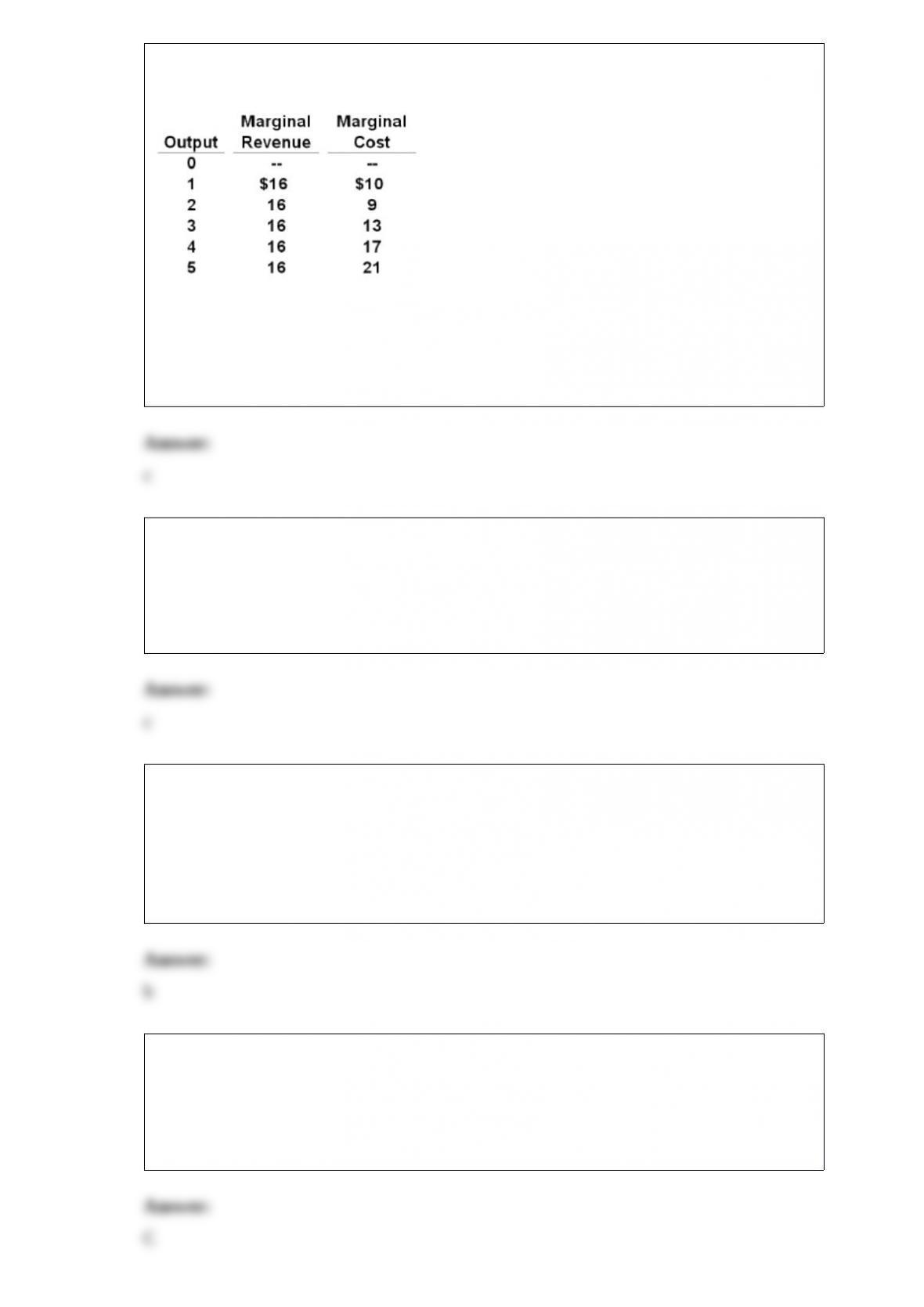
1) the following data confronting a firm:
refer to the above data. this firm is selling its output in a(n):
a.imperfectly competitive market.
b.monopolistic market.
c.purely competitive market.
d.oligopolistic market.
2) assuming a pure monopolist’s demand curve is downsloping, its total revenue:
a.is rising.
b.is falling.
c.may be either rising or falling.
d.must be negative.
3) the lowest point on a purely competitive firm’s short-run supply curve corresponds
to:
a.the minimum point on its atc curve.
b.the minimum point on its avc curve.
c.the minimum point on its afc curve.
d.the minimum point on its mc curve.
4) Where there is asymmetric information between buyers and sellers.
A.product shortages will occur at the equilibrium price.
B.product surpluses will occur at the equilibrium price.
C.markets can produce inefficient outcomes.
D.markets will fail due to the “free-rider problem.”

5) determine, other things equal, the effects of a given change in a determinant of
demand or supply for product x upon (1) the demand (d) for, or supply (s) of, x, (2) the
equilibrium price (p) of x and (3) the equilibrium quantity (q) of x.
refer to the above. an increase in the prices of resources used to produce x will:
a.increase s, increase p, and increase q.
b.increase d, increase p, and increase q.
c.decrease s, decrease p, and decrease q.
d.decrease s, increase p, and decrease q.
6) As compared to a purely competitive labor market, in a nonunionized monopsonistic
labor market wages:
A.and employment will both be lower.
B.will be higher, but employment will be lower.
C.will be lower, but employment will be higher.
D.and employment will both be higher.
7) in 2005, tatum’s nominal income rose by 4.6 percent and the price level rose by 1.6
percent. we can conclude that tatum’s real income:
a.may have either increased or decreased.
b.rose by approximately 6.2 percent.
c.rose by approximately 3 percent.
d.fell by approximately 13 percent.
8) which of the following economic regions has experienced the least growth in real
gdp per capita since 1820?
a.africa
b.asia excluding japan
c.latin america
d.western europe
9) The crowding-out effect is:
A.strongest when the economy is at full employment.
B.strongest when the economy is in a deep recession.
C.weakest when there is demand-pull inflation.
D.equally strong, regardless of the state of the macroeconomy.
10) health care expenditures coming directly out of consumers’ pockets, primarily in the
form of deductibles and copayments, account for what percent of u.s. health care
spending?
a.19 percent.
b.34 percent.
c.47 percent.
d.81 percent.
11) the natural rate of unemployment is:
a.higher than the full-employment rate of unemployment.
b.lower than the full-employment rate of unemployment.
c.that rate of unemployment occurring when the economy is at its potential output.
d.found by dividing total unemployment by the size of the labor force.
12)
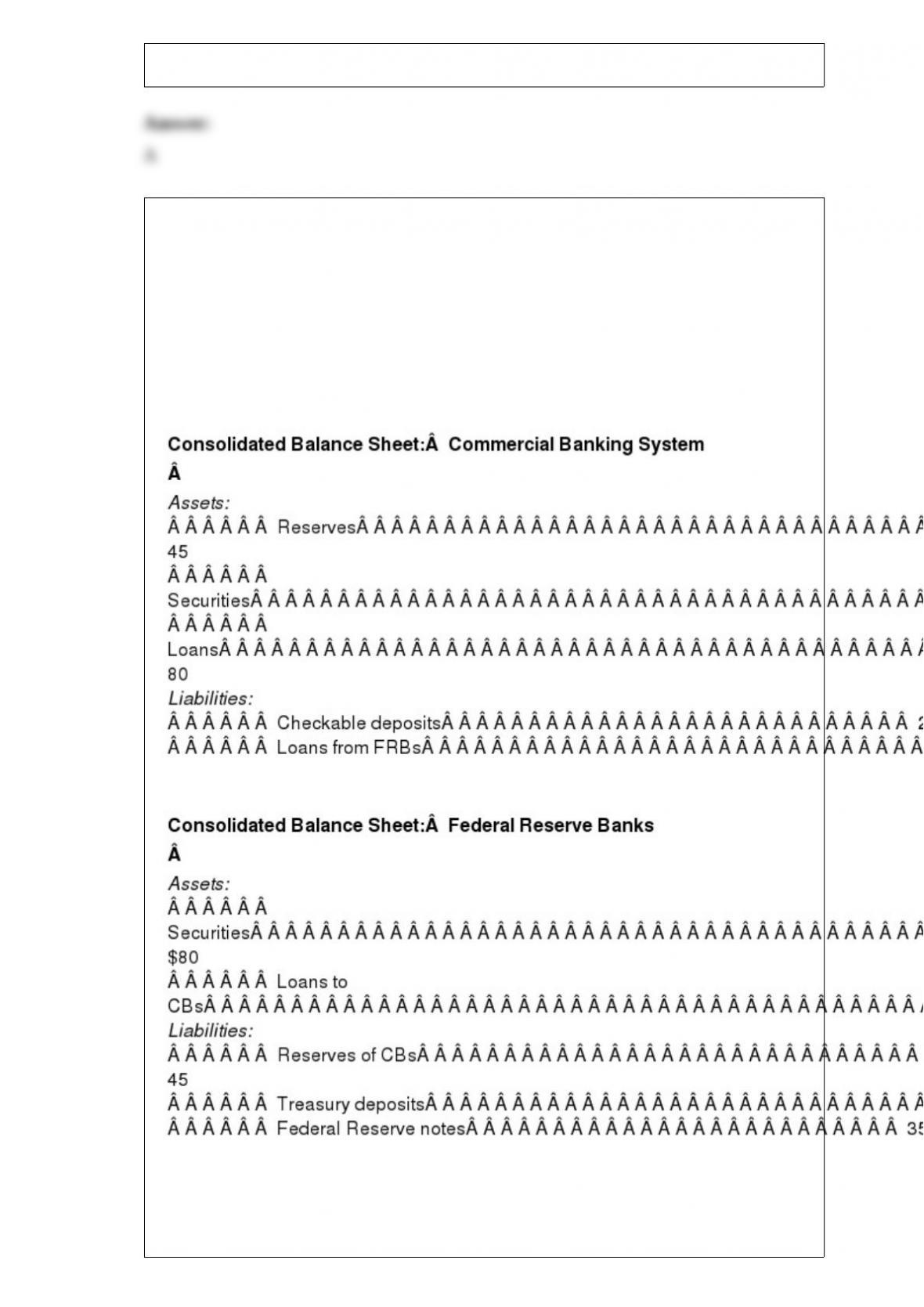
Refer to the above diagram of the market for product X. Curve St embodies all costs
(including externalities) and Dt embodies all benefits (including externalities)
associated with the production and consumption of X. Assuming the equilibrium output
is Q2, we can conclude that the existence of external:
A.costs has resulted in an overallocation of resources to X.
B.benefits has resulted in an overallocation of resources to X.
C.costs has resulted in an underallocation of resources to X.
D.benefits has resulted in an underallocation of resources to X.
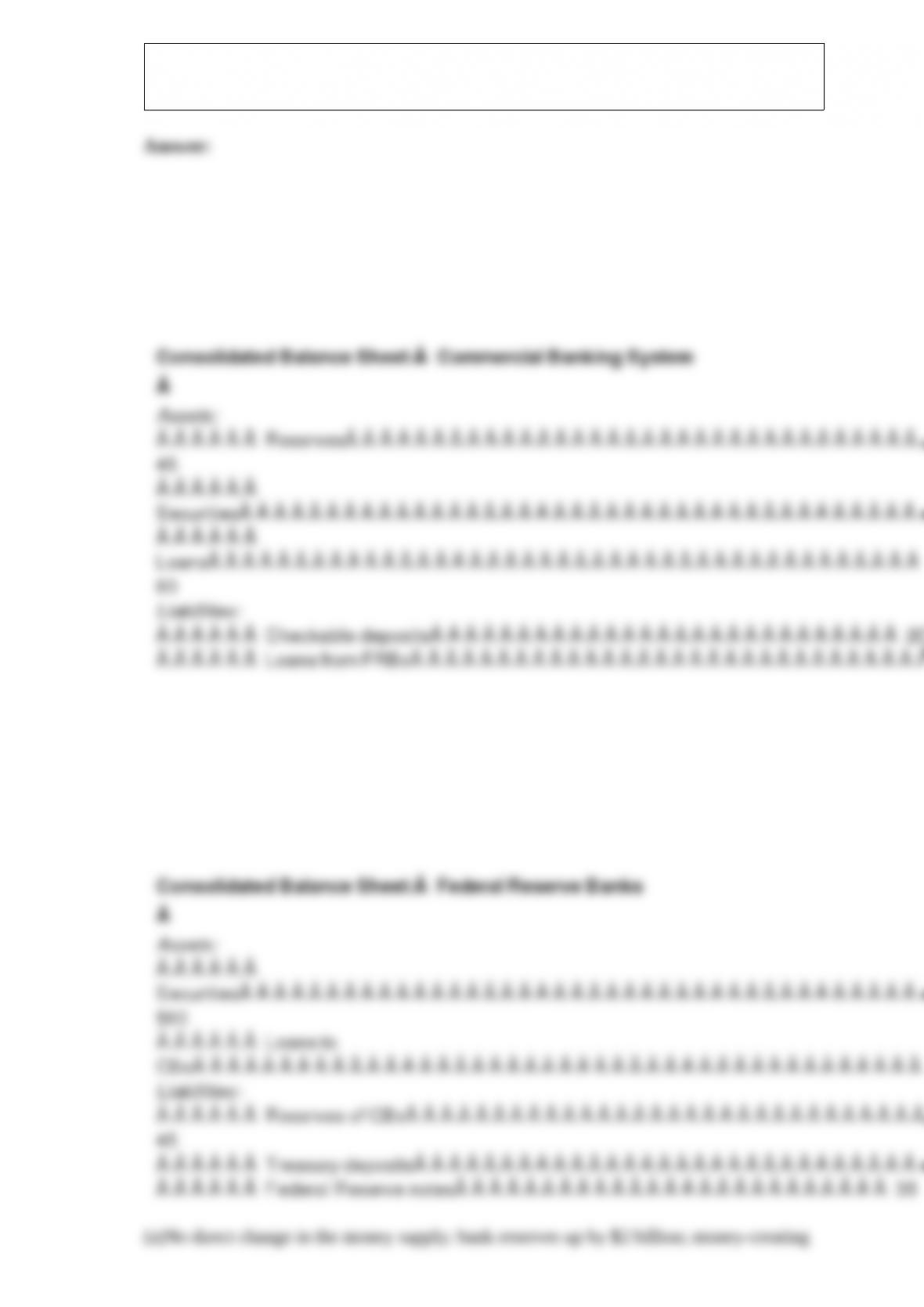
13) The following are simplified balance sheets for the commercial banking system and
the Federal Reserve system. Perform each of the following three transactions, a, b, and
c, making appropriate changes in columns (1) through (3) in each balance sheet. Do not
cumulate your answers. Also, answer these three questions for each part: (a) What
change, if any, took place in the money supply as a direct result of this transaction? (b)
What change, if any, occurred in commercial bank reserves? (c) What change occurred
in the money-creating potential of the commercial banking system if the reserve ratio is
20%? All figures are in billions of dollars.
(a)Suppose a drop in the discount rate causes commercial banks to borrow an additional
$2 billion from the Fed. Show the new sheet figures in column 1.
(b)The Fed buys $3 billion of government bonds from the public. Show the new sheet
figures in column 2.
(c)The Treasury spends $1 billion on research on new farm products. Show the new
sheet figures in column 3.

14) Answer the next question(s) on the basis of the following list of assets:
1> Large ($100,000 and over) time deposits
2> Noncheckable savings deposits
3> Currency (coins and paper money)
4> Small (under $100,000) time deposits
5> Stock certificates
6> Checkable deposits
7>Money market deposit accounts
8>Money market mutual fund balances held by individuals
9>Money market mutual fund balances held by businesses
Refer to the above list. Which of the following are considered to be “near-monies?”
A.items 2, 5, 8, and 9
B.all items except for 3
C.items 2, 4, 7, and 8
D.items 1 and 5
15) The Clayton Act of 1914:
A.outlawed price discrimination, tying contracts, intercorporate stockholding, and
interlocking directorates that lessen competition.
B.prohibited unfair or deceptive acts or practices in commerce that tend to reduce
competition.
C.outlawed vertical and conglomerate mergers.
D.prohibited one firm from acquiring the assets of another when the effect was to limit
competition.
16) the following is cost information for the creamy crisp donut company:
entrepreneur’s potential earnings as a salaried worker = $50,000
annual lease on building = $22,000
annual revenue from operations = $380,000
payments to workers = $120,000
utilities (electricity, water, disposal) costs = $8,000

value of entrepreneur’s talent in the next best entrepreneurial activity = $80,000
entrepreneur’s forgone interest on personal funds used to finance the business = $6,000
refer to the above data. creamy crisp’s total economic costs (explicit + implicit costs,
including a normal profit) are:
a.$286,000.
b.$150,000.
c.$94,000.
d.$156,000.
17) The Federal Reserve System was created in:
A.1926.
B.1946.
C.1895.
D.1913.
18) The total global demand for resources is expected to:
A.increase for the coming decades, but eventually peak and decline.
B.increase indefinitely.
C.decrease for the coming decades, and eventually flatten out.
D.plateau for the coming decades and then increase exponentially.