
The factor accounting for the steepest rise in the currency ratio since 1892 is
a. taxes.
b. bank panics.
c. illegal activity.
d. an increase in wealth.
Answer:
If the required reserve ratio is 10 percent, currency in circulation is $400 billion,
checkable deposits are $1000 billion, and excess reserves total $1 billion, then the
monetary base is
a. $400 billion.
b. $401 billion.
c. $500 billion.
d. $501 billion.
Answer:
A hyperinflation is

A. a period of extreme inflation generally greater than 50% per month.
B. a period of anxiety caused by rising prices.
C. an increase in output caused by higher prices.
D. impossible today because of tighter regulations.
Answer:
China chooses to have ________ and ________ and therefore, cannot have free capital
mobility at the same time.
A) a fixed exchange rate; no control of monetary policy
B) a fixed exchange rate; an independent monetary policy
C) a flexible exchange rate; an independent monetary policy
D) a flexible exchange rate; no control of monetary policy
Answer:
The percentage of deposits that banks must hold in reserve is the
A. excess reserve ratio.
B. required reserve ratio.

C. total reserve ratio.
D. currency ratio.
Answer:
A decrease in the expected future domestic exchange rate causes the demand for
domestic assets to shift to the ________ and the domestic currency to ________,
everything else held constant.
A. right; appreciate
B. right; depreciate
C. left; appreciate
D. left; depreciate
Answer:
You would be more willing to buy AT&T bonds (holding everything else constant) if
A. the brokerage commissions on bond sales become cheaper.
B. interest rates are expected to rise.
C. your wealth has decreased.

D. you expect diamonds to appreciate in value.
Answer:
You can borrow $5000 to finance a new business venture. This new venture will
generate annual earnings of $251. The maximum interest rate that you would pay on the
borrowed funds and still increase your income is
A. 25%.
B. 12.5%.
C. 10%.
D. 5%.
Answer:
In response to the overvalued dollar in the early 1970s, the German Bundesbank bought
________ and sold ________ to keep the exchange rate fixed, gaining international
reserves.
A) marks; dollars
B) marks; pounds
C) dollars; marks
D) dollars; pounds
Answer:
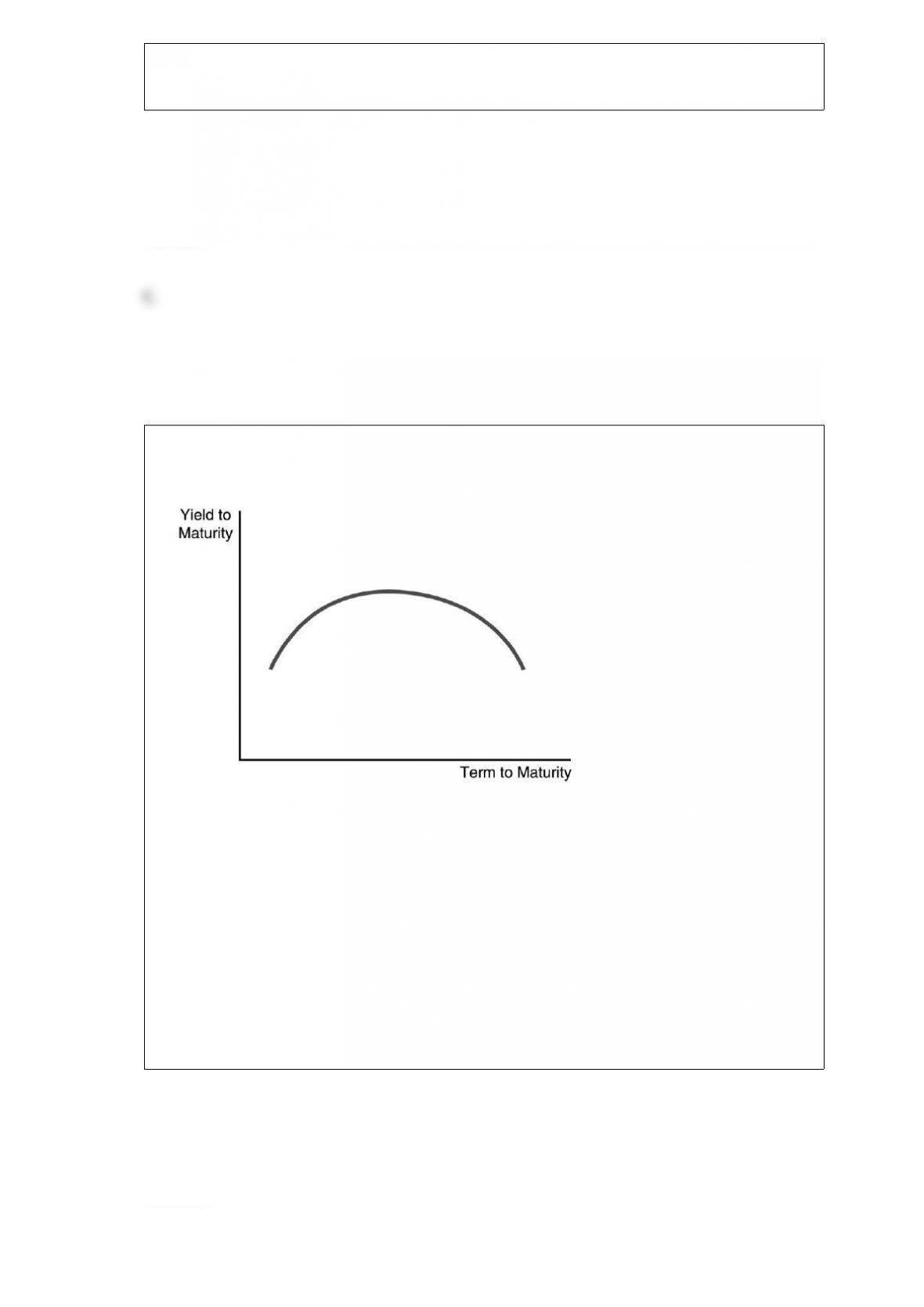
The mound-shaped yield curve in the figure above indicates that short-term interest
rates are expected to
A. rise in the near-term and fall later on.
B. fall moderately in the near-term and rise later on.
C. fall sharply in the near-term and rise later on.
D. remain unchanged in the near-term and fall later on.
Answer:

In the equation of exchange, the concept that provides the link between M and PY is
called
A. the velocity of money.
B. aggregate demand.
C. aggregate supply.
D. the money multiplier.
Answer:
Newly-issued high-yield bonds rated below investment grade by the bond-rating
agencies are frequently referred to as
A. municipal bonds.
B. Yankee bonds.
C. “fallen angels.”
D. junk bonds.
Answer:

A ________ pays out cash flows from a collection of assets in different tranches, with
the highest-rated tranch paying out first, while lower ones paid out less if there are
losses on the underlying assets.
A. collateralized debt obligation (CDO)
B. adjustable-rate mortgage
C. negotiable CD
D. discount bond
Answer:
Keynes hypothesized that the precautionary component of money demand was
primarily determined by the level of
A. interest rates.
B. velocity.
C. income.
D. stock market prices.
Answer:

________ in the domestic interest rate causes the demand for domestic assets to
________ and the domestic currency to appreciate, everything else held constant.
A. An increase; increase
B. An increase; decrease
C. A decrease; increase
D. A decrease; decrease
Answer:
In a business cycle expansion, the ________ of bonds increases and the ________
curve shifts to the ________ as business investments are expected to be more
profitable.
A. supply; supply; right
B. supply; supply; left
C. demand; demand; right
D. demand; demand; left
Answer:
The Depository Institutions Deregulation and Monetary Control Act of 1980

A. established higher reserve requirements for nonmember than for member banks.
B. established higher reserve requirements for member than for nonmember banks.
C. abolished reserve requirements.
D. established uniform reserve requirements for all banks.
Answer:
Predicting the impact of institutional change on the effectiveness of monetary policy is
best done with a
A. structural model.
B. reduced-form model.
C. black-box model.
D. scientific model.
Answer:
Under an exchange-rate targeting rule for monetary policy, a crawling peg
A) fixes the value of the domestic currency to a commodity such as gold.

B) fixes the value of the domestic currency to that of a large, low-inflation country.
C) allows the domestic currency to depreciate at a steady rate so that inflation in the
pegging country can be higher than that of the anchor country.
D) allows the domestic currency to depreciate at a steady rate so that inflation in the
pegging country can be lower than that of the anchor country.
Answer:
Under the Gramm-Leach-Bliley Act states retain regulatory authority over
A) bank holding companies.
B) securities activities.
C) insurance activities.
D) bank subsidiaries engaged in securities underwriting.
Answer:
Large fluctuations in money supply growth and smaller fluctuations in the federal funds
rate between October 1982 and the early 1990s indicate that the Fed had shifted to
________ as an operating target.
A. borrowed reserves

B. nonborrowed reserves
C. excess reserves
D. required reserves
Answer:
Prices of money market instruments undergo the least price fluctuations because of
A. the short terms to maturity for the securities.
B. the heavy regulations in the industry.
C. the price ceiling imposed by government regulators.
D. the lack of competition in the market.
Answer:
Higher tariffs and quotas cause a country’s currency to ________ in the ________ run,
everything else held constant.
A. depreciate; short
B. appreciate; short
C. depreciate; long

D. appreciate; long
Answer:
Everything else held constant, when output is ________ the natural rate level, wages
will begin to ________, increasing short-run aggregate supply.
A. above; fall
B. above; rise
C. below; fall
D. below; rise
Answer:
If unplanned investment is positive, firms will ________ production and output will
________.
A. cut; rise
B. cut; fall
C. increase; rise
D. increase; fall

Answer:
In the FOMC’s “Statement on Long-Run Goals and Monetary Policy Strategy,”the
FOMC agreed to a single numerical value of the inflation objective, 2% on the
________.
A. PCE deflator
B. GDP deflator
C. CPI
D. PPI
Answer:
A swap that involves the exchange of one set of interest payments for another set of
interest payments is called
A. an interest rate swap.
B. a currency swap.
C. a swaption.
D. an international swap.

Answer:
One of the concerns of increased bank consolidation is the reduction in community
banks which could result in
A) less lending to small businesses.
B) loss of cultural identity.
C) higher interest rates.
D) more bank regulation.
Answer:
A $5 million deposit outflow from a bank has the immediate effect of
A. reducing deposits and reserves by $5 million.
B. reducing deposits and loans by $5 million.
C. reducing deposits and securities by $5 million.
D. reducing deposits and capital by $5 million.
Answer:

An expansionary monetary policy lowers the real interest rate, causing the domestic
currency to ________, thereby ________ net exports.
A. appreciate; raising
B. appreciate; lowering
C. depreciate; raising
D. depreciate; lowering
Answer:
________ in the foreign interest rate causes the demand for domestic assets to decrease
and the domestic currency to ________, everything else held constant.
A. An increase; appreciate
B. An increase; depreciate
C. A decrease; appreciate
D. A decrease; depreciate
Answer:

A bank will want to hold more excess reserves (everything else equal) when
A. it expects to have deposit inflows in the near future.
B. brokerage commissions on selling bonds increase.
C. the cost of selling loans falls.
D. the discount rate decreases.
Answer:
The discount rate is
A. the interest rate the Fed charges on loans to banks.
B. the price the Fed pays for government securities.
C. the interest rate that banks charge their most preferred customers.
D. the price banks pay the Fed for government securities.
Answer:
Explain the Fed’s three tools of monetary policy and how each is used to change the
money supply. Does each tool affect the monetary base or the money multiplier?
Answer:
Explain the traditional interest-rate channel for expansionary monetary policy. Explain
how a tight monetary policy affects the economy through this channel.
Answer:
Explain why the simple deposit multiplier overstates the true deposit multiplier.
Answer:
Explain and show graphically the effect of an increase in the expected inflation rate on
the equilibrium exchange rate, everything else held constant.
Answer:
Keynes believed that unstable investment caused the Great Depression. Using the
simple Keynesian model, explain how a fall in investment affects equilibrium output.
Answer:
What rights does ownership interest give stockholders?
Answer:
How can specializing in lending help to reduce the adverse selection problem in
lending?
Answer:
Who are the voting members of the Federal Open Market Committee and why is this
committee important? Where does the power lie within this committee?
Answer:
Explain the 1992 crisis that led to the breakdown of the European Union’s Exchange
Rate Mechanism. What disadvantages of exchange-rate targeting were exhibited during
this crisis?
Answer:
What is the impact on interest rates when the Federal Reserve decreases the money
supply by selling bonds to the public?
Answer:
Explain the margin requirement for financial futures and how marking to market affects
the margin account.
Answer:
What factors have slowed down the movement to a system where all payments are
made electronically?
Answer:
Explain two concepts of central bank independence. Is the Fed politically independent?
Why do economists think central bank independence is important?
Answer:
If a higher inflation is expected, what would you expect to happen to the shape of the
yield curve? Why?
Answer:

Using the liquidity preference framework, what will happen to interest rates if the Fed
increases the money supply?
Answer:
Corporations receive funds when their stock is sold in the primary market. Why do
corporations pay attention to what is happening to their stock in the secondary market?
Answer:
Explain the time-inconsistency problem. What is the likely outcome of discretionary
policy? What are the solutions to the time-inconsistency problem?
Answer:
From 1980-1985, the dollar strengthened in value against other currencies. Who was
helped and who was hurt by this strong dollar?
Answer:
What two key factors trigger speculative attacks leading to currency cries in emerging
market countries?
Answer: