
1) In 2007, about ____ percent of employed wage and salary workers belonged to
unions.
A.20.3
B.6.8
C.10.4
D.12.1
2) a firm can sell more or less output at a constant price. demand is thus:
a.perfectly inelastic.
b.perfectly elastic.
c.relatively inelastic.
d.relatively elastic.
3) The incidence of an excise tax is:
A.such that the tax is progressive in its effect.
B.distributed among the consumer and the seller in a manner determined by the
elasticities of demand and supply.
C.upon the consumer of the product.
D.upon the seller of the product.
4) Suppose Leslie is considering developing an asset portfolio. She must receive a
minimum of 5% to compensate for her delayed consumption and given her investment
bundle, receive 10% in return.
(a)What is if?
(b)What is the risk premium?
(c)What is the average expected return?
5) Government-provided foreign aid to developing countries has:
A.averaged about 1 percent of the IACs GDP each year.
B.increased sharply since 1995.
C.dwarfed the size of foreign direct investment to the DVC in recent years.
D.declined from 1995 to 1999, but has rebounded sharply in recent years.
6) according to estimates, what percentage of cleaning workers in the united states are
illegal immigrants?
a.12
b.17
c.24
d.43
7) Planned investment equals saving:
A.at all levels of GDP.
B.at all below-equilibrium levels of GDP.
C.at all above-equilibrium levels of GDP.
D.only at the equilibrium GDP.
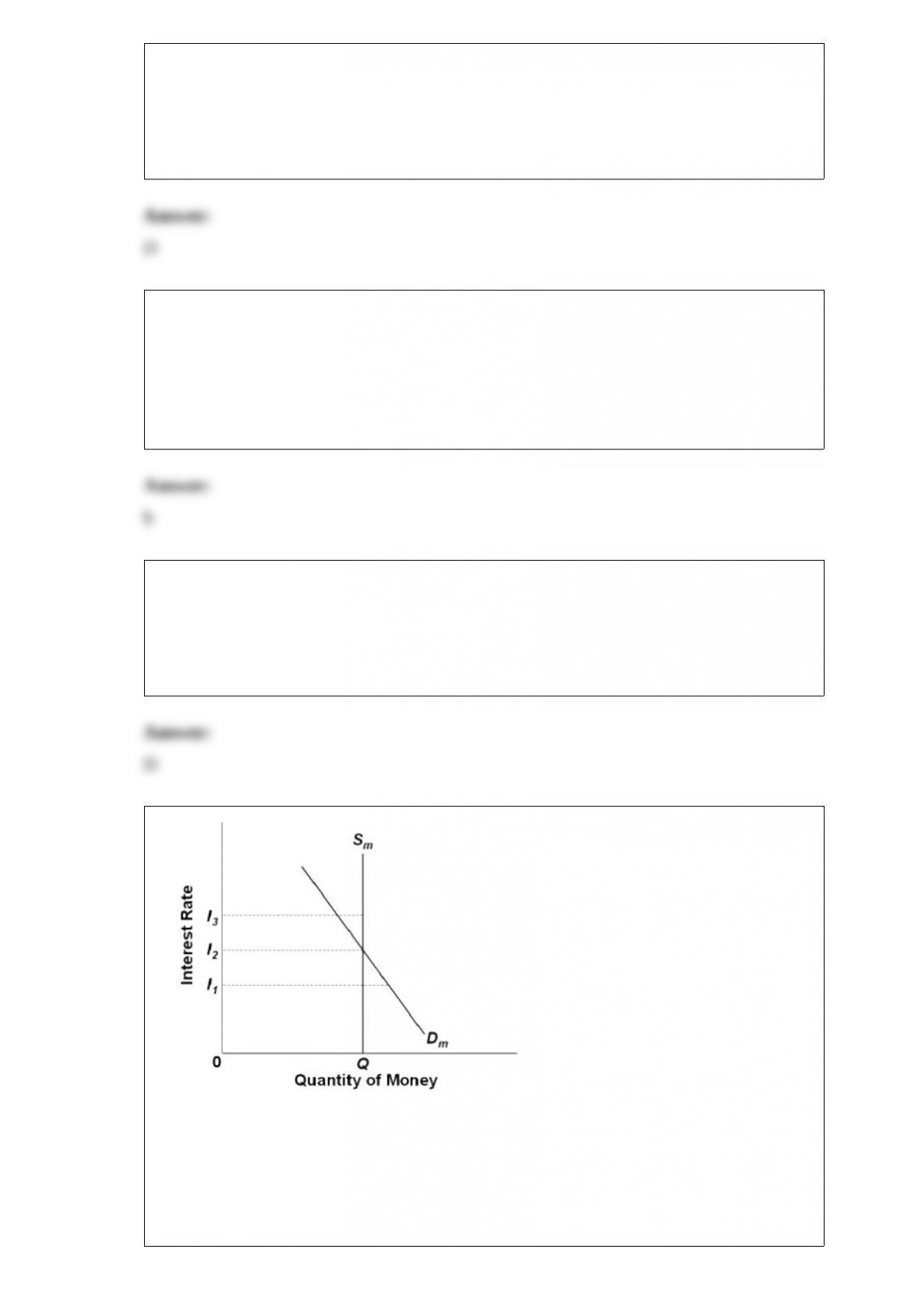
8)
Refer to the above diagram of the market for money. Given Dm and Sm, an interest rate
of i3 is not sustainable because the:
A.supply of bonds in the bond market will decline and the interest rate will rise.
B.supply of bonds in the bond market will increase and the interest rate will decline.
C.demand for bonds in the bond market will decline and the interest rate will rise.
D.demand for bonds in the bond market will rise and the interest rate will fall.
9) the economic function of profits and losses is to:
a.bring about a more equal distribution of income.
b.signal that resources should be reallocated.
c.eliminate small firms and reduce competition.
d.tell government which industries need to be subsidized.
10) The distribution of U.S. income by quintiles:
A.reveals a marked increase in the relative importance of the middle class between
1970 and 2006.
B.has been unchanged since 1970.
C.shows a movement toward greater inequality since 1970.
D.shows a movement toward greater equality since 1970.
11) Imports have the same effect on the current size of GDP as:
A.exports.
B.investment.
C.consumption.
D.saving.
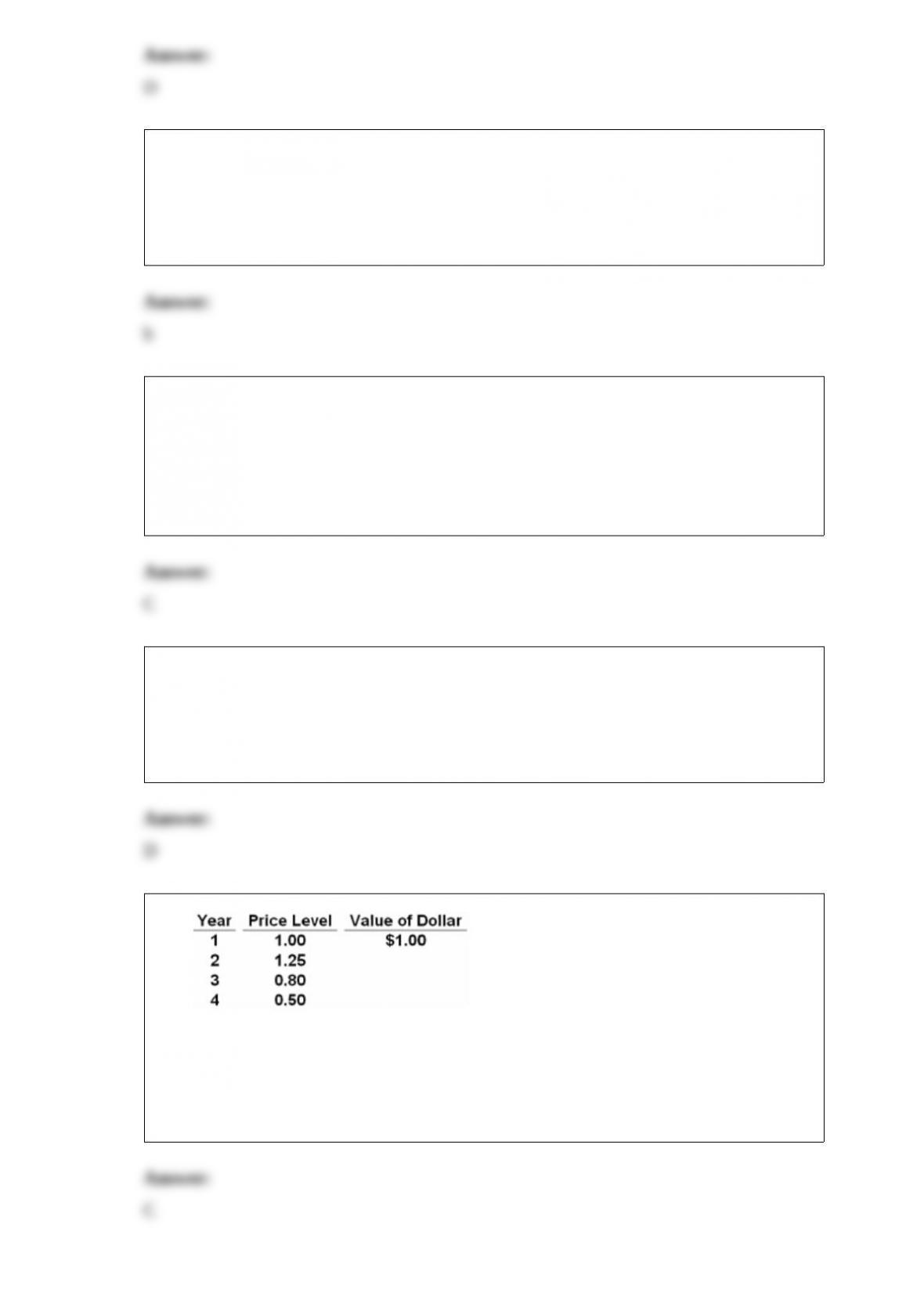
12)
Refer to the above table. The value of the dollar in year 2 is:
A.$1.25.
B.$1.33.
C.$.80.
D.$1.00.

13) gdp is the:
a.national income minus all non-income charges against output.
b.monetary value of all final goods and services produced within the borders of a nation
in a particular year.
c.monetary value of all economic resources used in producing a year’s output.
d.monetary value of all goods and services, final and intermediate, produced in a
specific year.
14) Marginal revenue product measures the:
A.amount by which the extra production of one more worker increases a firm’s total
revenue.
B.decline in product price that a firm must accept to sell the extra output of one more
worker.
C.increase in total resource cost resulting from the hire of one extra unit of a resource.
D.increase in total revenue resulting from the production of one more unit of a product.
15) In a certain year the aggregate amount demanded at the existing price level consists
of $100 billion of consumption, $40 billion of investment, $10 billion of net exports,
and $20 billion of government purchases. Full-employment GDP is $200 billion. To
obtain full employment under these conditions the government should:
A.encourage personal saving by increasing the interest rate on government bonds.
B.decrease government expenditures.
C.reduce tax rates and/or increase government spending.
D.discourage private investment by increasing corporate income taxes.