
1) Present law forbids all trades or sales of pollution rights.
2) water has greater marginal utility than diamonds, yet diamonds have greater total
utility than water.
3) If you pay a $1,000 tax on $10,000 of taxable income and a $3,000 tax on a taxable
income of $16,000, the tax is progressive.
4) market economies use capital goods because they improve productive efficiency.
5) The Clean Air Act of 1990 established a program for trading emission rights.
6) because of the ability to influence price, a pure monopolist can increase price and
increase volume of sales simultaneously.
7) if nominal gdp is 150 and the gdp price index is 200, real gdp is 75.
8) For an open mixed economy the equilibrium level of GDP is determined where Sa +
Ig + X = T + G.

9) The crowding-out effect refers to the possibility that deficit spending may motivate
people to increase their saving in anticipation of higher future taxes.
10) A firm’s optimal amount of R&D occurs where the interest-rate cost of funds and
the expected rate of return are equal.
11) real gdp per capita is found by dividing real gdp by the size of the labor force.
12) in the short run a pure monopolist will maximize profits by producing at that level
of output where the difference between price and average total cost is at a maximum.
13) the demand for health care in the united states is price:
a.elastic and, according to some studies, income inelastic.
b.elastic and, according to some studies, income elastic.
c.inelastic and, according to some studies, income inelastic.
d.inelastic and, according to some studies, income elastic.
14) which of the following constitutes an implicit cost to the johnston manufacturing
company?
a.payments of wages to its office workers
b.rent paid for the use of equipment owned by the schultz machinery company
c.depreciation charges on company-owned equipment
d.economic profits resulting from current production
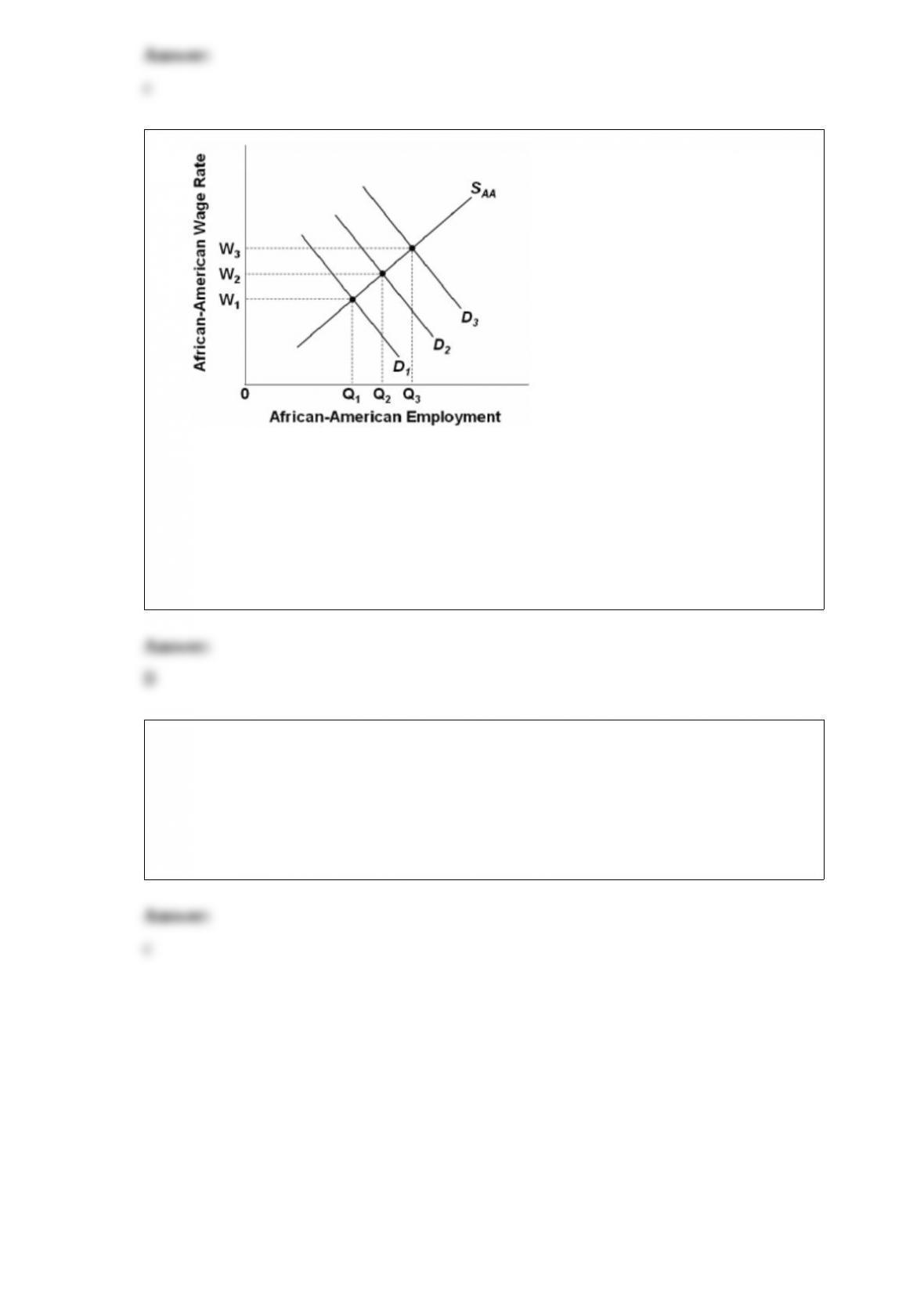
15)
Refer to the above diagram. Which of the following would be consistent with an
increase in racial prejudice against African-Americans and thus an increase in the
discrimination coefficients of employers, taken as a group?
A.a shift in the labor demand curve from D2 to D3.
B.a shift in the labor demand curve from D2 to D1.
C.an increase in African-American employment from Q2 to Q3.
D.an increase in the African-American wage rage from W1 to W2.
16) in 2007, “tax-freedom day” (the day average workers have earned enough to pay
their tax bills) was:
a.march 21
b.april 15
c.april 30
d.july 7
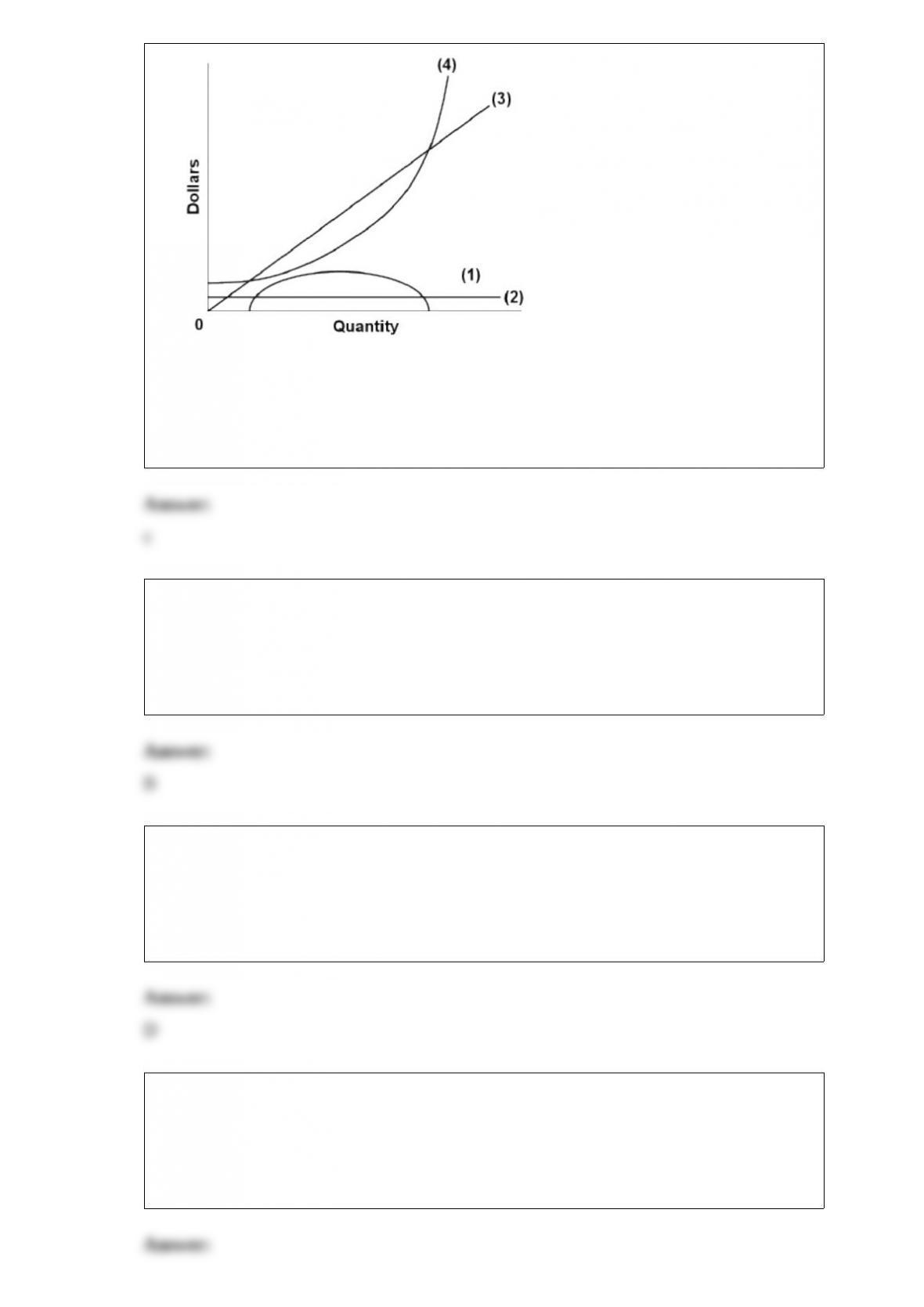
17)
the firm represented by the above diagram would maximize its profit where:
a.curves (2) and (1) intersect.
b.curve (1) touches the horizontal axis for the second time.
c.the vertical distance between curves (3) and (4) is the greatest.
d.curves (3) and (4) intersect.
18) Tying contracts are illegal under the:
A.Wagner Act of 1935
B.Clayton Act of 1914
C.FTC Act of 1914
D.Celler-Kefauver Act of 1950
19) If the dollar appreciates relative to foreign currencies, we would expect:
A.the multiplier to decrease.
B.a country’s exports and imports to both fall.
C.a country’s net exports to rise.
D.a country’s net exports to fall.
20) New classical economists say that a fully anticipated increase in aggregate demand:
A.shifts the long-run aggregate supply curve to the right.
B.shifts the long-run aggregate supply curve to the left.
C.moves the economy up along its vertical long-run aggregate supply curve.
D.eventually results in a self-correcting decrease in aggregate demand.

21) the incentive problem under communist central planning refers to the idea that:
a.planners had to direct required inputs to each enterprise.
b.workers, managers, and entrepreneurs could not personally gain by responding to
shortages or surpluses or by introducing new and improved products.
c.the immediate effect of more investment was less consumption.
d.exports had to be equal to imports for a central plan to work.
22) Approximately how much trash per person per day was generated in the United
States in 2006?
A.2 pounds.
B.3.4 pounds.
C.4.5 pounds.
D.12.8 pounds.
23) the division of u.s. businesses into the categories of proprietorships, partnerships,
and corporations is based on:
a.generally accepted accounting principles.
b.legal considerations.
c.the judgment of the american economic association.
d.an executive order of the president.
24) What is the difference between capital-using and capital-saving technological
advances? Give examples.

25) What is the relationship between uninsurable risk and profit? What three general
sources contribute to uninsurable risk?
26) Explain the differences among the frictional, structural, and cyclical forms of
unemployment.
27) What are the major assets and the major claims (liabilities) on a commercial banks
balance sheet?
28) Assume that in a purely competitive industry: (1) the entry and exodus of firms are
the only long-run adjustments; (2) firms in the industry have identical cost curves; and
(3) the industry is a constant-cost industry. Explain how long-run equilibrium is
eventually achieved in the industry when there are initially economic profits and losses.
29) Evaluate this statement: A monopolistically competitive industry would be more
efficient if there were fewer firms.
30) Explain the difference between the special interest effect and rent-seeking behavior.
31) Explain and give examples of invention. What does government do to protect it?
32) Assume that nominal income is $35,000 and the price index is 1.20 in year 1. In
year 2, nominal income rises to $38,000 and the price index rises to 1.25. What was the
percentage change in real income from year 1 to year 2? What was the absolute amount
of increase in real income? Make your calculations of the percentage change in real
income and the absolute change in real income using the approximation formula and
using the more precise method with index numbers.