
______ is an increase in the price level, while ______ is an increase in the price of one
good in comparison to other goods and services.
A. Inflation; hyperinflation
B. A relative price increase; inflation
C. Hyperinflation; inflation
D. Inflation; a relative price increase
The Federal Reserve can decrease the money supply by:
A. increasing reserve requirements.
B. decreasing the discount rate.
C. introducing deposit insurance.
D. conducting open market purchases.
For an economy starting at potential output, a decrease in autonomous expenditure in
the short run results in a(n):
A. expansionary output gap.
B. recessionary output gap.

C. increase in potential output.
D. decrease in potential output.
When Argentines increase their savings in U.S. dollars, the U.S. money:
A. supply curve shifts left.
B. supply curve shifts right.
C. demand curve shifts right.
D. demand curve shifts left.
A good or service that is both rival and excludable is a:
A. public good.
B. private good.
C. collective good.
D. commons good.

Curly just graduated from State U and has three job offers: teaching at a prestigious
private high school nine months a year with summers off, working forty hours a week at
a bank in a small city, and working more than sixty hours a week for a high-powered
investment firm in New York. Suppose all of the jobs currently offer exactly the same
annual salary, and that most people prefer leisure to work, all else equal. In order to
attract workers, the______ would have to offer a ______ salary than the others.
A. high school;lower.
B. bank; higher.
C. investment firm; lower.
D. investment firm; higher.
Union membership in the United States probably ______ an important explanation for
why workers with similar qualifications earn different incomes because union
membership rates are relatively ______.
A. is; high
B. is; low
C. is not; high
D. is not; low

According to the textbook, the private provision of television programming may not be
socially optimal because:
A. consumers don’t pay for broadcast television.
B. the government strictly regulates the market.
C. most consumers don”t like watching television commercials.
D. programs are chosen on the basis of audience size rather than the value to the
audience.
When the production process extends over more than one year, the value of the final
product is:
A. included in GDP for the year in which production began.
B. included in GDP for the year in which production was completed.
C. allocated to GDP in each year according to the value added in that year.
D. allocated equally to GDP in each year.
The role that prices play in directing resources away from overcrowded markets and
towards markets that are underserved is known as the ______ function of price.
A. allocative
B. market
C. rationing
D. transitive
Refer to the figure below. Based on the diagram, if potential output equals 5,000 and the
real interest rate is 3%, then there is ______ gap and the Fed must ______ the real
interest rate so that output will equal potential output.
A. a recessionary; raise
B. a recessionary; reduce
C. no output; not change
D. an expansionary; raise

One year before maturity, the price of a bond with a principal amount of $1,000 and a
coupon rate of 5% paid annually fell to $981. The one-year interest rate must be:
A. 8.5%.
B. 7.0%.
C. 5.0%.
D. 1.9%.
Oil and oil products remain the main fuel for cars, planes, ships, and power plants. The
amount of oil still in the earth is finite. Given this information, the supply of gasoline is
______.
A. relatively elastic
B. relatively inelastic
C. unit elastic
D. greater than the quantity demanded

Sven likes to water ski, but can only water ski during the one week each year when he
is on vacation. Therefore, he plans to ski every day, for eight hours a day. The first day,
Sven skied for eight hours and enjoyed every hour. The second day, Sven slept in and
then skied for seven hours, which was fun but not as much fun as the first day. The third
day, Sven skied for six hours, but was starting to get a bit bored by the end. The fourth
day, Sven skied for four hours and then took a nap. On the fifth day of Sven’s vacation,
Sven went blueberry picking all day. Sven’s vacation convinced him that:
A. even for activities he really enjoys, diminishing marginal utility eventually sets in.
B. blueberry picking yields higher total utility than does water skiing.
C. even for activities he really enjoys, total utility declines over time.
D. economic theory applies to things you buy, but not to recreational activities.
The figure below depicts the short-run market equilibrium in a perfectly competitive
market and the cost curves for a representative firm in that market. Assume that all
firms in this market have identical cost curves.
Given that the current equilibrium price is $8, what will happen to the number of firms
in this market in the long run?
A. The number of firms in the market will not change unless there is a change in either
demand or in the cost of production.
B. The number of firms in the market will fall as firms exit the market in response to
negative economic profit.
C. It is impossible to determine whether the number of firms in this market will rise or
fall.
D. The number of firms in the market will rise as firms enter the market in response to
positive economic profit.

Average labor productivity times the proportion of the population employed equals:
A. real GDP.
B. real GDP per person.
C. real GDP per worker.
D. output per worker.
A supply-side policy is a policy that:
A. shifts the short-run aggregate supply curve.
B. shifts the long-run aggregate supply curve.
C. shifts the aggregated demand curve.
D. prevents recessionary gaps that shift the AS curve.
Tracy and Amy are playing a game in which Tracy has the first move at X in the
decision tree shown below. Once Tracy has chosen either the top or bottom branch at X,
Amy, who can see what Tracy has chosen, must choose the top or bottom branch at Y or
Z. Both players know the payoffs at the end of each branch.
If before Tracy chose, Amy could make a credible commitment to choose either the top
or bottom branch when her turn came, then Amy would commit to the ______ branch
and Tracy would choose the ______ branch.
A. top; top
B. bottom; bottom
C. top; bottom
D. bottom; top
The figure below shows a single consumer’s demand for ice cream at the student union.
Fran is one of the students whose demand curve for ice cream is shown above. When
price is $4.00, Fran demands ______ scoops a week, and when price is $2.00, Fran
demand ______ scoops.
A. 1; 3
B. 2; 5

C. 2; 4
D. 2; 6
Social Security benefits, welfare payments, and farm support payments are examples
of:
A. consumption spending.
B. public interest payments.
C. investment spending.
D. transfer payments.
Judy is planning to sell an antique grandfather clock that she values at $200. If she sells
the clock on Craigslist, it will be bought by someone who values it at $450. If she uses
an antique dealer to sell the clock, it will be bought by someone who values it at $850.
The antique dealer will charge Judy $100 to sell the clock, which just covers the antique
dealer’s opportunity cost of selling the clock. Relative to selling the clock on Craigslist,
selling the clock through an antique dealer will lead:
A. to no change in total economic surplus.
B. total economic surplus to decrease by $100.
C. total economic surplus to increase by $400.
D. total economic surplus to increase by $300.

A risk-neutral individual will:
A. accept only better-than-fair gambles.
B. see risk as neither good nor bad.
C. accept only gambles with an expected value of zero or greater.
D. accept only gambles with an expected value of zero.
Refer to the figure below. Which of the following is true?
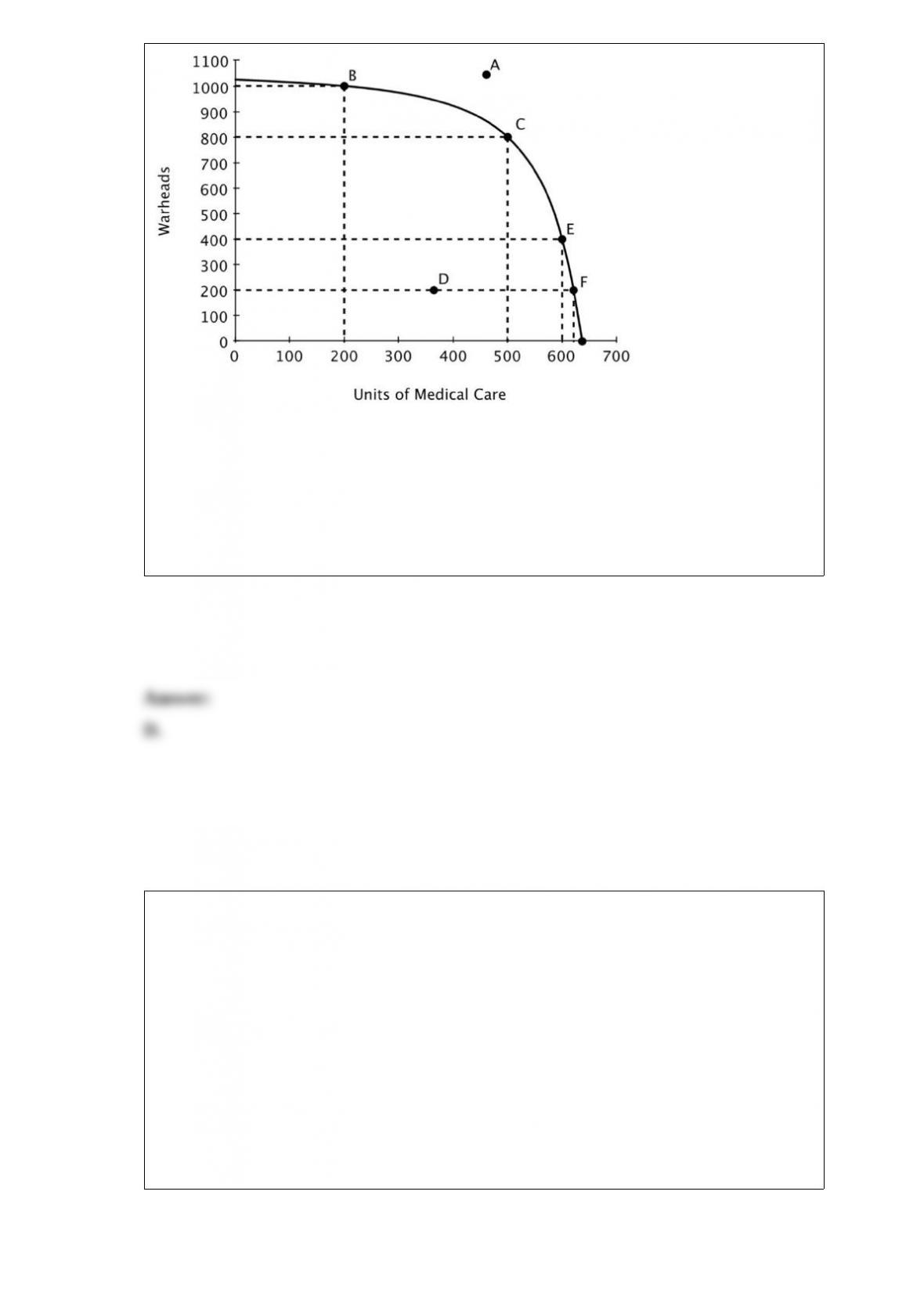
A. Point A is efficient because it is farthest from the origin.
B. Point D is efficient because it requires using the fewest resources.
C. Point F is the most efficient because medical care is the highest there.
D. Points B, C, E and F are efficient.
Lou and Toby both live in a little town and are trying to sell their cars. Both of their cars
have a blue book value of $10,000. Lou has an American car like most of the people in
town own. Toby owns the only Bulgarian car in town. If people in their town are risk
averse, then who will get closest to the blue book value for his car?
A. Lou will because American cars are better than Bulgarian cars.
B. Toby will because there is less uncertainty about the quality of Lou’s car.
C. Lou will because there is less uncertainty about the quality of Lou’s car.
D. Both should get the same price for their cars because both cars have the same blue
book value.

More economic growth is not necessarily better unless the benefits of growth:
A. exceed the costs of growth.
B. increase average labor productivity.
C. increase real GDP per capita.
D. increase human capital.
Banks help savers find productive uses for their funds because banks are specialized in:
A. gathering information about and evaluating potential borrowers.
B. obtaining preferential tax treatment for savers.
C. securing government guarantees for loans.
D. evaluating the riskiness of stocks.
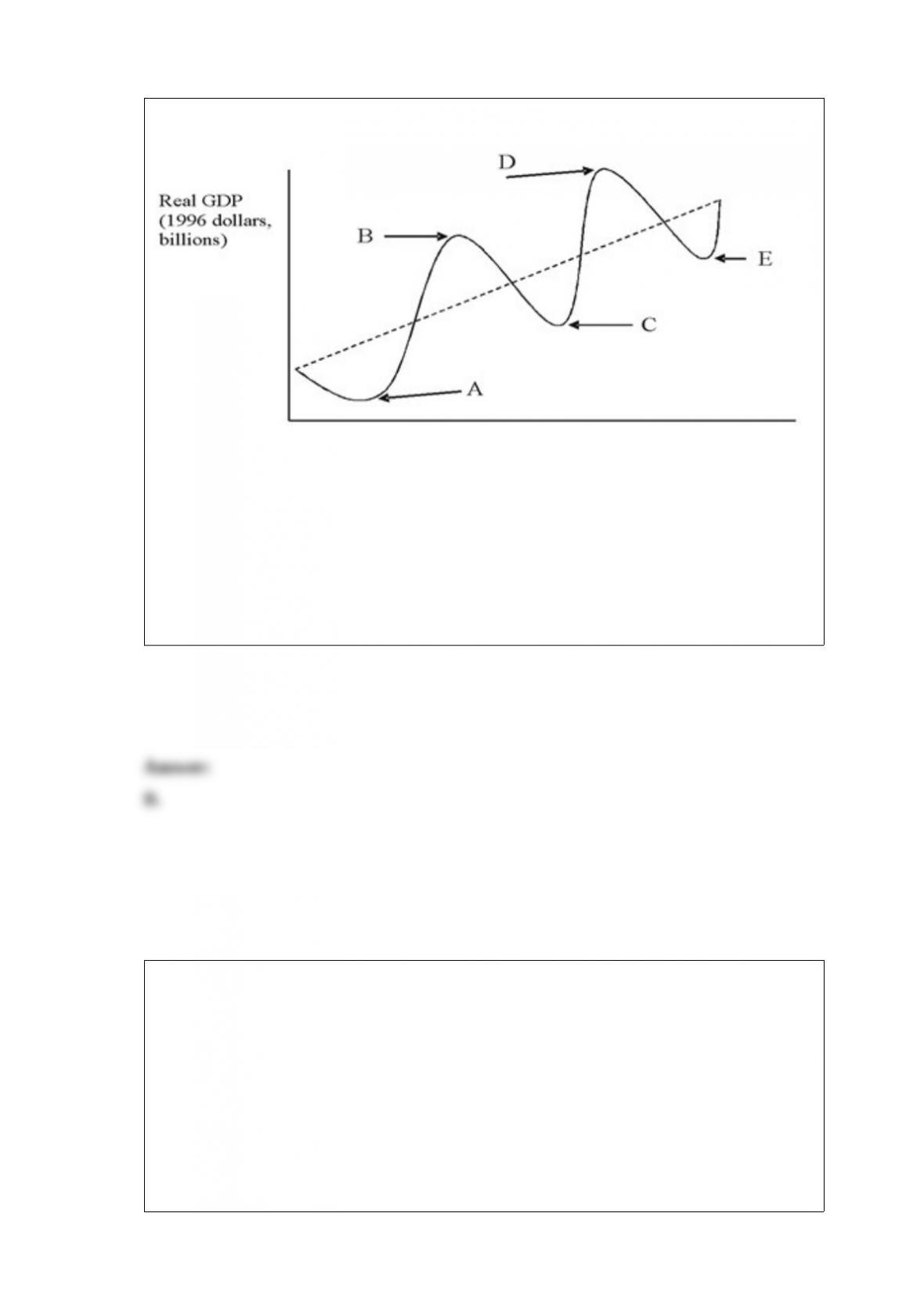
Refer to the figure below.
In the figure, a business cycle peak is shown by which point(s)?
A. A and C and E
B. B and D
C. D only
D. E only
Casey earns $150 a week and consumes only fish and shrimp. The price of fish is $3 a
pound and the price of shrimp is $5 a pound. Casey can buy a maximum of ______
pounds of fish or a maximum of ______ pounds of shrimp.
A. 30; 50
B. 50; 30
C. 15; 30
D. 30; 15

The specialized information-gathering activities that banks use to evaluate borrowers
are an example of the:
A. cost-benefit principle.
B. principle of comparative advantage.
C. scarcity principle.
D. principle of increasing opportunity cost.
Firms that face menu costs react to a sustained increase in demand by:
A. increasing output and then raising the price of their output.
B. charging higher prices, without necessarily increasing the amount of output they are
willing to sell.
C. charging lower prices, while simultaneously increasing the amount of output they are
willing to sell.
D. increasing output and then reducing the price of their output.

Consider an industry with two firms producing similar products. Each firm’s total cost
(in dollars) is given below.
Mega Corp: TC = 5,000 + 100Q.
Big Inc: TC = 4,000 + 200Q.
______ has a higher fixed cost and ______ has a higher marginal cost.
A. Big Inc; Mega Corp
B. Mega Corp; Big Inc
C. Big Inc; Big Inc
D. Mega Corp; Mega Corp
Moe divides his time between studying Physics and studying Economics. His
production possibilities curve for his final grade in each class is shown below.
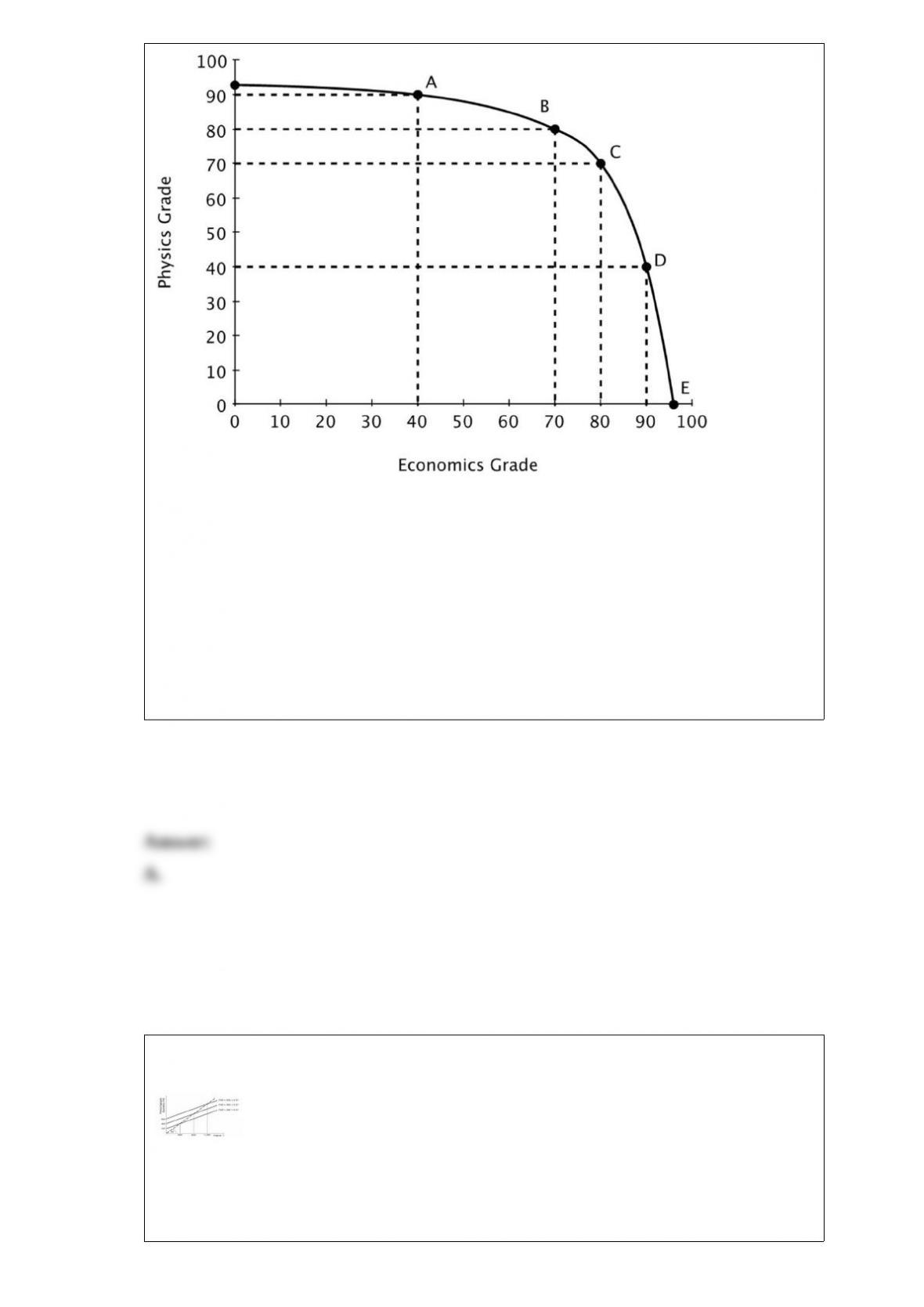
If Moe moves from Point A to point C, his grade in Physics will go down by ______ his
grade in economics.
A. less than the increase in
B. more than the increase in
C. more than the decrease in
D. less than the decrease in
Refer to the figure below.
Based on the figure, the income-expenditure multiplier equals:
A. 0.5.
B. 2.
C. 5.
D. 200.
Suppose Erie Textiles can dispose of its waste “for free” by dumping it into a nearby
river. While the firm benefits from dumping waste into the river, the waste reduces fish
and bird reproduction. This causes damage to local fishermen and bird watchers. At a
cost, Erie Textiles can filter out the toxins, in which case local fishermen and bird
watchers will not suffer any damage. The relevant gains and losses (in thousands of
dollars) for the three parties are listed below.
If Erie Textiles does not install the filter, there will be a net social ______ of ______ (in
thousands of dollars).
A. loss; $35
B. gain; $75
C. loss; $110
D. gain; $200