
1) A surplus indicates that the quantity demanded is greater than the quantity supplied at
that price.
2) Answer the question on the basis of the following information. Assume that by
devoting all its resources to the production of X, nation Alpha can produce 20 units of
X. By devoting all its resources to Y, Alpha can produce 30Y. Comparable figures for
nation Beta are 60X and 40Y.
Refer to the given information. There is no basis for trade between Alpha and Beta
because Beta has an absolute advantage in the production of both goods.
3) Automatic payroll deductions help people to fight their time inconsistency problem
with regards to saving.
4) In 2011, refugees comprised a bigger portion of total legal immigration into the U.S.
than employment-based immigrants.
5) From the viewpoint of a firm, competition can come even from other firms that are
not in the same industry.
6) Repeated games may involve either simultaneous or sequential decision making.
7) Personal consumption expenditures include expenditures for new houses.

8) From 1995 until the start of the recession in 2007, the U.S. economy grew at the
same rate as the economy of Japan.
9) A decrease in taxes will have a larger effect on equilibrium GDP if the marginal
propensity to consume is smaller.
10) The industrially advanced nations can assist developing nations by reducing trade
barriers and by providing both private and public capital.
11) If the government implements regulations and policies in the economy, it tends to
replace the function of the “invisible hand.”
12) Land reform (or the reform of land ownership) is a relatively minor institutional
obstacle to economic growth in many developing countries.
13) In recent years, immigration has contributed an insignificant amount to the U.S.
population growth.
14) An expansionary monetary policy increases the money supply, lowers interest rates,
and increases aggregate demand.

15) In 2010, the Medicare and Medicaid programs reimbursed approximately what
percentage of hospitals’ total cost of providing care to the patients covered by those
programs?
A.80 percent.
B.92 percent.
C.100 percent.
D.105 percent.
16) Assume that the required reserve ratio is 20 percent. If the Federal Reserve buys
$80 million in government securities from commercial banks, then the money supply
will immediately:
A.Increase by $0 with this transaction, and the maximum money-lending potential of
the commercial banking system will increase by $400 million
B.Increase by $0 with this transaction, but the maximum money-lending potential of the
commercial banking system will increase by $320 million
C.Increase by $80 million with this transaction, and the maximum money-lending
potential of the commercial banking system will increase by another $400 million
D.Increase by $80 million with this transaction, and the maximum money-lending
potential of the commercial banking system will increase by another $320 million
17) A firm should increase the amount of R&D expenditures to:
A.The maximum amount of funding that is available to the firm
B.The point where the expected return equals the cost of funds
C.A critical minimum level so that the firm can remain competitive
D.A point where the difference between the expected return and the cost of funds is at a
maximum
18) With a tax of $2,000 on $30,000 of income, and $2,000 on $70,000 of income, we
can describe the structure of this tax as:
A.Progressive
B.Proportional
C.Regressive
D.Marginal
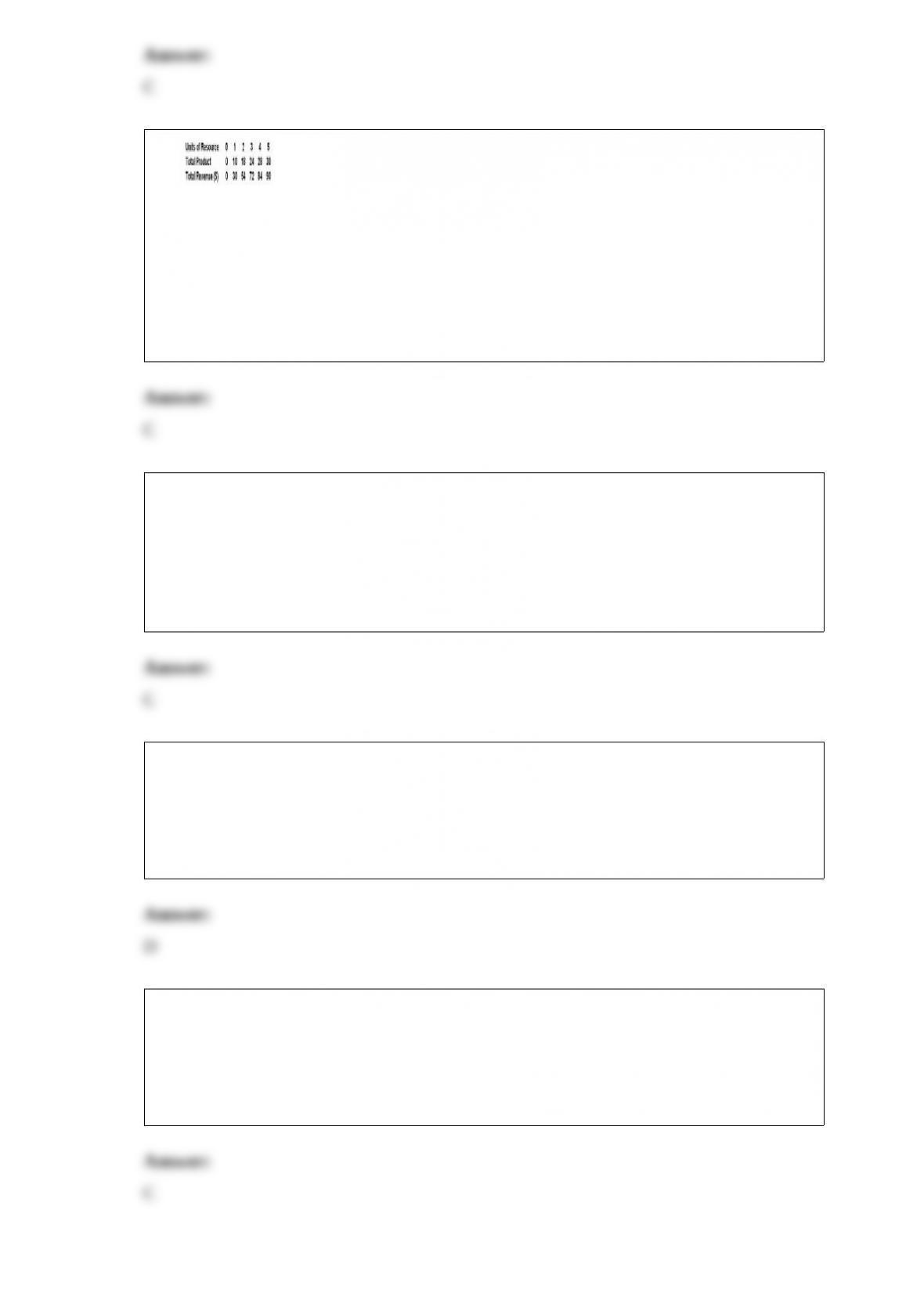
19)
Refer to the above table. How many units of the resource would the profit-maximizing
firm use if the price of the resource was $18.00?
A.1
B.2
C.3
D.4
20) The problematic trend in the “inverse dependency ratio” in the U.S. is likely to
show up first in:
A.The manufacturing sector
B.Agriculture
C.Social security
D.National defense
21) The lending ability of commercial banks increases when the:
A.Reserve ratio is raised
B.Treasury collects tax revenues
C.Fed sells securities in the open market
D.Fed buys securities in the open market
22) Data on per capita energy use in the United States since 1950 show that it has:
A.Continually increased
B.Continually decreased
C.Increased and then leveled off
D.Decreased and then leveled off

23) The graphs below illustrate the market for a product on which an excise tax has
been imposed by government.
Refer to the above graph. What is the amount of the tax per unit of product?
A.$3
B.$5
C.$6
D.$8
24) Majority voting may produce economically inefficient outcomes because it:
A.Does not always lead to fair results
B.Requires everyone to vote and bear the costs
C.Does not consider the strength of individual voters’ preferences
D.Does not provide benefits to everyone
25) If the price elasticity of demand for orange juice is 0.8, then a reduction in the price
of orange juice will cause buyers to buy:
A.Fewer bottles of orange juice, and their total spending on orange juice will decrease
B.Fewer bottles of orange juice, but their total spending on orange juice will increase
C.More bottles of orange juice, and their total spending on orange juice will increase
D.More bottles of orange juice, but their total spending on orange juice will decrease
26) Government officials tend to make:
A.better economic decisions than private individuals because of the wealth of
information at their disposal.
B.better economic decisions than private individuals because of the efficient processes
and flexibility built into the government bureaucracy.
C.inefficient choices because they lack the information necessary to accurately weigh
marginal benefits and marginal costs.
D.inefficient choices because the invisible hand directs them away from the resource
allocation where marginal benefits equal marginal costs.

27) Which person is least likely to have health care insurance?
A.A disabled person
B.A temporary worker in a bank
C.An accountant employed by a large corporation
D.A person who receives Social Security benefits
28) If an industry evolves from monopolistic competition to oligopoly, we would
expect:
A.the four-firm concentration ratio to decrease.
B.the four-firm concentration ratio to increase.
C.the four-firm concentration ratio to remain the same.
D.barriers to entry to weaken.
29) Which of the following is considered to be an economic resource?
A.Rent
B.Money
C.Interest
D.Capital
30) In the last six decades (1950-2009) farm employment in the U.S. has been:
A.Increasing both in absolute numbers and as a proportion of the total employment
B.Increasing in absolute numbers, but declining as a proportion of the total employment
C.Decreasing both in absolute numbers and as a proportion of the total employment
D.Decreasing in absolute numbers, but rising as a proportion of the total employment
31) As disposable income goes up, the:
A.average propensity to consume falls.
B.average propensity to save falls.
C.volume of consumption declines absolutely.
D.volume of investment diminishes.
32) In a command system:
A.Self-interest motivates and commands each business firm’s decisions and actions
B.The head of each family decides what to do with the family’s resources
C.The government makes production and allocation decisions
D.Market traders command what outputs are produced and how they are allocated
33) If tariffs contribute to inefficiency in the international allocation of resources and
lower output and income, why have nations enacted tariffs?
34) Discuss the political pressures associated with monetary policy. What has the
United States done to try to reduce these political pressures?
35) “Gathering economic facts is futile unless accompanied by economic analysis.”
Explain.
36) Are countries that began modern economic growth more recently doomed to be
permanently poorer than the countries that began modern economic growth in earlier
periods? Explain.
37) What is one alternative to the PPACA that has been proposed?
38) A graph shows the quantity of corn on the vertical axis and the quantity of steel on
the horizontal axis. What is the proper interpretation of a horizontal line at a particular
quantity for corn that is parallel to the horizontal axis of the graph? What is the slope of
the horizontal line?
39) How would economic growth and mild inflation be depicted in the extended
aggregate demand and aggregate supply model?
40) Why are there mixed effects from unexpected inflation for most individuals?