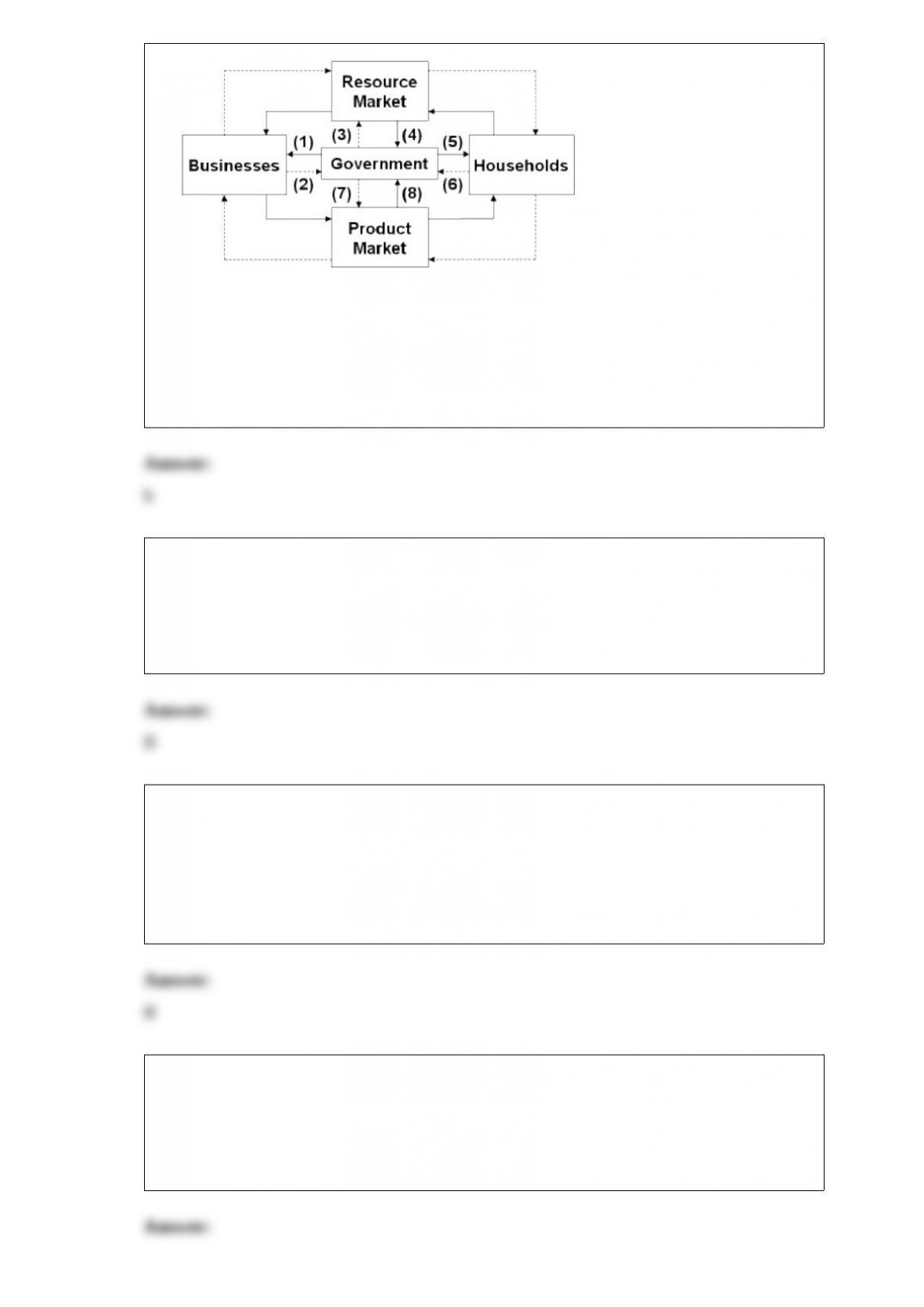
1)
refer to the above diagram, in which solid arrows reflect real flows; broken arrows are
monetary flows. flow (8) might represent:
a.personal income taxes.
b.automobile purchases by the state of maine.
c.the services of firefighters.
d.subsidies to farmers.
2) What was the largest U.S. fishery, in dollar terms, in 2006?
A.Pacific Halibut.
B.Lobster.
C.Walleye Pollock.
D.Blue Crab.
3) In the U.S. balance of payments account for a certain year, a positive number in the
financial account means a:
A.net buildup of assets held by the U.S.
B.net reduction in the ownership of assets by U.S. interests.
C.buildup of total foreign debt.
D.reduction of total foreign debt.
4) The purpose of an expansionary monetary policy is to shift the:
A.aggregate demand curve leftward.
B.aggregate demand curve rightward.
C.aggregate supply curve leftward.
D. investment demand curve leftward.

5) In the above diagram:
A.any rate of inflation is consistent with the natural rate of unemployment in the long
run.
B.inflation can occur but disinflation cannot occur.
C.unemployment rates exceeding the natural rate are permanent.
D.unemployment rates less than the natural rate are permanent.
6) Tying contracts which lessen competition are specifically illegal under provisions of
the:
A.Sherman Act.
B.Federal Trade Commission Act.
C.Celler-Kefauver Act.
D.Clayton Act.
7) According to public choice theorists, the private sector is more efficient than the
public sector mainly because:
A.the private sector has a clear test of performance: profit and loss.
B.wages, salaries, and fringe benefits are higher in the private sector.
C.worker turnover is higher in the public sector.
D.of extensive negative externalities in the public sector.
8) the demand for health care in the united states is price:
a.elastic and, according to some studies, income inelastic.
b.elastic and, according to some studies, income elastic.
c.inelastic and, according to some studies, income inelastic.
d.inelastic and, according to some studies, income elastic.
9) Which one of the following would increase income inequality as measured by
official Census data and the quintile distribution?
A.a doubling of social security retirement benefits
B.the elimination of the food stamp program
C.the elimination of the TANF program
D.reduced divorce rates
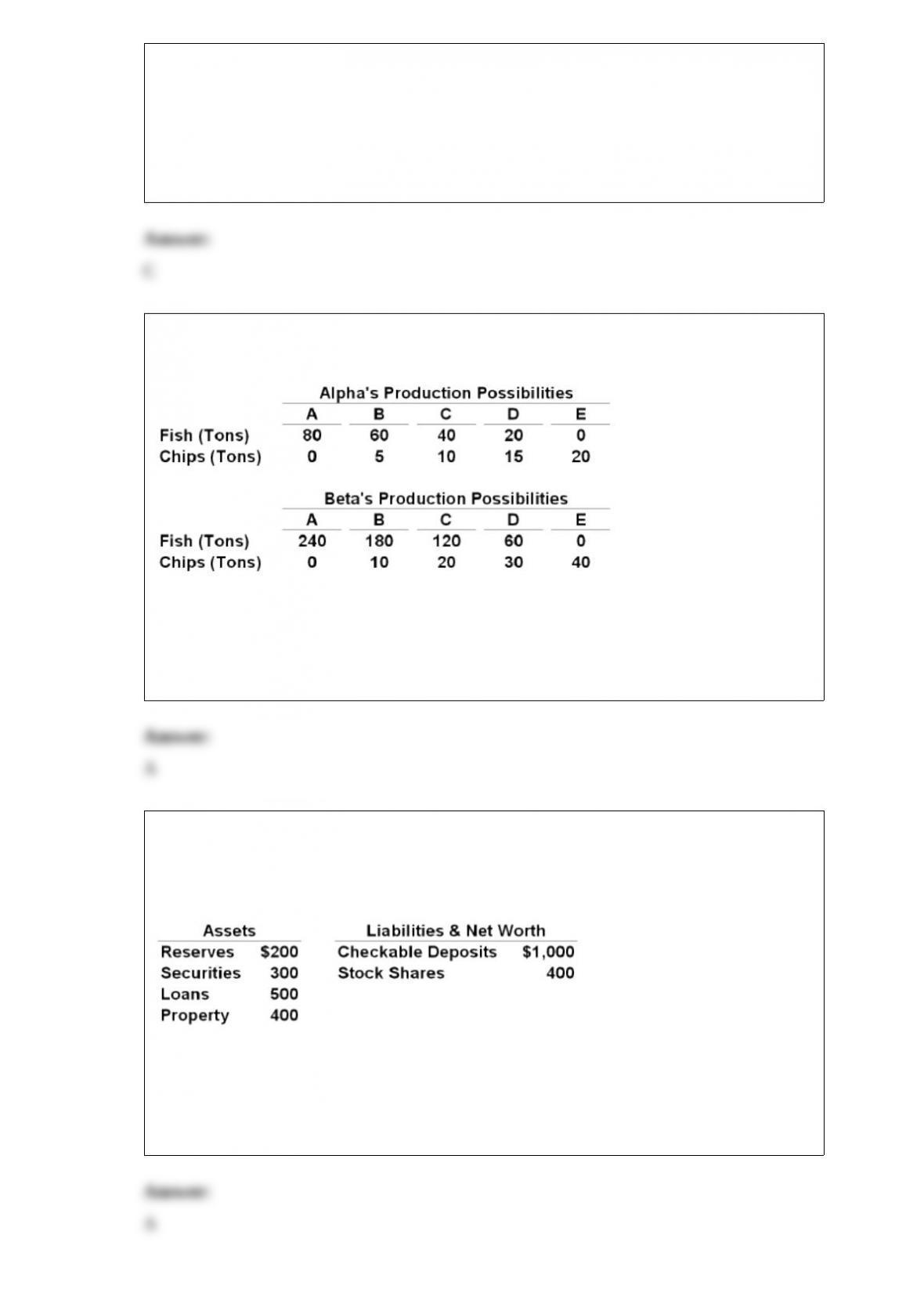
10) The following production possibilities data for two countries, Alpha and Beta,
which have populations of equal size.
Refer to the above data. Beta:
A.should specialize in catching fish and trade with Alpha for chips.
B.should specialize in producing chips and trade with Alpha for fish.
C.will not realize gains from specialization and trade.
D.will export both fish and chips to Alpha.
11) The following consolidated balance sheet of the commercial banking system.
Assume that the reserve requirement is 20 percent. All figures are in billions and each
question should be answered independently of changes specified in all preceding ones.
Refer to the above data. The commercial banking system has excess reserves of:
A.zero.
B.$2 billion.
C.$5 billion.
D.$10 billion.
12)
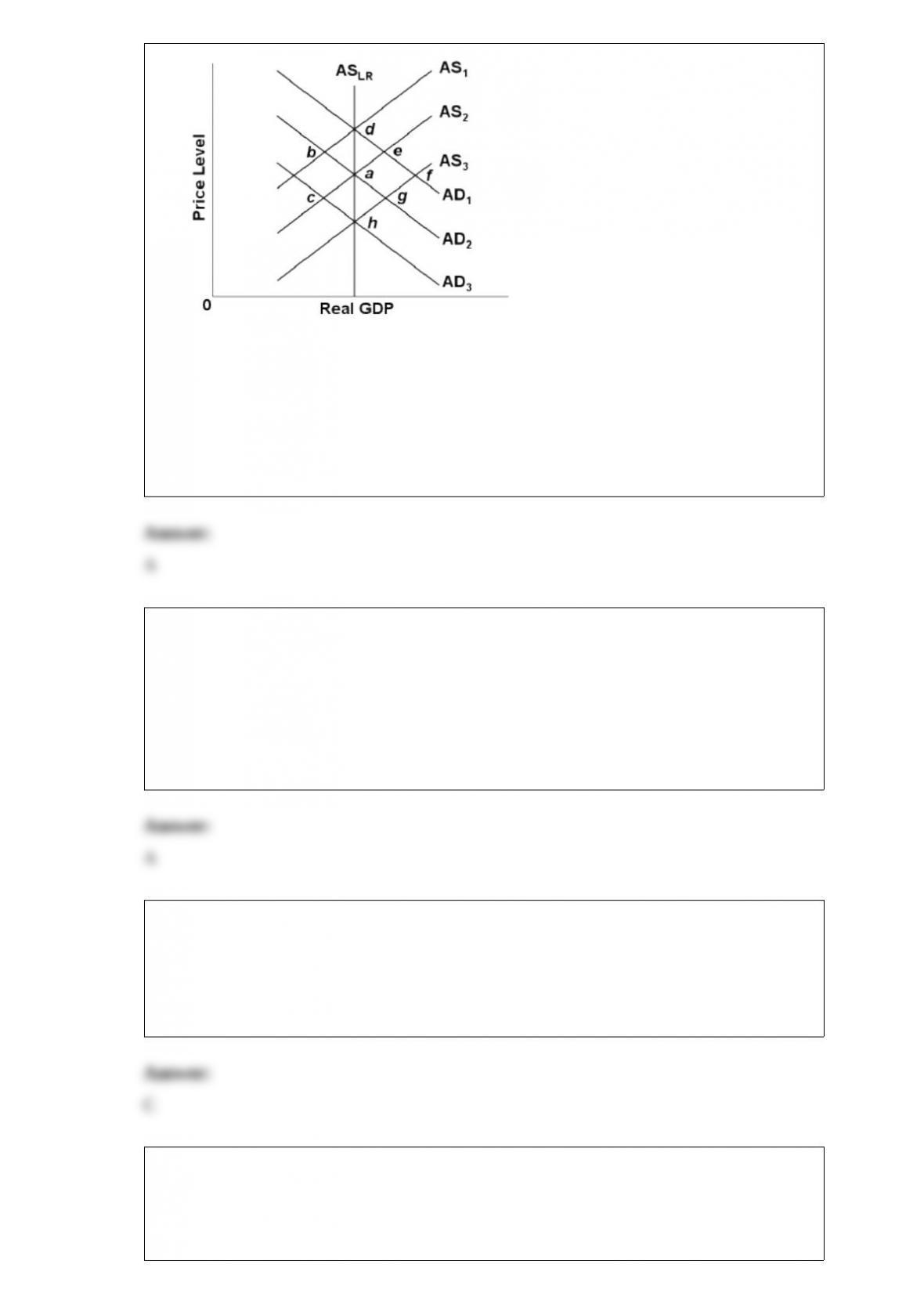
Refer to the above figure and assume the economy initially is in equilibrium at point a.
In the new classical theory, a fully anticipated increase in aggregate demand from AD2
to AD1 would move the economy:
A.directly from a to d
B.from a to b to d
C.from a to e to d
D.directly from a to f
13) In the Alcoa case of 1945 the courts held that:
A.the mere possession of monopoly power is a violation of the antitrust laws.
B.only contracts and combinations that unreasonably restrain trade are in violation of
the Sherman Act.
C.retail and wholesale firms are exempt from antitrust legislation.
D.firms which sell more than one-half of their output overseas are exempt from
antitrust.
14) Which of the following is typically not a problem for low-income DVCs?
A.capital flight
B.”brain drains”
C.high saving rates
D.poor infrastructure
15) In recent years, the United States has had large:
A.current account surpluses.
B.current account deficits.
C.balance of trade surpluses.

D.balance of payments surpluses.
16) the use of money contributes to economic efficiency because:
a.governmental direction of the production and distribution of output can be avoided by
using money.
b.roundabout production could not occur without the availability of money.
c.it is necessary for the creation of capital goods.
d.it promotes specialization by overcoming the problems with barter.
17) any point inside the production possibilities curve indicates:
a.the presence of technological change.
b.that resources are imperfectly substitutable among alternative uses.
c.the presence of inflationary pressures.
d.that more output could be produced with available resources.
18) (Consider This) Which of the following has been an effect of the U.S. government’s
ethanol program?
A.Prices for crops such as soybeans and sorghum have fallen dramatically.
B.Prices for beef, pork, and chicken have risen.
C.Water use has declined as corn is a less water-intensive crop.
D.All of these effects have resulted from the ethanol program.
19) An inflationary expenditure gap is the amount by which:
A.equilibrium GDP falls short of the full-employment GDP.
B.aggregate expenditures exceed any given level of GDP.
C.saving exceeds investment at the full-employment GDP.
D.aggregate expenditures exceed the full-employment level of GDP.