
Both monopolistically competitive firms and perfectly competitive firms maximize
profits
A) by producing where price equals average total cost.
B) by producing where marginal revenue equals average revenue.
C) by producing where marginal revenue is equal to marginal cost.
D) by producing where price equals average variable cost.
Pegging a country’s exchange rate to the dollar can be advantageous if
A) the country does not trade much with the United States.
B) investors believe the dollar to be more stable than the domestic country’s currency.
C) a country wishes to conduct independent monetary policy.
D) imports are not a significant fraction of the goods the country’s consumers buy.
________ means the supply curve has shifted to the right, while ________ refers to a
movement along a given supply curve in response to an increase in price.
A) An increase in supply; a decrease in supply
B) A decrease in supply; an increase in supply
C) An increase in supply; an increase in quantity supplied

D) A decrease in supply; a decrease in quantity supplied
Because of the ________ of vaccinations, economic efficiency would be improved if
more people were vaccinated.
A) negative externality
B) positive externality
C) moral hazard
D) adverse selection
Consumption spending is $22 million, planned investment spending is $7 million,
actual investment spending is $7 million, government purchases are $9 million, and net
export spending is $3 million. Based on this information, which of the following is
true?
A) There was an unplanned change in inventories.
B) Aggregate expenditure is equal to GDP.
C) Aggregate expenditure is greater than GDP.
D) Aggregate expenditure is less than GDP.
A monetary growth rule means that
A) the Fed will lower interest rates if it thinks a recession is on the horizon.
B) the Fed will raise interest rates if it thinks the economy is growing faster than
potential.
C) the money supply should grow at a constant rate.
D) the money supply should grow in response to economic conditions.
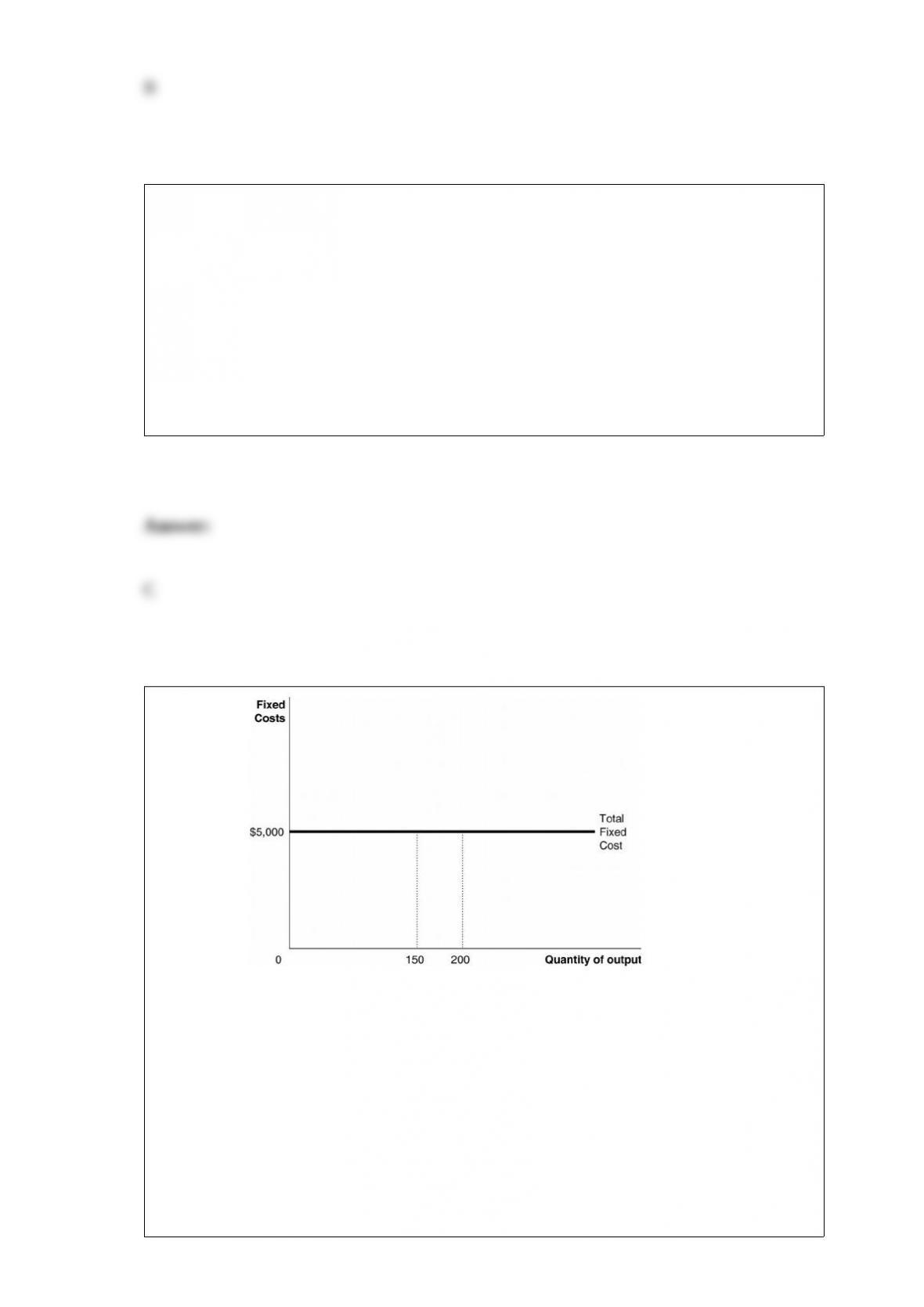
Figure 11-4
What happens to the average fixed cost of production when the firm increases output
from 150 to 200?
A) It remains constant.
B) It rises.
C) It falls.
D) It could rise or fall depending on what happens to total cost.
Suppose a competitive firm is paying a wage of $12 an hour and sells its product at $3
per unit. Assume that labor is the only input. If hiring another worker would increase
output by three units per hour, then to maximize profits the firm should
A) not change the number of workers it currently hires.
B) not hire an additional worker.
C) hire another worker.
D) There is not enough information to answer the question.
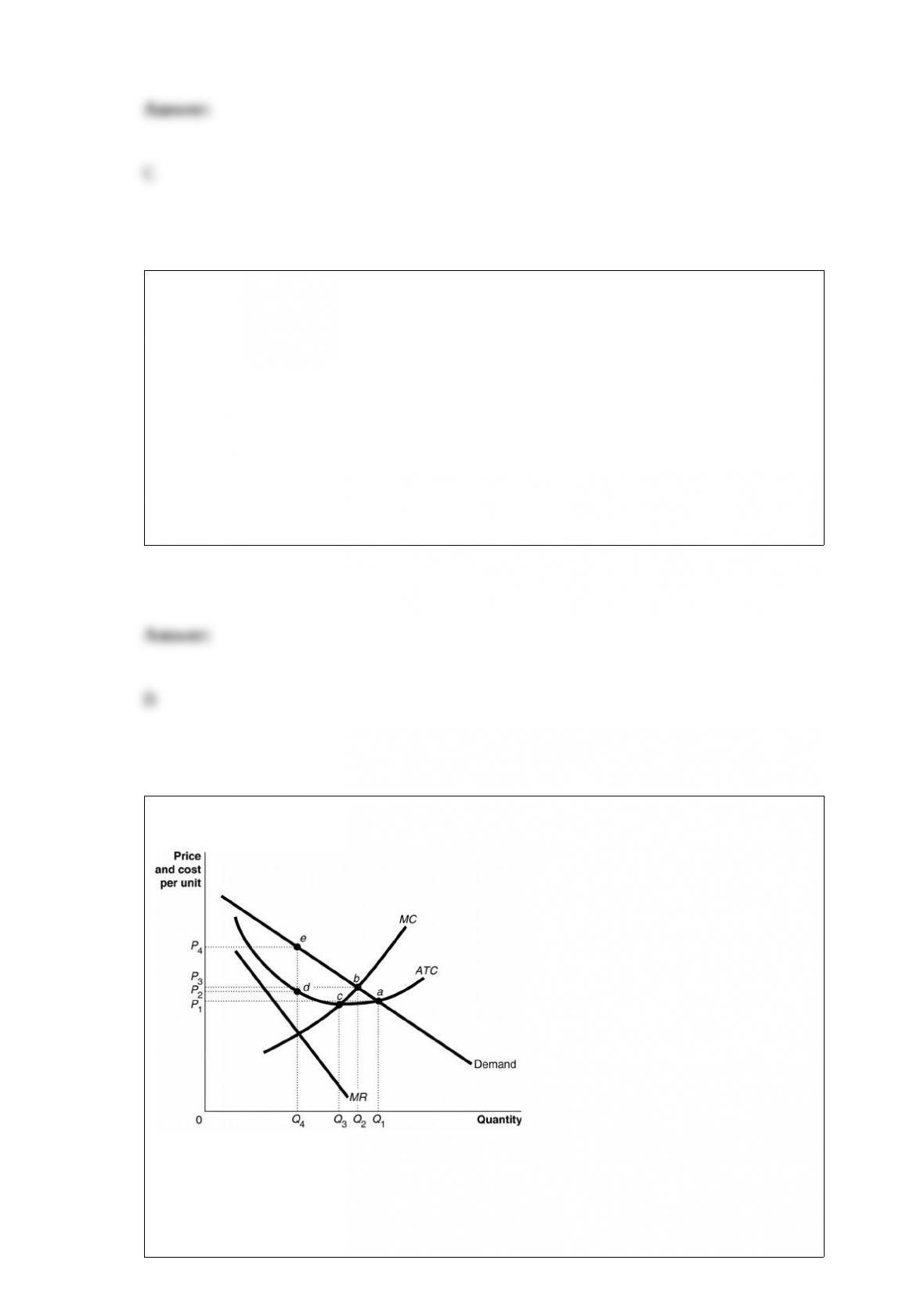
Figure 13-13
If the diagram represents a typical firm in the market, what is likely to happen in the
long run?
A) Some firms will exit the market causing the demand to increase for firms remaining

in the market.
B) New firms will enter the market causing the demand to decrease for existing firms.
C) Inefficient firms will exit the market and new cost-efficient firms will enter the
market.
D) Competition will be intensified as firms strive to make long-run profits.
A perfectly competitive firm cannot practice price discrimination because
A) a firm that breaks even in the long run cannot afford to engage in yield management.
B) it does not advertise; this prevents the firm from marketing its product to different
segments of the market.
C) each consumer in a perfectly competitive market has the same willingness to pay.
D) the firm can only charge the market price.
Arnold Harberger was the first economist to estimate the loss of economic efficiency
due to market power. Harberger found that
A) the loss of economic efficiency in the U.S. economy due to market power was less
than 1 percent of the value of production.
B) because of the increase in the average size of firms since World War II, the loss of
economic efficiency has been relatively large, about 10 percent of the value of total
production in the United States.
C) although the number of monopolies was small, the large number of other
non-competitive firms in the United States resulted in a large loss of economic
efficiency, about 20 percent of the value of total production.
D) the loss of economic efficiency in the U.S. economy due to market power was small
around 1973, about 1 percent of the value of production, but has since grown to about
10 percent.
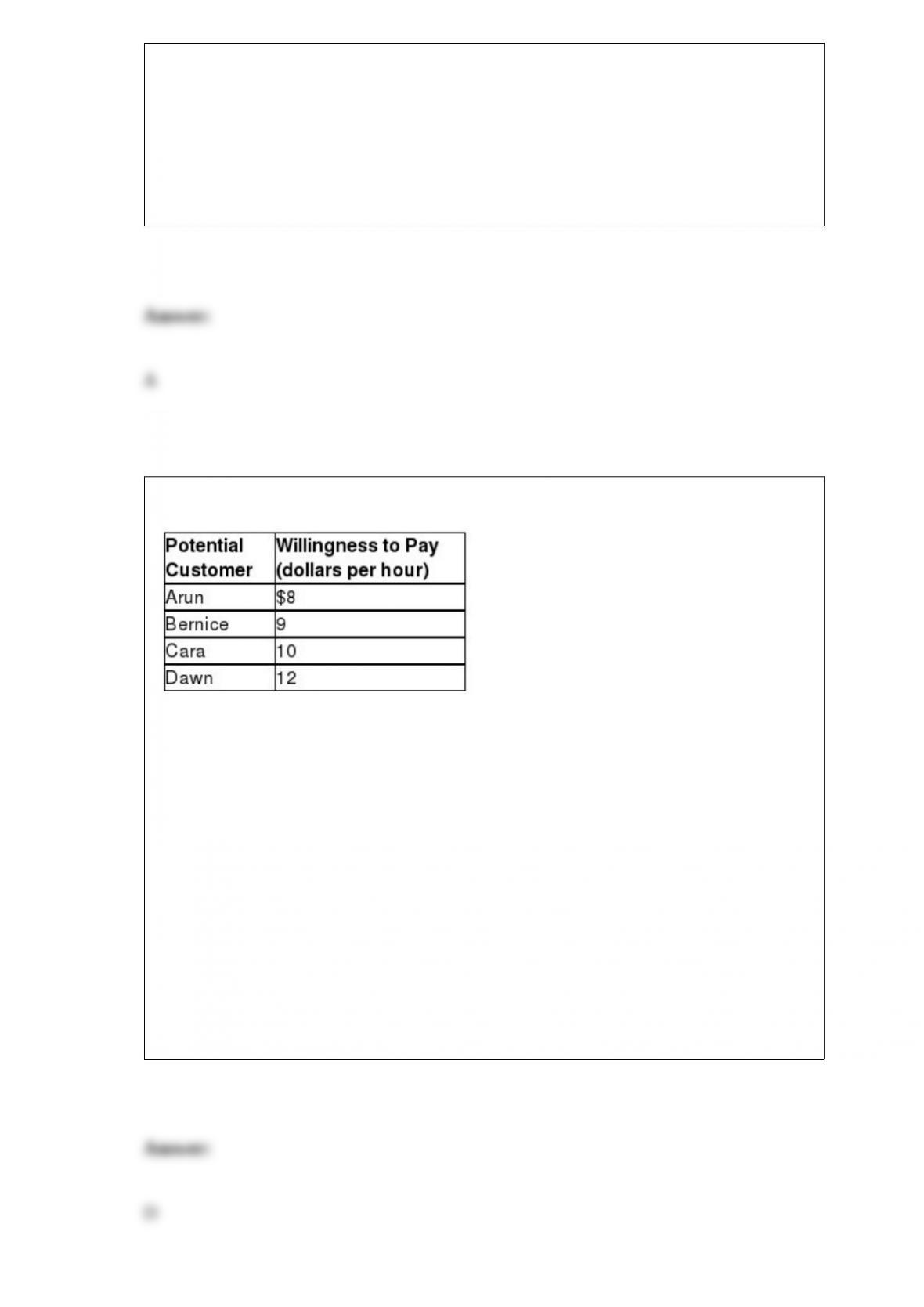
Table 16-3
Julie plans to start a pet-sitting service. She surveyed her neighborhood to determine the
demand for this service. Assume that each person surveyed demands only one hour of
pet sitting services per period. Table 16-3 above shows a portion of her survey results.
Suppose Julie’s marginal cost of providing this service is constant at $7 and she decides
to charge each customer according to his or her willingness to pay. What is the value of
consumer surplus by her customers?
A) $39
B) $28
C) $11
D) $0

If an increase in autonomous consumption spending of $10 million results in a $50
million increase in equilibrium real GDP, then
A) the MPC is 0.5.
B) the MPC is 0.75.
C) the MPC is 0.8.
D) the MPC is 0.9.
Some economists argue that the productivity slowdown from mid-1970s to mid-1990s
actually didn’t happen, but just “appeared” to happen because
A) services were becoming a more important part of the economy, and it was hard to
measure increases of output from services.
B) new environmental laws had passed and forced firms to spend to reduce pollution,
and this spending did not raise output.
C) increased spending on health and safety raised worker productivity.
D) A and B
E) B and C
Suppose that Congress allocates $1 billion to clean up after the hurricanes of 2005. It

also raises taxes by $1 billion to keep the deficit from growing. If the marginal
propensity to consume is 0.9, what is the effect on equilibrium GDP?
A) GDP does not change.
B) GDP increases by $10 billion.
C) GDP increases by $900,000.
D) GDP increases by $1 billion.